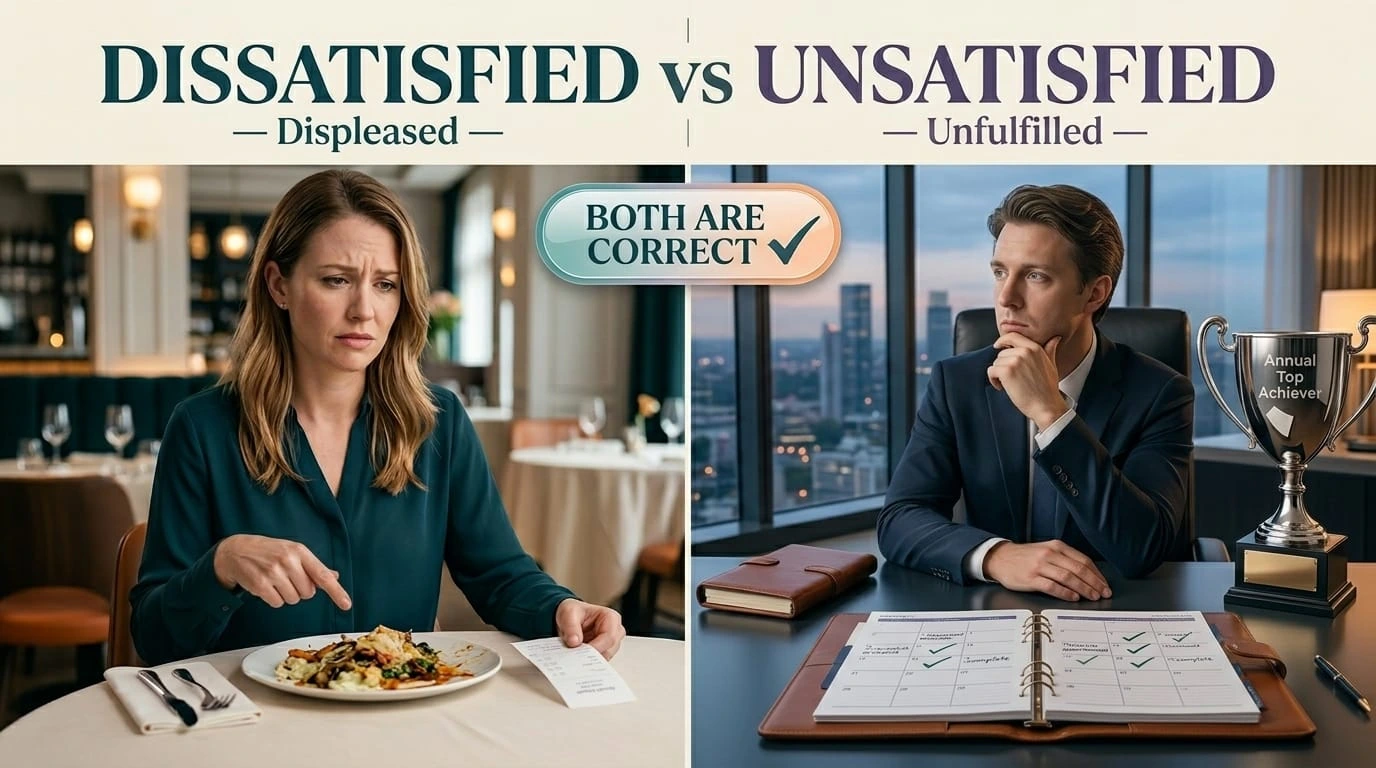
Unsatisfied usually means something has not been fulfilled or is not enough, while dissatisfied means unhappy or displeased with something.
Have you ever finished a meal and thought, “That was not enough”? Or have you paid for a service and thought, “That was terrible”?
Both feelings can make you want to say, “I’m not satisfied.” But which word should you choose: unsatisfied or dissatisfied?
This is a small difference, but it can change the meaning of your sentence.
As an English writer, I have often seen these two words cause trouble because both relate to satisfaction. They can sometimes be used in the same situation, yet they do not always express the same idea. One may focus on something being unfulfilled or incomplete, while the other often shows disappointment or unhappiness.
The good news is that the difference is easy to remember once you see it in real examples.
In this guide, you will learn what unsatisfied and dissatisfied mean, how they differ, when to use each one, and how native English speakers use them in everyday and formal writing.
Let’s make the choice simple.
Unsatisfied or Dissatisfied: Quick Answer
Unsatisfied means that a need, desire, expectation, or requirement has not been fully met.
Dissatisfied means that you are unhappy or disappointed with something because it did not meet your expectations.
For example:
- I was unsatisfied with the amount of food.
→ The food was not enough. - I was dissatisfied with the restaurant’s service.
→ The service made me unhappy or disappointed.
There is some overlap. In many situations, either word can work. The main difference is the focus.
Unsatisfied = not fully satisfied.
Dissatisfied = unhappy or disappointed.
That simple rule will help you make the right choice most of the time.
The Origin and Background of Unsatisfied and Dissatisfied
Both words come from the word satisfied.
The word satisfied comes from the Latin satisfacere, meaning “to satisfy” or “to make enough.”
The prefixes change the meaning.
What does “un-” mean?
The prefix un- often means not or the opposite of.
So:
unsatisfied = not satisfied
It can suggest that something remains incomplete or that a need has not been met.
For example:
The customer was unsatisfied with the portion size.
The customer may simply feel that the amount was not enough.
What does “dis-” mean?
The prefix dis- can express separation, opposition, or lack of approval.
So:
dissatisfied = unhappy because something did not meet expectations
For example:
The customer was dissatisfied with the slow service.
Here, the focus is on the customer’s negative reaction.
This is why the two words can look almost identical but carry slightly different shades of meaning.
Unsatisfied vs Dissatisfied: Key Differences
The easiest way to understand the difference is to think about what is missing.
With unsatisfied, something may be incomplete, insufficient, or not fully fulfilled.
With dissatisfied, the person usually has a negative opinion or feeling about the result.
| Term | Meaning | When to Use | Region/Context |
|---|---|---|---|
| Unsatisfied | Not fully satisfied or fulfilled | When a need, desire, or expectation remains unmet | General English |
| Dissatisfied | Unhappy or displeased | When expressing disappointment with a person, product, service, or result | General and formal English |
| Satisfied | Content because expectations are met | When something meets your needs or expectations | General English |
Example 1: Food
I am unsatisfied because I am still hungry.
The issue is that your need for food has not been fully met.
You could also say:
I am dissatisfied with the restaurant.
Now the focus is your negative opinion of the restaurant.
Example 2: Work
She felt unsatisfied with her career.
This can mean that her career did not fulfill her personal goals or desires.
But:
She was dissatisfied with her manager.
This sounds more like a complaint about the manager’s behavior or performance.
Example 3: A Product
The customer was dissatisfied with the quality of the product.
This clearly expresses disappointment.
You could also say:
The customer was unsatisfied with the product.
This is grammatically correct, but it sounds less direct. It may suggest that the product failed to meet a need or expectation.
The Simple Rule: Unfulfilled vs Unhappy
Here is an easy memory trick.
Ask yourself:
“Is something still missing?”
If yes, unsatisfied may be the better choice.
Ask:
“Am I unhappy or disappointed about something?”
If yes, dissatisfied is often the better choice.
Compare these:
His hunger remained unsatisfied.
Something was not fulfilled.
He was dissatisfied with the meal.
He was unhappy with the meal.
The distinction is not always strict. English speakers often use the two words in overlapping ways. Context tells you which meaning is stronger.
Which Word Should You Use?
Your choice depends on what you want to say.
For unmet needs or desires → Use unsatisfied
Choose unsatisfied when you want to show that something has not been fulfilled.
Examples include:
- an unsatisfied hunger
- an unsatisfied desire
- an unsatisfied need
- an unsatisfied demand
- an unsatisfied curiosity
For example:
Her curiosity remained unsatisfied after the explanation.
The explanation did not give her enough information.
For complaints or disappointment → Use dissatisfied
Choose dissatisfied when someone is unhappy with a product, service, decision, person, or experience.
For example:
The customer was dissatisfied with the company’s response.
This sounds natural in customer service and business writing.
For formal business communication → Prefer dissatisfied
If you are writing a complaint, survey, report, or customer service message, dissatisfied is often the clearest choice.
For example:
We are dissatisfied with the quality of the service provided.
It clearly communicates a complaint without sounding informal.
For personal goals or fulfillment → Consider unsatisfied
When you are talking about desires, ambitions, curiosity, or personal fulfillment, unsatisfied can be a better fit.
For example:
He felt unsatisfied with his progress.
This may mean he wanted to achieve more.
Common Mistakes with Unsatisfied and Dissatisfied
These words are easy to mix up. Here are some common mistakes.
1. Using dissatisfied for physical hunger
Less precise:
My hunger is dissatisfied.
Better:
My hunger is unsatisfied.
We normally describe hunger as unsatisfied because the need for food has not been fulfilled.
2. Using unsatisfied for a clear complaint
Possible but less direct:
I am unsatisfied with your service.
Stronger for a complaint:
I am dissatisfied with your service.
Both can be grammatically correct. Dissatisfied makes the negative feeling clearer.
3. Confusing dissatisfaction with lack of fulfillment
Consider:
She has an unsatisfied desire to travel.
This focuses on an unfulfilled desire.
Compare:
She is dissatisfied with her travel experience.
This focuses on disappointment with an actual experience.
4. Assuming the words are always interchangeable
They are sometimes interchangeable, but not always.
For example:
His curiosity remained unsatisfied.
This sounds natural.
His curiosity remained dissatisfied.
This sounds unnatural because curiosity is not normally described as being unhappy.
5. Thinking one word is American and the other British
This is another common misunderstanding.
Unsatisfied and dissatisfied are both used in British and American English.
The difference is mainly about meaning and context, not geography.
Unsatisfied or Dissatisfied in Real-World Examples
Seeing the words in realistic sentences can make the difference much easier to remember.
1. Professional Email
Dear Customer Service Team,
I am dissatisfied with the service I received during my recent order. The package arrived late, and two items were missing. I would appreciate a quick solution to this problem.
Here, dissatisfied works well because the writer is making a formal complaint.
2. News Article
Several customers said they were dissatisfied with the company’s new pricing policy.
The word describes public disappointment with a business decision.
3. Social Media Post
I left the restaurant feeling dissatisfied. The food was cold, and the service was very slow.
Again, the speaker is expressing disappointment.
4. Formal Report
The survey found that many employees were dissatisfied with the current workplace policies.
This is a formal complaint or negative evaluation.
5. Personal Reflection
Even after reaching her goal, she felt unsatisfied because she wanted to achieve more.
Here, unsatisfied suggests that her personal desire for achievement was not fully fulfilled.
6. Curiosity
His curiosity remained unsatisfied after reading the short explanation.
The information did not fully satisfy his desire to know more.
Unsatisfied vs Dissatisfied: A Quick Comparison
| Term/Variant | Meaning | Region/Context | Best Used When |
|---|---|---|---|
| Unsatisfied | Not fully satisfied or fulfilled | British and American English | A need, desire, curiosity, or expectation remains unmet |
| Dissatisfied | Unhappy or displeased | British and American English | Someone is unhappy with a product, service, person, or result |
| Satisfied | Content or pleased | British and American English | Needs and expectations have been met |
A useful shortcut
Think of these two phrases:
Unsatisfied need
→ The need has not been met.
Dissatisfied customer
→ The customer is unhappy.
This shortcut covers many everyday situations.
Unsatisfied or Dissatisfied: Data, Trends & Usage
The search intent behind “unsatisfied or dissatisfied” is mainly informational. People usually search for the phrase because they want to know whether the words are synonyms and which one sounds correct in a particular sentence.
The confusion is easy to understand. Both words contain satisfied, and both can describe a negative state.
But usage depends heavily on context.
In everyday English, dissatisfied is especially useful when talking about:
- customers
- services
- products
- employees
- policies
- decisions
- experiences
- complaints
Unsatisfied often appears with ideas such as:
- needs
- desires
- hunger
- curiosity
- ambitions
- expectations
- demands
- personal fulfillment
This distinction matters because choosing the more precise word can make your writing sound clearer and more natural.
For SEO and content writing, understanding this difference also helps you answer a common reader question: Are these words true synonyms?
The answer is not always. They overlap, but their emphasis can be different.
Is “Unsatisfied” a Correct Word?
Yes. Unsatisfied is a completely correct English word.
It is not a spelling mistake or an incorrect form of dissatisfied.
For example:
The child remained unsatisfied with the answer.
His desire for adventure was still unsatisfied.
The word is especially useful when something has not been completely fulfilled.
Is “Dissatisfied” a Correct Word?
Yes. Dissatisfied is also completely correct.
It is commonly used to describe someone who is unhappy or disappointed with something.
For example:
The customer was dissatisfied with the service.
Many workers were dissatisfied with the new policy.
It is especially common in professional, business, and customer-service contexts.
Frequently Asked Questions
Is it better to say unsatisfied or dissatisfied?
It depends on what you mean. Use unsatisfied when something is not fully fulfilled, such as a need, desire, or curiosity. Use dissatisfied when someone is unhappy or disappointed with a product, service, or experience.
Can I use unsatisfied and dissatisfied interchangeably?
Sometimes, but not always. The two words overlap, yet unsatisfied often focuses on something being incomplete or unmet, while dissatisfied focuses more on unhappiness or disappointment.
Is “dissatisfied customer” correct?
Yes, dissatisfied customer is completely correct and very common. It describes a customer who is unhappy with a product, service, or overall experience.
Is “unsatisfied customer” grammatically correct?
Yes, unsatisfied customer is grammatically correct. It can mean that the customer’s needs or expectations were not fully met, although dissatisfied customer is often more natural when talking about a complaint.
What is the difference between unsatisfied and unhappy?
Unsatisfied means something has not fully met a need, desire, or expectation. Unhappy is broader and simply means feeling sad, displeased, or not content. For example, you can be unsatisfied with your career without necessarily being unhappy in every part of your life.
Final Verdict: Unsatisfied or Dissatisfied?
So, which word should you choose?
The answer depends on the idea behind your sentence.
Use unsatisfied when something is not fully fulfilled. Think about hunger, curiosity, desire, ambition, or an unmet need.
Use dissatisfied when someone is unhappy, displeased, or disappointed. Think about customers, services, products, policies, and experiences.
Here is the easiest rule to remember:
Unsatisfied = something is still missing.
Dissatisfied = you are unhappy about something.
Both words are correct. Neither is simply a “wrong version” of the other. The key is choosing the word that matches your meaning.
If you are writing a customer complaint, dissatisfied will usually be the safer choice. If you are describing an unfulfilled need or desire, unsatisfied often fits better.
Once you learn that small difference, this confusing word pair becomes much easier.
Angel or Angle: Easy Difference Explained

I’m an English language researcher and content writer. I am specialized in spelling comparisons, commonly confused words, grammar usage, and vocabulary guides. Through detailed language articles,I am helping readers to understand the differences between similar words and improve their written communication skills.