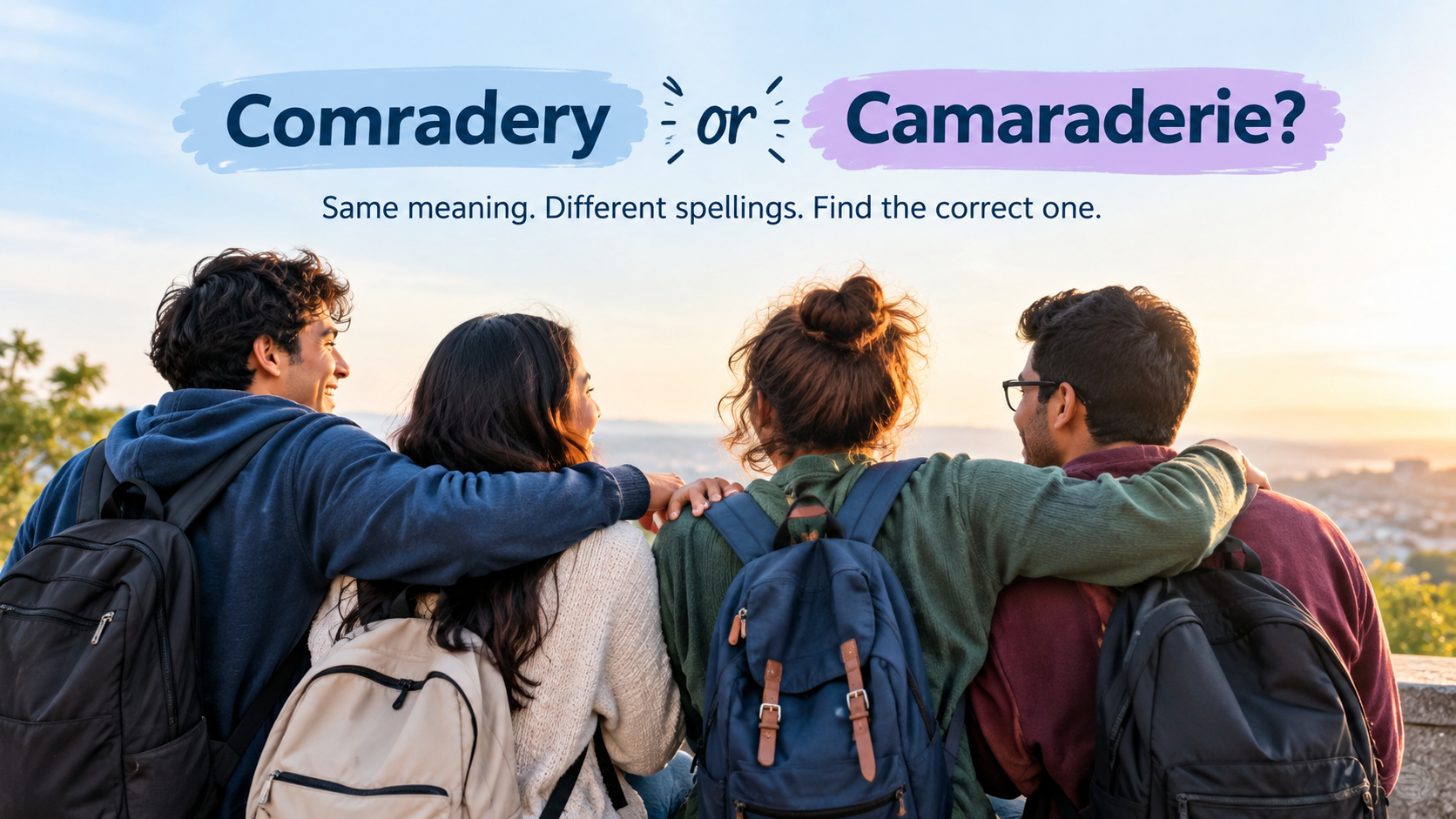
Camaraderie is the standard and widely preferred spelling. Comradery is also an accepted variant, and both words mean friendship, trust, and a feeling of unity among people who share an experience or goal.
Comradery or Camaraderie: Quick Answer
Both comradery and camaraderie describe a friendly bond between people. This bond often grows when people work together, face challenges, or share the same goals.
However, camaraderie is the more widely used spelling. It is the safer choice for school assignments, professional emails, formal reports, and most other types of writing.
Examples:
- The team built strong camaraderie during the season.
- A sense of comradery helped the workers support one another.
Both spellings can be correct, but use camaraderie when you want the most widely recognized form.
The Origin and Background of Comradery or Camaraderie
The story behind camaraderie helps explain why its spelling can seem unusual.
The word comes from the French word camarade, which means a companion or friend. That French word came from Spanish camarada, a term linked to people who share a room or live together.
Over time, the word developed into camaraderie. It came to describe the friendship and trust that grow between people who spend time together or share a common purpose.
Think of soldiers who rely on one another during difficult times. Or picture classmates who help each other prepare for a hard exam. Their bond is more than simple friendship. It includes trust, support, and a sense of belonging.
Comradery developed as a simpler spelling of the same word. It is accepted in English, but it is less common than camaraderie.
This difference can confuse writers. The longer spelling may look unfamiliar, while the shorter spelling may seem easier to remember. Still, the traditional spelling remains the more common choice in published writing.
Why Do People Confuse These Spellings?
There are three main reasons:
- Unusual spelling: Camaraderie does not sound exactly as many readers expect it to.
- Similar meaning: Both forms express the same basic idea.
- Different spelling habits: Some writers prefer the shorter form because it looks simpler.
The key point is easy to remember: both spellings can be correct, but camaraderie is more widely used.
Comradery vs. Camaraderie Explained: Key Differences
The main difference is spelling, not meaning. Both words refer to friendship, trust, and a shared sense of connection.
| Term | Meaning | When to Use | Region/Context |
| Camaraderie | Friendship and trust among people | Formal writing, schoolwork, business writing, and everyday use | Widely used in English |
| Comradery | The same sense of friendship and unity | Informal writing or when following a preferred spelling | Accepted English variant; less common |
1. What Does Camaraderie Mean?
Camaraderie means a feeling of friendship and mutual support among people who share an activity, workplace, group, or experience.
It often develops when people help one another and work toward a common goal.
Examples:
- The players showed great camaraderie after the match.
- Our office has a strong sense of camaraderie.
- The trip created lasting camaraderie among the students.
In each example, the word describes a bond between people.
2. What Does Comradery Mean?
Comradery has the same meaning as camaraderie. It describes friendship, trust, and unity within a group.
Examples:
- The volunteers developed a sense of comradery.
- Their shared struggle created strong comradery.
- The crew relied on comradery to get through the long journey.
These examples use an accepted spelling variant. However, readers are more likely to recognize camaraderie because it is more common.
3. Is There Any Difference in Meaning?
No major difference in meaning separates the two spellings.
Both can describe:
- Friendship between coworkers.
- Team spirit among athletes.
- Trust among soldiers or emergency workers.
- Unity among classmates or volunteers.
- A close bond between people facing the same challenge.
For example, The team enjoyed strong camaraderie and The team enjoyed strong comradery express the same idea.
The choice is mainly about spelling preference and how widely recognized the form is.
Which Version Should You Use?
The best choice depends on your audience and the type of writing you are doing. In most cases, camaraderie is the easiest option to recommend.
For Students
Use camaraderie in essays, exams, homework, and school projects.
It is the more widely used form, so it is a good choice when you want to avoid questions about spelling.
Example:
The students developed strong camaraderie while working on their science project.
For Teachers and Academic Writers
Choose camaraderie in lesson plans, academic assignments, research papers, and educational materials.
Using the common spelling helps keep your writing consistent and familiar to readers.
For Business Professionals
Use camaraderie in reports, emails, presentations, and workplace documents.
Example:
Our team-building event helped improve camaraderie among employees.
The word works well when you want to describe a positive workplace culture.
For Bloggers and Everyday Writers
You can use either spelling, but camaraderie is the better default.
It is suitable for blog posts, social media captions, personal stories, and general articles. If you use comradery, keep that spelling consistent throughout the same piece.
For British and American English
Camaraderie is widely used in both British and American English. Comradery is also accepted, but it is less common.
Neither spelling is limited strictly to one of these regions. If you write for an international audience, choose camaraderie.
Common Mistakes with Comradery or Camaraderie
These spellings are easy to mix up, but a few simple rules can help you avoid errors.
Mistake 1: Treating Comradery as Always Incorrect
Incorrect claim: Comradery is never a correct word.
Better understanding: Comradery is an accepted spelling variant. However, camaraderie is more widely used.
Why it happens: Many writers learn only the more common spelling.
Mistake 2: Thinking the Words Have Different Meanings
Incorrect claim: Camaraderie means friendship, while comradery means teamwork.
Correction: Both words express a similar sense of friendship, trust, and unity.
Why it happens: The different spellings may make the words look like separate terms.
Mistake 3: Misspelling Camaraderie
Common incorrect forms include:
- Camaradarie
- Camaraderiee
- Comraderyy
Correct forms: Camaraderie and comradery.
Why it happens: The longer spelling can be hard to remember because it is not spelled exactly as many people expect from its pronunciation.
Mistake 4: Using the Word for Any Group of People
Weak example: The people in the room showed camaraderie.
This sentence is not necessarily wrong, but it gives little information about their bond.
Better example: The volunteers showed camaraderie as they worked together to help families after the storm.
Why it happens: Writers may forget that the word describes a feeling of connection, not simply the presence of a group.
Mistake 5: Changing Spellings in the Same Document
Inconsistent: The report mentions camaraderie in one section and comradery in another without a reason.
Better: Choose camaraderie and use it throughout.
Why it happens: Writers may not notice that they have switched forms while editing.
Consistency makes your writing easier to read.
Comradery or Camaraderie in Real-World Examples
The word camaraderie can fit many situations. It is useful when you want to show how people support one another.
1. Professional Email
Hi Team,
Thank you for your hard work on the recent project. Your support and cooperation showed the strong camaraderie that makes our team successful.
I look forward to working with you on our next goal.
Best regards,
Alex
Why it works: The word describes a positive bond between coworkers.
2. News Headline or Article
Headline: Local Volunteers Build Camaraderie While Supporting Families
Example sentence: The volunteers formed close bonds as they worked together to provide food and supplies to local families.
Why it works: Camaraderie highlights unity and shared effort.
3. Social Media Post
Great results come from more than hard work. They come from trust, teamwork, and camaraderie. Proud to be part of such a supportive team!
Why it works: The word expresses a warm sense of belonging.
4. Formal Report
Team Collaboration and Camaraderie
The project encouraged collaboration among team members. Regular meetings and shared tasks helped build trust and strengthen camaraderie. These connections supported communication and helped the team work toward its common goals.
Why it works: The word fits a formal discussion of team relationships.
5. School Assignment
The students developed camaraderie while preparing for the school play. They shared ideas, solved problems, and helped one another learn their lines.
Why it works: It shows how a shared task can create friendship and trust.
6. Sports Writing
The coach praised the team’s camaraderie after the players supported one another through a difficult season.
Why it works: The word captures the bond that can grow through shared effort and challenges.
Comradery or Camaraderie: Data, Trends and Usage
People who search for comradery or camaraderie usually want to know which spelling is correct. Their goal is often to avoid a spelling mistake in schoolwork, a professional document, or an online article.
This makes the topic mainly informational.
Where Is This Spelling Question Relevant?
The question can matter to several groups:
- Students: They want to use the accepted spelling in essays and exams.
- Teachers: They need a clear explanation for vocabulary lessons.
- Professionals: They want polished emails and reports.
- Bloggers and content writers: They want to avoid spelling errors and help readers understand the word.
- English learners: They may know the word when they hear it but find its spelling difficult.
The question is relevant in both American and British English because camaraderie is widely used across English-speaking regions.
Which Spelling Is More Common?
Camaraderie is the more common spelling in general English usage. Comradery is an accepted alternative, but it appears less often.
Exact search volumes and regional differences can change over time. Without current keyword data, it would be misleading to give specific search figures or claim that one country searches for the term more than another.
Why Does This Matter for Writers?
Readers may recognize a word more quickly when they see its familiar spelling. Choosing camaraderie can also help keep your writing consistent with dictionaries and common published usage.
For website owners and SEO writers, this topic is a useful example of spelling-comparison search intent. A helpful page should answer the spelling question directly, explain both forms, and provide natural examples.
The main lesson is simple: use camaraderie as your default spelling, but understand that comradery is also accepted.
Comradery vs. Camaraderie: Comparison Table
| Term/Variant | Meaning | Region/Context | Best Used When |
| Camaraderie | Friendship, trust, and unity | Widely used in English | You want the most common and familiar spelling |
| Comradery | Friendship, trust, and unity | Accepted spelling variant | You prefer the shorter variant or are following a chosen style |
| Teamwork | People working together toward a goal | General and professional English | You want to focus on cooperation and shared tasks |
| Fellowship | A sense of friendship, community, or shared purpose | Social, academic, and sometimes religious contexts | You want to highlight belonging or a shared bond |
| Companionship | The state of spending time with and enjoying others | Personal and everyday English | You want to emphasize having company or a friend |
Remember: Teamwork, fellowship, and companionship are related words, but they are not exact replacements for camaraderie in every sentence.
Frequently Asked Questions
Q: What does comradery or camaraderie mean?
A: Both spellings mean friendship, trust, and unity among people who share an activity or goal. The word often describes a bond between coworkers, teammates, classmates, or people facing a challenge together.
Q: Is comradery or camaraderie the correct spelling?
A: Both are accepted spellings. However, camaraderie is more common and is the best choice for most writing.
Q: What is the difference between comradery and camaraderie?
A: There is no major difference in meaning. Both describe a friendly bond and a sense of support among people. The main difference is that camaraderie is more widely used.
Q: Is camaraderie acceptable in formal writing?
A: Yes. Camaraderie is suitable for essays, reports, professional emails, academic writing, and business documents. It is the recommended choice when you want the more common spelling.
Q: Where does the word camaraderie come from?
A: Camaraderie came into English through French camarade, meaning a companion or friend. Its history is linked to the Spanish word camarada, which referred to people who shared living space or company.
Q: Can I use comradery in an essay?
A: Yes, comradery is an accepted spelling variant. Still, camaraderie is the safer choice for a school essay or formal assignment because it is more common.
Q: What is a simple synonym for camaraderie?
A: Useful alternatives include friendship, team spirit, fellowship, unity, and mutual support. The best choice depends on the sentence and the kind of bond you want to describe.
Q: Is camaraderie the same as teamwork?
A: Not exactly. Teamwork means working together to reach a goal, while camaraderie means the friendship and trust that may grow among people who work together. A team can show both.
Q: How do you pronounce camaraderie?
A: It is commonly pronounced kah-muh-RAH-duh-ree, though pronunciation can vary slightly by accent. Listening to a trusted dictionary’s audio pronunciation can help you learn it.
Conclusion: Choose the Spelling That Readers Know Best
When deciding between comradery or camaraderie, remember that both spellings can be correct. They share the same meaning: friendship, trust, and a sense of unity among people who have something in common.
The key difference is how widely each spelling is used. Camaraderie is the more common form, so it is the best choice for school assignments, business emails, formal reports, blog posts, and most everyday writing.
You can use comradery as an accepted alternative, but avoid switching between the two forms in the same document. Consistent spelling makes your work look clear and polished.
Also, remember that camaraderie is more than simply being in a group. It describes the bond that grows when people support one another, share experiences, and work toward common goals.
Your best rule: Choose camaraderie when you are unsure. It is familiar, widely accepted, and easy to use in almost any context.
Now that you know the difference, use the word with confidence in your next essay, email, or article. Bookmark this guide so you can check the spelling whenever you need it.
Dessert or Desert: The Easy Way to Remember the Difference

I am a language content specialist specializing in spelling comparisons, vocabulary usage, and commonly confused English words. I write detailed, informative articles that help readers improve their language skills. I am passionate about helping students, writers, and professionals develop a stronger understanding of the English language.