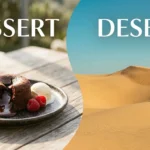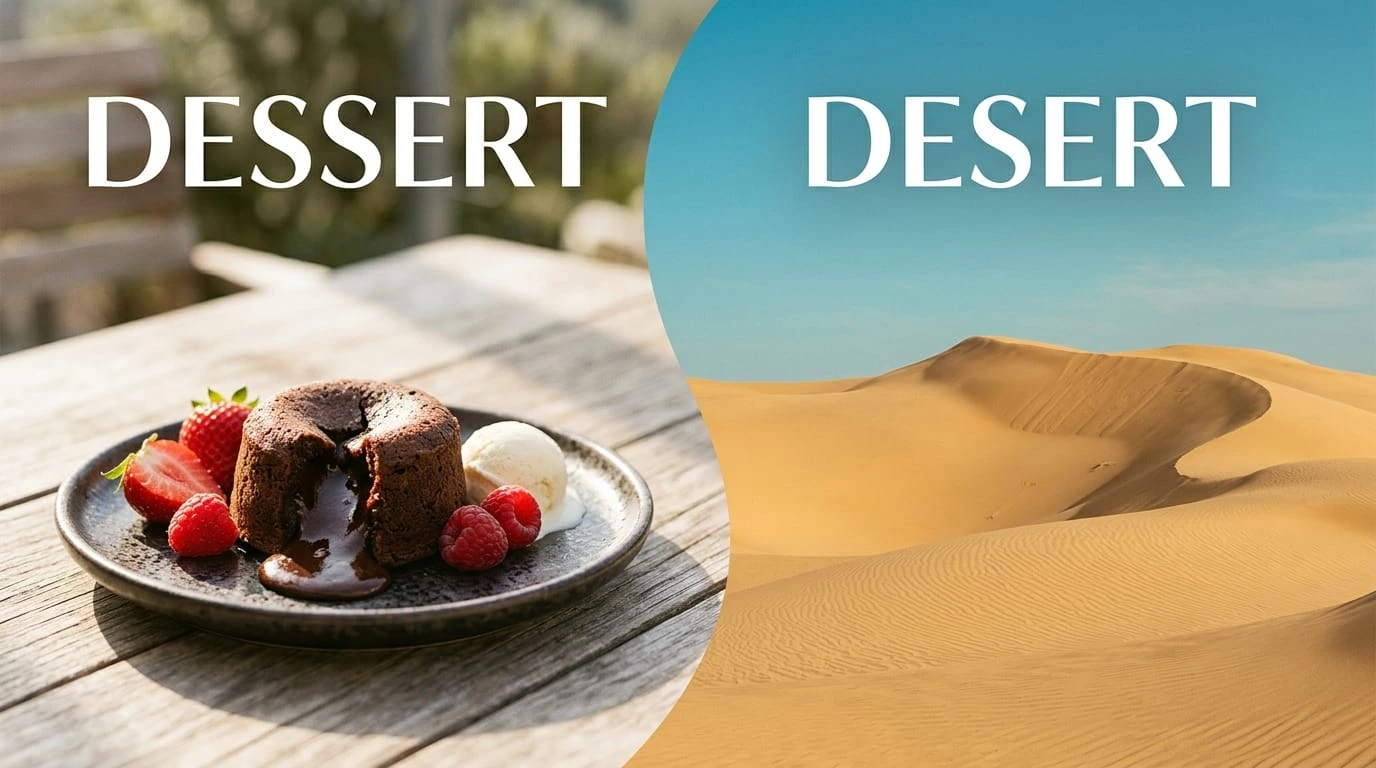
Dessert is a sweet food eaten after a meal, while desert is a dry area with little rain. Remember the double s in dessert by thinking, “I want seconds of something sweet!”
The words dessert and desert differ by just one letter, yet they have completely different meanings. One is a sweet treat served after a meal, while the other is a dry region with very little rain. Mixing them up can change the meaning of your sentence and lead to simple but avoidable spelling mistakes.
As an English teacher, I believe that learning the meaning behind a word is the best way to remember its spelling. For example, dessert has two s letters because you may want seconds of your favorite cake or ice cream. In contrast, desert with one s refers to a dry place, such as the Sahara.
Understanding this difference can help students, English learners, and writers improve their spelling and communicate more clearly. In this guide, you will learn the meanings, pronunciation, and origins of both words. You will also find practical examples, common mistakes, and a simple memory trick to help you choose the correct word every time.
Dessert or Desert; Quick Answer
Dessert means a sweet dish served after a meal. Cakes, ice cream, pudding, and fruit pies are common desserts.
Desert means a dry region that gets very little rain. Deserts may have sand, rocks, plants, and animals that can survive in dry conditions.
Here are two simple examples:
- We had chocolate dessert after dinner.
- Camels can live in the desert.
The main spelling difference is the letter s. Dessert has two s letters, while desert has one.
There is also a difference in pronunciation. As a noun, dessert usually sounds like “dih-ZURT.” The noun desert, meaning a dry region, usually sounds like “DEH-zurt.”
This means the two words differ in both spelling and stress.
The Origin and Background of Dessert and Desert
The words dessert and desert have different histories. Their similar spelling can make them hard to remember, but their origins offer a useful clue.
Where does the word dessert come from?
The word dessert comes from the French word desservir. This word refers to clearing the table after a meal.
Dessert became the name for the food served at the end of a meal. It is often the sweet part of a dinner, such as cake, ice cream, or a fruit dish.
Today, dessert can be simple or fancy. You might eat a biscuit after lunch or enjoy a large chocolate cake at a party. Both can count as desserts.
Where does the word desert come from?
The word desert, meaning a dry region, comes from Latin roots linked to the idea of leaving or abandoning a place. It later developed through French into English.
A desert is a region where very little rain falls. Many people picture endless sand dunes, but not all deserts are sandy. Some are rocky, cold, or covered with gravel.
For example, the Sahara is a hot desert in Africa. Antarctica is also classed as a desert because it receives very little precipitation.
Why are these words confused?
There are three main reasons:
- Similar spelling: Both words use almost the same letters.
- Different meanings: One is food, while the other is a type of land.
- Similar sounds: In many accents, the words sound alike except for their stress pattern.
The easiest way to remember the difference is to connect the spelling with the meaning. Dessert has two S’s because you may want seconds. A desert has one S and is a dry place.
Dessert vs. Desert Explained: Key Differences
The key difference between these words is their meaning and use. One is a noun for food. The other is usually a noun for a dry region, though desert can also be a verb.
1. Dessert: A sweet treat
Use dessert when you talk about a sweet dish served after a meal.
Examples:
- My favorite dessert is chocolate cake.
- We ordered ice cream for dessert.
- She made a fruit dessert for the guests.
- Would you like dessert after lunch?
You can use dessert in everyday speech, restaurant menus, recipes, and formal writing.
Memory tip: If you are thinking about cake, cookies, pudding, or ice cream, you probably need dessert.
2. Desert: A dry region
Use desert when you talk about a dry place that receives little rain.
Examples:
- The Sahara Desert is in Africa.
- Few plants can grow in some parts of the desert.
- We learned about desert animals in school.
- The travelers crossed a hot desert.
The word can describe a place, its climate, or its natural life.
Memory tip: If you are thinking about sand, dry land, or a place with little rain, use desert.
3. Desert as a verb
There is one more use to learn. Desert can also be a verb. It means to leave someone or something behind, often when help or support is needed.
Examples:
- The soldiers refused to desert their post.
- He felt that his friends had deserted him.
- The village was deserted after the storm.
Notice the pronunciation change. As a verb, desert usually has stress on the second part: “dih-ZURT.” This is similar to the pronunciation of dessert.
Comparison table
| Term | Meaning | When to Use | Context |
| Dessert | A sweet dish | Talking about food after a meal | Food, restaurants, recipes |
| Desert | A dry region | Talking about land or climate | Geography, science, travel |
| Desert | To abandon or leave behind | Talking about leaving a person, place, or duty | Stories, news, formal writing |
| Deserted | Empty or abandoned | Describing a place or person left behind | Everyday and formal writing |
Remember that dessert refers to food, while desert can refer to a dry region or the act of leaving someone or something behind.
Which Word Should You Use?
Choosing the correct word becomes easy when you think about the sentence first.
For students
If you are writing a school essay, check what you want to describe.
- Writing about food? Use dessert.
- Writing about climate or land? Use desert.
- Writing about someone leaving a place or person? Use desert as a verb.
For example, “The desert is dry” is correct. So is “The cake was our dessert.”
For teachers and English learners
Teach the words with simple pictures. Show a cake beside the word dessert. Show a dry landscape beside the word desert.
Then ask learners to complete short sentences:
- We ate ice cream for ______.
- A camel can live in the ______.
- He did not ______ his friends.
This method helps learners connect the spelling with the meaning.
For professional writers
Use the word that matches the intended meaning. In an article about travel, desert may refer to a landscape. In a food review, dessert may refer to the final course.
Always proofread both words. Spell-check tools may not catch the error because dessert and desert are both correct English words.
For global or neutral English
Both spellings are standard in British and American English. There is no regional spelling rule that changes dessert into desert or the other way around.
Your choice depends on meaning, not country.
Common Mistakes with Dessert and Desert
Even skilled writers can mix up these words. Here are five common errors and how to fix them.
Mistake 1: Using desert for sweet food
Incorrect: We had ice cream for desert.
Correct: We had ice cream for dessert.
Why it happens: People may forget the second s. Remember that dessert is the sweet course after a meal.
Mistake 2: Using dessert for a dry region
Incorrect: The Sahara Dessert is very large.
Correct: The Sahara Desert is very large.
Why it happens: The two words look similar. But a desert is a type of land, not a type of food.
Mistake 3: Thinking every desert is sandy
Incorrect: A place cannot be a desert unless it has sand.
Correct: A desert is defined mainly by its low level of precipitation.
Why it happens: Pictures often show sand dunes. Yet some deserts are rocky, and some are cold. Antarctica is a well-known example of a cold desert.
Mistake 4: Forgetting the verb meaning of desert
Incorrect: The captain would never dessert the team.
Correct: The captain would never desert the team.
Why it happens: The writer may think only of the food word. In this sentence, desert means to abandon or leave behind.
Mistake 5: Relying only on spell-check
Incorrect: I checked my sentence, so I know the word is right.
Correct: I checked the spelling and made sure the meaning fits.
Why it happens: Spell-check may accept both words. Read the sentence again and ask whether you mean food, dry land, or abandonment.
Dessert or Desert in Real-World Examples
Seeing these words in different settings can help you use them with confidence.
1. Professional email
Hi everyone,
Our team lunch is planned for Friday at 1 p.m. We will serve a main meal followed by dessert. Please let me know if you have any food allergies.
Best,
Alex
Here, dessert is correct because the email refers to food served after the main meal.
2. News headline
Scientists Study Life in the Desert
Researchers are studying how plants and animals survive in dry regions. Their work may help us better understand how living things adapt to harsh conditions.
The word desert is correct because the headline is about dry land and its wildlife.
3. Social media post
Nothing makes a meal better than homemade chocolate dessert! 🍰 What sweet treat would you choose?
The word dessert fits because the post is about a sweet dish.
4. Formal report
Report Title: Water Use in Desert Regions
This report examines the challenges faced by communities living in the desert. It reviews water supply, farming methods, and ways to protect local resources.
Here, desert describes a dry region.
5. Everyday conversation
- “What is your favorite dessert?” “Chocolate pudding.”
- “Have you ever visited a desert?” “Yes, I saw the dunes during my trip.”
- “He did not desert his team.” This means he did not abandon them.
These examples show why context matters. The letters may look similar, but the meaning tells you which word to choose.
Dessert and Desert: Data, Trends, and Usage
People often search for dessert or desert because they want a quick answer to a spelling or grammar question. This is an informational search. The reader wants to know which word is correct and how to remember it.
The topic is useful for several groups:
- Students who need correct spelling in homework and exams.
- English learners who want to build their vocabulary.
- Teachers who explain common spelling errors.
- Writers and editors who need clear, accurate text.
- Travel and food readers who use these words in different contexts.
The confusion can appear in any English-speaking region because both words are used in British and American English.
There is no verified search-volume figure given here, so it would be misleading to claim that one country searches for this phrase more than another.
One useful insight is that these words can pass through basic spell-check tools without a warning. Both are valid words. That is why learning the meaning is more helpful than memorizing the spelling alone.
For website owners, this topic also suits a short comparison article, a spelling quiz, or a classroom worksheet. Clear examples and a simple memory trick can help readers solve their question quickly.
Dessert vs. Desert: Standalone Comparison Table
Use this table as a quick reference whenever you are unsure which word belongs in your sentence.
| Term/Variant | Meaning | Region/Context | Best Used When |
| Dessert | A sweet course or dish | British and American English | Talking about cake, ice cream, or other sweet food |
| Desert (noun) | A region with very little rain | British and American English | Describing a dry landscape or climate |
| Desert (verb) | To abandon or leave behind | British and American English | Describing someone leaving a person, place, or duty |
| Deserted | Empty or abandoned | British and American English | Describing an empty town, building, or place |
The simplest rule: Two s letters mean a sweet dessert. One s in desert usually points to dry land or the verb meaning “to abandon.”
Frequently Asked Questions
Q1: What does dessert mean?
Dessert is a sweet dish that people often eat at the end of a meal. Common examples include cake, ice cream, pudding, and pie.
Q2: What does desert mean?
A desert is a region that receives very little rain. It can be hot or cold, and it does not have to be covered in sand.
Q3: What is the difference between dessert and desert?
Dessert means sweet food, while desert usually means a dry region. Desert can also be a verb that means to abandon someone or something.
Q4: Is dessert or desert correct in formal writing?
Both words are correct in formal writing when used with the right meaning. Use dessert for food and desert for a dry region or the act of abandonment.
Q5: How can I remember the spelling of dessert?
Remember this phrase: “Dessert has two S’s because you may want seconds.” The extra s can remind you of another serving of something sweet.
Q6: Where do the words dessert and desert come from?
Dessert comes from French desservir, linked to clearing the table after a meal. Desert, for a dry region, comes through Latin and French from roots connected with leaving or abandoning a place.
Q7: Can desert be used as a verb?
Yes. Desert can mean to leave someone or something behind, often when support is needed. For example, “She would never desert her friends.”
Q8: Is Antarctica a desert?
Yes. Antarctica is classed as a desert because it receives very little precipitation. A desert is defined by its dryness, not by how hot it is or how much sand it contains.
Q9: Do British and American English spell dessert differently?
No. Both British and American English use dessert for sweet food and desert for a dry region. The spelling difference is based on meaning, not location.
Conclusion: Never Confuse Dessert and Desert Again
The difference between dessert or desert is simple once you connect each word with its meaning. Dessert is the sweet food you may enjoy after dinner. Desert is a dry region with very little rain. The word desert can also mean to abandon someone or something.
Keep these three tips in mind:
- Use dessert when you talk about sweet food.
- Use desert when you talk about dry land.
- Use desert as a verb when you mean to leave or abandon someone or something.
The best memory trick is to remember that dessert has two S’s because you may want seconds. It is short, easy, and useful for students, teachers, and writers.
Do not rely on spell-check alone. Both words are spelled correctly, so the tool may not notice when you use the wrong one. Instead, read your sentence and check the meaning.
Now you know how to use dessert or desert with confidence. Try writing one sentence with each word, then share this guide with someone who often mixes them up!
Tare or Tear: The Easy Way to Know Which Word Is Correct

I specialize in spelling comparisons, confusing word pairs, grammar, and vocabulary development. My content helps readers improve their English, avoid common mistakes, and write with confidence. My goal is to provide accurate, reliable, and easy-to-understand language resources