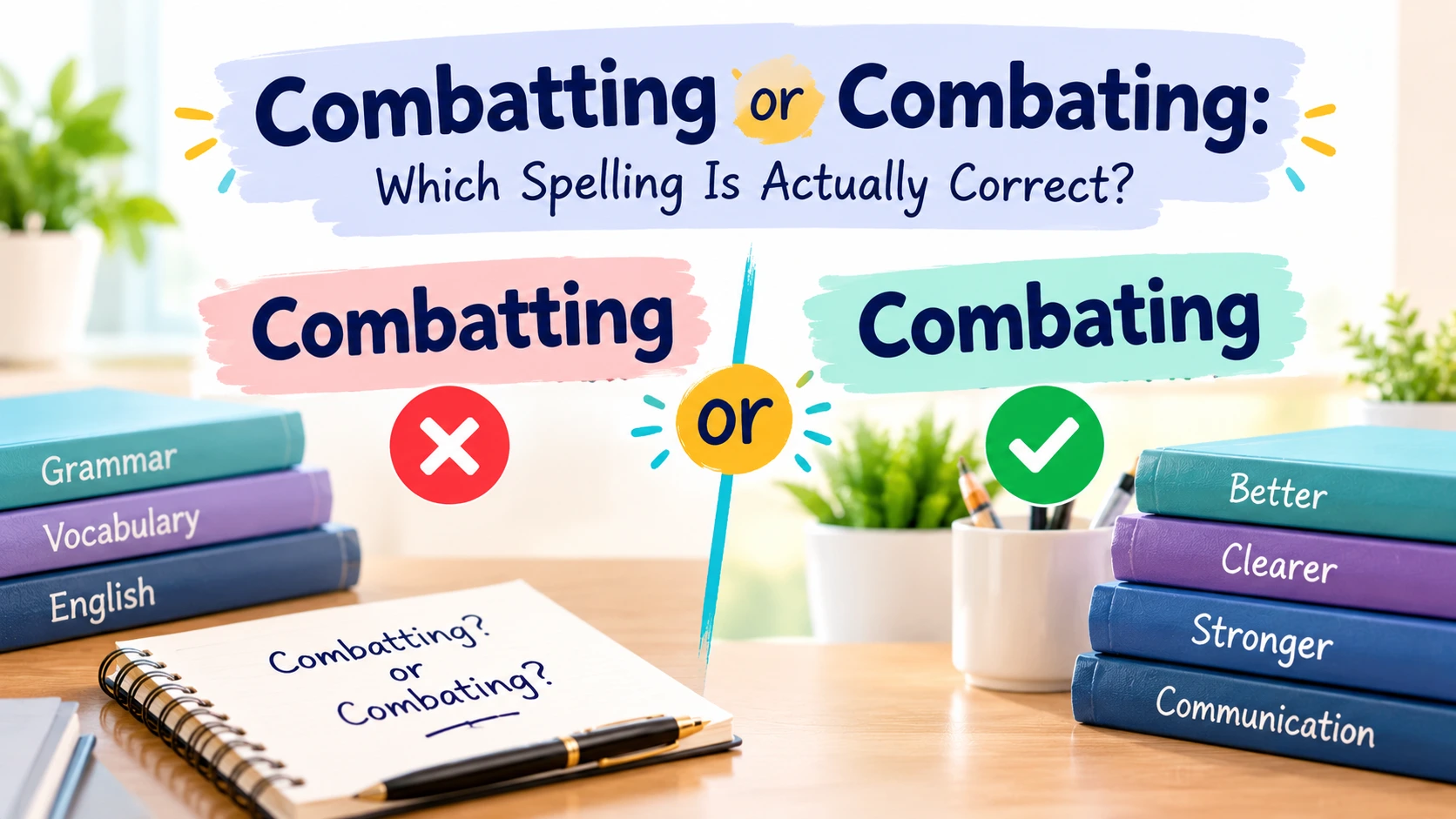
Both combating and combatting are correct spellings of the verb combat, which means to fight, oppose, or take action against something. Combating is more widely used, while combatting is also accepted, especially in British English.
Have you ever stopped while writing a sentence because you could not decide whether combating needs one t or two? You are not alone. This spelling can confuse students, teachers, bloggers, and even experienced writers.
Imagine writing, “The government is combating pollution.” You may wonder if the sentence should say combatting pollution instead. Both forms look right, and both can be found in English writing. So, which one should you choose?
As an English teacher, I would explain the rule with a simple example. The base verb is combat. When you add -ing, you can write combating or combatting. The first form is more common and is the safest choice for most readers.
In this guide, you will learn the meaning of combating, why the two spellings exist, and how to use them in everyday and formal writing. You will also discover whether combat has two ts, which words can replace combating, and why combative is correct while combatative is not the standard spelling. Let’s make this word easy to remember.
Combatting or Combating: Quick Answer
Both spellings are correct:
- Combating: the more common spelling.
- Combatting: an accepted alternative spelling.
Both mean fighting, resisting, or taking action against a problem. The difference is in spelling, not meaning.
Examples:
- The team is combating online fraud.
- The team is combatting online fraud.
Both sentences are correct. However, combating is the better default for schoolwork, websites, and most professional writing.
The Origin and Background of Combating
The word combat comes from Old French combatre, meaning to fight. Its roots are linked to the Latin words com- (together) and battuere (to beat). Over time, English began using combat for physical fighting and for efforts to stop problems such as crime, disease, and poverty.
The spelling confusion comes from a common English rule.
When you add -ing to a verb, you sometimes double the final consonant. For example:
- Run → running
- Sit → sitting
- Stop → stopping
But English does not double the final consonant in every verb. With combat, both combating and combatting are accepted.
The form combating keeps the single t. It is the more common form in modern English. The form combatting doubles the final t and is also used, particularly in British English.
This is why you may see both spellings in articles, books, and online content. The meaning stays the same.
Combating Explained: Key Differences and Variations
Let’s look at the two forms and the words related to them.
1. Combating
Combating is the present participle of combat. It can describe an action happening now or an ongoing effort to stop something harmful.
Examples:
- The city is combating air pollution.
- Doctors are combating the spread of infection.
- Schools are combating bullying through education.
- The company is combating online fraud.
It can also describe a general activity.
Example: “Combating poverty requires long-term planning.”
2. Combatting
Combatting has the same meaning as combating. It is an accepted spelling with a doubled t.
Examples:
- The group is combatting child poverty.
- New rules are aimed at combatting fraud.
- The campaign focuses on combatting waste.
You do not need to change the sentence’s meaning when switching between these two spellings. However, it is best to follow the spelling style used by your school, publisher, or organization.
Comparison Table: Combating vs. Combatting
| Term | Meaning | When to Use | Context |
| Combating | Fighting or taking action against something | The default choice for most writing | General and professional English |
| Combatting | Fighting or taking action against something | When following a style that uses this form | Also used in British English |
| Combat | To fight or oppose something | When using the base verb | All major English varieties |
| Combated | Fought or opposed something | When using the past tense or past participle | Standard English |
| Combatant | A person or group engaged in fighting | When referring to a participant in a conflict | Military or conflict-related contexts |
| Combative | Ready or eager to argue or fight | When describing someone’s behavior | Everyday and formal English |
Which Spelling Should You Use?
The best spelling depends on your audience and the style you follow. Here is a simple guide.
For Students and Exams
Use combating unless your teacher or required style guide specifies otherwise.
Example:
“People are combating climate change by reducing waste.”
This form is widely used and easy to recognize.
For Teachers and Academic Writers
Use combating in essays, lesson plans, worksheets, and research papers. Keep the spelling consistent throughout the document.
Example:
“The study examines methods for combating school bullying.”
For Business and Professional Writing
Both spellings are acceptable, but combating is a practical default for reports, emails, and company websites.
Example:
“Our new system helps in combating online fraud.”
A clear sentence matters more than choosing the less common spelling.
For British English
You may encounter both forms in British writing. Combatting is a recognized variant, but combating is also widely used. Do not assume that every British writer must double the t.
For American English
Combating is the more common choice in American English. Use it in essays, business documents, and website content unless a particular style guide says otherwise.
For Global Readers
If your content is aimed at readers around the world, choose combating. It is the most practical option because it is widely recognized and commonly used.
My recommendation: Use combating by default, and keep the same spelling throughout your writing.
Common Mistakes with Combating and Combatting
Here are five errors to avoid.
1. Thinking Combatting Is Always Wrong
Incorrect claim: Combatting is never correct.
Correct understanding: Both combating and combatting are accepted spellings.
The single-t form is more common, but the double-t form is not automatically an error.
2. Writing Combatting in One Place and Combating in Another
Inconsistent:
- The team is combating fraud.
- The same team is combatting waste.
Better: Choose one spelling for the document and use it throughout.
Consistency helps your writing look polished.
3. Using Combatative Instead of Combative
Incorrect: The player became combatative during the discussion.
Correct: The player became combative during the discussion.
The standard word is combative, meaning ready to argue, fight, or oppose others. Combatative is not the standard form.
4. Using Combatting When You Mean Combatant
Incorrect: The combatting entered the area.
Correct: The combatants entered the area.
A combatant is a person or group engaged in a fight or armed conflict. Combating and combatting describe an action.
5. Using the Wrong Verb Form
Incorrect: They are combated online fraud.
Correct: They are combating online fraud.
Use are combating for an action in progress. Use combated when describing a past action, as in “The team combated the problem last year.”
Combating in Real-World Examples
These examples show how the word works in different settings.
1. Professional Email
Dear Team,
We are introducing new checks for combating workplace fraud. Please review the updated process and report any concerns to your manager.
Thank you for helping us maintain a safe and honest workplace.
Best regards,
Management Team
Here, combating describes ongoing efforts to prevent fraud.
2. News Headline
New Campaign Focuses on Combating Plastic Pollution
The word shows that the campaign aims to reduce or stop a harmful problem.
3. Social Media Post
Small actions can make a big difference! 🌱 We can all help in combating plastic pollution by using fewer single-use items and recycling when possible.
This example uses combating in a friendly, public message.
4. Formal Report
Report: Combating Workplace Bullying
The organization has introduced a new policy for combating workplace bullying. The policy includes staff training, clear reporting steps, and support for affected employees.
The word suits a formal report because it describes planned action against a problem.
Combating: Usage, Trends, and Search Intent
People searching for “combatting or combating” usually want to confirm the correct spelling. Others want to understand the meaning or learn how to use the word in a sentence.
The main search intent is informational.
This topic is useful for:
- Students checking spelling before an exam.
- English learners studying verb forms.
- Teachers explaining spelling variations.
- Bloggers and editors writing about social issues.
- Business writers discussing fraud, risk, or workplace problems.
The word appears in many contexts. News stories may discuss combating crime or pollution. Health articles may focus on combating disease. Business reports may describe efforts to combat fraud.
There is no verified search-volume data here to establish which country searches for this phrase most often. However, the spelling question is relevant to English users across different regions.
For writers and website owners, this topic has clear value. A direct answer helps readers choose a spelling quickly, while examples explain how to use it naturally.
The main point is simple: both forms are correct, but combating is the more widely used choice.
Standalone Comparison Table: Combating vs. Combatting
| Term/Variant | Meaning | Region/Context | Best Used When |
| Combating | Fighting or opposing a problem | General English | You want the most common spelling |
| Combatting | Fighting or opposing a problem | Also used in British English | Your chosen style accepts this form |
| Combat | To fight or oppose | General English | You need the base verb |
| Combated | Fought or opposed | General English | You are describing a past action |
| Combatant | A person involved in a fight | Conflict-related contexts | You mean a participant in a conflict |
| Combative | Eager to argue or fight | General English | You are describing a person’s attitude |
| Combatative | Nonstandard spelling of combative | Avoid in standard writing | Use combative instead |
Frequently Asked Questions
Q1: Is it spelled combating or combatting?
Both combating and combatting are correct. Combating is more widely used and is the recommended default for most writing.
Q2: What is the meaning of combating?
Combating means fighting, opposing, or taking action against something. For example, “The community is combating pollution” means the community is working to reduce or stop pollution.
Q3: Does combating have two ts?
No. Combating has one t before -ing. The alternative spelling combatting has two consecutive ts. Both forms are accepted.
Q4: What is the verb form of combat?
Combat is the base verb. Its common forms are combat, combats, combating or combatting, and combated.
Examples: “They combat fraud,” “She combats waste,” and “They are combating fraud.”
Q5: What is another word for combatting?
Useful alternatives include:
- Fighting
- Opposing
- Resisting
- Tackling
- Countering
- Battling
- Confronting
The best choice depends on the sentence. For example, tackling a problem sounds natural in everyday English, while countering a threat may suit a formal report.
Q6: Which is correct, combative or combatative?
Combative is the standard spelling. It means ready to argue, fight, or oppose someone. Avoid combatative in standard English writing.
Q7: Is combating British or American English?
Combating is used in both British and American English. Combatting is also accepted, particularly in British usage, but it is not limited to Britain.
Q8: What is the past tense of combat?
The past tense is combated. For example, “The organization combated fraud through better checks.”
Q9: Can I use combating in formal writing?
Yes. Combating is suitable for essays, reports, professional emails, and academic writing. It is often used to describe efforts against crime, disease, poverty, and pollution.
Q10: What is the difference between combating and fighting?
Both words can mean taking action against something. Fighting is more common in everyday speech, while combating often sounds more formal and is widely used for social problems or organized efforts.
Conclusion
The choice between combating and combatting is simpler than it may seem. Both spellings are correct, and both describe the act of fighting, opposing, or taking action against something harmful.
However, combating is the more widely used form. It is a practical choice for students, teachers, professional writers, and website owners. The double-t spelling, combatting, is also accepted, so you do not need to treat it as a spelling error.
Remember these key points:
- Use combating as your default spelling.
- Recognize combatting as an accepted alternative.
- Use combated for the past tense.
- Choose combative, not combatative, when describing someone who is eager to argue or fight.
The most useful rule is to choose one spelling and use it consistently. This keeps your writing clear and professional.
Bookmark this guide so you never second-guess “combating or combatting” again, and share it with someone who wants to improve their English spelling.
Comradery or Camaraderie: The Correct Spelling Made Easy

I’m a language enthusiast and content writer. I’m specialized in English grammar, spelling differences, vocabulary explanations, and word comparisons. My goal is to help readers improve their writing skills through clear, accurate, and easy-to-understand language guides.