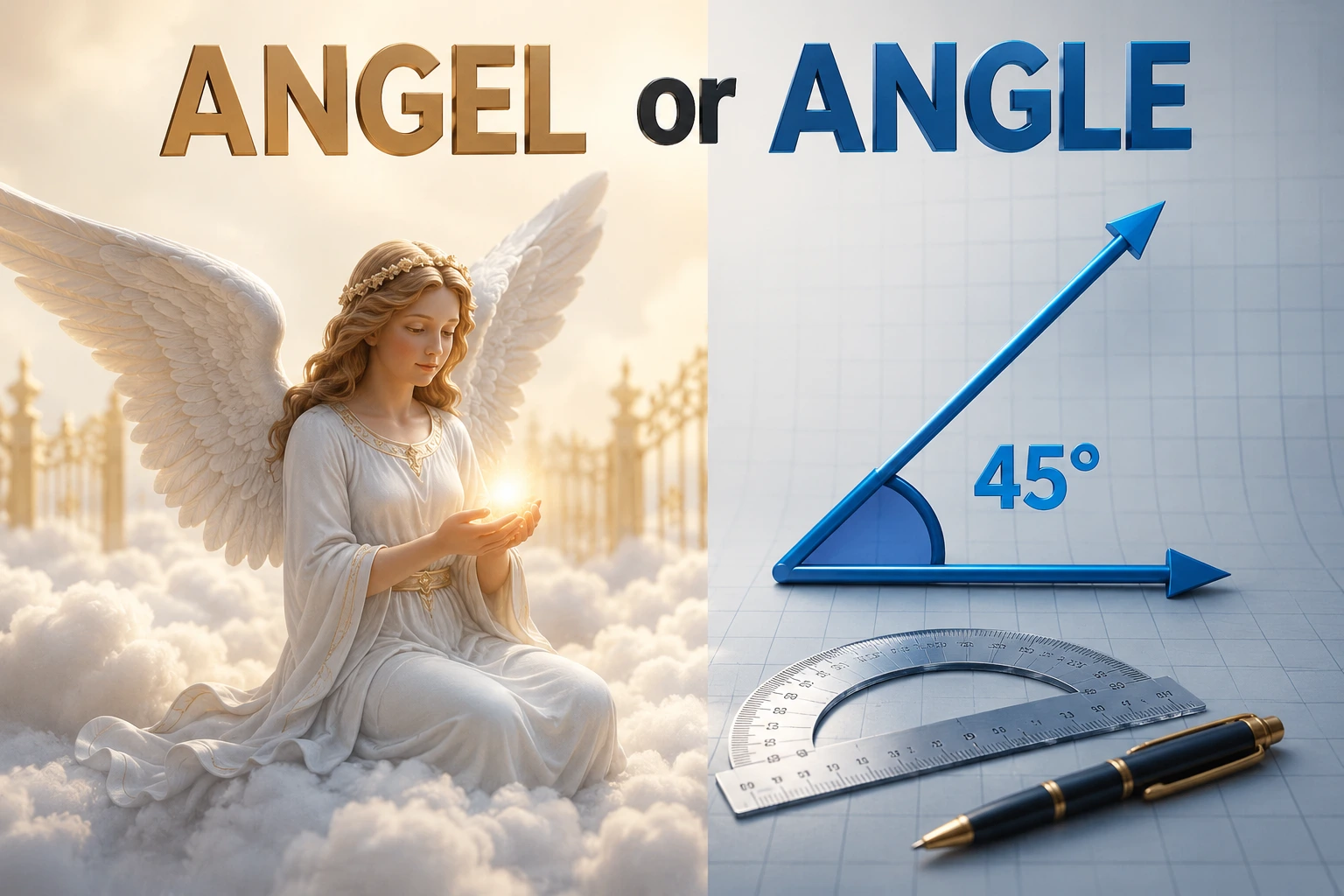
“Angel means a spiritual being or a very kind person, while angle means the space between two lines or a particular point of view. They sound alike but have completely different meanings.”
Have you ever typed “angle” when you meant “angel”? It is an easy mistake to make.
The two words sound almost the same when spoken quickly. But one can describe a heavenly being, while the other can describe the shape of a corner. A single letter changes the whole meaning.
As an English writer, I often see this kind of mistake in everyday writing. People usually know what they want to say. The problem comes when two words have similar sounds but different spellings and meanings. Angel and angle are a perfect example.
You might write about an angel helping someone. Or you might describe the angle of a photograph. If you switch the two words, your sentence can suddenly sound strange or even funny.
The good news is that the difference is simple once you know what each word means.
This guide explains angel vs. angle, shows you how to use each word, covers common mistakes, and gives you easy examples to remember the difference.
Angel or Angle: Quick Answer
Angel refers to a spiritual being, especially one believed to act as a messenger or protector. It can also describe a very kind or helpful person.
Angle refers to the space formed when two lines meet. It can also mean a particular way of looking at a topic.
Examples
- The child believed that her grandmother was an angel.
- The photographer changed the angle of the camera.
- She is an angel for helping me.
- The two lines form a right angle.
Easy memory trick
Think of the “L” in angle as standing for lines.
Angle = lines meet.
An angel has an extra E because it refers to a heavenly being.
The Origin and Background of Angel and Angle
Although angel and angle look very similar, they come from different language roots.
Where does “angel” come from?
The word angel comes from the Greek word angelos, meaning messenger. It passed into Latin and later Old English before becoming the modern English word angel.
In religious traditions, an angel is often described as a spiritual messenger or servant of God.
Over time, the word gained a second common meaning. We may call a person an angel when they are extremely kind, helpful, or generous.
For example:
“You brought me dinner when I was sick. You’re an angel!”
Here, angel does not mean a literal heavenly being. It is a warm way to praise someone’s kindness.
Where does “angle” come from?
Angle has a different history.
It comes from Latin angulus, meaning corner or angle. The word developed through French and entered English with its geometric meaning.
Today, angle has several related uses.
It can describe:
- A shape in geometry
- The position of an object
- The direction from which something is viewed
- A particular point of view
- A way to present a story or idea
That is why you may see angle in mathematics, photography, journalism, business, and everyday speech.
The similar spelling is simply a coincidence. The words do not mean the same thing.
Pronunciation of Angel and Angle
Both angel and angle are pronounced differently, even though they look and sound quite similar.
Angel
Angel sounds like “AYN-juhl.”
The word has two syllables: an-gel.
Example:
She believes her guardian angel is watching over her.
Angle
Angle sounds like “ANG-guhl.”
It has two syllables: an-gle, with a clear ng sound.
Example:
Measure the angle with a protractor.
Quick pronunciation tip
- Angel → AYN-juhl → heavenly being 👼
- Angle → ANG-guhl → geometry or viewpoint 📐
The key difference is the first vowel sound: angel begins with an “ay” sound, while angle begins with an “ang” sound.
Angel vs. Angl: Key Differences
The easiest way to understand these words is to look at their meanings side by side.
| Term | Meaning | When to Use | Region/Context |
|---|---|---|---|
| Angel | A spiritual being or a very kind person | Talking about religion, kindness, or protection | General English |
| Angle | The space between two lines or a particular viewpoint | Talking about geometry, photography, ideas, or stories | General English |
Angel
Use angel when you mean a heavenly or spiritual being.
Example:
The painting shows an angel with large wings.
You can also use angel to praise someone who has been very kind.
Example:
You helped me finish the project. You’re an angel!
Angle
Use angle when talking about geometry.
Example:
A triangle has three angles.
You can also use angle when talking about a position or viewpoint.
Example:
Try taking the picture from another angle.
Journalists use the word in another way.
Example:
The reporter found an interesting angle for the story.
Here, angle means a particular way of approaching or presenting a subject.
Angel or Angle: Which One Should You Use?
The correct word depends on what you mean.
If you mean a heavenly being
Use angel.
The child drew an angel with wings.
If you mean a kind person
Use angel.
My neighbor was an angel and brought us some food.
If you mean a corner or geometric shape
Use angle.
Measure the angle carefully.
If you mean a viewpoint
Use angle.
The photographer found the perfect angle.
If you are writing for school
Be careful with the spelling. A spelling mistake can change your meaning completely.
For example:
❌ The triangle has three angels.
✅ The triangle has three angles.
If you are writing about religion
Use angel when referring to the spiritual being.
The Bible describes angels as messengers of God.
For global English
Both angel and angle are standard English words. There is no British-versus-American spelling difference here.
The main issue is meaning, not regional spelling.
Common Mistakes with Angel and Angle
These words are often confused because they look and sound alike. Here are some of the most common mistakes.
1. Using “angel” in geometry
❌ The square has four angels.
✅ The square has four angles.
Why does this happen?
The word angel is more familiar to many people. But geometry always uses angle.
2. Using “angle” for a heavenly being
❌ She saw an angle in the dream.
✅ She saw an angel in the dream.
Why does this happen?
The two words have nearly identical sounds. A quick spelling mistake can easily replace one with the other.
3. Writing “angle” when praising someone
❌ You are such an angle!
✅ You are such an angel!
If you call someone an angel, you are saying they are very kind or helpful.
4. Writing “angel” when talking about photography
❌ Take the picture from a different angel.
✅ Take the picture from a different angle.
Photography uses angle because it refers to the position or direction from which the camera sees something.
5. Confusing “angle” with “view”
Angle can mean a viewpoint, but it is not always exactly the same as view.
For example:
The article takes a fresh angle on climate change.
Here, angle means a particular approach or perspective.
Angel or Angle in Real-World Examples
Seeing these words in different situations makes the difference easier to remember.
1. Professional Email
Thank you for helping me with the presentation. You were an angel for staying late and helping me finish it.
Here, angel means a very kind or helpful person.
Another example:
Could you adjust the camera angle before the meeting begins?
Here, angle refers to the camera’s position.
2. News Article
The reporter explored a new angle on the city’s housing problem.
In journalism, an angle is a particular approach to a story.
A news article about religion might say:
The ceremony included a large statue of an angel.
Here, angel refers to a spiritual figure.
3. Social Media Post
My sister brought me soup when I was sick. She’s an angel! ❤️
The word expresses affection and gratitude.
A photography post might say:
Same place, new angle. 📸
Here, angle refers to the photographer’s position.
4. Formal Document or Report
The survey examined the issue from several different angles.
This means the report considered several viewpoints.
A religious document could say:
The artwork depicts an angel standing beside the child.
The meaning is completely different.
Angel or Angle: Data, Trends and Usage
People usually search “angel or angle” because they are unsure which spelling is correct. This makes the phrase mainly informational in search intent.
The confusion is easy to understand. The words differ by only one letter, and their pronunciation can be very similar in everyday speech.
The two words also appear in very different topics.
Angel is common in contexts such as:
- Religion
- Spirituality
- Art
- Literature
- Personal descriptions
- Expressions of kindness
Angle is common in:
- Mathematics
- Geometry
- Photography
- Journalism
- Business
- Science
- Everyday descriptions of position or perspective
This difference matters because context gives you a strong clue.
If you are talking about wings, heaven, guardians, or kindness, you probably need angel.
If you are talking about lines, corners, cameras, viewpoints, or perspectives, you probably need angle.
Angel vs. Angle: Comparison Table
| Term/Variant | Meaning | Region/Context | Best Used When |
|---|---|---|---|
| Angel | Spiritual being | Religion and spirituality | Referring to a heavenly messenger or being |
| Angel | Kind or helpful person | Informal everyday English | Praising someone’s kindness |
| Angle | Space between two lines | Mathematics and geometry | Describing geometric shapes |
| Angle | Position or direction | Photography and physical objects | Describing how something is viewed |
| Angle | Point of view or approach | Journalism and general writing | Presenting a topic from a certain perspective |
The important point is simple: angel and angle are both correct words. Neither is a misspelling of the other.
You simply need to choose the one that matches your meaning.
A Simple Trick to Remember Angel vs. Angle
Still mixing them up?
Try this:
ANGLE = LINES
The word angle contains an L.
Think:
A + NGLE → Lines
An angle is made when lines meet.
ANGEL = HEAVEN
Think of an angel with wings.
Angel = heavenly being.
You can also remember the spelling pattern:
- Angel → ends in -gel
- Angle → ends in -gle
That tiny letter swap changes the word.
Frequently Asked Questions About Angel or Angle
Q: What does angel mean?
A: Angel usually means a spiritual or heavenly being. It can also describe a person who is extremely kind, helpful, or generous.
Q: What does angle mean?
A: Angle can mean the space formed when two lines meet. It can also mean a viewpoint, position, direction, or particular way of approaching a subject.
Q: Is angel or angle correct?
A: Both are correct words. Angel refers to a spiritual being or kind person, while angle refers to a geometric shape, position, or viewpoint.
Q: How do you use angel in a sentence?
A: You can use angel for a spiritual being or a kind person. For example, “The story describes an angel,” or “You are an angel for helping me.”
Q: How do you use angle in a sentence?
A: Use angle for geometry, position, or perspective. For example, “The triangle has a 90-degree angle,” or “Take the photo from another angle.”
Q: Is angel the same as angle?
A: No. They have different meanings even though they look and sound similar. Angel relates to a spiritual being or kindness, while angle relates to lines, positions, or viewpoints.
Q: Is angel or angle used in formal writing?
A: Both words are standard and acceptable in formal writing when used correctly. The important thing is to choose the word that matches your intended meaning.
Q: Where does the word angel come from?
A: Angel comes from the Greek angelos, meaning “messenger.” The word later passed through Latin and Old English before developing into modern English.
Q: Where does the word angle come from?
A: Angle comes from Latin angulus, meaning “corner” or “angle.” It developed through other European languages before entering English.
Q: Can angle mean a point of view?
A: Yes. Angle can mean a particular way of looking at or presenting a subject. For example, “The writer took a different angle on the issue.”
Conclusion: Angel or Angle?
The difference between angel and angle is small in spelling but large in meaning.
An angel is usually a spiritual being. The word can also describe someone who is wonderfully kind or helpful. For example, you might say, “She is an angel.”
An angle, on the other hand, relates to geometry, position, direction, or perspective. You might measure an angle in math, change the angle of a camera, or explore an issue from a new angle.
Remember the easiest trick:
Angle = lines.
Angel = heavenly being.
Neither word is more correct than the other. Your meaning decides which one you need.
Once you connect angle with lines and angel with heaven, this spelling pair becomes much easier to remember.
Merked or Murked? What's the Difference?

I am a professional content writer with a strong interest in English spelling and vocabulary. I am interested in creating informative guides on commonly confused words, spelling differences, and language usage to help readers write more accurately and effectively.