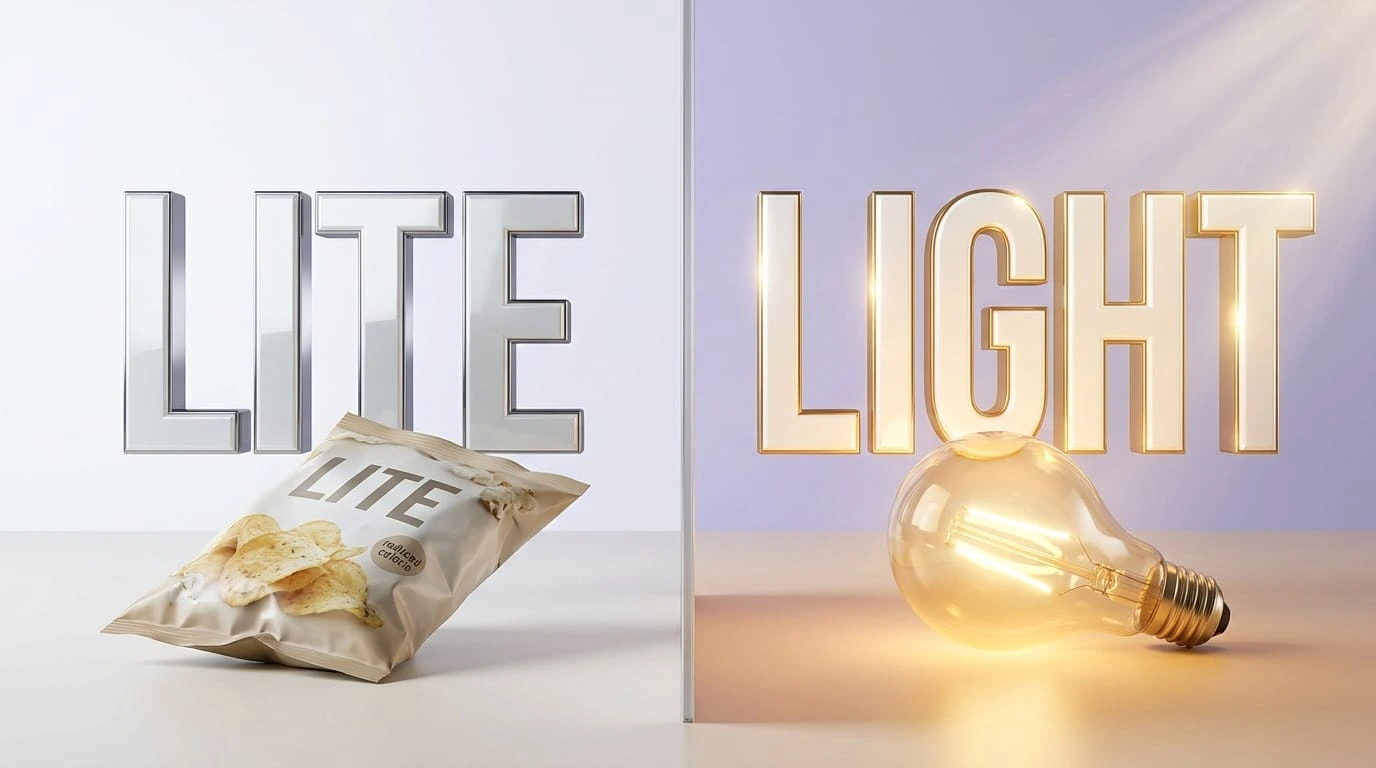
Light is the correct word for brightness, something that is not heavy, or something that makes things easier. Lite is an informal spelling used mainly in product names and marketing to mean a lighter or reduced version of something.
Have you ever seen the words lite and light and wondered which one to use? You may see a “lite” drink in a shop or read about a “light” meal on a menu. Both spellings look right, but they do not work in the same way.
As an English writer, I often find that small spelling choices can cause big doubts. This pair is a good example. One letter can change how a word looks and how people understand it.
The good news is that the rule is simple. Light is the standard spelling in everyday English. It can describe brightness, weight, color, or something that is not strong. Lite is a special, informal form. Companies often use it to suggest fewer calories, less weight, or fewer features.
In this guide, you will learn the meaning of lite and light, see clear examples, and discover common mistakes. You will also learn which spelling works best in schoolwork, business writing, product labels, and online posts.
Lite or Light: Quick Answer
Use light in standard English. Use lite mainly in product names, advertising, and informal labels.
For example:
- The bag is light, so I can carry it easily.
- I bought a lite version of the drink.
Remember this simple rule: Light is the standard word; lite is a special spelling used in certain contexts.
The Origin and Background of Lite and Light
Where Does Light Come From?
The word light has a long history. It comes from Old English words such as lēoht, which referred to brightness or illumination.
Over time, light gained more meanings. It came to describe things that weigh little, colors that are pale, and activities that are not difficult or intense.
Today, we use light in many ways:
- Light from the sun filled the room.
- This box is light enough to lift.
- She wore a light blue dress.
- We had a light lunch.
Where Does Lite Come From?
Lite is a later, nonstandard spelling of light. It became popular in commercial use, especially in the twentieth century.
Companies often use lite to make a product sound lighter or less heavy. It may also suggest fewer calories, less fat, or fewer features.
For example, a product called “Lite” may contain fewer calories than the regular version. A software app called “Lite” may use less storage or offer fewer features.
However, lite does not have one fixed meaning. The exact meaning depends on the product and its label.
Lite vs. Light: Key Differences Explained
The main difference is standard spelling versus special commercial spelling.
| Term | Meaning | When to Use | Region/Context |
| Light | Brightness or illumination | When talking about lamps, the sun, or visibility | Standard English worldwide |
| Light | Not heavy | When describing weight | Standard English worldwide |
| Light | Pale in color or low in intensity | When describing colors, food, or activity | Standard English worldwide |
| Lite | A reduced or lighter version | In product labels and marketing | Informal and commercial English |
| Lite | A product or service name | When the official brand uses this spelling | Brand-specific usage |
1. Light as Brightness
Use light when you mean something that helps you see.
Examples:
- The light in the kitchen is too bright.
- Sunlight brings light into the room.
- Please turn on the light.
2. Light as Weight
Use light when something does not weigh much.
Examples:
- My school bag is very light.
- This chair is light and easy to move.
- She picked up the light box.
3. Light as a Color
Use light to describe a pale color.
Examples:
- He wore a light green shirt.
- The walls are painted light pink.
- I prefer light blue curtains.
4. Lite as a Product Label
Use lite when it is part of an established product name or an informal label for a reduced version.
Examples:
- The shop sells a lite version of the drink.
- I downloaded the Lite app to save space.
- This brand offers a lite snack option.
Do not assume that every product labeled lite contains fewer calories or is healthier. Check the product details to learn what has been reduced.
Which Spelling Should You Use?
Your choice depends on what you want to say.
For Students and Academic Writing
Use light in essays, homework, exams, and formal assignments.
Correct: The room was filled with light.
Avoid using lite as a replacement for standard spelling unless you are quoting a product name.
For Business and Professional Writing
Use light in reports, emails, and other formal documents.
For example:
- The new device is light and easy to carry.
- We need a light meal before the meeting.
Use Lite when writing an official product or brand name.
For Marketing and Product Labels
Lite may be suitable when a company uses it to describe a reduced version of a product.
For example, a company might advertise a “Lite Plan” with fewer features. The meaning should be clear to customers.
For Global and Neutral English
Choose light whenever you are unsure. It is the standard spelling and works in both British and American English.
Common Mistakes with Lite and Light
Mistake 1: Using Lite to Describe Weight
Incorrect: This suitcase is very lite.
Correct: This suitcase is very light.
Why? The standard adjective for something that weighs little is light.
Mistake 2: Using Lite for Brightness
Incorrect: The room needs more lite.
Correct: The room needs more light.
Why? The word light refers to brightness and illumination.
Mistake 3: Using Lite in Formal Essays
Incorrect: I prefer a lite meal in the evening.
Better: I prefer a light meal in the evening.
Why? Standard writing uses light for a small or less heavy meal.
Mistake 4: Assuming Lite Always Means Healthy
Incorrect: This product says “lite,” so it must be healthy.
Better: Check the nutrition label to see what has been reduced.
Why? Lite is a marketing term. It does not guarantee that a product is healthy or low in calories.
Mistake 5: Changing an Official Product Name
Incorrect: Changing a brand’s official “Lite” name to “Light.”
Correct: Keep the spelling used in the official name.
Why? Brand names may use special spellings on purpose.
Lite or Light in Real-World Examples
1. Professional Email
Example:
Subject: New Equipment for the Office
Hi Team,
The new laptop is light and easy to carry between meetings. Please review its features before we place the next order.
Best regards,
Alex
Why it works: Light describes the laptop’s weight.
2. News Headline
Example:
“New Lightweight Laptop Offers Longer Battery Life”
Why it works: Lightweight is the standard word for something that weighs little.
3. Social Media Post
Example:
“Looking for a quick snack? Try a light meal that keeps you comfortable without feeling too full.”
Why it works: Light describes a meal that is not heavy.
4. Product Advertisement
Example:
“Try our new Lite plan for a simple way to access essential features.”
Why it works: Lite is used as a commercial label for a reduced version. The company should explain which features are included.
5. Formal Report
Example:
“The team selected a light material to reduce the total weight of the equipment.”
Why it works: Light is the correct standard adjective for weight.
Lite or Light: Data, Trends, and Usage
People often search for lite or light because the words look similar and can appear on the same types of products. Their meanings overlap in some commercial contexts, but their spelling rules differ.
The main search intent is informational. Readers want to know which spelling is correct, what each word means, and how to use it in a sentence.
The confusion is common in online shopping, food labels, mobile apps, and software. Product names may use Lite, while standard descriptions use light.
For example, a product may have a “Lite” version, but its packaging can still describe the product as “light” in weight.
There is no need to guess which spelling is correct. In ordinary writing, choose light. When copying an official product name, follow the brand’s spelling.
Lite vs. Light: Quick Comparison Table
| Term/Variant | Meaning | Region/Context | Best Used When |
| Light | Brightness | All English varieties | Talking about visibility |
| Light | Not heavy | All English varieties | Describing weight |
| Light | Pale or soft in color | All English varieties | Describing colors |
| Light | Not heavy or intense | All English varieties | Describing meals or activity |
| Lite | A reduced version | Commercial English | Describing a product with fewer features or a stated reduction |
| Lite | Official product name | Brand-specific | Using the exact name of a product or service |
Frequently Asked Questions
Q: What does lite mean?
A: Lite is an informal spelling often used in product names and marketing. It may describe a version with fewer calories, less weight, or fewer features. Its exact meaning depends on the product.
Q: How do you use light correctly?
A: Use light for brightness, low weight, pale colors, and things that are not heavy or intense. For example, “The bag is light” and “The room needs more light” are both correct.
Q: What is the difference between lite and light?
A: Light is the standard English spelling. Lite is a special form mainly used in advertising, product labels, and brand names.
Q: Is lite acceptable in formal writing?
A: It is acceptable when it is part of an official name or a quoted label. In formal writing, use light for ordinary meanings such as low weight or low intensity.
Q: Which spelling is correct, lite or light?
A: Both spellings exist, but they are not interchangeable. Use light in standard English and lite when the context calls for that special spelling.
Q: Where does the word light come from?
A: Light comes from Old English lēoht, which referred to brightness. Over time, it gained meanings related to weight, color, and intensity.
Q: Can lite be used for food?
A: Yes. Food companies sometimes use lite to describe a product with a reduced amount of something, such as calories or fat. Always read the nutrition label to find out what has changed.
Q: Is light used in British and American English?
A: Yes. Light is the standard spelling in both British and American English. The special spelling lite is also used in commercial contexts in both varieties.
Conclusion
The difference between lite and light is easy to remember once you know the rule. Light is the standard English word for brightness, low weight, pale colors, and things that are not heavy or intense.
Lite is mainly used in advertising, product labels, and official names. It often suggests a reduced version, but the exact meaning depends on the product.
When writing an essay, email, report, or school assignment, choose light for ordinary meanings. When you refer to a product that uses Lite in its official name, keep that spelling.
Remember these examples: “a light bag,” “a light meal,” and “a Lite app.” Each phrase uses the spelling that fits its meaning.
Now you know how to choose between lite and light. Practise using both in your own sentences, and bookmark this guide so you can check the rule whenever you need it.
Lying or Laying: Which Word Is Correct?

I am a professional content writer with a strong interest in English spelling and vocabulary. I am interested in creating informative guides on commonly confused words, spelling differences, and language usage to help readers write more accurately and effectively.