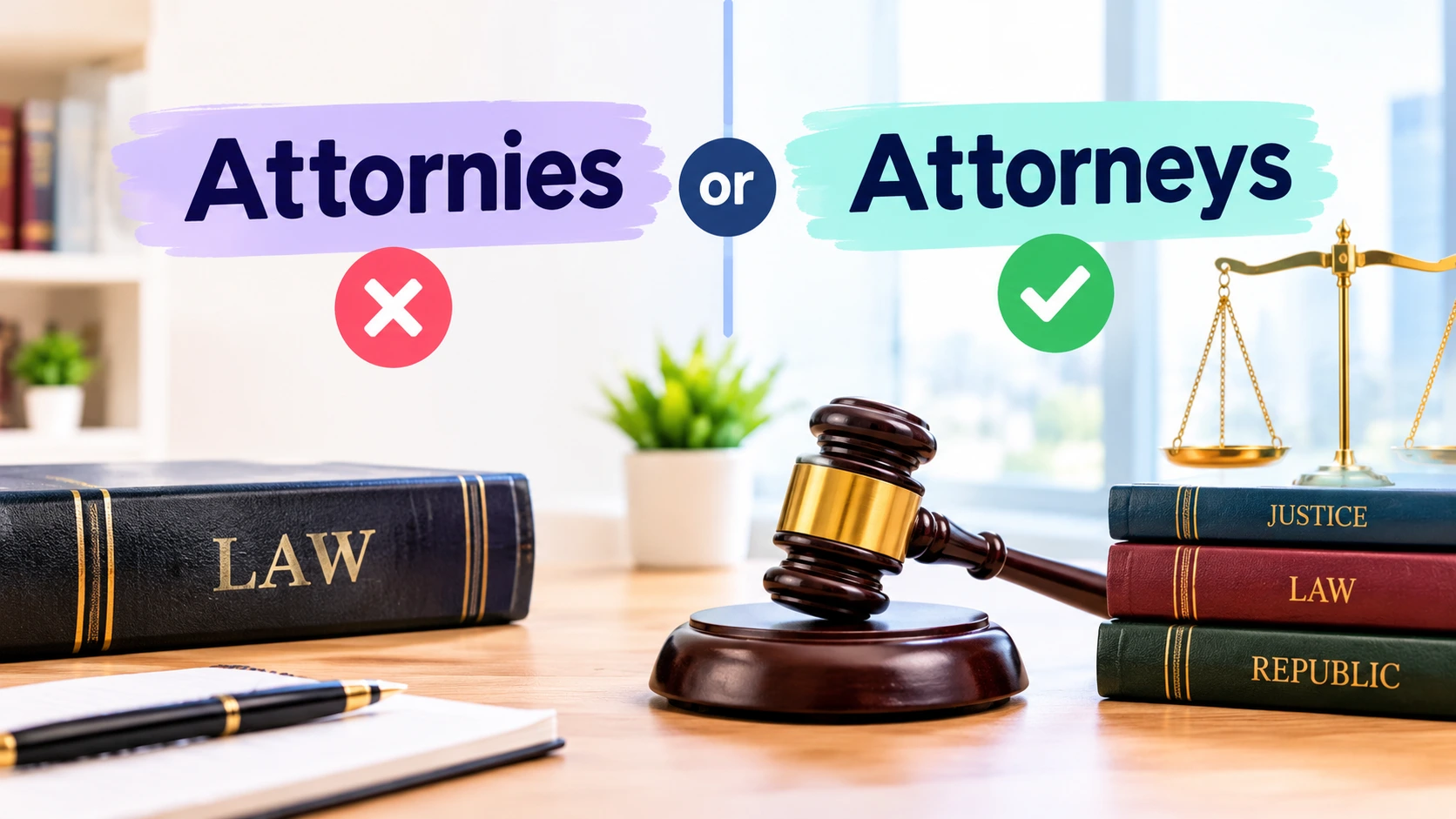
Attorneys is the correct spelling of the plural of attorney, meaning lawyers who give legal advice or represent people in legal matters. Attornies is a common spelling error and should not be used in standard English.
A small spelling mistake can make a professional document look less polished. This is especially true when you write about lawyers, legal services, or court cases. One word that often causes confusion is attornies or attorneys. Both spellings may look reasonable, but only one is correct in standard English.
As an English teacher, I have seen how words ending in -y can confuse learners. Many English nouns change their final y to ies when they become plural. For example, city becomes cities, and party becomes parties. It may seem logical to apply the same rule to attorney. However, this word follows a different spelling pattern because the letter before its final y is a vowel.
The correct plural is attorneys. Once you learn this simple rule, you can avoid the mistake in essays, emails, reports, and legal content. This guide explains the correct spelling, the reason behind it, common errors, and practical examples so you can use the word with confidence.
Attornies or Attorney: Quick Answer
Attorneys is the correct plural form of attorney. An attorney is a person who is qualified to practice law and may advise or represent clients in legal matters.
The spelling attornies is incorrect in standard modern English. Use attorneys in school assignments, business documents, legal articles, and everyday writing.
Examples:
- Correct: The company hired two attorneys to review the contract.
- Incorrect: The company hired two attornies to review the contract.
Why is attorneys correct?
The word attorney ends in -ey, not simply -y after a consonant. When a noun ends in a vowel followed by y, you usually add -s to make it plural.
For example:
- Attorney → Attorneys
- Monkey → Monkeys
- Key → Keys
- Journey → Journeys
Compare these with words that end in a consonant followed by y:
- City → Cities
- Story → Stories
- Party → Parties
This difference explains why attorneys is correct, while attornies is not.
The Origin and Background of Attorneys
The word attorney has a long history in English. It came through Anglo-French from a verb meaning to appoint or assign someone to act on another person’s behalf.
Over time, the word became linked to people who act for others in legal matters. Today, an attorney may advise clients, prepare legal documents, negotiate agreements, or represent clients in court, depending on their role and local laws.
How did the word attorney develop?
The word attorney entered English through legal language used in medieval times. Its early sense focused on acting for another person or serving as their representative.
The plural form developed as attorneys, following the usual English rule for nouns that end in a vowel plus y.
Why do people write attornies?
The confusion often comes from a common spelling rule. Many English words ending in a consonant plus y change to -ies in the plural.
For example, baby becomes babies. Learners may apply that same rule to attorney, even though the letter before the final y is e, a vowel.
The result is the incorrect spelling attornies.
The easiest way to avoid this mistake is to look at the letters before the final y. If a vowel comes before y, you usually keep the y and add s.
Attorneys Explained: Key Differences and Variations
There is no difference in meaning between attornies and attorneys because only attorneys is the accepted standard plural spelling. The other form is a misspelling.
However, related legal terms can have different meanings. Understanding them helps you choose the right word in context.
1. Attorney
An attorney is a legal professional who is authorized to perform legal work under the rules of the relevant jurisdiction.
Example: The attorney explained the client’s legal options.
2. Attorneys
Attorneys is the plural form of attorney. Use it when referring to two or more attorneys.
Example: The attorneys met to discuss the case.
3. Attorney’s
Attorney’s is the singular possessive form. It shows that something belongs to one attorney or is connected with that attorney.
Example: The attorney’s office is on the second floor.
4. Attorneys’
Attorneys’ is the plural possessive form. It shows that something belongs to, or is shared by, more than one attorney.
Example: The attorneys’ meeting lasted two hours.
Comparison table
| Term | Meaning | When to Use | Context |
| Attorney | One legal professional | Referring to one person | Legal and general writing |
| Attorneys | More than one legal professional | Referring to two or more people | Legal documents, articles, emails |
| Attorney’s | Belonging to one attorney | Showing singular possession | An attorney’s office |
| Attorneys’ | Belonging to multiple attorneys | Showing plural possession | Attorneys’ fees or meeting |
| Attornies | Nonstandard misspelling | Avoid in standard English | Incorrect spelling |
Remember: attorneys is the plural. The apostrophe forms show possession, not a different plural spelling.
Which Spelling Should You Use?
The choice is simple. Use attorneys whenever you mean more than one attorney.
For students and English learners
Use attorneys in essays, exams, homework, and vocabulary exercises.
A useful example is:
“The attorneys prepared the documents before the hearing.”
Check the spelling by remembering that attorney ends in a vowel plus y. Add s, and the word becomes attorneys.
For teachers and writers
When teaching or editing, explain the difference between vowel + y and consonant + y.
- Vowel + y: key → keys; attorney → attorneys.
- Consonant + y: city → cities; story → stories.
This short comparison helps learners understand the rule instead of memorizing one word at a time.
For legal professionals and businesses
Use attorneys in legal websites, contracts, reports, client emails, and professional profiles when referring to more than one attorney.
Always proofread the word in headings and page titles, too. A spelling error on a law firm’s website can reduce trust in the content, even when the legal information is correct.
For British and American English
Attorneys is the correct plural spelling in both British and American English. The word attorney is especially common in American legal contexts. In other English-speaking legal systems, terms such as solicitor or barrister may be used for specific legal roles.
These titles are not always interchangeable, since legal roles differ by jurisdiction.
Common Mistakes with Attorneys
Here are five errors to watch for when using attorney and its related forms.
Mistake 1: Writing attornies as the plural
- Incorrect: Three attornies joined the meeting.
- Correct: Three attorneys joined the meeting.
The error comes from applying the -y to -ies rule to a word that ends in a vowel plus y.
Mistake 2: Using an apostrophe to form the plural
- Incorrect: The attorney’s arrived early.
- Correct: The attorneys arrived early.
An apostrophe is not needed to make a regular noun plural. Use attorney’s only when showing singular possession or a contraction, where applicable.
Mistake 3: Confusing attorneys’ with attorney’s
- Singular possessive: The attorney’s advice was helpful.
- Plural possessive: The attorneys’ advice was helpful.
The first refers to one attorney. The second refers to more than one attorney.
Mistake 4: Assuming all legal titles mean the same thing
- Incorrect: Every attorney in every country has the same legal role.
- Better: An attorney’s role depends on the laws of the place where they practice.
Legal titles and duties vary across countries. Use the right title for the relevant legal system.
Mistake 5: Trusting spell-check without checking meaning
A spell-check tool may flag attornies, but tools do not always catch every error. When writing for a professional audience, check the spelling and the sentence’s meaning yourself.
Quick rule: One attorney, two attorneys. Use an apostrophe only when you need to show possession.
Attorneys in Real-World Examples
These examples show how to use the correct spelling in everyday and professional writing.
1. Professional email
Hello Jordan,
The attorneys have reviewed the contract and are ready to discuss the proposed changes. Please confirm whether you are available for a meeting on Thursday.
Best regards,
Taylor
Here, attorneys is correct because the email refers to more than one legal professional.
2. News headline
Attorneys Review New Rules Affecting Local Businesses
The headline uses attorneys to describe multiple legal professionals reviewing changes that may affect businesses.
3. Social media post
Choosing the right legal professional can make a difference. Ask questions, check their experience, and make sure you understand the services they offer. #LegalAdvice #Attorneys
The plural spelling attorneys works because the post refers to legal professionals as a group.
4. Formal report
Legal Review Report
The company consulted several attorneys before approving the new agreement. Their review helped the team identify legal questions that needed further attention.
The spelling is correct because the report refers to multiple attorneys.
5. Everyday conversation
- “The attorneys are meeting with the client today.”
- “I spoke to an attorney about the contract.”
- “The attorney’s office called this morning.”
- “The attorneys’ offices are in the same building.”
These examples show the difference between the singular, plural, and possessive forms.
Attorneys: Data, Trends, and Usage
People searching for attornies or attorneys usually want to confirm the correct spelling. This is an informational search intent. They may be writing an essay, preparing a legal document, editing a website, or checking a professional email.
This spelling question can matter to several groups:
- Students learning English spelling rules.
- Legal writers preparing accurate articles and reports.
- Law firms creating website content and professional profiles.
- Editors checking legal documents and business communication.
- Job seekers writing about legal careers or legal services.
The word attorney is especially common in American legal language. Readers in other countries may encounter related terms such as lawyer, solicitor, or barrister. The best choice depends on the legal system and the meaning you want to convey.
No verified search-volume figures are provided here, so it would be misleading to claim exact numbers or rank countries by interest.
One useful insight is that spelling errors can remain unnoticed when a reader understands the intended meaning. In legal content, however, accurate spelling helps maintain a professional tone and makes the text easier to trust.
Attorneys: Standalone Comparison Table
Use this table as a quick guide when choosing the correct form.
| Term/Variant | Meaning | Region/Context | Best Used When |
| Attorney | One legal professional | Common in American legal English | Referring to one person |
| Attorneys | More than one legal professional | Standard English | Referring to a group |
| Attorney’s | Singular possessive | Standard English | Showing something linked to one attorney |
| Attorneys’ | Plural possessive | Standard English | Showing something linked to multiple attorneys |
| Attornies | Incorrect spelling | Nonstandard | Do not use in formal or standard writing |
The key point is simple: attorneys is the correct plural form. The apostrophe forms have separate uses, and attornies should be avoided.
Frequently Asked Questions
Q1: Is attornies or attorneys correct?
Attorneys is correct. Attornies is a misspelling in standard English.
Q2: What is the plural of attorney?
The plural of attorney is attorneys. Add -s because the word ends in a vowel followed by y.
Q3: Why is attorneys spelled with an s instead of ies?
The letter before the final y is a vowel, e. Nouns that end in a vowel plus y usually form the plural by adding s, as in keys and monkeys.
Q4: Is attorneys acceptable in formal writing?
Yes. Attorneys is the standard plural form and is suitable for formal writing, legal articles, business emails, and academic work.
Q5: What is the difference between attorney’s and attorneys’?
Attorney’s is the singular possessive form, while attorneys’ is the plural possessive form. For example, “the attorney’s office” refers to one attorney, while “the attorneys’ offices” refers to multiple attorneys.
Q6: Where does the word attorney come from?
The word attorney entered English through Anglo-French legal language. It developed from a term related to appointing someone to act on another person’s behalf.
Q7: Is attorney the same as lawyer?
The terms often refer to people who practice law, but their exact use can vary by legal system. In the United States, attorney commonly refers to a lawyer authorized to practice law.
Q8: Should I use attorney or lawyer in my writing?
Use the term that best fits your audience and context. Lawyer is widely understood across many English-speaking countries, while attorney is especially common in American legal contexts.
Conclusion
The correct spelling is attorneys, not attornies. Although the incorrect version may look right at first, the spelling rule is easy to remember. When a noun ends in a vowel followed by y, you usually add -s to make it plural.
Keep these key points in mind:
- Attorney means one legal professional.
- Attorneys means more than one legal professional.
- Attorney’s shows possession by one attorney.
- Attorneys’ shows possession by multiple attorneys.
Use attorneys in essays, legal articles, emails, reports, and website content. If you are writing for an international audience, remember that legal titles can differ across countries, even when the spelling rule stays the same.
A small spelling detail can make your writing clearer and more professional. Instead of memorizing the word alone, remember why it takes an s rather than changing y to ies. That simple rule can help you with many other English words, too.
Bookmark this guide so you can check the correct spelling whenever you need it, and share it with someone who may be making the same mistake.
Tying or Tieing: The Correct Spelling Explained

I’m an English language researcher and content writer. I am specialized in spelling comparisons, commonly confused words, grammar usage, and vocabulary guides. Through detailed language articles,I am helping readers to understand the differences between similar words and improve their written communication skills.