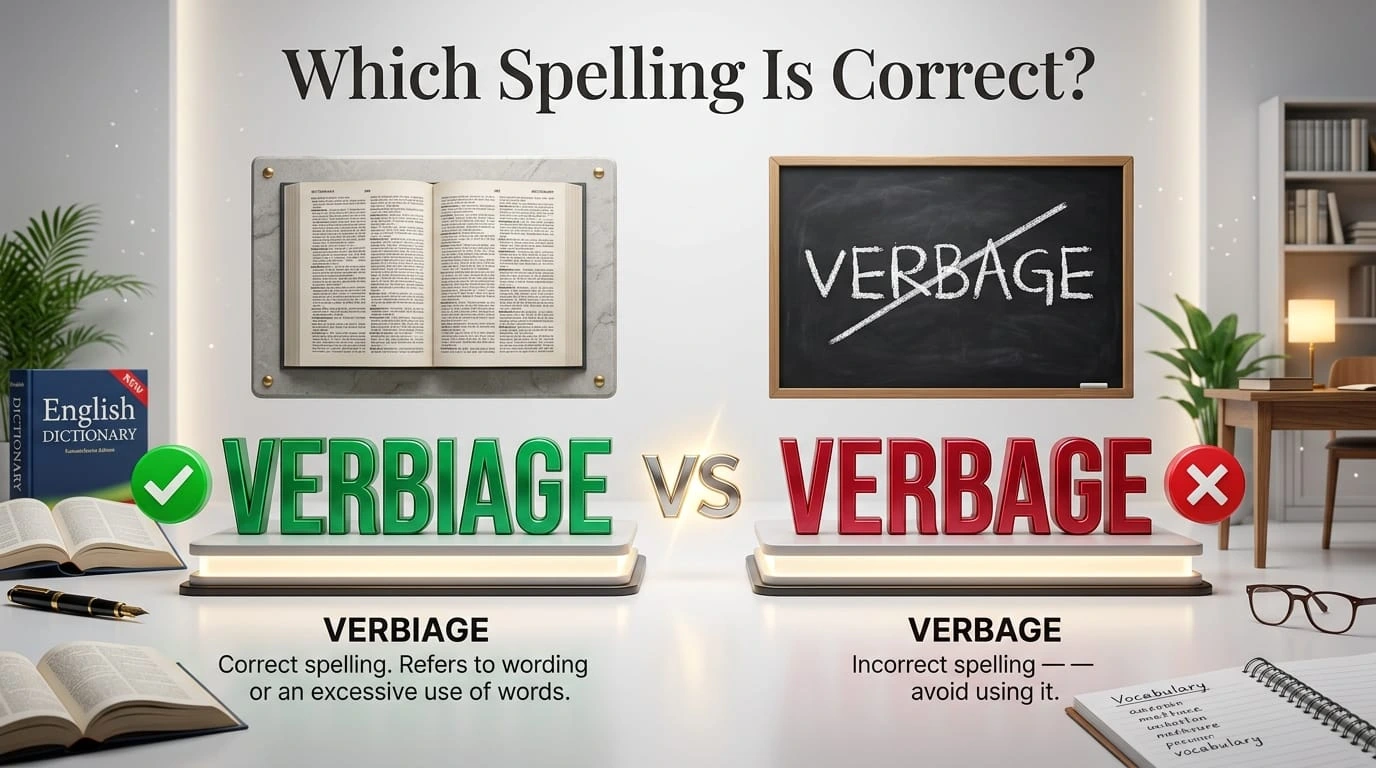
“Verbiage” means the specific wording or phrasing used in a document, or overly wordy language. “Verbage” is a common misspelling and isn’t a real word in standard English.
I once emailed a client asking them to “update the verbage on the homepage.” They replied asking what I meant, since they’d never seen that word before. I froze, then quickly realized I’d been spelling “verbiage” wrong for years without anyone correcting me.
If you’ve ever typed this word and hesitated, you’re definitely not alone. This is one of the more commonly misspelled business and marketing terms, largely because the correct spelling doesn’t match how most people pronounce it in casual speech.
This guide clears up exactly why “verbiage” is correct, where the confusion comes from, and how to spell it confidently every time, whether you’re writing a marketing brief, a contract, or a quick email.
Verbage or Verbiage: Quick Answer
“Verbiage” is always correct. It refers to the specific wording or phrasing of a text, or sometimes to language that’s excessively wordy.
- ✅ Please review the verbiage on the landing page before we launch.
- ❌ Please review the verbage on the landing page before we launch.
The confusion happens because many people pronounce this word quickly, dropping the middle syllable, which makes “verbage” sound like a reasonable spelling even though it isn’t one.
The Origin of Verbiage
“Verbiage” comes from French verbiage, itself derived from verbe, meaning “word” or “verb,” rooted in Latin verbum. The word originally carried a slightly negative connotation, describing language padded with unnecessary or excessive words, essentially wordiness for its own sake.
Over time, English usage broadened the meaning. Today, “verbiage” commonly refers simply to the specific wording or text used in a document, without necessarily implying anything negative, such as “legal verbiage” or “marketing verbiage.”
“Verbage,” on the other hand, has no legitimate etymology. It’s not a shortened or alternate historical form, it’s simply a mispronunciation that made its way into casual writing. Because the middle syllable in “verbiage” often gets swallowed in fast speech, many writers never actually hear the full word clearly enough to spell it correctly.
Verbiage Explained: Key Differences and Variations
| Word | Correct Spelling | Meaning | Example |
|---|---|---|---|
| Verbiage | Verbiage | Specific wording, or excessive wordiness | The contract’s verbiage was hard to follow. |
| Verbose | Verbose | Using more words than necessary | His verbose explanation lost the audience. |
| Wording | Wording | General word choice or phrasing | We need to adjust the wording slightly. |
| Verbage | Not a real word | Common misspelling of “verbiage” | Incorrect in any context. |
Notice that “verbiage” shares a root with “verbose,” both tracing back to the same Latin word for “word,” which helps explain why “verbiage” can carry a slightly negative, wordy connotation in certain contexts.
Which Spelling Should You Use?
For business and marketing writing
Always use verbiage. It’s the standard, professional term for referring to specific text or wording in documents, ads, or web pages.
For legal or contract writing
Use verbiage confidently, it’s commonly used to describe the exact wording of clauses or agreements.
For casual or conversational writing
Stick with verbiage as well, since “verbage” isn’t accepted in any register, formal or informal.
For global or neutral use
Verbiage is standard across American, British, Australian, and all other English dialects. There’s no regional variation here.
Common Mistakes with Verbiage
Mistake 1: Writing “verbage” instead of “verbiage”
✅ The verbiage in the proposal needs a final review.
❌ The verbage in the proposal needs a final review.
Why it happens: The middle syllable often disappears in fast speech, leading writers to spell the word the way they hear it.
Mistake 2: Assuming “verbiage” always has a negative meaning
✅ Please update the verbiage on the pricing page. (neutral, simply means “wording”)
❌ Assuming every use of “verbiage” implies the text is too wordy.
Why it happens: The word’s older meaning focused on excessive wordiness, but modern usage often uses it neutrally.
Mistake 3: Confusing “verbiage” with “verbose”
✅ The document’s verbiage was clear and concise. (verbiage = wording)
❌ The document’s verbose was clear and concise. (verbose is an adjective, not a noun)
Why it happens: Both words share the same root and sound similar, leading writers to mix up their grammatical roles.
Mistake 4: Using “verbage” in professional documents
✅ Legal verbiage must be reviewed by counsel before publishing.
❌ Legal verbage must be reviewed by counsel before publishing.
Why it happens: Business jargon often gets passed along verbally between colleagues, spreading the misspelling before anyone checks a dictionary.
Mistake 5: Assuming spellcheck will always catch it
✅ Proofread carefully, since “verbage” sometimes slips past casual spellcheck settings.
❌ Relying only on autocorrect to flag the error.
Why it happens: Depending on the platform, some spellcheck tools don’t consistently catch this specific mistake.
Tomatoes or Tomatos: The Correct Spelling (2026)
Verbiage in Real-World Examples
Professional email:
“Can you review the verbiage in section three before we send this to the client?”
News headline:
“Company Faces Backlash Over Confusing Verbiage in Privacy Policy”
Social media post:
“Spent all morning tweaking the verbiage on our new landing page. 📝”
Formal document:
“The updated verbiage clarifies the terms of service for all new users.”
In every case, verbiage is the only correct spelling, regardless of tone or formality.
Verbiage: Data, Trends & Usage
Search interest in “verbage vs verbiage” is steady, driven largely by marketers, copywriters, and business professionals confirming spelling before finalizing documents, websites, or contracts. This falls into the informational search category, with people wanting a fast, reliable answer before hitting publish or send.
This mistake appears frequently in corporate and marketing environments, where the word gets used constantly in meetings and emails, often spoken aloud before it’s ever written down. Because the word is heard far more often than it’s read, the mispronunciation-driven misspelling continues to spread through casual business communication.
Verbage vs Verbiage: Comparison Table
| Term/Variant | Meaning | Region/Context | Best Used When |
|---|---|---|---|
| Verbiage | Specific wording, or excessive wordiness | Universal, all English dialects | Always, in any writing context |
| Verbage | Misspelling, not a real word | None, incorrect everywhere | Never, avoid entirely |
| Wording | General term for word choice | Universal | Casual alternative to “verbiage” |
Frequently Asked Questions
Q: What does “verbiage” mean?
A: “Verbiage” refers to the specific wording or phrasing used in a piece of writing, or sometimes to language that’s excessively wordy or padded.
Q: How do you use “verbiage” correctly in a sentence?
A: Use “verbiage” to refer to the actual text or wording in a document, such as “We need to simplify the verbiage in this email.”
Q: Verbiage vs verbage, what’s the difference?
A: There’s no real difference in meaning, since “verbage” isn’t a correct word at all. “Verbiage” is the only accepted spelling.
Q: Is “verbiage” acceptable in formal writing?
A: Yes, completely. “Verbiage” is standard in legal, business, marketing, and academic writing whenever referring to specific wording.
Q: Which version is correct, verbage or verbiage?
A: “Verbiage” is correct. “Verbage” is a spelling error that doesn’t appear in any English dictionary.
Q: Where does the word “verbiage” come from?
A: It comes from French verbiage, derived from verbe meaning “word,” rooted in Latin verbum. It originally described excessively wordy language.
Q: Can “verbiage” be used in casual conversation and texting?
A: Yes. The spelling never changes based on tone, it’s “verbiage” whether you’re texting a colleague or writing a formal contract.
Final Takeaway
Here’s the short version. “Verbiage” is always correct. “Verbage” is always wrong.
Key points to remember:
- The rule: “Verbiage” comes from French and Latin roots meaning “word,” it isn’t a shortened form of anything
- Watch pronunciation: The middle syllable often disappears in speech, which drives the misspelling
- Two meanings: “Verbiage” can mean neutral wording, or excessively wordy language, depending on context
- No exceptions: “Verbiage” is standard in every English dialect, formal or casual
Once you connect “verbiage” to its French and Latin roots, you’ll never write “verbage” again.
Verbiage vs verbage explained, correct spelling, meaning, and examples. Learn the simple rule and avoid this common mistake.
Blonde or Blond: The Correct Spelling (2026)

I’m a language enthusiast and content writer. I’m specialized in English grammar, spelling differences, vocabulary explanations, and word comparisons. My goal is to help readers improve their writing skills through clear, accurate, and easy-to-understand language guides.