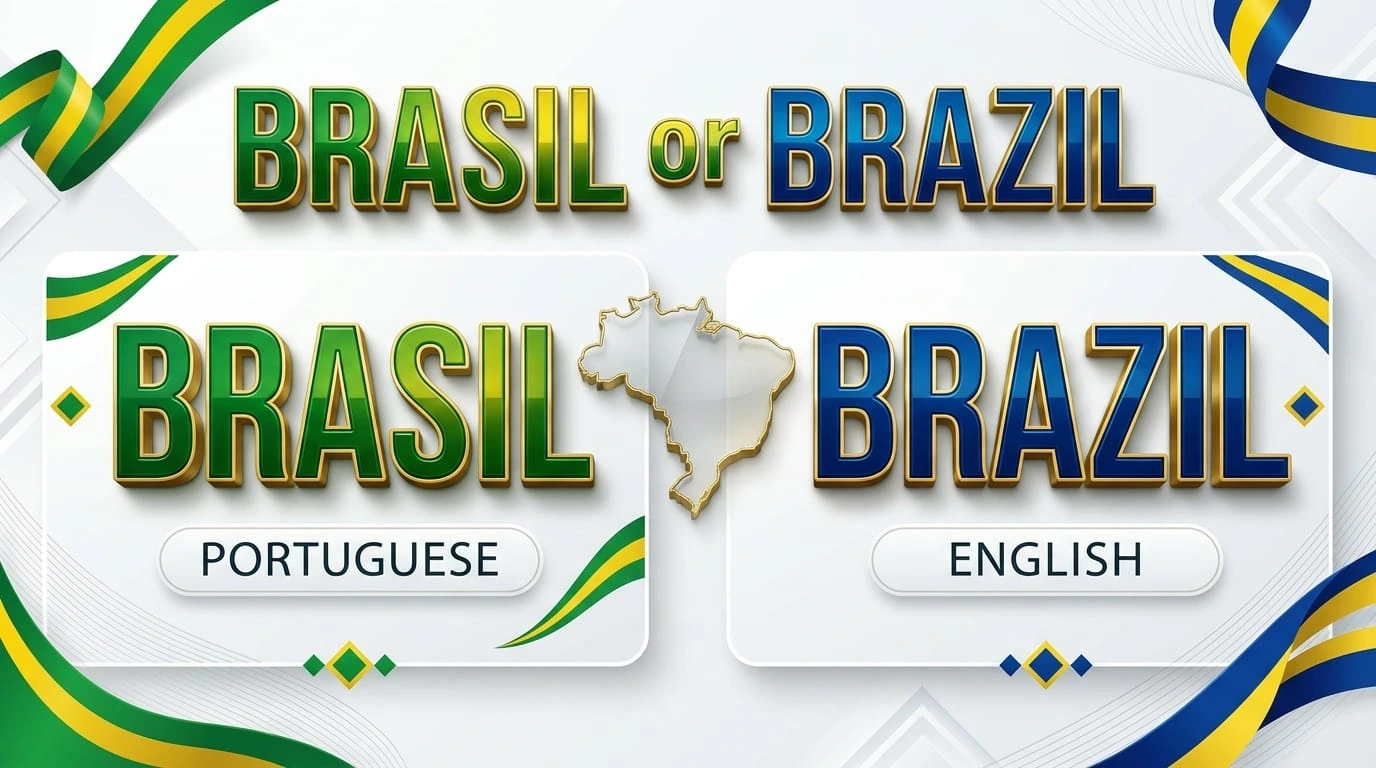
Brazil is the correct English spelling of the South American country’s name. Brasil is the Portuguese spelling used in Brazil and in other Portuguese-language contexts.
Brasil or Brazil: Quick Answer
If you are writing in English, use Brazil. If you are writing in Portuguese, use Brasil.
Both spellings refer to the same country. The difference comes from the language, not from the place itself.
Examples:
- Correct in English: I want to visit Brazil next summer.
- Correct in Portuguese: Eu quero visitar o Brasil. (I want to visit Brazil.)
The simple rule is easy to remember: Brazil in English, Brasil in Portuguese.
The Origin and Background of Brasil or Brazil
Have you ever seen a football shirt, travel post, or country flag labeled “Brasil” and wondered if “Brazil” was spelled wrong? You are not alone.
The two spellings often appear online because Brazil has a strong international presence. People see the Portuguese name on sports kits, official materials, and local websites. English-language articles usually use “Brazil” instead.
As an English writer, I would use the language of the text as my guide. When explaining country names to learners, the key is to show that a different spelling does not always mean a mistake. Sometimes, it is simply the name used in another language.
The English name Brazil developed from the country’s Portuguese name, Brasil. The name is linked to pau-brasil, a tree whose reddish wood was valuable in early trade. The tree’s name is commonly associated with the Portuguese word brasa, meaning “ember” or “glowing coal.”
Over time, the country became known as Brasil in Portuguese and Brazil in English. Today, both forms remain correct in their own language settings.
Brasil or Brazil Explained: Key Differences
The main difference between Brasil and Brazil is the language in which you are writing. They do not name two different countries.
Here is a simple comparison.
| Term | Meaning | When to Use | Region/Context |
| Brazil | The name of the country in English | English articles, schoolwork, and reports | English-language contexts |
| Brasil | The name of the country in Portuguese | Portuguese writing and local materials | Brazil and Portuguese-language contexts |
| Brazilian | A person or thing from Brazil | When describing people, culture, or products in English | English |
| brasileiro / brasileira | Portuguese words for Brazilian | When writing in Portuguese | Portuguese |
1. What Does Brazil Mean?
Brazil is the standard English name for the country in South America. It is the correct choice for English writing.
Examples:
- Brazil is famous for its Amazon rainforest.
- My friend is traveling to Brazil.
- The Brazilian football team has fans around the world.
Use “Brazil” in English essays, emails, news reports, and travel guides.
2. What Does Brasil Mean?
Brasil is the Portuguese name for the same country. Portuguese is the official language of Brazil.
Examples:
- Brasil é um país da América do Sul. — Brazil is a country in South America.
- Eu moro no Brasil. — I live in Brazil.
- Brasil, meu país. — Brazil, my country.
You may also see “Brasil” on football shirts, flags, websites, and products made for Portuguese-speaking audiences.
3. Why Do Both Spellings Exist?
Languages often have their own forms of country names. For example, English uses “Germany,” while German uses “Deutschland.” The country is the same, but the names differ by language.
The same idea applies here:
- English: Brazil
- Portuguese: Brasil
Neither spelling is universally wrong. The correct choice depends on your audience and the language of your text.
Which Version Should You Use?
Choose the spelling that matches the language you are using.
- For English students: Use Brazil in essays, exams, and assignments written in English.
- For English writers and bloggers: Use Brazil in articles, travel guides, and news content for English-speaking readers.
- For Portuguese speakers: Use Brasil in Portuguese sentences and documents.
- For international audiences: Use “Brazil” in English text, but keep “Brasil” when it is part of an official name, brand, quote, or Portuguese text.
For example, an English article might say, “Brazil is known for Carnival.” A Portuguese article would use “O Brasil é conhecido pelo Carnaval.”
Best rule: Do not switch between “Brasil” and “Brazil” without a reason. Keep your spelling consistent with the language of your text.
Common Mistakes with Brasil or Brazil
These are common errors to avoid.
Mistake 1: Using Brasil in an English Essay
Incorrect: Brasil is the largest country in South America.
Correct: Brazil is the largest country in South America.
Why it happens: Students may see “Brasil” on football shirts or online and assume it is the standard English form.
Mistake 2: Calling Brasil a Different Country
Incorrect: Brasil and Brazil are two different countries.
Correct: Brasil and Brazil are two names for the same country in different languages.
Why it happens: The spelling difference can make the words look like separate place names.
Mistake 3: Using Brazil in a Portuguese Sentence
Incorrect: Eu moro no Brazil.
Correct: Eu moro no Brasil.
Why it happens: English speakers may carry their usual spelling into Portuguese writing.
Mistake 4: Changing the Spelling in a Direct Quote
If someone writes “Brasil” in a Portuguese quote, do not change it to “Brazil” just to match English spelling. Keep the original wording when quoting accurately.
Mistake 5: Confusing Brazil with Brazilian
“Brazil” names the country. “Brazilian” describes a person or thing connected to the country.
- Correct: She lives in Brazil.
- Correct: She is a Brazilian artist.
- Incorrect: She lives in Brazilian.
Brasil or Brazil in Real-World Examples
Seeing the words in everyday writing can help you remember which form to use.
1. In a Professional Email
Subject: Travel Plans for Brazil
“Hello Alex,
I am planning a business trip to Brazil next month. Could you please share the latest travel details?
Thank you.”
The email is in English, so “Brazil” is the correct choice.
2. In a News Headline
Brazil Announces New Plans to Protect the Amazon
An English-language news headline uses “Brazil” because it follows English spelling conventions.
3. In a Social Media Post
“Dreaming of sunny beaches and a trip to Brazil! 🇧🇷”
This is correct for an English-language post.
A Portuguese-language post could use:
“Quero conhecer o Brasil! 🇧🇷”
This means, “I want to visit Brazil!”
4. In a Formal Report
“Brazil is the largest country in South America by land area and population.”
Use “Brazil” in an English school report, business document, or research paper.
5. On a Football Shirt
You may see BRASIL printed on a football shirt or other sports item.
That spelling reflects the Portuguese name. It is not a mistake simply because English uses “Brazil.”
Brasil or Brazil: Data, Trends and Usage
People may search for “Brasil or Brazil” when they see both forms online. The question often comes up in language learning, travel planning, sports, and schoolwork.
The search intent is mainly informational. Readers want to know which spelling is correct and whether the words have different meanings.
Here are the main contexts where the distinction matters:
- Education: Students need the correct English spelling for assignments and exams.
- Travel: Travelers may encounter “Brasil” on local signs, websites, and official materials.
- Sports: Football fans often see “Brasil” on team shirts and Portuguese-language content.
- Writing and editing: Writers need to keep spelling consistent with their chosen language.
- Translation: Translators must use the form that fits the target language while preserving official names and quotations when needed.
Without reliable keyword-volume data, it would be misleading to claim an exact number of monthly searches for this phrase. However, the question has a clear practical purpose: helping people choose the correct spelling for their writing.
Knowing the difference is useful because a word can be correct in one language and unsuitable in another. The same principle applies to many country names and everyday words.
Brasil vs. Brazil: A Quick Comparison Table
| Term/Variant | Meaning | Region/Context | Best Used When |
| Brazil | English name of the country | English-language writing | Writing in English |
| Brasil | Portuguese name of the country | Portuguese-language writing | Writing in Portuguese |
| Brazilian | Relating to Brazil or its people | English | Describing people, culture, food, or products |
| brasileiro | Portuguese masculine form for Brazilian | Portuguese | Describing a man or using the masculine form |
| brasileira | Portuguese feminine form for Brazilian | Portuguese | Describing a woman or using the feminine form |
Remember that “Brazilian,” “brasileiro,” and “brasileira” are related terms, but they are not alternative spellings of the country’s name.
Frequently Asked Questions
Q1: Is Brasil or Brazil correct?
Both are correct, but they belong to different languages. Brazil is the standard English spelling, while Brasil is the Portuguese spelling.
Q2: Why do Brazilians spell Brazil as Brasil?
Portuguese uses “Brasil” as the country’s name. Brazilians generally use Portuguese in their country’s official and everyday language settings, so “Brasil” is the natural form there.
Q3: Is Brasil a misspelling of Brazil?
No. “Brasil” is not a misspelling when used in Portuguese. It is only the wrong choice when you need the standard English name in ordinary English writing.
Q4: Should I write Brasil or Brazil in a school essay?
Use Brazil if your essay is written in English. Use “Brasil” if you are writing in Portuguese. Always follow your teacher’s language and spelling requirements.
Q5: What is the difference between Brazil and Brazilian?
“Brazil” is the name of the country. “Brazilian” is an adjective or noun used for people and things connected with that country.
Examples:
- Brazil has many beautiful beaches.
- She is a Brazilian student.
- Brazilian music is popular around the world.
Q6: Where does the name Brazil come from?
The name is linked to pau-brasil, a tree valued for its reddish wood. Its name is commonly associated with the Portuguese word brasa, meaning an ember or glowing coal.
Q7: Can I use Brasil in an English article?
Yes, when there is a specific reason, such as quoting Portuguese text, reproducing a brand name, or referring to a title that uses “Brasil.” In ordinary English sentences, use “Brazil.”
Q8: Is Brasil the official name of the country?
“Brasil” is the Portuguese form of the country’s name. Its full official name in Portuguese is República Federativa do Brasil, which translates into English as “Federative Republic of Brazil.”
Conclusion: Brasil or Brazil?
The difference between Brasil and Brazil is simple once you know which language you are using.
- Brazil is the correct spelling in standard English.
- Brasil is the correct spelling in Portuguese.
- Both names refer to the same South American country.
- “Brazilian” is the English word for a person or thing connected with Brazil.
If you are writing an English essay, blog post, email, news story, or school assignment, choose Brazil. If you are writing in Portuguese, choose Brasil.
You do not need to worry when you see the other form on a football shirt or a local website. It is usually a sign of a different language, not a spelling error.
Now you know exactly when to use Brasil or Brazil. Bookmark this guide or share it with someone who has been confused by the two spellings.
Lite or Light: Easy Spelling Rules and Examples

I’m a language enthusiast and content writer. I’m specialized in English grammar, spelling differences, vocabulary explanations, and word comparisons. My goal is to help readers improve their writing skills through clear, accurate, and easy-to-understand language guides.