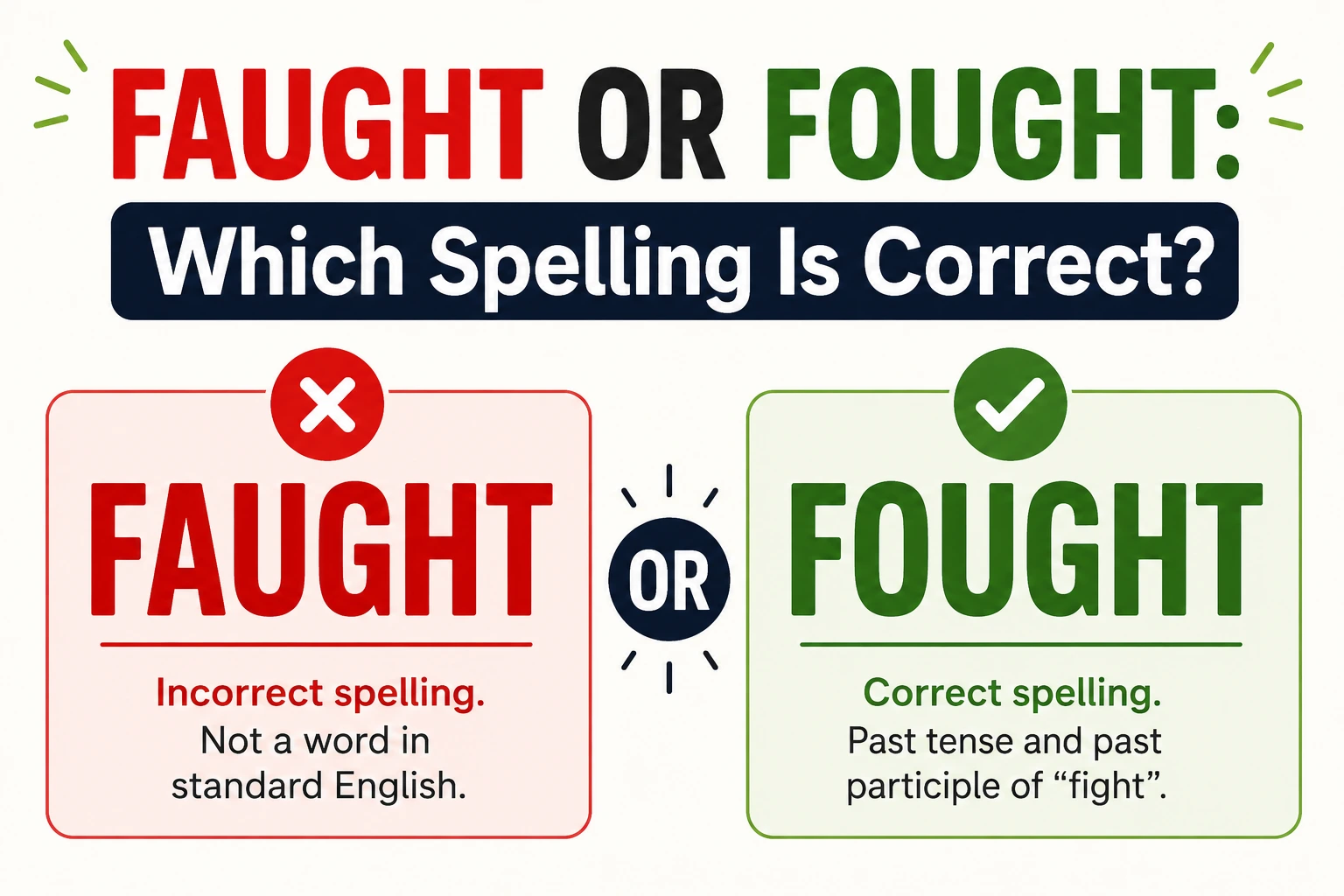
Faught is a misspelling. Fought is the correct past tense and past participle of fight, meaning to argue, struggle, or take part in a physical battle.
Have you ever typed “faught” and then stopped to wonder if it looked right? You are not alone. This is one of those spelling mistakes that feels natural because English has many verbs that change their vowel sounds in the past tense.
As an English writer, I have seen this mistake often in student work and everyday writing. The problem is easy to understand. We say fight like “fite,” but its past form sounds like “fawt.” That sound can make faught seem like a logical spelling.
But English does not always spell a word the way it sounds.
The correct word is fought. It is the past tense and past participle of fight. You can use it when talking about a battle, an argument, a struggle, or an effort to achieve something.
In this guide, you will learn why fought is correct, why faught is wrong, how to use fought in a sentence, and how to remember the spelling without second-guessing yourself.
Faught or Fought: Quick Answer
Fought is the correct spelling. Faught is not a standard English word.
Fight → Fought
The word fought is used when an action happened in the past.
Examples
- She fought for her rights.
- They fought over the last piece of cake.
- He fought in the war.
- We fought hard to win the match.
So, if you are choosing between faught or fought, always choose fought in standard English.
Correct: She fought bravely.
Incorrect: She faught bravely.
The Origin and Background of Fought

The word fought comes from the verb fight.
The history of fight goes back to Old English feohtan, which meant to fight or contend. Over time, English changed the spelling and sound of the word.
The past form also changed.
Today, we have:
Fight → Fought
This is an example of an irregular verb. An irregular verb does not form its past tense by simply adding -ed.
For example:
- walk → walked
- play → played
- jump → jumped
But:
- fight → fought
- buy → bought
- teach → taught
- think → thought
This pattern helps explain why fought looks different from fight.
The spelling faught may seem reasonable because the sound of fought can make you expect an au spelling. English has words such as caught, taught, and daughter, which use au.
However, fight does not change to faught.
It changes to fought.
Faught or Fought Explained: What Is the Difference?
There is a very simple difference.
| Term | Meaning | When to Use | Region/Context |
|---|---|---|---|
| Fought | Past tense of fight | For a past struggle, battle, argument, or effort | Standard English |
| Faught | Misspelling of fought | Do not use in standard writing | Nonstandard/misspelled |
What does fought mean?
Fought can have several meanings.
Physcial Fit:
The soldiers fought bravely.
An argument:
The two brothers fought about the game.
It can describe a struggle:
She fought against the disease.
It can also describe an effort to achieve something:
He fought for a better future.
The meaning changes with the context, but the spelling stays the same.
What about faught?
Faught is simply an incorrect spelling of fought.
You may see it in informal posts, messages, comments, or learner writing. That does not make it a correct standard spelling.
For school, work, exams, articles, and formal documents, use fought.
Why Do People Spell Fought as Faught?
The mistake usually comes from pronunciation.
The word fought is pronounced roughly like “fawt.” Because of that sound, some people spell it as faught.
There is another reason, too.
English contains many words with au:
- caught
- taught
- daughter
- author
- autumn
So faught may look familiar.
But spelling cannot always be predicted from pronunciation.
Consider these pairs:
- buy → bought
- bring → brought
- think → thought
- fight → fought
The spelling must be learned as part of the verb.
A useful trick is to remember the family:
fight → fought → fought
The first form is the present form. The second and third forms are the same.
Which Version Should You Use?
The answer is easy: use fought.
For students
Use fought in essays, assignments, tests, and exams.
The two armies fought for control of the city.
For professional writers
Use fought in reports, articles, emails, and other professional content.
The company fought to protect its brand.
For everyday communication
Use fought in texts, social media posts, and conversations when describing a past event.
We fought yesterday, but everything is fine now.
For global or neutral English
Fought is the safest choice. It is the standard spelling in both British and American English.
There is no normal British-versus-American spelling difference here.
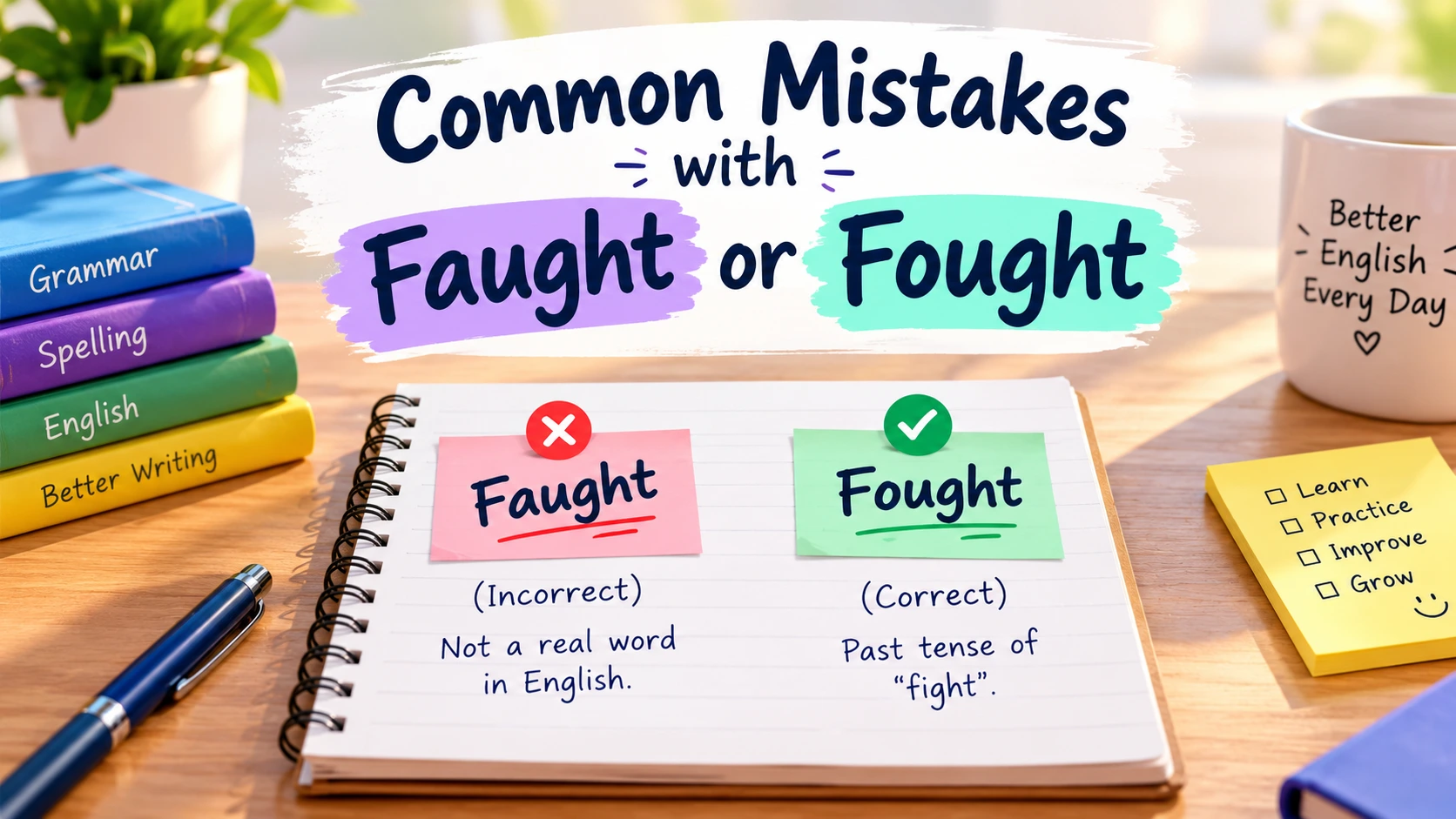
Common Mistakes with Faught or Fought
Here are some mistakes you should avoid.
1. Writing faught instead of fought
❌ They faught all night.
✅ They fought all night.
Why does this happen?
The pronunciation can make faught look correct.
2. Using fight for a past event
❌ Yesterday, they fight over money.
✅ Yesterday, they fought over money.
Why?
The action happened yesterday, so you need the past tense.
3. Adding -ed to fight
❌ He fighted hard.
✅ He fought hard.
Why?
Fight is an irregular verb. You cannot make its past tense by adding -ed.
4. Confusing fought with thought
❌ They thought in the battle.
✅ They fought in the battle.
Why?
The two words look similar, but they have different meanings.
- Fought = took part in a fight or struggle
- Thought = used the mind to consider something
5. Confusing fought with caught
❌ She caught for her freedom.
✅ She fought for her freedom.
Why?
Both words have similar sounds, but they are completely different verbs.
Fought in Real-World Examples
Learning a spelling rule is useful. Seeing the word in real situations is even better.
1. Professional Email
The team fought hard to meet the project deadline, and we are pleased with the final result.
Here, fought means made a strong effort.
2. News Headline
Local Team Fought Until the Final Minute
Here, fought describes a strong effort during a competition.
3. Social Media Post
We fought through every setback and finally reached our goal!
In this example, fought is used in a motivational way. It does not mean a physical fight.
4. Formal Report
The organization fought for equal access to education for many years.
Here, fought means worked strongly for a cause.
5. Everyday Conversation
I fought with my brother yesterday, but we made up later.
Here, fought describes an argument or disagreement.
Fought Can Describe More Than Physical Fighting
One common mistake is thinking that fought always means someone used physical force.
It does not.
The word can describe many types of struggle.
Physical conflict
The soldiers fought bravely.
An argument
The couple fought about money.
A competition
Our team fought hard to win.
A personal struggle
She fought to overcome her fears.
A social cause
They fought for equal rights.
An effort
He fought to keep the business alive.
This wider meaning is why fought appears in news stories, sports writing, personal stories, and formal documents.
Faught or Fought: Comparison Table
| Term/Variant | Meaning | Region/Context | Best Used When |
|---|---|---|---|
| Fought | Past tense of fight | Standard English | Talking about a past fight or struggle |
| Faught | Misspelling | Nonstandard writing | Never use in formal or standard English |
| Fight | Present/base form | Standard English | Talking about the present or general action |
| Fighting | -ing form of fight | Standard English | Describing an ongoing action |
The key pattern is:
Fight → Fought → Fought
For example:
I fight for what I believe in.
I fought for what I believed in.
I have fought for what I believe in.
Notice that the past tense and past participle are both fought.
Fought: Data, Trends & Usage
The search intent behind “faught or fought” is mainly informational. People usually search this phrase because they are unsure about the correct spelling.
The confusion is understandable. Faught looks like it could be a real word because English has many words containing au.
However, standard dictionaries and normal English usage recognize fought as the past tense and past participle of fight.
This makes the search especially useful for:
- Students checking homework
- English learners
- Writers proofreading their work
- People checking a text before sending it
- Anyone unsure about irregular verbs
The spelling issue also connects to a larger English-learning problem: English spelling often does not match pronunciation perfectly.
That is why memorizing common irregular verb forms can save time.
A small group of words can cause many mistakes:
- fight → fought
- buy → bought
- bring → brought
- teach → taught
- think → thought
Learning these as word pairs makes them much easier to remember.
A Simple Memory Trick for Fought
Still struggling to remember fought?
Use this pattern:
Think: fight has “ought” in the past
fight → fought
You can also connect it with these familiar forms:
- buy → bought
- bring → brought
- think → thought
- fight → fought
The important part is the “ought” pattern.
When you hear the sound “fawt,” do not automatically write faught.
Stop and remember:
FIGHT changes to FOUGHT.
That one sentence can prevent the mistake.
Fought vs Fight: A Quick Grammar Check
Knowing the spelling is only half the job. You also need the right form.
Present tense: fight
They fight every weekend.
This talks about a regular or current action.
Past tense: fought
They fought last weekend.
This talks about an action that already happened.
Past participle: fought
They have fought many times.
The word fought is also used after helping verbs such as have, has, and had.
Examples:
- I have fought for this.
- She has fought many battles.
- They had fought before.
So fought has two important grammar roles:
Past tense:
She fought yesterday.
Past participle:
She has fought before.
Frequently Asked Questions About Faught or Fought
Q: Is faught a correct word?
A: No. Faught is a misspelling of fought. In standard English, always use fought as the past tense and past participle of fight.
Q: Is fought the past tense of fight?
A: Yes. Fought is the simple past form of fight. For example, “They fought yesterday” is correct.
Q: What is the difference between faught and fought?
A: Fought is the correct spelling. Faught is an incorrect spelling caused mainly by the pronunciation of fought.
Q: Is fought acceptable in formal writing?
A: Yes. Fought is a standard English word and is completely appropriate in formal writing. You can use it in essays, reports, emails, and professional documents.
Q: Why is fought spelled with “ough”?
A: Fought comes from the older forms of the verb fight. English spelling developed over time, so its modern spelling does not match its pronunciation perfectly.
Q: How do you spell the past tense of fight?
A: The correct spelling is fought. The basic pattern is fight → fought → fought.
Q: Can fought describe an argument?
A: Yes. Fought can describe a physical conflict, an argument, a competition, or a broader struggle. For example, “The sisters fought about money” is correct.
Final Verdict
When you are choosing between faught or fought, there is no need to hesitate.
Fought is correct. Faught is incorrect.
The word fought is the past tense and past participle of fight. It can describe a physical battle, an argument, a competition, a personal struggle, or an effort to achieve something.
The easiest form to remember is:
Fight → Fought → Fought
Do not let the pronunciation trick you. Although fought sounds like it could be spelled faught, that spelling is not standard English.
If you are writing an email, essay, report, social media post, or school assignment, choose fought.
Once you remember the pattern, this spelling becomes much easier. Fight today, fought yesterday, and fought after have or has.
Attorneys or Attornies: What's The Difference?

I am a professional content writer with a strong interest in English spelling and vocabulary. I am interested in creating informative guides on commonly confused words, spelling differences, and language usage to help readers write more accurately and effectively.