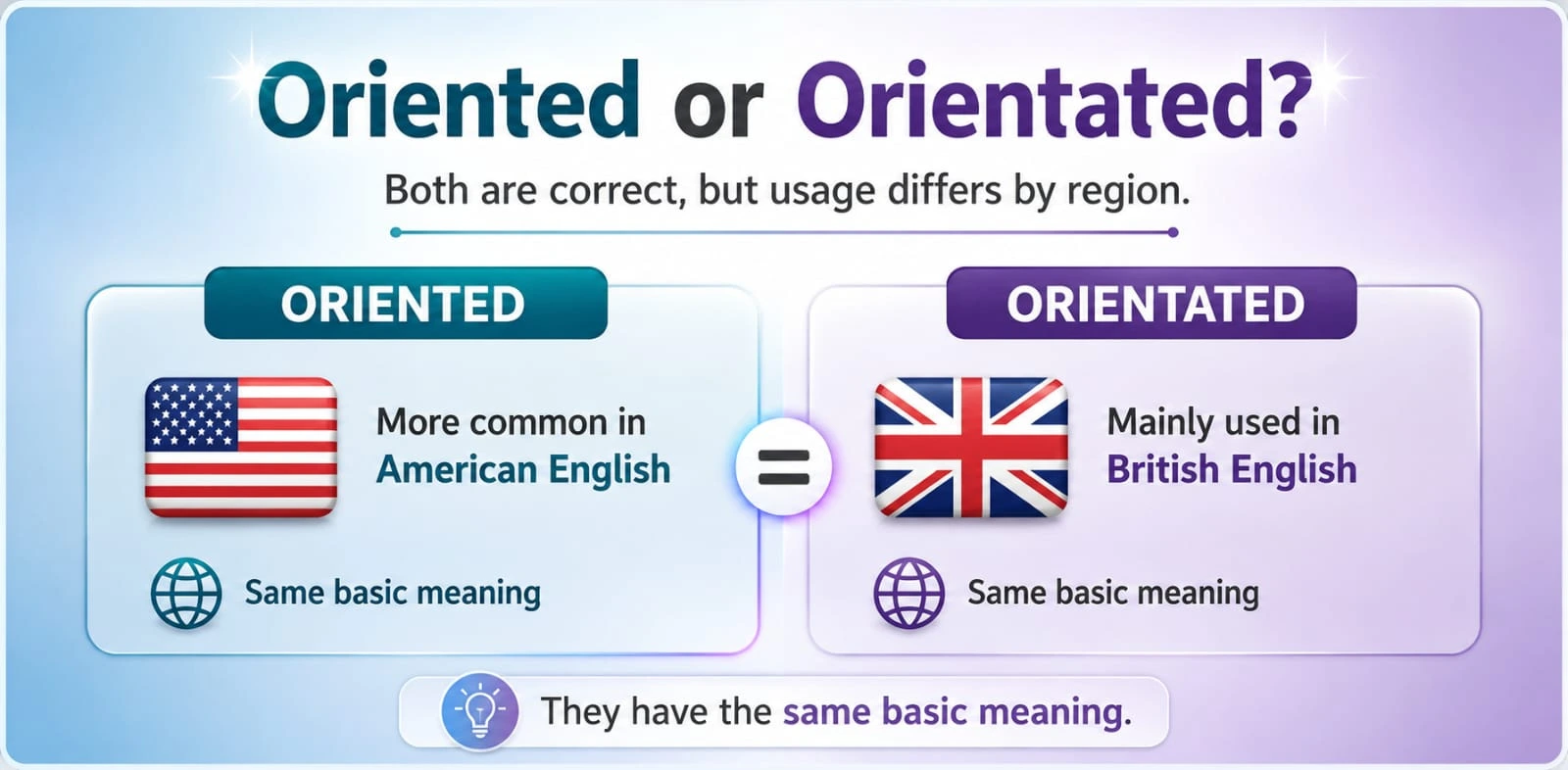
Oriented and orientated are both correct, but oriented is more common in American English, while orientated is mainly used in British English. They have the same basic meaning.
Have you ever written “customer oriented” and then wondered whether it should be “customer orientated”? You are not alone. This small spelling difference can make even confident English writers stop and check a dictionary.
The good news is simple: neither word is wrong. Both oriented and orientated are real English words. The main difference is regional usage.
Cambridge Dictionary lists oriented as mainly American and orientated as mainly British. Merriam-Webster also identifies orientated as chiefly British.
You may see both forms in workplaces, schools, reports, websites, and everyday writing. The choice often depends on the variety of English you are using.
In this guide, you will learn exactly what oriented and orientated mean, where they come from, how they differ by region, and which one you should use. You will also see simple examples that make the choice much easier.
Oriented or Orientated: Quick Answer
Oriented or orientated have the same basic meaning: directed toward something, focused on something, or familiar with a situation or place.
For example:
- The company is customer-oriented.
- The course is career-oriented.
- The program is career-orientated.
- The new employees became oriented with their duties.
- The new employees became orientated with their duties.
The first forms are more common in American English. The second forms are more common in British English. Cambridge specifically describes oriented as mainly US and orientated as mainly UK.
So, if you write for an American audience, oriented is usually the safest choice. For British English, orientated is perfectly acceptable.
Meaning of Oriented and Orientated
Oriented Meaning
Oriented means directed toward a particular person, place, purpose, or goal.
Example:
- The course is oriented toward beginners.
Orientated Definition
Orientated means directed or adjusted toward a particular person, purpose, or situation. It has the same basic meaning as oriented.
Example:
- The training is orientated toward new employees.
The Origin and Background of Oriented and Orientated
Both words are connected to the verb orient.
The word orient originally had a connection with the east. The east was linked with the rising sun, so the word developed ideas of direction and position.
Over time, orient became a verb meaning to determine a position or direction. It also developed a broader meaning: to help someone understand where they are, what they are doing, or what they should focus on.
The noun orientation later became common. It can refer to the process of becoming familiar with something or the direction of a person, object, or idea. Merriam-Webster dates the first known use of orientation to 1839.
Then we get the two forms:
- orient + -ed = oriented
- orientate + -ed = orientated
Orientated developed from the verb orientate, which is itself related to orient.
This explains why both forms exist. They are not two words with completely different meanings. They are alternative forms that developed within English.
Oriented vs Orientated: Key Differences
The biggest difference is regional preference, not meaning.
| Term | Meaning | When to Use | Region/Context |
|---|---|---|---|
| Oriented | Directed toward or focused on something | General and formal writing | Mainly American English |
| Orientated | Directed toward or focused on something | General and formal writing | Mainly British English |
| Customer-oriented | Focused on customers | Business writing | Common internationally |
| Customer-orientated | Focused on customers | Business writing | Especially British English |
| Goal-oriented | Focused on goals | Professional and academic writing | Very common internationally |
| Goal-orientated | Focused on goals | Professional and academic writing | Mainly British English |
Cambridge gives examples such as profit-oriented and notes that the British form is profit-orientated.
What Does Oriented Mean?
Oriented can mean directed toward something or focused on a particular goal.
Examples:
- She is career-oriented.
- The business is customer-oriented.
- This program is research-oriented.
- The school offers student-oriented services.
It can also describe someone who has gained an understanding of a new situation.
For example:
I felt oriented after the first week at my new job.
Here, oriented means that the person became familiar with the new environment.
What Does Orientated Mean?
Orientated has the same basic meanings.
Examples:
- The company is customer-orientated.
- The course is career-orientated.
- The project is research-orientated.
- The organization is community-orientated.
The main difference is that orientated is especially associated with British English. Merriam-Webster calls it “chiefly British,” while Cambridge labels it “mainly UK.”
Which Version Should You Use?
The easiest rule is to match your audience.
For American English
Use oriented.
Examples:
- customer-oriented
- detail-oriented
- goal-oriented
- results-oriented
- service-oriented
This is the natural choice for most American business, academic, and general writing.
For British English
You can use orientated.
Examples:
- customer-orientated
- detail-orientated
- goal-orientated
- results-orientated
- service-orientated
British English also uses oriented, so you do not need to treat it as an error. However, orientated is a recognized British form.
For Global or Neutral English
Oriented is usually the safer choice.
It is widely understood and common in international business and online writing. If you are writing for readers from many countries, oriented can help you avoid unnecessary regional variation.
The key is consistency. If your document follows American English, use oriented throughout. If it follows British English and your style guide prefers orientated, stay with that form.
Common Mistakes with Oriented or Orientated
These words cause a few common problems.
1. Thinking Orientated Is Incorrect
Mistake:
“Orientated” is wrong.
Correction:
“Orientated” is a valid English word, especially in British English.
Cambridge and Merriam-Webster both recognize it.
2. Treating Them as Different in Meaning
Mistake:
Oriented and orientated always have different meanings.
Correction:
They normally have the same basic meaning. The main difference is regional preference.
3. Mixing Styles in One Document
Mistake:
The company is customer-oriented and employee-orientated.
Better:
The company is customer-oriented and employee-oriented.
Or, in a British style:
The company is customer-orientated and employee-orientated.
Using one form throughout makes your writing look more polished.
4. Assuming the Longer Word Is More Formal
Some writers think orientated sounds more formal because it is longer.
That is not true.
Oriented is perfectly suitable for formal writing. In fact, it is common in professional and academic contexts.
5. Confusing Oriented With Orientation
These words are related but have different grammatical jobs.
- Oriented = adjective or past participle
- Orientation = noun
Example:
The training is employee-oriented.
But:
The company provides employee orientation.
Oriented or Orientated in Real-World Examples
The best way to understand this difference is to see how these words work in real situations.
Professional Email
Our new training program is customer-oriented and designed to improve communication skills.
A British writer could use:
Our new training program is customer-orientated and designed to improve communication skills.
Both are correct.
News Headline
New School Program Takes a Student-Oriented Approach
A British publication may instead write:
New School Program Takes a Student-Orientated Approach
The choice depends on the publication’s style.
Social Media Post
We are building a more customer-oriented service that puts your needs first.
This form is especially natural for international business communication.
Formal Report
The study recommends a more community-oriented approach to public services.
In British English, you may also see:
The study recommends a more community-orientated approach to public services.
Both forms communicate the same idea.
Oriented vs Orientated: Standalone Comparison
| Term/Variant | Meaning | Region/Context | Best Used When |
|---|---|---|---|
| Oriented | Directed toward or focused on something | Mainly US; widely used internationally | American English and global writing |
| Orientated | Directed toward or focused on something | Mainly UK | British English |
| -oriented | A suffix showing focus or direction | International | Business, academic, and general writing |
| -orientated | A suffix with the same basic function | Mainly UK | British-style writing |
Cambridge specifically recognizes forms such as profit-oriented and profit-orientated, with the latter marked as mainly British.
Oriented or Orientated: Data, Trends & Usage
This is mainly an informational search. People who search for oriented or orientated usually want to know which spelling is correct and whether the two forms have different meanings.
The usage pattern is clear:
- American English favors oriented.
- British English commonly allows orientated.
- International readers generally understand both.
- Compound forms such as goal-oriented, customer-oriented, and detail-oriented are common in professional English.
Cambridge’s American and British dictionary entries reflect this regional split. Merriam-Webster also describes orientated as chiefly British.
This matters because English is not one fixed system. Regional standards can differ without one form being wrong.
For modern business writing, this distinction is useful. If your readers are international, oriented often gives you the broadest and simplest choice. If you are following a British house style, orientated remains a valid option.
Frequently Asked Questions
Q: What does oriented mean?
A: Oriented means directed toward, focused on, or interested in something. It can also mean familiar with a new situation or environment.
Q: What does orientated mean?
A: Orientated has the same basic meaning as oriented. It is mainly associated with British English.
Q: Is oriented or orientated correct?
A: Both are correct. Use oriented for American English and general international writing, while orientated is common in British English.
Q: Is oriented more common than orientated?
A: Oriented is more widely used across international English, especially in American English. Orientated remains a recognized form, particularly in British English.
Q: Is orientated acceptable in formal writing?
A: Yes. Orientated is acceptable in formal British English. The important point is to follow the spelling style used by your audience, organization, or publication.
Q: What is the difference between oriented and orientated?
A: There is usually no major difference in meaning. The main distinction is regional usage: oriented is mainly American, while orientated is mainly British.
Q: Should I write customer-oriented or customer-orientated?
A: Use customer-oriented in American English and for broad international audiences. Use customer-orientated if you are following a British English style.
Is it oriented or orientated?
Both oriented and orientated are correct. Oriented is more common overall, while orientated is also widely used, especially in British English. The choice usually depends on your preferred variety of English and writing style.
Conclusion
The choice between oriented and orientated is much easier once you know the regional rule.
Oriented is the more common choice in American English. It is also a strong option for international writing. Orientated is mainly used in British English and is fully acceptable there. Major dictionaries recognize both forms.
The two words usually have the same meaning. They can describe something focused on a goal, person, activity, or idea. They can also describe someone who has become familiar with a new situation.
If you are unsure which one to choose, ask yourself one simple question: Who will read this?
Most importantly, do not worry when you see orientated in British writing. It is not a spelling mistake.
Traveller or Traveler: Which Spelling Is Correct?

I specialize in spelling comparisons, confusing word pairs, grammar, and vocabulary development. My content helps readers improve their English, avoid common mistakes, and write with confidence. My goal is to provide accurate, reliable, and easy-to-understand language resources