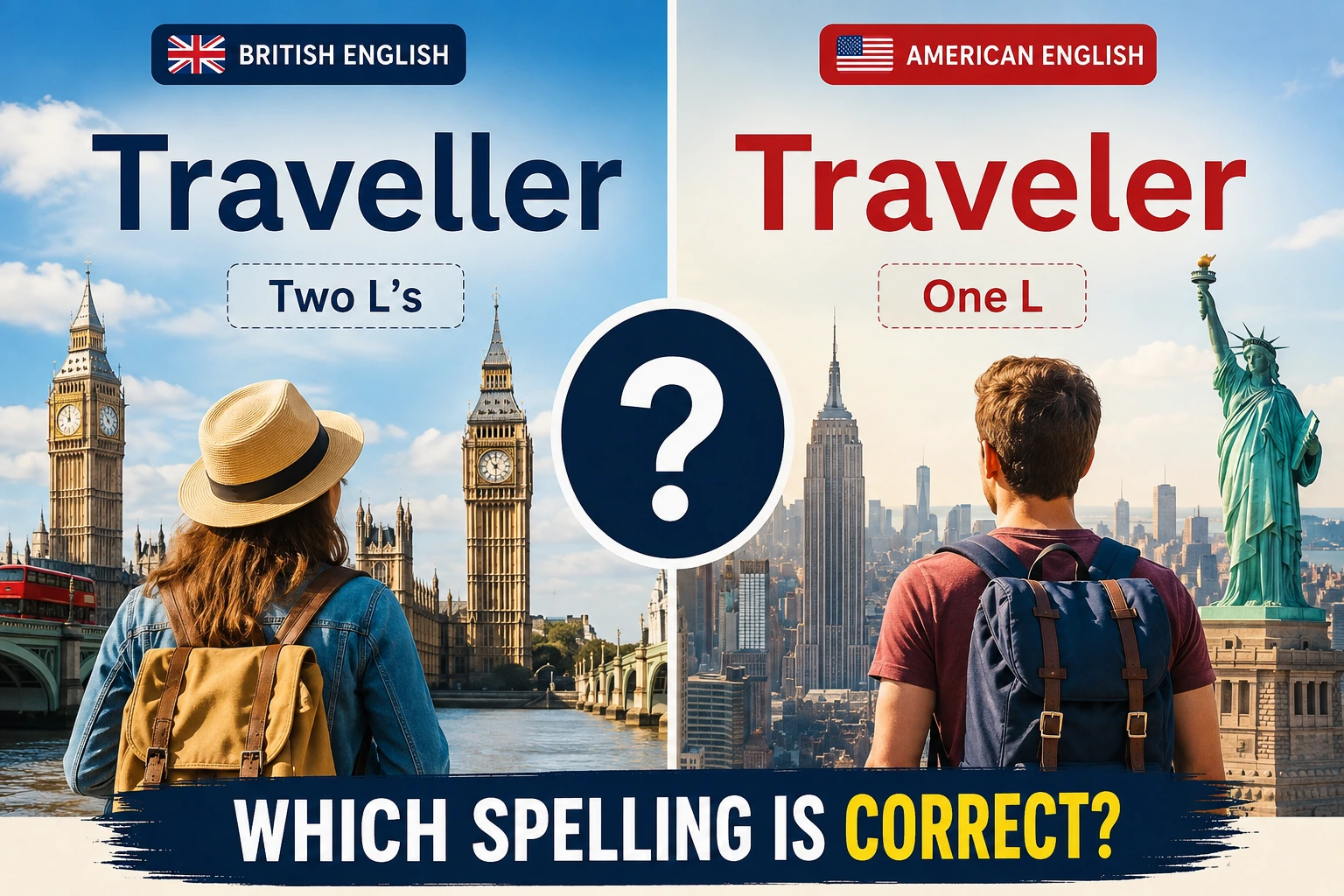
Traveller or traveler are both correct spellings for a person who travels. Traveller is standard in British English, while traveler is standard in American English.
Have you ever typed traveler, then stopped and wondered, “Should there be two Ls?”
You are not alone. Traveller or traveler is a common spelling question because both forms are correct. The difference is mainly based on the type of English you use.
As an English language writer, I often come across small spelling differences like this. They can look confusing at first, especially when both versions appear in books, websites, and everyday writing.
The good news is that you do not need to memorize a difficult rule. There is a simple pattern to follow.
Traveller is the usual British spelling. Traveler is the usual American spelling. Both words have the same meaning. They describe someone who travels from one place to another.
In this guide, you will learn exactly when to use each spelling. You will also see real examples, common mistakes, regional differences, and an easy memory trick.
Let’s make this spelling choice simple.
Traveller or Traveler: Quick Answer
Traveller and traveler have the same meaning.
The only main difference is regional spelling:
- Traveller = British English
- Traveler = American English
For example:
The traveller arrived in London early.
The traveler arrived in New York early.
Both sentences are correct. The spelling simply follows a different form of English.
You may also see the same pattern in related words, such as travelling and traveling.
Pronunciation
- Traveller → TRAV-uh-ler /ˈtræv.əl.ər/
- Traveler → TRAV-uh-ler /ˈtræv.əl.ɚ/
Both are pronounced almost the same way. The spelling difference (traveller vs. traveler) does not change the pronunciation.
Easy pronunciation
Traveller: TRAV-uh-luh
Traveler: TRAV-uh-ler
The stress is on the first syllable:
TRAV-uh-ler
Example:
“She is an experienced traveller.”
“He is an experienced traveler.”
Both sound essentially identical.
The Origin and Background of Traveller or Traveler
Both traveller and traveler come from the verb travel.
The word travel has a long history. It developed from an Old French word related to work, hardship, and journeys. Over time, its meaning became connected with moving from one place to another.
The noun traveler/traveller simply describes a person who travels.
So why are there two spellings?
The answer comes from the development of British and American English.
British English often keeps a doubled consonant when adding certain endings to words. American English tends to use a single consonant in some of these cases.
That is why you get:
| British English | American English |
|---|---|
| traveller | traveler |
| travelling | traveling |
| travelled | traveled |
| travelling abroad | traveling abroad |
The meaning does not change.
This is not a case where one spelling is correct and the other is wrong. Both forms belong to standard English.
Traveller or Traveler Explained: Key Differences
The easiest way to understand the difference is to think about where your audience is.
| Term | Meaning | When to Use | Region/Context |
|---|---|---|---|
| Traveller | A person who travels | British-style writing | UK and many other varieties |
| Traveler | A person who travels | American-style writing | United States |
| Travellers | More than one person who travels | British English | UK and related styles |
| Travelers | More than one person who travels | American English | US |
| Travelling | The act of going from place to place | British English | UK |
| Traveling | The act of going from place to place | American English | US |
Traveller
Use traveller when you are following British English spelling.
For example:
The traveller packed a small bag for the trip.
You may find this spelling in British newspapers, books, schools, and websites.
It is also common in countries and organizations that follow British English conventions.
Traveler
Use traveler when you are writing in American English.
For example:
The traveler booked a hotel near the airport.
This spelling is standard in the United States.
American English generally uses one l in this word.
The Meaning Is Exactly the Same
This is the key point to remember.
Traveller does not describe a different type of person from traveler.
Both mean:
A person who travels.
The difference is spelling, not meaning.
Which Version Should You Use?
Your choice should depend on your audience and writing style.
For British English: Use Traveller
If your readers are mainly in the UK, use:
traveller
For example:
The traveller visited several cities in England.
This keeps your spelling consistent with British English.
For American English: Use Traveler
If your readers are mainly in the United States, use:
traveler
For example:
The traveler visited several cities across the country.
This matches standard American English.
For Global or Neutral Writing: Choose One Style
If your website has readers from many countries, either spelling can work.
The most important thing is consistency.
Do not switch between:
traveler
traveller
traveling
travelling
without a reason.
Choose one English style and use it across your article or website.
If your site mainly follows American English, use traveler.
If it follows British English, use traveller.
Common Mistakes with Traveller or Traveler
Small spelling differences can cause unnecessary confusion. Here are some common mistakes to avoid.
1. Thinking One Spelling Is Wrong
Mistake:
Traveler is wrong.
Correct:
Traveler is correct in American English.
Why? Both spellings are accepted. They belong to different regional forms of English.
2. Mixing British and American Forms
Mistake:
The traveller was traveling across the country.
This sentence mixes British traveller with American traveling.
Better British style:
The traveller was travelling across the country.
Better American style:
The traveler was traveling across the country.
3. Using Two Ls in American Writing
Mistake:
The traveller arrived in Boston.
American English:
The traveler arrived in Boston.
The two-L spelling is normally associated with British English.
4. Using One L in British Writing
Mistake:
The traveler arrived in London.
British English:
The traveller arrived in London.
The British form normally doubles the l.
5. Assuming Pronunciation Changes
The spelling difference does not create a major difference in pronunciation.
The words are pronounced in essentially the same way.
The main difference is how they are written.
Traveller or Traveler in Real-World Examples
Seeing both spellings in context makes the difference much easier to remember.
Professional Email
British English:
We are pleased to confirm that the traveller has received the updated booking details.
American English:
We are pleased to confirm that the traveler has received the updated booking details.
Both sentences are correct.
News Article
British style:
The traveller arrived at the airport after a long journey.
American style:
The traveler arrived at the airport after a long journey.
The choice depends on the publication’s style guide.
Social Media Post
British English:
Every traveller has a favorite place to visit. What is yours?
American English:
Every traveler has a favorite place to visit. What is yours?
Formal Report
British English:
The report examines the experiences of international travellers.
American English:
The report examines the experiences of international travelers.
Everyday Sentence
She is an experienced traveller who has visited more than 20 countries.
Or:
She is an experienced traveler who has visited more than 20 countries.
Again, both are correct.
Traveller or Traveler: Data, Trends and Usage
The spelling you see most often can depend heavily on location.
Traveler is strongly associated with American English. It is common in US publications, businesses, travel websites, and American educational material.
Traveller is strongly associated with British English. It is common in the UK and in writing that follows British spelling conventions.
This difference also appears in related forms:
- traveler → American English
- traveller → British English
- traveling → American English
- travelling → British English
- traveled → American English
- travelled → British English
This matters for writers because spelling consistency can make your content look more polished.
If your website uses American English in one article but British English in another, readers may notice the difference.
For a global website, the best approach is to choose a clear house style and follow it.
Traveller vs Traveler: Simple Comparison Table
| Term/Variant | Meaning | Region/Context | Best Used When |
|---|---|---|---|
| Traveller | A person who travels | British English | Writing for UK readers |
| Traveler | A person who travels | American English | Writing for US readers |
| Travellers | Multiple people who travel | British English | UK-style plural writing |
| Travelers | Multiple people who travel | American English | US-style plural writing |
| Travelling | Going from place to place | British English | UK spelling |
| Traveling | Going from place to place | American English | US spelling |
| Travelled | Past form of travel | British English | UK spelling |
| Traveled | Past form of travel | American English | US spelling |
Easy Memory Trick
Here is a simple way to remember the difference:
British = Traveller = LL
American = Traveler = L
Think of the British version as having an extra L.
You can use the same trick with related words:
British:
- traveller
- travelling
- travelled
American:
- traveler
- traveling
- traveled
Once you remember this pattern, the spelling becomes much easier.
What About Travelled and Traveled?
The difference does not stop at traveller or traveler.
The same regional pattern appears in the past tense.
British English usually uses:
travelled
American English usually uses:
traveled
For example:
British:
She travelled around Europe last summer.
American:
She traveled around Europe last summer.
The same applies to travelling/traveling.
British:
He is travelling to France.
American:
He is traveling to France.
This makes the pattern easier to spot across the whole word family.
Is Traveller or Traveler More Correct?
Neither one is more correct in all situations.
The correct choice depends on the English variety you are using.
Use traveller for British English.
Use traveler for American English.
If you are writing for a specific publication, school, employer, or website, follow its preferred style guide.
For example, a British publication may expect traveller, while an American publication may expect traveler.
The goal is not to pick one spelling forever.
The goal is to use the spelling that fits your audience.
Frequently Asked Questions
Q: What does traveller mean?
A: Traveller means a person who travels from one place to another. It is the standard British English spelling of the word.
Q: What does traveler mean?
A: Traveler also means a person who travels. It is the standard American English spelling.
Q: Is traveller or traveler correct?
A: Both are correct. Traveller is used mainly in British English, while traveler is used mainly in American English.
Q: Is traveler acceptable in formal writing?
A: Yes. Traveler is completely acceptable in formal American English. If you are following British English, use traveller instead.
Q: Is traveller acceptable in American English?
A: It may be understood easily, but it is not the usual American spelling. American writers normally use traveler.
Q: Why does traveller have two Ls?
A: British English commonly uses the double-L form in traveller. American English simplified the spelling to traveler.
Q: Is traveling or travelling correct?
A: Both are correct. Traveling is the standard American spelling, while travelling is the standard British spelling.
Q: Should I use traveler or traveller on my website?
A: Choose the version that matches your target audience and keep it consistent. Use traveler for American English and traveller for British English.
Conclusion
The traveller or traveler question is much simpler than it first appears.
Both spellings are correct. The difference is mainly regional.
Use traveller when you are following British English. Use traveler when you are following American English.
The same pattern appears in related words. British English uses travelling and travelled, while American English uses traveling and traveled.
The most useful rule is simple: British English usually keeps the double L, while American English uses one L.
If you are writing for a UK audience, choose traveller. If your readers are mainly American, choose traveler. For a global audience, either can work, but consistency matters.
You do not need to worry when you see the other spelling. It is not a mistake. It is simply another accepted form of English.
Now that you know the difference, choose the spelling that fits your audience and use it with confidence.
Traveller or traveler explained with meaning, spelling, British and American usage, examples, and simple tips to avoid common mistakes.Traveller or Traveler: The Easy Spelling Guide
Colour or Color: Which Spelling Should You Use? (2026)

I am a professional content writer with a strong interest in English spelling and vocabulary. I am interested in creating informative guides on commonly confused words, spelling differences, and language usage to help readers write more accurately and effectively.