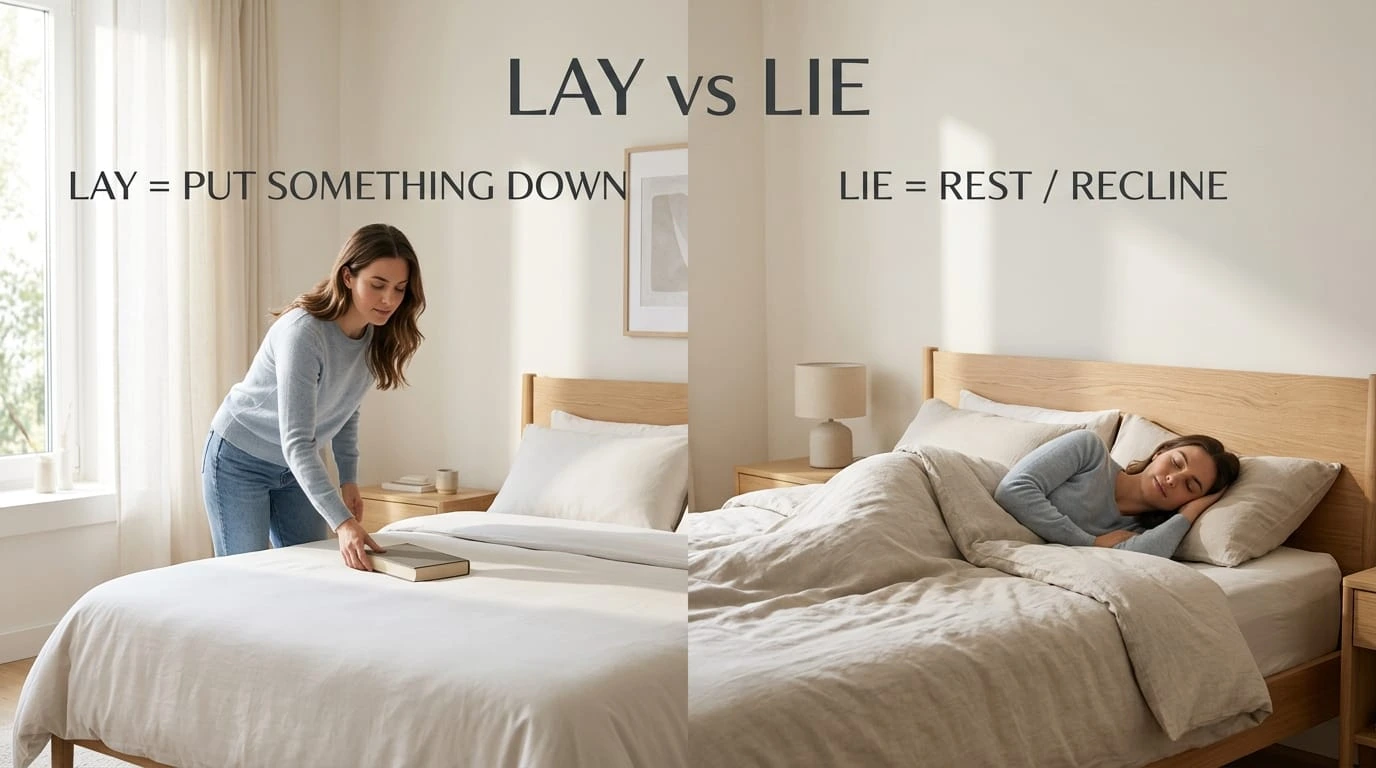
Lay means to put something down, while lie means to rest or recline. The main trick is that the past tense of lie is lay, which causes much of the confusion.
Lay or Lie: Quick Answer
Lay needs an object. You lay something somewhere.
Please lay the book on the table.
Lie means to rest or be in a flat position. It does not take a direct object.
I need to lie down.
The confusing part is the past tense:
- lie → lay → lain
- lay → laid → laid
So, you can say:
Yesterday, I lay on the sofa.
But:
Yesterday, I laid the book on the sofa.
A simple question can help: Are you putting something somewhere, or are you resting yourself?
The Origin / Background of Lay or Lie
The confusion between lay and lie is not new. Both words come from old English verbs, and their forms have changed over many centuries.
Lie comes from Old English licgan, meaning “to be in a lying or resting position.” Its forms developed into the modern pattern lie, lay, lain.
Lay comes from Old English lecgan, meaning “to place or put something down.” Its modern forms are lay, laid, laid.
The two verbs have always had related ideas. One describes being in a position, while the other describes putting something into that position.
The past tense of lie is especially confusing because it is lay. That means lay can be both a present-tense verb and the past tense of lie.
For example:
I lay the phone on the desk.
I lay on the sofa yesterday.
The first sentence uses lay as the present form. The second uses lay as the past form of lie.
Lay or Lie Explained: Key Differences
Lay
It means to put or place something somewhere.
It normally needs a direct object.
She laid the baby in the crib.
He lays the keys on the desk every morning.
The thing being placed is the object.
Lie
Lie means to rest, recline, or be in a flat position.
It does not need a direct object.
I want to lie on the bed.
The dog is lying on the floor.
You are not putting something somewhere. You are describing a position.
The Main Difference
| Term | Meaning | When to Use | Region/Context |
|---|---|---|---|
| Lay | Put or place something | When there is an object | Standard English |
| Laid | Past form of lay | Something was placed | Standard English |
| Lie | Rest or recline | When the subject rests | Standard English |
| Lay | Past form of lie | Someone rested in the past | Standard English |
| Lain | Past participle of lie | With has, have, or had | Standard English |
| Lying | Resting or being flat | Continuous form of lie | Standard English |
Which Version Should You Use?
There is no single version that replaces the other. Lay and lie have different meanings.
For putting something somewhere
Use lay.
Lay the papers on my desk.
For resting yourself
Use lie.
I need to lie down.
For something that happened in the past
Use laid when something was placed.
She laid the phone on the table.
Use lay when someone rested.
She lay on the sofa for an hour.
For perfect tenses
Use lain when lie means to rest.
He has lain in bed all morning.
Use laid for lay.
She has laid the clothes on the bed.
For global or neutral English
Both lay and lie are standard English words. The key is not region but meaning and grammar.
Common Mistakes With Lay or Lie
Mistake 1: “I am going to lay down.”
Incorrect:
I am going to lay down.
Correct:
I am going to lie down.
Why? Because you are describing your own action of resting. There is no object after lay.
Mistake 2: “I laid down yesterday.”
Incorrect:
I laid down yesterday.
Correct:
I lay down yesterday.
Why? Lay is the past tense of lie.
Mistake 3: “She lies the book on the table.”
Incorrect:
She lies the book on the table.
Correct:
She lays the book on the table.
Why? She is putting an object somewhere. The verb is lay.
Mistake 4: “I have laid there all day.”
Incorrect:
I have laid there all day.
Correct:
I have lain there all day.
Why? Lain is the past participle of lie.
Mistake 5: “He is laying on the bed.”
Incorrect:
He is laying on the bed.
Correct:
He is lying on the bed.
Why? Laying means putting something down. Lying means resting.
Compare:
She is laying the blanket on the bed.
She is lying on the bed.
Lay or Lie in Real-World Examples
Professional Email
I will lay the documents on your desk before the meeting.
Here, lay is correct because documents are being placed somewhere.
News Headline
Emergency supplies laid across the affected area
Here, laid can describe supplies that were placed or distributed.
Social Media Post
I just want to lie down and relax after this long day.
Here, lie means rest.
Formal Report
Several documents were laid before the committee for review.
Here, laid means formally placed or presented.
Lay or Lie: Data, Trends & Usage
People often search lay or lie because the forms overlap.
The biggest problem is the verb pattern:
Lie → lay → lain
but:
Lay → laid → laid
This creates a common grammar trap. A learner may remember that lay is connected with putting something down, then see lay used for past rest and assume the rules are inconsistent.
The key is to identify the base verb first.
If the base verb is lie, its past form is lay.
If the base verb is lay, its past form is laid.
This distinction matters in school assignments, emails, professional writing, grammar tests, and everyday English.
Standalone Comparison: Lay vs. Lie
| Term/Variant | Meaning | Region/Context | Best Used When |
|---|---|---|---|
| lay | Put or place something | Standard English | You have an object |
| laid | Put or placed | Standard English | Past or perfect form of lay |
| lie | Rest or recline | Standard English | The subject rests |
| lay | Rested | Standard English | Past form of lie |
| lain | Rested or been in a position | Standard English | Perfect tense |
| lying | Resting or reclining | Standard English | Continuous tense |
A Simple Memory Trick
Try this:
Lay = place.
If you can answer “lay what?”, you probably need lay.
Lay what? The book.
Lie = rest.
If you are talking about yourself, another person, or an animal resting, you probably need lie.
I want to lie down.
Then remember the tricky past form:
Yesterday, I lay down.
And:
Yesterday, I laid the book down.
Lay, Lie, Laid, and Lain: Full Verb Forms
Lie
| Tense/Form | Verb |
|---|---|
| Present | lie |
| Past | lay |
| Past participle | lain |
| -ing form | lying |
Examples:
I lie down every afternoon.
Yesterday, I lay down early.
I have lain here for an hour.
I am lying on the sofa.
Lay
| Tense/Form | Verb |
|---|---|
| Present | lay |
| Past | laid |
| Past participle | laid |
| -ing form | laying |
Examples:
I lay the book on the desk.
I laid the book there yesterday.
I have laid the papers on the table.
I am laying the clothes on the bed.
Quick Test: Lay or Lie?
Choose the correct word.
1. I need to ___ down.
Answer: lie
I need to lie down.
2. She ___ the baby in the crib.
Answer: laid
She laid the baby in the crib.
3. He ___ on the beach yesterday.
Answer: lay
He lay on the beach yesterday.
4. Please ___ the keys here.
Answer: lay
Please lay the keys here.
5. She has ___ on the sofa all afternoon.
Answer: lain
She has lain on the sofa all afternoon.
6. They are ___ the books on the shelf.
Answer: laying
They are laying the books on the shelf.
FAQ: Lay or Lie
Q: What does “lay” mean?
A: Lay means to put or place something somewhere. It normally takes a direct object.
Q: What does “lie” mean?
A: Lie means to rest or be in a flat or resting position. It does not normally take a direct object.
Q: Is “lay down” or “lie down” correct?
A: Lie down is correct when you mean to rest yourself. For example, “I need to lie down.” Lay down is correct when you place something down, such as “Lay the book down.”
Q: Is “lay” the past tense of “lie”?
A: Yes. The verb pattern is lie → lay → lain when lie means to rest.
Q: What is the past tense of “lay”?
A: The past tense of lay is laid. The pattern is lay → laid → laid.
Q: Is “lying” the correct form of lie?
A: Yes. Lying is the -ing form of lie when it means resting or reclining. For example, “She is lying on the bed.”
Q: Is “laying” also correct?
A: Yes. Laying is the -ing form of lay. It means putting or placing something. For example, “He is laying the papers on the desk.”
Q: Why is lay or lie so confusing?
A: The main reason is that lay has two roles. It is the present form of the verb lay, but it is also the past tense of lie. Remembering the two verb patterns makes the difference much easier.
Conclusion
Lay and lie are different verbs, but their forms overlap. That is why even confident English speakers sometimes pause before using them.
Remember the basic rule: lay means put something down, while lie means rest. If you place an object, use lay. If you rest yourself, use lie.
The past forms need extra care. Lie → lay → lain, while lay → laid → laid. This one pattern explains many common mistakes.
Try asking yourself one simple question: “Am I putting something somewhere, or am I resting?” That question will often give you the answer.
Keep practicing these verbs in short sentences. Soon, lay, lie, laid, lain, laying, and lying will feel much easier to use.
Bookmark this guide so you never have to second-guess lay or lie again.
Threw vs Through: One Sound, Two Very Different Words

I specialize in spelling comparisons, confusing word pairs, grammar, and vocabulary development. My content helps readers improve their English, avoid common mistakes, and write with confidence. My goal is to provide accurate, reliable, and easy-to-understand language resources