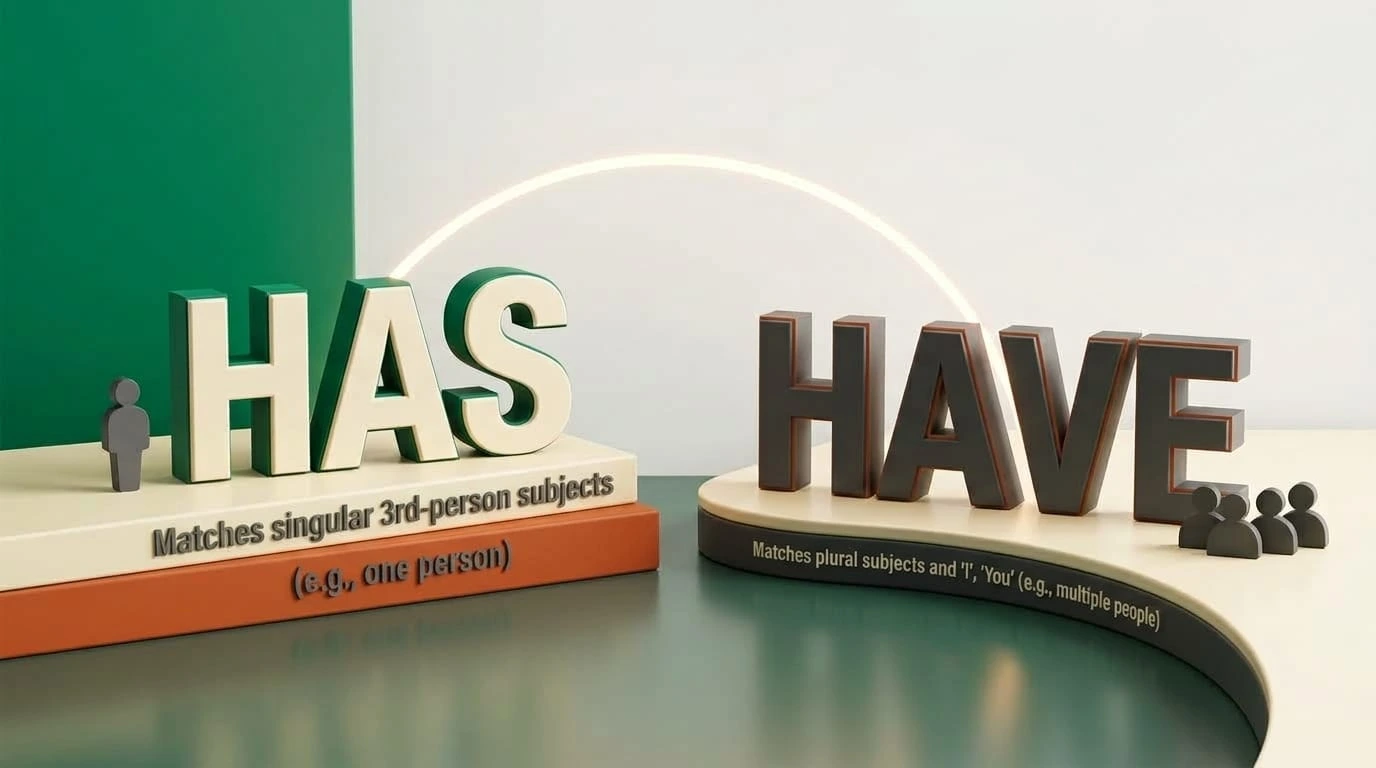
“Use has with he, she, it, and singular nouns; use have with I, you, we, they, and plural nouns.“
A student once wrote, “She have a new bag.” A few lines later, the same student wrote, “They has two books.” Both sentences looked almost right, but one small verb was causing the problem.
This is a common issue when learning English because has and have both come from the same verb. The choice depends mainly on the subject of the sentence.
The tricky part comes when questions and perfect tenses enter the picture. For example, should you say “Does she have a car?” or “Does she has a car?” And why do we say “He has been working” but “They have been working”?
The good news is that you do not need to memorize dozens of rules. Once you understand how the subject controls has and have, these sentences become much easier to form correctly.
Has or Have: The Basic Rule
The main rule is simple:
- I → have
- You → have
- We → have
- They → have
- He → has
- She → has
- It → has
- Singular noun → has
- Plural noun → have
Examples
- I have a new phone.
- You have a good idea.
- We have enough time.
- They have two children.
- He has a new job.
- She has a beautiful voice.
- It has four legs.
- Maria has a blue dress.
- The students have an exam tomorrow.
The important thing is to look at the subject, not the word that comes after the verb.
When to Use Have or Has?
So, when to use have or has? Use have with I, you, we, they, and plural subjects. Use has with he, she, it, and singular third-person subjects.
Compare these sentences:
- I have a car.
- She has a car.
- We have a meeting.
- He has a meeting.
- The boys have new shoes.
- The boy has new shoes.
A useful shortcut is to remember:
He, She, It = Has
I, You, We, They = Have
This rule works especially well when you are talking about possession, relationships, experiences, conditions, or things someone needs.
Has or Have for 2 People?
When you are talking about two people, use have if the two people are treated as a plural subject.
For example:
- Ali and Sara have a new house.
- John and Emma have two children.
- My brother and sister have the same teacher.
- Tom and David have different opinions.
Why?
Because Ali and Sara means two people, so the subject is plural.
You can also replace the two names with they:
Ali and Sara have a car.
They have a car.
Therefore, when deciding has or have for 2 people, remember that two people normally make a plural subject, so use have.
One person vs. two people
- Ali has a laptop.
- Ali and Sara have laptops.
The same idea applies to groups:
- The student has a question.
- The students have questions.
Does He Have or Has?
This is one of the most common questions about has and have.
The correct form is:
Does he have…?
Not:
Does he has…?
For example:
- Does he have a car?
- Does he have enough money?
- Does he have a brother?
- Does he have any questions?
Why does have appear after does?
Because does already carries the third-person singular form. After does, we use the base form of the main verb.
So:
He has a car.
becomes:
Does he have a car?
The same pattern works with other subjects:
- She has a dog. → Does she have a dog?
- He has a job. → Does he have a job?
- It has a problem. → Does it have a problem?
Does She Have or Has a Car?
The correct sentence is:
Does she have a car?
Not:
Does she has a car?
The statement is:
She has a car.
When we turn it into a question using does, the main verb returns to its base form:
Does + she + have + a car?
This is an important grammar pattern:
Does + subject + base verb
Examples:
- Does she have a car?
- Does he have a job?
- Does Maria have a passport?
- Does the dog have enough food?
Short answers
You can answer the question like this:
Does she have a car?
- Yes, she does.
- No, she doesn’t.
You do not normally answer:
- Yes, she has. ❌
- No, she hasn’t. ❌
when the question specifically uses does in this simple present pattern.
Has Been or Have Been?
Both has been and have been are correct. The choice depends on the subject.
Use has been with he, she, it, and singular subjects.
Use have been with I, you, we, they, and plural subjects.
Examples with has been
- He has been busy.
- She has been sick.
- It has been difficult.
- The teacher has been helpful.
Examples with have been
- I have been busy.
- You have been helpful.
- We have been waiting.
- They have been working.
- The students have been studying.
This pattern is common in the present perfect and present perfect continuous tenses.
For example:
She has been studying for two hours.
They have been studying for two hours.
The subject changes, so has changes to have.
What Is the V1, V2, V3 of Has?
The word has is a form of the verb have.
The basic forms are:
| Verb Form | Word |
| V1 | have |
| V2 | had |
| V3 | had |
So, the V1, V2, and V3 of has are based on the verb have:
Have → Had → Had
Where does has fit?
Has is the third-person singular present form of have.
For example:
- I have a car.
- She has a car.
- They have a car.
In the past, both have and has normally change to had:
- I had a car.
- She had a car.
- They had a car.
Has vs. Have: Quick Comparison
| Subject | Correct Form | Example |
| I | have | I have a question. |
| You | have | You have a choice. |
| We | have | We have enough time. |
| They | have | They have a house. |
| He | has | He has a new phone. |
| She | has | She has a car. |
| It | has | It has a problem. |
| Singular noun | has | Ahmed has a bike. |
| Plural noun | have | Ahmed and Ali have bikes. |
Has and Have in Negative Sentences
The same idea changes slightly when we use do not or does not.
With I, you, we, and they, use:
do not/don’t + have
Examples:
- I don’t have enough money.
- We don’t have a car.
- They don’t have any questions.
With he, she, and it, use:
does not/doesn’t + have
Examples:
- He doesn’t have a car.
- She doesn’t have a passport.
- It doesn’t have enough power.
Notice that we use have, not has, after doesn’t.
She doesn’t have a car. ✅
She doesn’t has a car. ❌
Common Mistakes with Has and Have
1. Using has with I
I has a book. ❌
I have a book. ✅
2. Using have with she
She have a car. ❌
She has a car. ✅
3. Using has after does
Does he has a job? ❌
Does he have a job? ✅
4. Using has after doesn’t
She doesn’t has a dog. ❌
She doesn’t have a dog. ✅
5. Using has with two people
Ali and Ahmed has a car. ❌
Ali and Ahmed have a car. ✅
6. Confusing has been and have been
They has been working. ❌
They have been working. ✅
She have been waiting. ❌
She has been waiting. ✅
Has or Have in Real-Life English
You will hear and see these forms in many everyday situations.
Talking about possessions
- I have a new laptop.
- She has a new laptop.
- They have a new laptop.
relationships
- He has two sisters.
- We have three children.
- They have many friends.
experiences
- I have some experience.
- She has experience in teaching.
- They have experience with this type of work.
conditions
- He has a headache.
- I have a cold.
- They have a problem.
recent or continuing actions
- She has been working all morning.
- We have been waiting for an hour.
- They have been studying since morning.
A Simple Trick to Remember Has or Have
If you are unsure, first replace the subject with a pronoun.
For example:
Ahmed and Sara ___ a car.
Replace the names with they:
They have a car.
So the answer is have.
Now try:
Sara ___ a car.
Replace Sara with she:
She has a car.
So the answer is has.
For questions, watch for does:
Does she ___ a car?
After does, use have:
Does she have a car?
This small trick can help you avoid many common mistakes.
FAQs About Has or Have
When should I use has instead of have?
Use has with he, she, it, and singular nouns in the simple present. Use have with I, you, we, they, and plural nouns.
Is it “Does he have” or “Does he has”?
The correct form is “Does he have?” After does, use the base form have, not has.
Is it “Does she have a car” or “Does she has a car”?
The correct sentence is “Does she have a car?” The auxiliary verb does takes the third-person form, so the main verb stays in its base form.
Do two people take has or have?
Two people normally form a plural subject, so use have.
For example: “Sarah and Emma have a new teacher.”
Is “has been” or “have been” correct?
Both are correct. Use has been with singular third-person subjects and have been with I, you, we, they, and plural subjects.
What are the V1, V2, and V3 forms of have?
The three main forms are have (V1), had (V2), and had (V3). Has is the present-tense form used with he, she, it, and singular third-person subjects.
Conclusion
The difference between has and have becomes much easier when you focus on the subject.
Use has with he, she, it, and singular nouns. Use have with I, you, we, they, and plural nouns. After does or doesn’t, use have, because the auxiliary already carries the grammatical form.
Remember these three examples:
She has a car.
Does she have a car?
They have a car.
Once this pattern becomes familiar, choosing between has and have becomes a quick and natural part of everyday English.
Was or Were: Easy Rules and Real Examples

I am a language content specialist specializing in spelling comparisons, vocabulary usage, and commonly confused English words. I write detailed, informative articles that help readers improve their language skills. I am passionate about helping students, writers, and professionals develop a stronger understanding of the English language.