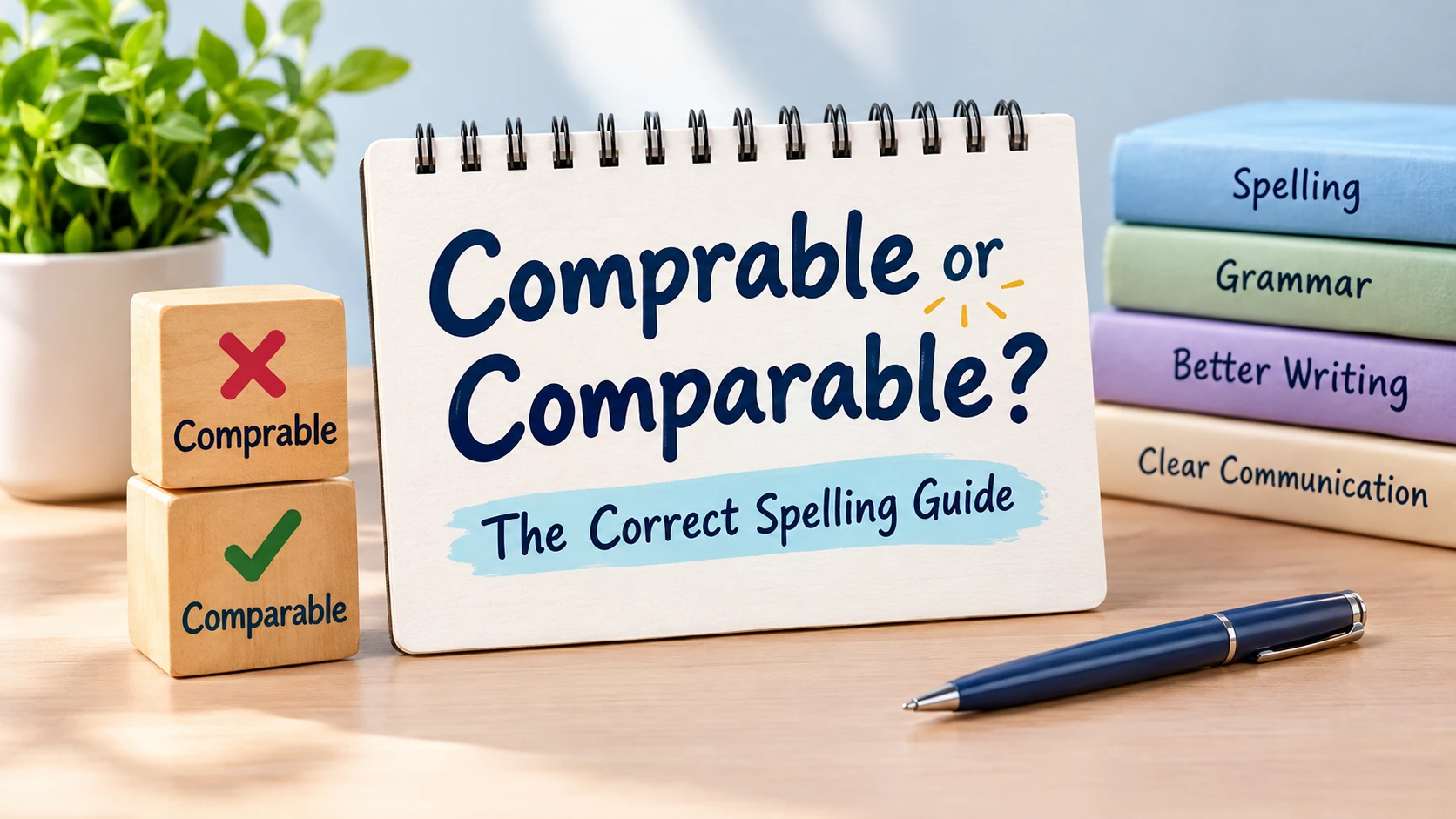
Comparable is the correct spelling. Comprable is a misspelling. Use comparable when you mean that two things are similar enough to be compared.
Have you ever typed a word that looked right, only to stop and wonder if one letter was missing? “Comprable” or “comparable” is one of those spelling questions.
As an English teacher, I have seen this mistake often in student writing, emails, and online content. The confusion usually comes from the way we pronounce comparable. When spoken quickly, the middle sound can seem easy to miss.
The good news is that the answer is simple. Comparable is the standard English spelling. Comprable is not the correct standard spelling.
This small spelling difference matters because comparable is common in academic, business, professional, and everyday English. You may use it when comparing prices, products, results, people, services, or situations.
In this guide, you will learn why comparable is correct, what it means, how to use it, and why comprable is so easy to write by mistake.
Comprable or Comparable: Quick Answer
The correct spelling is comparable.
Comprable is an incorrect spelling because it leaves out the “a” after the p.
For example:
- Correct: The two products are comparable in price.
- Incorrect: The two products are comprable in price.
Comparable means that two or more things are similar enough to be compared.
You might compare two phones, two salaries, two businesses, or two test results.
Remember: Compare → Comparable. The a stays in the word.
The Origin and Background of Comparable
The word comparable comes from the verb compare.
Compare traces back to Latin roots connected with bringing things together for comparison. English later developed comparable to describe something that can be compared with something else.
The spelling makes more sense when you look at the related words:
- compare
- comparison
- comparable
- comparability
The common compar- part helps explain why comparable keeps the a.
The spelling mistake comprable often happens because speakers do not strongly pronounce every sound in comparable. When a word is spoken quickly, the extra vowel can seem less noticeable.
That can lead writers to remove it when spelling the word.
However, pronunciation does not change the standard spelling. In formal English, write comparable.
Comparable Explained: Key Difference
There is a very simple difference between the two forms.
| Term | Meaning | When to Use | Region/Context |
|---|---|---|---|
| Comparable | Similar enough to be compared | Correct standard spelling | Standard English |
| Comprable | No standard meaning as a correct spelling | Do not use it | Misspelling |
What Does Comparable Mean?
Comparable is an adjective.
It describes things that can reasonably be compared because they share some qualities, features, or measurements.
For example:
- The two houses are comparable in size.
- These phones offer comparable performance.
- Her salary is comparable to mine.
- The two results are not directly comparable.
The word does not always mean that two things are exactly the same.
Instead, it usually means they are similar enough for a useful comparison.
Why Is Comprable Wrong?
Comprable is missing the letter a.
The correct form is:
compare + able → comparable
Not:
compare + ble → comprable
When you write comprable, the spelling does not follow the standard form of the word.
Which Version Should You Use?
For almost every standard English situation, use comparable.
For Students
Use comparable in essays, assignments, exams, and academic writing.
Example:
The results of the two studies are comparable.
For Professional Writing
Use comparable in reports, emails, presentations, and business documents.
Example:
Our service offers comparable features at a lower cost.
For Everyday Writing
You can also use comparable in normal conversation and informal writing.
Example:
I don’t think these two situations are comparable.
For Global English
If you want a form that works across standard varieties of English, choose comparable.
It is the standard spelling in both American and British English.
Common Mistakes with Comparable
1. Writing Comprable Instead of Comparable
Wrong: The two products are comprable.
Correct: The two products are comparable.
The mistake happens because the a can be easy to overlook.
2. Dropping the Second “a”
The correct spelling contains the sequence:
compar-able
Not:
compr-able
A useful trick is to connect the word with compare.
Compare → comparable
3. Treating Comparable as Meaning “Equal”
Comparable does not always mean equal.
For example:
The two cars have comparable prices.
This means their prices are similar enough to compare. It does not necessarily mean the prices are exactly the same.
4. Using Comparable Without a Useful Point of Comparison
A comparison usually needs a shared feature.
For example:
These two laptops have comparable battery life.
Here, battery life gives you the basis for comparison.
5. Confusing Comparable With Similar
These words are related, but they are not always interchangeable.
Similar focuses on likeness.
Comparable focuses on whether two things can reasonably be compared.
For example:
The two designs are similar.
This simply says they look alike.
The two designs are comparable in cost.
This gives a specific basis for comparison.
Comparable in Real-World Examples
Seeing the word in different settings can make the spelling easier to remember.
Professional Email
We reviewed both suppliers and found that their prices are comparable.
Here, comparable means the prices are similar enough to compare.
News Article
The company’s latest results are comparable with those reported last year.
The word shows that the two sets of results can be compared.
Social Media Post
These two phones have comparable cameras, but one has better battery life.
This is a natural use in an informal setting.
Formal Report
The findings from both groups were considered comparable for the purpose of the study.
Here, the word has a more formal and academic use.
Everyday Conversation
Your new car is comparable to mine in size.
This means both cars are similar in size.
Comparable: Data, Trends & Usage
The search intent behind “comprable or comparable” is mainly informational. People who search this phrase are usually unsure about the spelling and want a quick answer.
The question is especially useful for:
- Students checking assignments
- Writers proofreading content
- Job applicants preparing documents
- Professionals writing reports
- English learners improving spelling
- Anyone unsure about the word’s middle vowel
The confusion is likely to continue because comparable is not pronounced exactly as each letter might suggest. Fast speech can make the middle a less noticeable.
That makes this a good example of a wider English spelling lesson: a word may sound shorter than it looks when written.
The best way to avoid the mistake is to connect comparable with its base word compare.
If you remember compare, the spelling of comparable becomes much easier.
Comparable vs. Comprable: Comparison Table
| Term/Variant | Meaning | Region/Context | Best Used When |
|---|---|---|---|
| Comparable | Similar enough to compare | Standard English | Always use this spelling |
| Comprable | Incorrect spelling | Nonstandard/misspelled form | Avoid in writing |
The key point is simple: there is no standard spelling choice between “comprable” and “comparable.” Comparable is the correct form.
Comparable vs. Similar: What’s the Difference?
These two words are often confused because they can describe related ideas.
Comparable means two things can be compared in a meaningful way.
Similar means two things share qualities or characteristics.
Compare these examples:
The two apartments are similar.
This tells us they have things in common.
The two apartments are comparable in price.
This tells us that their prices are close enough to make a comparison useful.
Sometimes both words can work, but the meaning and focus can change.
How to Remember the Correct Spelling
Try this simple memory trick:
COMPARE → COMPARABLE
Start with the word compare.
Then add -able:
compare + able = comparable
You can also break the word into two parts:
compar + able
This helps you remember the a after p.
Another useful reminder is:
If you can compare it, it can be comparable.
Whenever you are unsure about comprable, think of compare first.
Frequently Asked Questions
Q: Is comprable or comparable correct?
A: Comparable is correct. Comprable is a misspelling and should be avoided in standard English.
Q: What does comparable mean?
A: Comparable means similar enough to be compared. For example, two products may have comparable prices or features.
Q: How do you spell comparable correctly?
A: The correct spelling is comparable: c-o-m-p-a-r-a-b-l-e.
Q: Why do people spell comparable as comprable?
A: The mistake often comes from pronunciation. When comparable is spoken quickly, the middle vowel can be less noticeable, which may cause writers to leave it out.
Q: Is comparable acceptable in formal writing?
A: Yes. Comparable is a standard English adjective and is suitable for academic, professional, business, and formal writing.
Q: Is comparable the same as similar?
A: Not exactly. Similar means having qualities in common, while comparable means that two things can be compared in a meaningful way.
Q: Can I use comparable for prices?
A: Yes. This is a very common use. For example: “The two products have comparable prices.”
Q: Is comparable spelled the same in British and American English?
A: Yes. Comparable is the standard spelling in both British and American English.
Conclusion
If you have ever wondered about comprable or comparable, the answer is clear: comparable is the correct spelling.
The word means that two or more things are similar enough to be compared. It can describe prices, products, results, services, people, sizes, features, and many other things.
The incorrect form comprable usually appears because the middle vowel in comparable can be easy to miss when the word is pronounced quickly. But the spelling still needs the a.
The easiest way to remember it is to connect the word with compare:
compare → comparable
Use comparable in your essays, emails, reports, social posts, and everyday writing. Once you connect it with compare, the correct spelling becomes much easier to remember.
Bookmark this guide so you never second-guess “comprable or comparable” again.
Michael or Micheal: Correct Spelling Comparison

I specialize in spelling comparisons, confusing word pairs, grammar, and vocabulary development. My content helps readers improve their English, avoid common mistakes, and write with confidence. My goal is to provide accurate, reliable, and easy-to-understand language resources