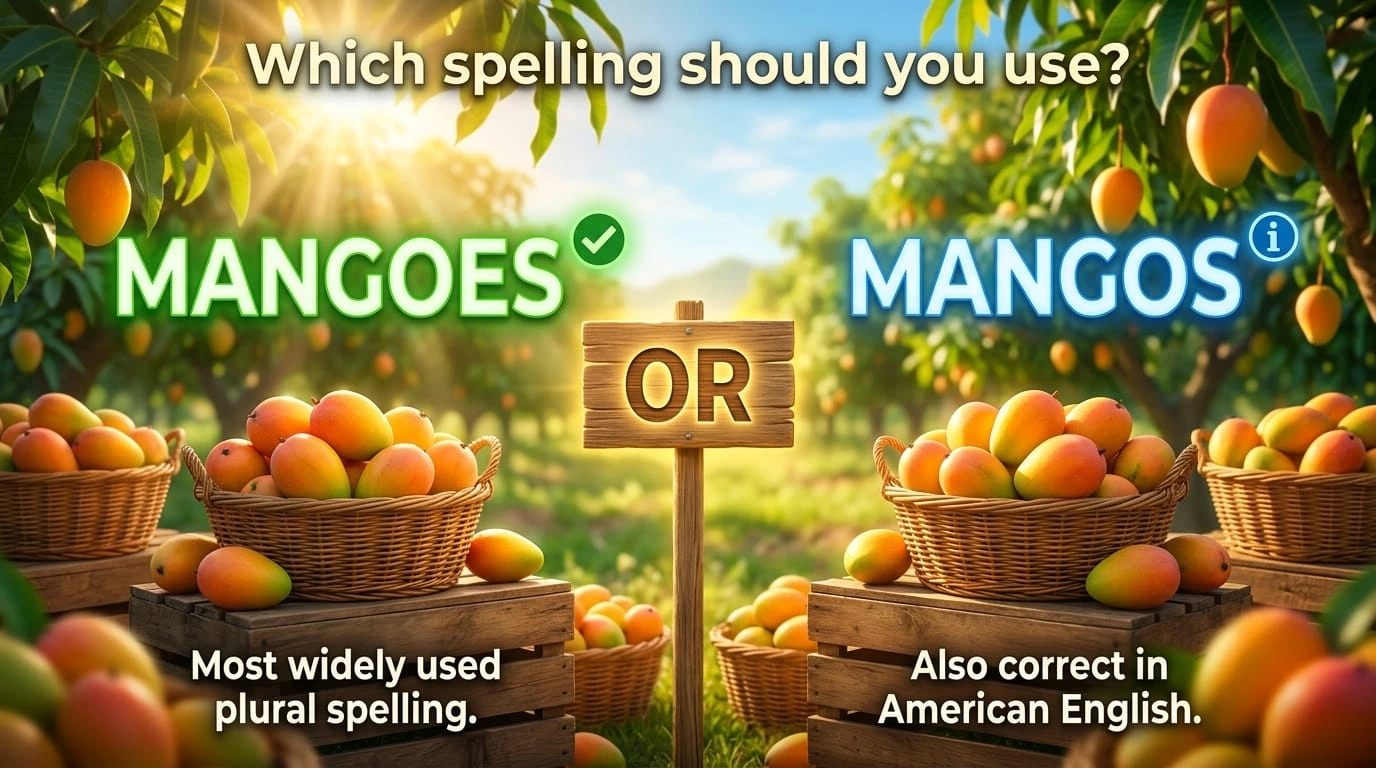
Both “mangoes” and “mangos” are correct plural spellings of “mango.” Dictionaries accept both, though “mangoes” is the more traditional and widely used form
I once worked a summer job stocking produce, and I hand-wrote a sign for the fruit bin: “Fresh Mangos, $1 each.” A coworker walked by and said, “Isn’t it mangoes, with an e?” I genuinely didn’t know the answer.
Here’s the twist: we were both technically right. Unlike a lot of English spelling debates, this one doesn’t have a clean winner. Both “mangoes” and “mangos” appear in major dictionaries, and both show up constantly in grocery stores, recipes, and menus.
That’s exactly why this word confuses so many people. There’s no obvious rule, just two accepted forms competing for the same job.
This guide breaks down where each spelling comes from, which one shows up more often today, and how to choose with confidence the next time you’re writing a label, a recipe, or a headline.
Mangoes or Mangos: Quick Answer
Both “mangoes” and “mangos” are correct plurals of “mango.” Neither one is a spelling mistake.
- ✅ I bought three ripe mangoes at the market.
- ✅ I bought three ripe mangos at the market.
In general, “mangoes” is the more traditional and more widely used spelling, especially in formal or published writing. “Mangos” is a simpler, more modern alternative that’s grown common in casual and commercial use.
The Origin of Mangoes/Mangos
“Mango” entered English in the 1500s, borrowed from the Portuguese word manga, which itself came from the Tamil word mankay. As the word spread through trade routes, English speakers had to decide how to pluralize it, and nouns ending in o have never followed one consistent English rule.
Some o-ending nouns take -es (tomato → tomatoes, potato → potatoes). Others take a simple -s (photo → photos, piano → pianos). Loanwords like “mango” landed in a gray zone, and English speakers ended up using both plural forms side by side for centuries.
Style guides eventually picked a lead. Merriam-Webster and most British dictionaries list “mangoes” first, treating it as the primary form, with “mangos” listed as an accepted variant. That’s why “mangoes” still feels like the “default” choice to many writers, even though “mangos” isn’t wrong.
Mangoes vs Mangos Explained: Key Differences
| Term | Meaning | When to Use | Region/Context |
|---|---|---|---|
| Mangoes | Plural of mango (traditional form) | Formal writing, recipes, published content | Preferred in dictionaries and most style guides |
| Mangos | Plural of mango (simplified form) | Casual writing, branding, packaging | Increasingly common in the US and commercial use |
| Mango | Singular form | Referring to one fruit | Universal, no variation |
Unlike “tomato/tomatoes,” where only one plural is correct, “mango” is one of the rare English nouns where two plural spellings both pass as standard.
Which Spelling Should You Use?
For formal or published writing
Use mangoes. It’s the spelling most dictionaries and style guides list first.
For recipes and food blogs
Either spelling works, but mangoes tends to feel slightly more polished for print cookbooks and detailed recipes.
For branding, packaging, or casual content
Mangos is common and increasingly popular, especially in the US grocery and beverage industry.
For global or neutral use
Mangoes is the safer default if you want to match the more traditional, widely recognized spelling.
Common Mistakes with Mangoes/Mangos
Mistake 1: Assuming one spelling is simply wrong
✅ Both “mangoes” and “mangos” are correct plurals.
❌ “Mangos” is a typo for “mangoes.”
Why it happens: Writers assume every spelling pair must have one right answer, when this one genuinely allows both.
Mistake 2: Mixing spellings within the same document
✅ We sell mangoes by the box, and each mango is hand-picked.
❌ We sell mangoes by the box, and mangos are hand-picked.
Why it happens: Writers switch unconsciously between the two accepted forms.
Mistake 3: Misspelling the singular form
✅ This mango is perfectly ripe.
❌ This mangoe is perfectly ripe.
Why it happens: People assume the singular should mirror the plural spelling with an e.
Mistake 4: Adding an apostrophe before the plural
✅ I bought two mangoes.
❌ I bought two mango’s.
Why it happens: Writers confuse plural forms with possessive forms, a common error across many English nouns.
Mistake 5: Overthinking which spelling is “more correct”
✅ Pick one spelling and stay consistent throughout your writing.
❌ Constantly switching between “mangoes” and “mangos” out of uncertainty.
Why it happens: Because both are valid, writers sometimes second-guess themselves without needing to.
Mangoes/Mangos in Real-World Examples
Professional email:
“Please confirm the shipment includes 40 crates of mangoes for Friday’s delivery.”
News headline:
“Mango Season Brings Bumper Crop of Mangoes to Local Markets”
Social media post:
“Nothing beats fresh mangos on a hot summer day. 🥭”
Formal document:
“The inventory report lists 500 kg of mangoes among imported produce.”
Notice both spellings appear naturally across different tones. Formal writing leans toward “mangoes,” while casual or commercial content often uses “mangos.”
Tomatoes or Tomatos: The Correct Spelling (2026)
Mangoes/Mangos: Data, Trends & Usage
Search interest in “mangoes vs mangos” is steady year-round, with noticeable spikes during mango season and recipe-heavy months like summer. This falls into the informational search category, with home cooks, bloggers, and grocery businesses trying to confirm which spelling to use before publishing content.
“Mangoes” tends to dominate in the UK, India, and other Commonwealth countries, aligning with traditional dictionary preference. “Mangos” shows stronger usage in American commercial and marketing contexts, particularly in branding for juices, snacks, and packaged produce.
Mangoes vs Mangos: Comparison Table
| Term/Variant | Meaning | Region/Context | Best Used When |
|---|---|---|---|
| Mangoes | Traditional plural of mango | Preferred in UK, India, formal writing | Published content, recipes, formal documents |
| Mangos | Simplified plural of mango | Common in US branding and casual use | Marketing, packaging, informal writing |
| Mango | Singular form | Universal | Referring to a single fruit |
Frequently Asked Questions
Q: What does “mangoes” or “mangos” mean?
A: Both words refer to more than one mango, the tropical fruit known for its sweet flavor. The meaning is identical, only the spelling differs.
Q: How do you use “mangoes” correctly in a sentence?
A: Use “mangoes” the same way you’d use “mangos.” For example, “The market sells fresh mangoes” works exactly like “The market sells fresh mangos.”
Q: Mangoes vs mangos: what’s the difference?
A: There’s no grammatical difference. “Mangoes” is the more traditional, dictionary-preferred spelling, while “mangos” is a simplified, increasingly common alternative.
Q: Is “mangos” acceptable in formal writing?
A: Yes, though “mangoes” is still the more common choice in formal, published, and academic writing.
Q: Which version is correct: mangoes or mangos?
A: Both are correct. Choose “mangoes” for a more traditional feel, or “mangos” for a simpler, modern look, especially in branding.
Q: Where does the word “mango” come from?
A: It comes from the Tamil word mankay, passed into Portuguese as manga, and adapted into English as “mango” in the 1500s.
Q: Can “mangos” be used in recipes and cookbooks?
A: Yes. Many modern food blogs and recipe sites use “mangos,” though traditional cookbooks often stick with “mangoes.”
Final Takeaway
Here’s the short version. Both “mangoes” and “mangos” are correct. This isn’t a right-versus-wrong spelling situation.
Key points to remember:
- The rule: No strict rule exists; both plurals are dictionary-approved
- Traditional pick: “Mangoes” leads in formal writing and most dictionaries
- Modern trend: “Mangos” is common in US branding and casual content
- Consistency matters: Pick one spelling per document and stick with it
Once you know both are valid, choosing between “mangoes” and “mangos” comes down to style, not correctness.
Mangoes vs mangos explained: both spellings are correct. Learn the difference, common usage, and which one fits your writing.
Gasses or Gases: The Correct Spelling Explained(2026)

I am a language content specialist specializing in spelling comparisons, vocabulary usage, and commonly confused English words. I write detailed, informative articles that help readers improve their language skills. I am passionate about helping students, writers, and professionals develop a stronger understanding of the English language.