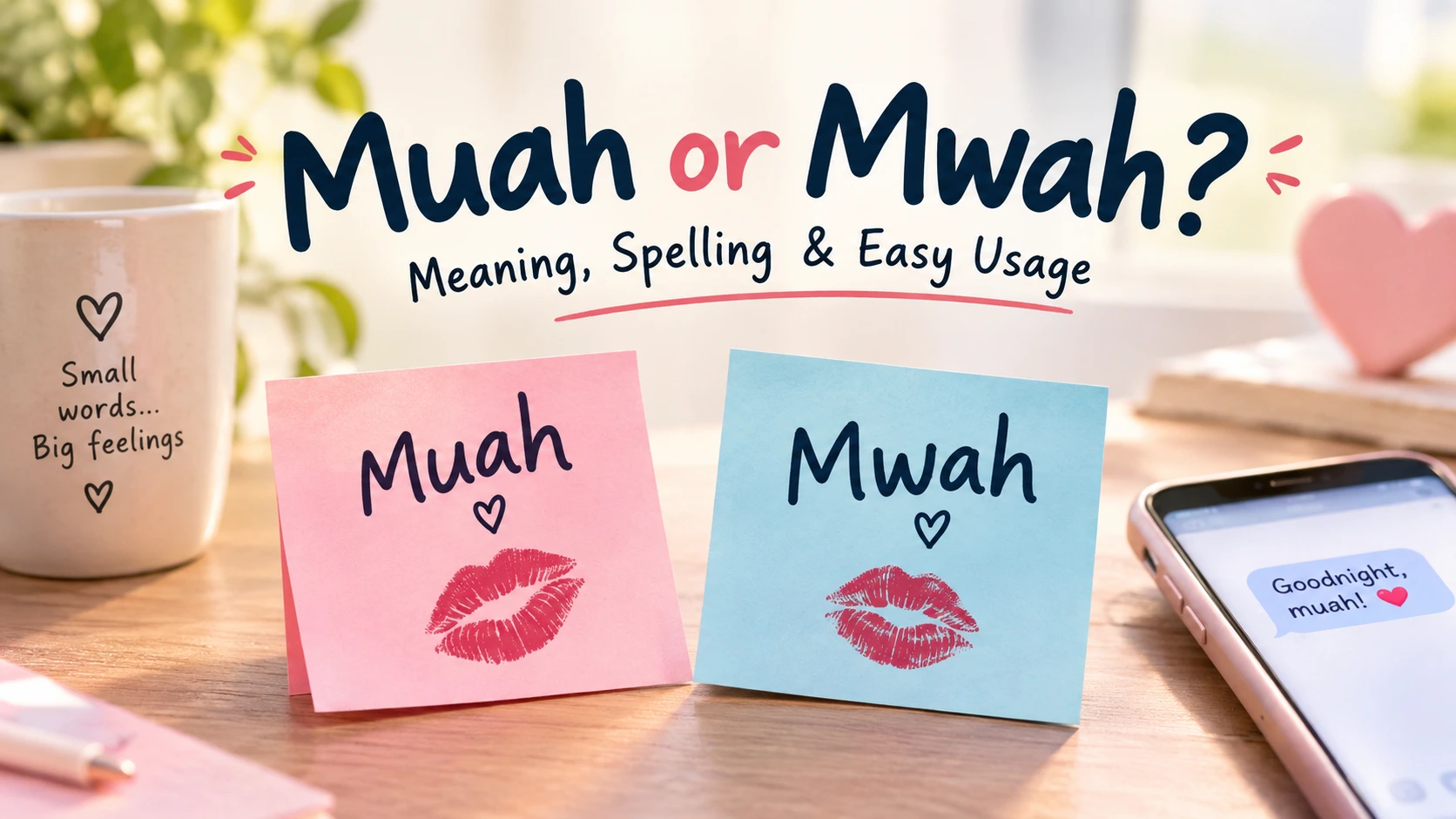
Muah and mwah are informal ways to represent the sound of a kiss. Both are correct in casual texting, but muah is more common for expressing affection.
Have you ever typed a kiss in a text and paused over one tiny detail: “Muah” or “mwah”? I have seen this question many times in casual English writing, especially in texts, social posts, and friendly chats.
At first, the two forms look almost the same. They both try to spell the sound people make when giving a kiss. Yet their style and feel can differ slightly.
Muah often looks softer and more playful. Mwah is a shorter spelling that tries to copy the quick sound of a kiss. Neither form works like a standard English word in formal writing.
This small difference matters when you want your message to sound natural. A friendly text, a social media caption, and a formal email all need different language choices.
In this guide, you will learn what muah and mwah mean, where they come from, how they differ, and when to use each one.
Muah or Mwah: Quick Answer
Muah and mwah are informal spellings used to represent the sound or expression of a kiss.
For example:
- “Goodnight, muah!” A warm, affectionate text.
- “Mwah! See you tomorrow.” A playful way to send a kiss.
Both spellings can express affection, warmth, love, or playful friendship.
The main difference is style rather than meaning. Muah looks more like a spoken kiss sound, while mwah is a shorter, punchier version.
Neither is normally suitable for formal reports, academic papers, or professional documents.
The Origin and Background of Muah and Mwah
Muah and mwah belong to a group of informal written expressions called onomatopoeic words or sound-based spellings.
Onomatopoeia happens when a word or expression imitates a sound. Words such as buzz, hiss, and bang are common examples.
A kiss does not have one fixed sound. People may write it as muah, mwah, muack, or other playful forms.
The spelling developed mainly through casual communication. Texting, instant messaging, social media, and online conversations made these sound-based expressions more common.
The letters do not describe a strict pronunciation rule. Instead, they give the reader an idea of the sound or action.
That is why you may see several spellings.
Muah adds a vowel sound after the opening m. Mwah keeps the expression shorter and closer to a quick kissing sound.
Neither spelling should be treated like a formal vocabulary term.
Muah vs Mwah: Key Differences
The meaning of muah and mwah is very similar. The main difference comes from tone and spelling style.
| Term | Meaning | When to Use | Region/Context |
|---|---|---|---|
| Muah | A written kiss sound | Affectionate texts and casual chats | Informal, widely understood |
| Mwah | A written kiss sound | Playful messages and social posts | Informal, widely understood |
| Muack | An exaggerated kiss sound | Very playful communication | Casual or humorous |
| Kiss | The actual word for a kiss | General writing | Formal and informal |
Muah
Muah often feels warm, cute, and affectionate.
Example:
“Thanks for helping me today. Muah!”
It can suggest a kiss without describing the action in a full sentence.
Mwah
Mwah carries much the same meaning.
Example:
“Good luck with your exam! Mwah!”
Because it is shorter, mwah can feel more dramatic or playful.
Muack
Muack is another playful spelling.
Example:
“Sending you a big muack!”
It is less neutral than muah or mwah and may sound deliberately cute or humorous.
Which Version Should You Use?
Your choice depends mainly on the tone of your message.
For casual texting
Both muah and mwah work well.
If you want a soft and affectionate tone, muah is a natural choice.
“Goodnight, muah ❤️”
If you want something short and playful, try mwah.
“See you soon, mwah!”
For social media
Both forms can work in captions, comments, and posts.
Muah may suit a sweet or affectionate caption.
Mwah can work well when the tone is playful, dramatic, or humorous.
For professional communication
Avoid both forms in formal work emails and reports.
Instead, use a normal closing such as:
- Best regards
- Kind regards
- Thank you
- Sincerely
For example, instead of:
“Thanks for your help, mwah!”
write:
“Thank you for your help. I really appreciate it.”
For global or neutral writing
If your goal is clear communication, use kiss instead.
For example:
“She sent him a kiss.”
This is easier to understand in formal and international contexts.
Common Mistakes with Muah or Mwah
These expressions are simple, but their informal nature can lead to some common mistakes.
1. Using muah in formal writing
Incorrect for formal writing:
“Dear Professor, muah and thank you for your support.”
Better:
“Dear Professor, thank you for your support.”
Why?
Muah is a casual expression. It can sound too personal in professional communication.
2. Treating muah as a standard verb
You would not normally write:
“I muah you.”
Instead, write:
“I’m sending you a kiss.”
Why?
Muah represents a sound or expression. It does not normally function as a standard verb.
3. Assuming mwah is a spelling error
Mwah is not simply a misspelling of muah.
Both forms are informal representations of a kiss sound.
4. Using it with someone who may misunderstand the tone
A message such as:
“Thanks, mwah!”
can sound affectionate or flirtatious depending on the relationship.
If you need to keep your message neutral, use:
“Thanks so much!”
5. Adding too many kiss sounds
A message such as:
“Muah mwah muah muah!!!”
may be funny among close friends. In other situations, it can feel excessive.
Use these expressions based on the relationship and context.
Muah or Mwah in Real-World Examples
These expressions are mainly used in informal communication, rather than formal documents.
Professional Email
Using muah or mwah is usually inappropriate in a professional email.
Better:
Thank you for your help with the project. I really appreciate it.
If the sender and recipient have a very casual relationship, the rules may differ, but the context matters.
News Headline
News writing normally avoids these expressions unless the story itself discusses online language, celebrity communication, or a quotation.
For example:
“‘Mwah’ becomes a popular expression in online messages.”
Here, the word is being discussed rather than used as part of ordinary news writing.
Social Media Post
Social media is a natural setting for both forms.
“Celebrating another year with my favorite people. Muah! ❤️”
Or:
“You all are too sweet. Mwah!”
Formal Document
A formal report would normally avoid both expressions.
Instead of:
“Mwah to everyone who helped.”
write:
“Thank you to everyone who contributed.”
Muah or Mwah: Data, Trends & Usage
Muah and mwah belong to the informal language of digital communication.
Their use is closely linked to:
- Text messages
- Social media
- Online chats
- Comments
- Personal emails
- Informal conversations
People search for “muah or mwah” because they often want to know whether one spelling is correct.
The key point is that these are informal sound representations, not formal spelling variants of a standard English word.
Digital communication also makes playful spellings easier to create and spread. People often write sounds in ways that match how they imagine them being spoken.
This is why several forms can exist at the same time.
Muah vs Mwah: Comparison Table
| Term/Variant | Meaning | Region/Context | Best Used When |
|---|---|---|---|
| Muah | Sound or expression of a kiss | Informal English | Affectionate texts |
| Mwah | Sound or expression of a kiss | Informal English | Playful messages |
| Muack | Playful kiss sound | Casual communication | Humorous or cute messages |
| Kiss | A kiss or act of kissing | Standard English | Formal and informal writing |
The important point is simple: muah and mwah have nearly the same meaning.
The difference is mostly about personal style.
Is Muah or Mwah a Real Word?
You may see muah and mwah in dictionaries, social media, texting, and informal writing, but their role is different from ordinary vocabulary.
They are mainly used as written representations of a kiss sound.
Think of them as a way to show something that might happen in spoken or physical communication.
For example:
“Goodnight! Muah!”
The writer is not using muah as a normal sentence verb. The expression represents a kiss.
That is why punctuation can vary.
You may see:
Muah!
or:
Mwah!
or:
Muah ❤️
The surrounding context helps communicate the intended emotion.
Muah vs Mwah: Which One Is Correct?
If you are asking which spelling is correct, there is no single formal spelling that applies in every casual conversation.
Muah and mwah are both established informal ways to represent a kiss sound.
Choose muah when you want a softer, more affectionate feel.
Choose mwah when you want a shorter, playful expression.
If you are writing something formal, avoid both and use standard wording such as kiss, sending a kiss, or another suitable phrase.
Frequently Asked Questions
Q: What does muah mean?
A: Muah is an informal written expression that represents the sound or gesture of a kiss. It often shows affection, warmth, or playfulness.
Q: Is muah or mwah correct?
A: Both muah and mwah are used in informal English. They have nearly the same meaning, so the choice usually depends on personal style and tone.
Q: What is the difference between muah and mwah?
A: The difference is mainly stylistic. Muah has a fuller vowel sound, while mwah is shorter and often feels more playful.
Q: Is muah acceptable in formal writing?
A: Usually, no. Muah is informal and is better suited to texts, chats, social media, and personal messages.
Q: Can I use mwah in a text message?
A: Yes. Mwah is common in casual digital communication. It can express affection, friendship, or playful emotion depending on the relationship.
Q: Where does muah come from?
A: Muah is a sound-based spelling used to represent a kissing sound. Its modern use is strongly associated with informal written communication and digital messaging.
Q: Can muah be used with friends?
A: Yes. Close friends may use muah playfully. However, the expression can also sound romantic or affectionate, so consider the relationship and context.
Final Thoughts on Muah or Mwah
Muah and mwah are both informal ways to write the sound or expression of a kiss. They are common in casual digital communication, especially in texts and social media.
The difference is small. Muah often has a softer and more affectionate feel, while mwah can sound shorter and more playful.
Neither should normally appear in formal writing. When you need a neutral or professional tone, use a standard expression such as kiss, sending a kiss, or thank you.
Most importantly, remember that these spellings are about tone and context, not strict formal spelling rules.
Now that you know the difference, you can choose the form that fits your message naturally. Bookmark this guide if you often second-guess muah or mwah.

I’m a language enthusiast and content writer. I’m specialized in English grammar, spelling differences, vocabulary explanations, and word comparisons. My goal is to help readers improve their writing skills through clear, accurate, and easy-to-understand language guides.