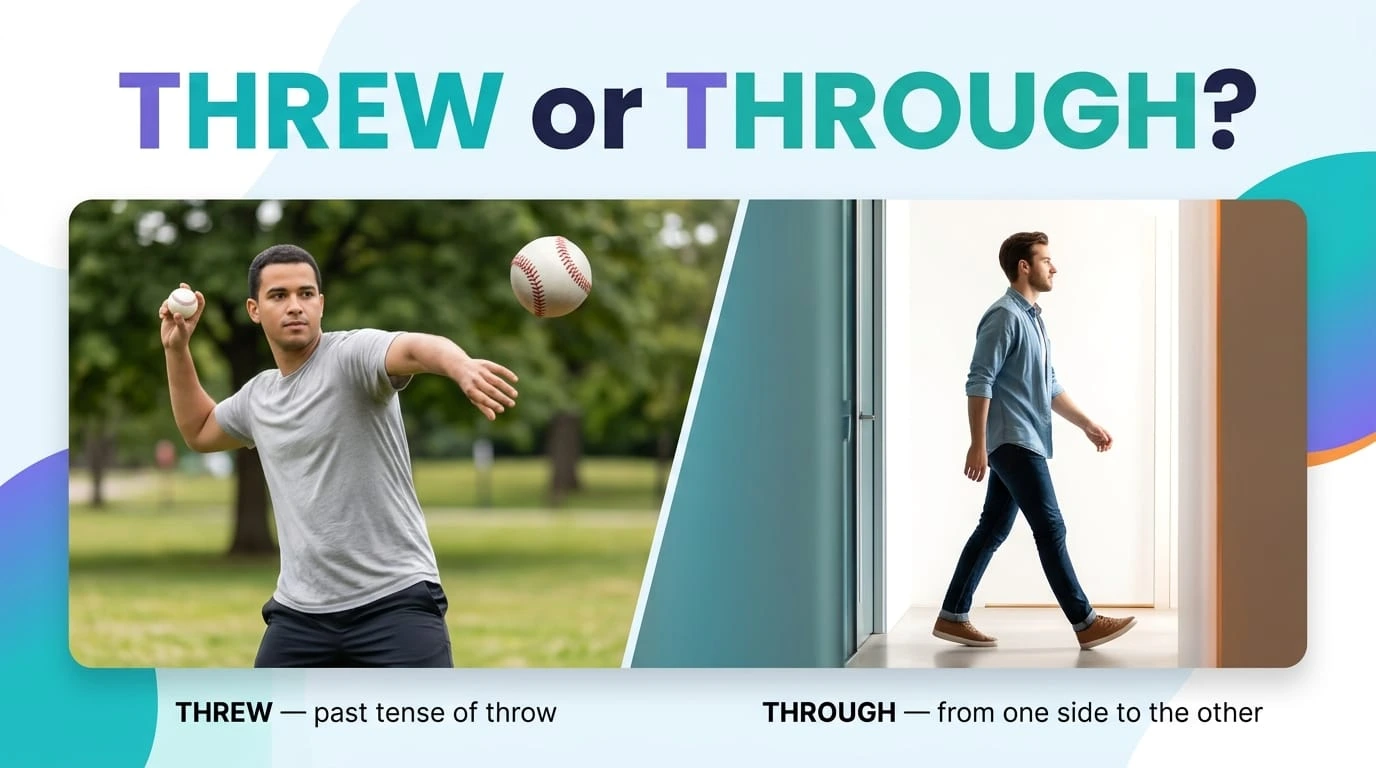
Threw is the past tense of throw, while through is a preposition, adverb, or adjective meaning from one side to another, during a period, or from start to finish.
A single letter can change the whole meaning of a sentence. That is exactly what happens with threw and through. They sound similar in some accents, but they are not the same word.
Imagine writing, “She threw the door.” It sounds strange because the intended word may be through. Now consider, “He walked threw the park.” That is also wrong if you mean that he moved through the park.
These words often confuse learners because their spelling and pronunciation can look or sound close. Yet their jobs in a sentence are very different.
The good news is that the difference is easy once you connect each word with its basic idea. Threw is about an action: someone tossed something. Through is about movement, direction, time, or completion.
This guide breaks down both words with simple rules, real examples, common mistakes, and useful answers to questions such as “Is it walk through or walk threw?” and “How do you use threw in a sentence?”
Threw or Through: Quick Answer
Threw is the past tense of throw.
- She threw the ball to me.
- He threw the paper in the bin.
Through usually shows movement, direction, a period of time, or completion.
- We walked through the park.
- I worked through the night.
- She read through the report.
A simple memory trick is:
Throw → Threw
Walk → Through
If someone tossed something, you probably need threw. If someone moved inside, across, during, or from beginning to end, you probably need through.
The Origin and Background of Threw and Through
Although threw and through look similar, they have different histories and developed from different Old English words.
Threw comes from the verb throw. The modern form developed from older Germanic forms related to the idea of twisting, turning, or hurling something. Over time, the verb became throw, with threw developing as its simple past form.
The word through has a different history. It comes from Old English forms such as þurh, which expressed the idea of moving from one side or point to another. Its spelling changed over many centuries before becoming the modern English through.
English spelling was not always fixed. Words changed as pronunciation, writing habits, and regional forms developed. That history helps explain why through contains several letters that do not seem obvious from its modern pronunciation.
Today, the two words have very different grammatical jobs:
- Threw = past action of throwing
- Through = movement, direction, time, or completion
Knowing this difference is more useful than trying to remember their spelling alone.
Threw or Through Explained: Key Differences
What Does Threw Mean?
Threw is the simple past tense of throw.
It means that someone sent, tossed, or moved something through the air using force.
Examples:
- Tom threw the ball.
- She threw the keys onto the table.
- The boy threw a stone into the water.
- He threw the old papers away.
The present form is:
throw → threw
For example:
- I throw the ball every day.
- I threw the ball yesterday.
What Does Through Mean?
Through has several uses. It can describe movement from one side or place to another.
- We walked through the forest.
- The train went through the tunnel.
- Light came through the window.
It can also describe a period of time.
- She studied through the night.
- We worked through the weekend.
It can also describe completion or examining something from beginning to end.
- I read through the report.
- He looked through the documents.
- She worked through the problem.
Is It Walk Through or Walk Threw?
The correct phrase is walk through.
Walk through means to move from one part of a place to another, usually inside or across it.
- We walked through the park.
- She walked through the hallway.
- They walked through the forest.
Walk threw is incorrect when you mean movement.
The word threw means that someone tossed something.
❌ We walked threw the park.
✅ We walked through the park.
Threw vs Through: Comparison Table
| Term | Meaning | Region/Context | Best Used When |
| Threw | Past tense of throw | Standard English | Someone tossed or sent something |
| Through | From one side or place to another | Standard English | Describing movement |
| Through | During a period | Standard English | Describing time |
| Through | From beginning to end | Standard English | Describing completion or examination |
When Should You Use Threw?
Use threw when you are talking about an action that happened in the past.
Throwing an Object
- She threw the ball.
- He threw the stone.
- The player threw the ball across the field.
Throwing Something Away
- I threw the empty bottle away.
- She threw the old papers in the bin.
Throwing Something Toward Someone
- He threw me the keys.
- Sarah threw the ball to her brother.
A quick test works well:
Ask yourself:
Did someone throw or toss something?
If yes, use threw for a past action.
When Should You Use Through?
Use through when you are talking about movement, time, or completion.
Movement
- We drove through the city.
- The cat ran through the door.
- They walked through the garden.
Time
- I stayed awake through the night.
- She worked through lunch.
- The shop remained open through the weekend.
From Beginning to End
- I read through the book.
- He checked through the list.
- We went through all the questions.
A Process or Experience
Through can also describe something that a person experiences or passes during a period.
- She went through a difficult time.
- He worked through many problems.
- They went through several changes.
Common Mistakes With Threw and Through
Mistake 1: Writing “Walk Threw”
❌ We walked threw the park.
✅ We walked through the park.
This mistake happens because threw and through can sound similar.
Mistake 2: Using “Through” for Throwing
❌ He through the ball.
✅ He threw the ball.
The sentence describes a past throwing action, so threw is needed.
Mistake 3: Using “Threw” After “Have”
❌ I have threw the ball.
✅ I have thrown the ball.
This is an important grammar point.
Threw is the simple past form.
Thrown is the past participle.
The pattern is:
Throw → Threw → Thrown
Examples:
- I throw the ball.
- I threw the ball.
- I have thrown the ball.
Mistake 4: Confusing “Through” With “Threw”
❌ We drove threw the tunnel.
✅ We drove through the tunnel.
The car is moving inside the tunnel, so through is correct.
Mistake 5: Using “Threw” for Time
❌ She worked threw the night.
✅ She worked through the night.
Here, through means during the whole period.
Threw or Through in Real-World Examples
Professional Email
I threw the old documents away after checking the records.
Here, threw describes a past action.
Another example:
I went through the report and found two small errors.
Here, through means examining the report carefully.
News Writing
The player threw the ball across the field during the final minute.
The word describes a past action.
Another example:
Heavy rain continued through the night.
Here, through refers to a period of time.
Social Media Post
I threw my old notes away today!
Or:
We walked through the old town and found a beautiful café.
Both words are correct, but they have different meanings.
Formal Report
The team went through the available records before making a decision.
Here, through means examining the records.
Everyday Conversation
I threw the keys on the table.
But:
I walked through the kitchen.
The first sentence describes throwing. The second describes movement.
How to Use Threw in a Sentence
Using threw is simple when you remember that it is the past form of throw.
Here are some natural examples:
- She threw the ball to her friend.
- He threw his bag on the bed.
- The child threw the toy across the room.
- I threw the paper away.
- The player threw the ball toward the goal.
- She threw a stone into the river.
Remember that threw needs a past-time meaning.
For present actions, use throw:
I throw the ball every morning.
For past actions, use threw:
I threw the ball yesterday.
For perfect tenses, use thrown:
I have thrown the ball.
What Are the Two Common Meanings of Through?
Through has more than two meanings, but two very common ones are especially useful for learners.
1. Movement From One Side to Another
This meaning shows movement inside or across something.
- We walked through the tunnel.
- The train passed through the city.
- Sunlight came through the window.
Think:
inside → across → out
2. From Beginning to End
This meaning shows that something continues for the whole period or process.
- She worked through the night.
- I read through the report.
- He stayed with us through the summer.
Think:
start → continue → finish
This is why through can talk about both physical movement and time.
A Simple Trick to Remember Threw vs Through
Use the THROW test.
If you can replace the word with tossed, use threw.
She threw the ball.
She tossed the ball.
If you can replace it with an idea like across, inside, during, or from start to finish, use through.
We walked through the tunnel.
We walked inside and across the tunnel.
Another useful pattern is:
Throw → Threw → Thrown
Never confuse threw with through.
- Threw = past of throw
- Through = movement, time, or completion
- Thrown = past participle of throw
Threw or Through: Data, Trends & Usage
The confusion between threw and through is mainly an informational grammar and spelling issue. Learners often search for these words when writing sentences, checking homework, or correcting English.
The problem is especially easy to understand because English contains many words that sound similar but have different meanings. These are often called homophones or near-homophones, depending on the speaker’s pronunciation.
Searchers are usually trying to answer one of three questions:
- Which spelling is correct?
- What does the word mean?
- How should I use it in a sentence?
That means a useful page should not only give a dictionary-style definition. It should also show the words in real sentences and explain the grammar behind them.
For learners, the strongest memory is simple:
Threw = an action of throwing in the past.
Through = movement, time, or completion.
Frequently Asked Questions
Is it walk through or walk threw?
The correct phrase is walk through. Use through when describing movement from one place or part of something to another. For example, “We walked through the park.”
How do you use threw in a sentence?
Use threw as the simple past form of throw. For example, “She threw the ball to her brother.” It means that she tossed or sent the ball.
What are the two meanings of through?
Two common meanings of through are movement from one side or place to another and movement or continuation from the beginning to the end of a period or process. For example, “We walked through the tunnel” and “She worked through the night.”
What does threw mean?
Threw is the simple past tense of throw. It means that someone tossed, sent, or moved something with force. For example, “He threw the ball.”
Is “he threw the ball” correct?
Yes. Threw is correct because the sentence describes a past action of throwing. The present form is throw, while the past form is threw.
Is “I walked threw the door” correct?
No. If you mean that you moved through the doorway, the correct sentence is “I walked through the door.” The word threw would mean that you tossed something.
What is the difference between threw, through, and thrown?
Threw is the simple past form of throw. Thrown is the past participle, used with helping verbs such as have or has. Through is a different word that commonly describes movement, time, or completion.
Final Verdict
The difference between threw and through is simple once you focus on meaning.
Threw is the past tense of throw. Use it when someone tossed or sent something.
She threw the ball.
Through is used for movement, time, or completion.
We walked through the park.
You should also remember that threw is not the same as thrown. The basic verb forms are:
Throw → Threw → Thrown
For through, think about moving across a place, continuing during a period, or going from beginning to end.
When you are unsure, ask yourself one question: Is someone tossing something? If yes, use threw. If the sentence is about movement, time, or a process, through is usually the right choice.
Keep this simple rule in mind, and you will stop mixing up these two words.
Was or Were: Easy Rules and Real Examples

I’m a language enthusiast and content writer. I’m specialized in English grammar, spelling differences, vocabulary explanations, and word comparisons. My goal is to help readers improve their writing skills through clear, accurate, and easy-to-understand language guides.