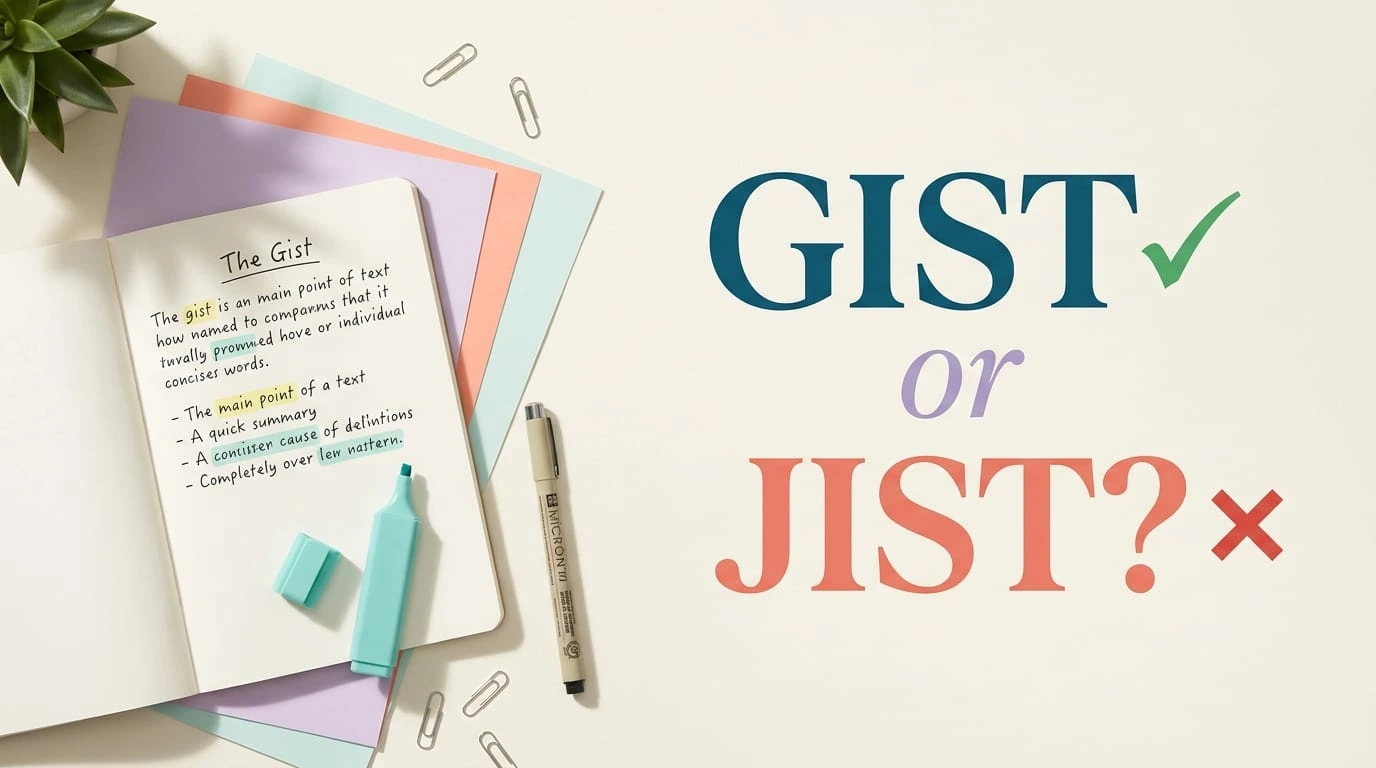
Gist is the correct spelling. It means the main idea or central point of something. Jist is a misspelling of gist.
Have you ever read a long story and wanted to explain it in just one sentence? You might say, “Here is the gist of the story.” This means you are sharing its main idea without repeating every detail.
The words gist or jist can confuse English learners because they sound similar when spoken. However, only one is the standard English spelling. If you write “jist” in an email, school assignment, or article, it will usually be marked as a spelling mistake.
Learning the correct form is simple. You need to remember what the word means, how to spell it, and when to use it.
In this guide, you will learn the difference between gist and jist, explore their meanings and origins, and see examples from daily life. You will also discover useful synonyms and common mistakes to avoid.
By the end, you will know which spelling to use in schoolwork, professional writing, and everyday conversations.
Gist or Jist: Quick Answer
The correct spelling is gist, not jist. Gist is a noun that means the main point, basic meaning, or central idea of something.
For example:
- Correct: I understood the gist of the lesson.
- Incorrect: I understood the jist of the lesson.
You can use gist when you want to explain the main idea of a book, speech, article, meeting, or conversation.
Remember this simple rule: Gist is correct; jist is incorrect in standard English.
The Origin and Background of Gist
The word gist has a long history in the English language. It came from Anglo-French legal language and is linked to a word meaning “it lies” or “it rests.”
Over time, gist developed its modern meaning: the main point or substance of a matter.
Today, people use gist in many situations. Students talk about the gist of a lesson. Journalists explain the gist of a report. Workers discuss the gist of a meeting.
But why do some people write “jist”?
The main reason is pronunciation. In English, the letter g can have a soft sound, as in “giant,” “gentle,” and “gist.” This sound is similar to the letter j in “jam” and “jump.”
Because gist sounds like it starts with a “j” sound, some writers spell it as jist by mistake.
However, pronunciation does not always tell you how to spell a word. The standard spelling remains gist.
Gist Explained: Key Differences and Variations
Gist and jist may sound alike, but they do not have the same status in standard English.
| Term | Meaning | When to Use | Region/Context |
| Gist | The main idea or point | When summarizing information | Standard English worldwide |
| Jist | A common spelling error for gist | Avoid in formal and standard writing | Nonstandard spelling |
| Essence | The most important part | When describing the core meaning | Formal and everyday English |
| Summary | A short account of longer content | When explaining a text or event briefly | Academic and professional English |
| Main point | The key idea | When explaining an argument or message | Everyday and formal English |
What Does Gist Mean?
Gist refers to the most important part of a message or piece of information.
For example:
“My teacher explained the gist of the chapter.”
This means the teacher explained the chapter’s main idea.
You do not need to know every small detail to understand the gist. You only need to understand the central message.
Is Jist Ever Correct?
In standard English, jist is not the accepted spelling of gist.
You may see jist in informal online writing, comments, or messages. However, that does not make it the correct spelling.
Use gist in essays, reports, emails, blog posts, and other forms of writing.
Which Spelling Should You Use?
The choice is simple: use gist in every standard English context.
For Students
Students should write gist in school assignments, exam answers, and reading summaries.
Example: “Write the gist of the passage in three sentences.”
For Teachers and Writers
Teachers and writers can use gist when asking readers to identify the central idea of a text.
Example: “The first paragraph gives the gist of the article.”
For Business Professionals
In business, gist is useful when sharing the main points of a discussion or meeting.
Example: “Please send me the gist of yesterday’s meeting.”
For Social Media Users
You can use gist in casual posts and messages when explaining something briefly.
Example: “I missed the meeting. Can you tell me the gist?”
Best advice: Use gist regardless of your audience or writing style. There is no need to use jist.
Common Mistakes with Gist or Jist
Here are five common mistakes and how to correct them.
1. Writing Jist Instead of Gist
Incorrect: “Can you explain the jist of the story?”
Correct: “Can you explain the gist of the story?”
Why it happens: Both spellings may sound the same when spoken.
2. Thinking Gist Means Every Detail
Incorrect: “The gist includes every sentence in the report.”
Correct: “The gist explains the report’s main idea.”
Why it happens: Some readers confuse a gist with a full summary. The gist focuses on the central point, not every detail.
3. Using Gist as a Verb
Incorrect: “Please gist this chapter for me.”
Correct: “Please summarize this chapter for me.”
Why it happens: People may assume that gist works like the verb summarize. In standard English, gist is mainly used as a noun.
4. Confusing Gist with a Summary
A gist gives the central idea in a few words or sentences. A summary may include several important points and more detail.
Example:
- Gist: The story is about friendship.
- Summary: The story follows two friends who overcome problems and learn to trust each other.
5. Forgetting the Correct Spelling in Exams
Incorrect: “The jist of the passage is about teamwork.”
Correct: “The gist of the passage is about teamwork.”
Why it happens: Students may remember the sound but forget the spelling.
Easy memory tip: Gist begins with G, just like “general idea.” Think of gist as the general idea of a text.
Gist in Real-World Examples
The word gist is useful in many everyday situations. Here are examples of how to use it naturally.
1. In a Professional Email
Subject: Meeting Summary
“Hi Sarah,
Could you please send me the gist of the client meeting? I need the main points before tomorrow’s discussion.
Thank you.”
Here, gist means the main points of the meeting.
2. In a News Article
Headline: “New Education Plan: The Gist of the Proposal”
“The gist of the proposal is to improve access to education and provide better learning resources.”
Here, gist introduces the central message of the proposal.
3. In a Social Media Post
“I did not have time to read the full report, but I got the gist from the first page.”
This is a natural, informal use of gist.
4. In a Formal Report
“The gist of the findings is that regular practice improves student performance.”
This sentence presents the central conclusion of the findings.
5. In Everyday Conversation
Person A: “Did you understand what the speaker said?”
Person B: “Yes, I got the gist, but I missed a few details.”
This shows that someone understood the main message without understanding everything.
Gist: Data, Trends, and Usage
The keyword gist or jist has clear informational search intent. People who search for it usually want to know which spelling is correct, what the word means, and how to use it.
The topic is especially useful for:
- English learners who need help with spelling and pronunciation.
- Students who write summaries and answer reading questions.
- Writers and editors who want to avoid common spelling mistakes.
- Everyday readers who want to understand unfamiliar words.
Gist is also useful in digital communication. People often need to explain long messages, reports, and discussions in a short form.
However, exact search volumes and regional search trends should be checked with a keyword research tool before making numerical claims.
One useful insight is that spelling searches often reflect a sound-based problem. When two spellings sound alike, readers may search both versions to check which one is correct.
For this keyword, the most helpful answer is direct: gist is the standard spelling, and jist is a misspelling.
Gist vs Jist: Comparison Table
| Term/Variant | Meaning | Region/Context | Best Used When |
| Gist | The main idea or central point | Standard English | Summarizing a message or text |
| Jist | Nonstandard spelling of gist | Informal spelling errors | Not recommended in standard writing |
| Essence | The core nature or meaning of something | Standard English | Explaining the heart of an idea |
| Main idea | The most important thought | Academic and everyday English | Identifying what a passage is about |
| Summary | A brief account of key information | Academic and professional English | Covering several important points |
The key difference is that gist is the correct spelling, while jist is not accepted as the standard form.
Frequently Asked Questions
Q1: What is the correct spelling, gist or jist?
A: Gist is the correct spelling in standard English. It means the main idea or central point of something. Jist is a common spelling mistake.
Q2: What does gist mean?
A: Gist means the main point or basic meaning of something. For example, “I understood the gist of the story” means you understood its main idea.
Q3: Why do people spell gist as jist?
A: People may write jist because gist begins with a soft “g” sound that resembles the “j” sound. This can cause confusion between pronunciation and spelling.
Q4: Is gist acceptable in formal writing?
A: Yes, gist is acceptable in formal writing. You can use it in reports, essays, business emails, and academic discussions when referring to the main point of something.
Q5: What is the difference between gist and summary?
A: Gist usually refers to the central idea in a short form. A summary can include several important points and more detail from the original content.
Q6: Where does the word gist come from?
A: Gist comes from Anglo-French legal language. Its history is linked to a phrase meaning “it lies” or “it rests.” The word later developed its modern sense of the main point or substance of something.
Q7: Can I use gist in everyday conversation?
A: Yes, gist is common in everyday English. You can say, “Give me the gist,” when you want someone to explain the main points quickly.
Q8: What are some synonyms for gist?
A: Common synonyms include main idea, essence, core, substance, central point, and main point. The best choice depends on the sentence and context.
Q9: Is gist a noun or a verb?
A: Gist is mainly used as a noun. For example, “The gist of the story is clear.” Use verbs such as summarize or explain when describing the action of giving the main idea.
Conclusion
When choosing between gist or jist, always use gist. It is the correct spelling in standard English and means the main idea or central point of something.
Remember these key points:
- Gist is the correct spelling.
- Jist is a spelling mistake in standard English.
- Gist helps you explain the main idea without giving every detail.
- You can use gist in conversations, schoolwork, emails, and reports.
The confusion often happens because gist starts with a soft “g” sound. But once you learn the correct spelling, the choice becomes easy.
You can also use words such as essence, main point, and central idea when they fit your sentence better.
Now you know exactly how to use gist. Practice it in your next sentence, and bookmark this guide to avoid the same spelling mistake again.
Tries or Trys: The Simple Rule That Ends the Confusion

I’m a language enthusiast and content writer. I’m specialized in English grammar, spelling differences, vocabulary explanations, and word comparisons. My goal is to help readers improve their writing skills through clear, accurate, and easy-to-understand language guides.