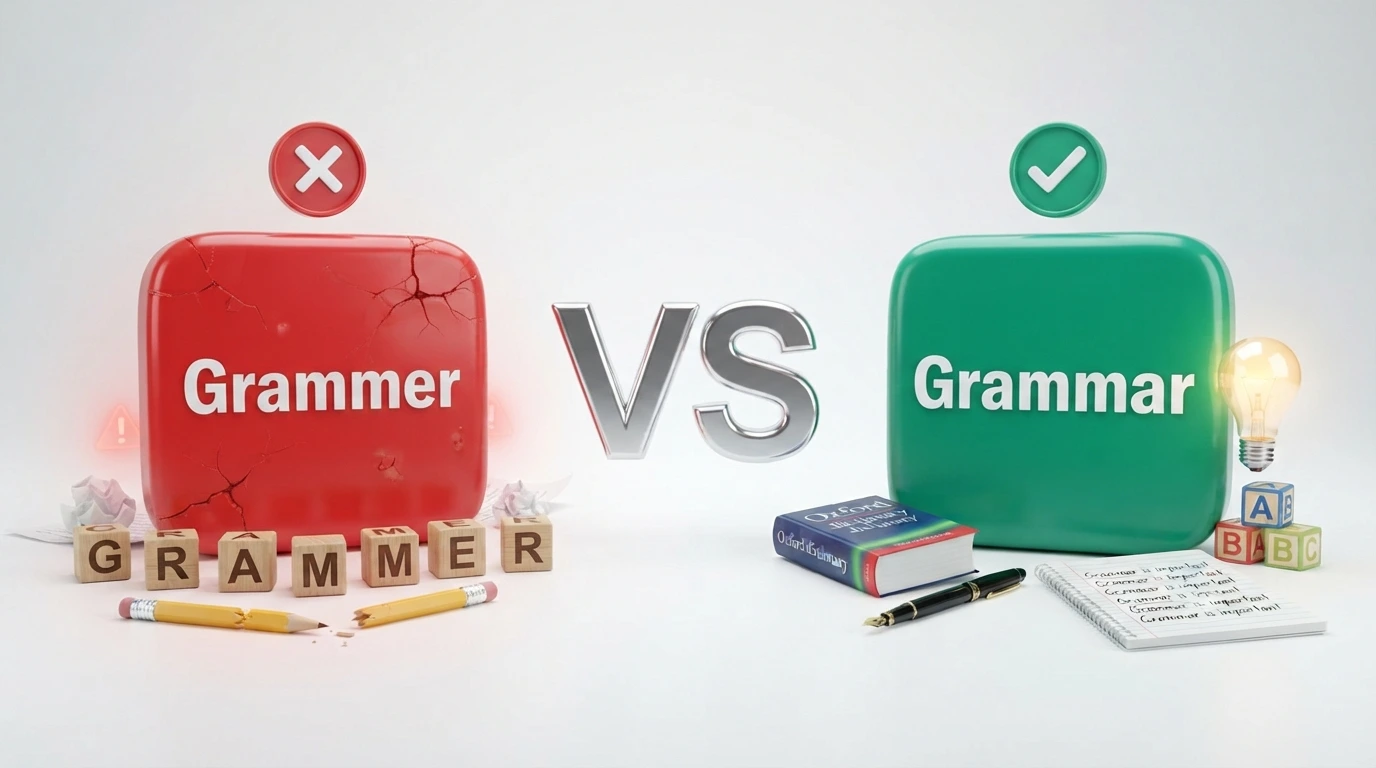
"Grammar" means the set of rules that govern how words combine to form sentences in a language. "Grammer" is a common misspelling and isn't a real word in standard English.
I once started a blog post with the sentence “Good grammer matters more than you think,” completely unaware of the irony until a reader pointed it out in the comments. I’d misspelled the very word I was writing an entire article about.
If you’ve ever made this exact mistake, you’re definitely not alone. This might be one of the most ironic misspellings in English, a word about language rules that trips up so many writers on spelling alone.
This guide clears up exactly why “grammar” ends in “-ar” instead of “-er,” where the confusion comes from, and how to spell it correctly every time, whether you’re writing an essay, a resume, or a quick email.
Grammer or Grammar: Quick Answer
“Grammar” is always correct. “Grammer” is a spelling error, not an accepted variant.
- ✅ Her grammar improved significantly after months of practice.
- ❌ Her grammer improved significantly after months of practice.
The confusion happens because English has many common words ending in “-er,” like “teacher” and “computer,” which makes “-ar” endings feel less intuitive, even though “grammar” has always used this specific spelling.
Grammar or Grammer Pronunciation
Grammar (GRAM-er)
Both grammar and the common misspelling grammer are generally pronounced the same: /ˈɡræm.ər/ (“GRAM-er”).
| Word | Pronunciation | Sounds Like | Correct? |
|---|---|---|---|
| Grammar | /ˈɡræm.ər/ | GRAM-er | ✅ Yes |
| Grammer | /ˈɡræm.ər/ | GRAM-er | ❌ No (Misspelling) |
Do They Sound Different?
No. Grammar and grammer sound the same when spoken. The difference is in the spelling:
- Grammar is the correct English word that refers to the rules of a language.
- Grammer is a common misspelling and is not accepted in standard English.
Example Sentences
- ✅ Her grammar has improved significantly this year.
- ❌ Her grammer has improved significantly this year.
Although both words are pronounced “GRAM-er,” only grammar is correct in formal and everyday English writing.
The Origin of Grammar
“Grammar” comes from Greek grammatikē, related to gramma, meaning “letter” or “something written.” The word passed through Latin grammatica and Old French grammaire before settling into English, consistently keeping that “-ar” ending throughout its long history across multiple languages.
Interestingly, “grammar” is related to another English word you might not expect, “glamour.” Both trace back to the same root, since “glamour” originally referred to magical learning or spellcasting, itself linked to the idea of grammar as specialized, almost mysterious knowledge in medieval times. Over centuries, “glamour” shifted toward meaning charm or enchantment, while “grammar” kept its more technical, language-focused meaning.
Because English contains so many more common “-er” endings than “-ar” endings, writers frequently default to the more familiar pattern, which is exactly why “grammer” shows up as one of the most persistent misspellings related to language and writing itself.
Grammar Explained: Key Differences and Variations
| Word | Correct Spelling | Ending | Example |
|---|---|---|---|
| Grammar | Grammar | -ar | She studied grammar rules before the exam. |
| Grammarian | Grammarian | -ian | The grammarian corrected the manuscript. |
| Grammatical | Grammatical | -ical | The sentence had a grammatical error. |
| Grammer | Not a real word | -er (incorrect) | Incorrect in any context. |
Notice that related words like “grammatical” and “grammarian” keep the same “gram-” root but add different endings, none of which include the incorrect “-er” pattern seen in “grammer.”
Which Spelling Should You Use?
For everyday writing
Always use grammar. There’s no context where “grammer” is correct.
For students and ESL learners
Remember the connection to “grammatical” and “grammarian,” both of which clearly keep the “-ar” spelling, as a helpful memory anchor.
For academic, professional, or published writing
Double-check carefully, since “grammer” is a surprisingly common typo, even in writing specifically about language or education.
For global or neutral use
Grammar is standard across American, British, Australian, and all other English dialects. There’s no regional variation here.
Dilemna or Dilemma: Which Spelling Is Correct?
Common Mistakes with Grammar
Mistake 1: Writing “grammer” instead of “grammar”
✅ Good grammar makes your writing clearer and more professional.
❌ Good grammer makes your writing clearer and more professional.
Why it happens: Writers default to the more common “-er” ending pattern found in many other English words.
Mistake 2: Misspelling related words the same way
✅ grammatical, grammarian
❌ grammerical, grammerian
Why it happens: Once the base word is misspelled, the error often carries over into related forms.
Mistake 3: Confusing “grammar” with “glamour”
✅ She studied grammar in college. The city has a certain glamour to it.
❌ Assuming these two unrelated-sounding words share no connection at all.
Why it happens: While they’re historically related, most writers don’t realize the connection, and mixing up their spellings or meanings is a separate, less common error.
Mistake 4: Writing “grammer” in professional or academic documents
✅ This report will be reviewed for grammar and clarity before submission.
❌ This report will be reviewed for grammer and clarity before submission.
Why it happens: Fast typing and rushed proofreading let this common typo slip through, even in careful professional writing.
Mistake 5: Assuming spellcheck will always catch it
✅ Proofread manually, since some browser extensions and casual writing tools still miss this error.
❌ Relying only on autocorrect to flag “grammer” as incorrect.
Why it happens: While most modern spellcheckers do catch this mistake, older or less robust tools sometimes miss it.
Grammar in Real-World Examples
Professional email:
“Please review the document for grammar and formatting before we send it to the client.”
News headline:
“Study Finds Grammar Skills Declining Among High School Students”
Social media post:
“My grammar isn’t perfect, but my enthusiasm definitely is. 😄”
Formal document:
“All submissions must follow standard grammar and style guidelines outlined in section two.”
In every case, grammar is the only correct spelling, regardless of tone or formality.
Grammar: Data, Trends & Usage
Search interest in “grammer vs grammar” stays consistently high, driven largely by students, writers, and professionals double-checking spelling before submitting essays, resumes, or published content. This falls into the informational search category, with people wanting a fast, reliable answer before finalizing important writing.
This particular misspelling sees notably high search volume given the word’s own subject matter, people writing about grammar rules while simultaneously misspelling the term itself. Educational platforms and writing tools drive significant traffic here, since correct spelling of foundational language terms remains a common early-learning challenge.
Grammer vs Grammar: Comparison Table
| Term/Variant | Meaning | Region/Context | Best Used When |
|---|---|---|---|
| Grammar | Rules governing sentence structure and word usage | Universal, all English dialects | Always, in any writing context |
| Grammer | Misspelling, not a real word | None, incorrect everywhere | Never, avoid entirely |
| Grammatical | Relating to grammar (adjective) | Universal | Describing something related to grammar rules |
Frequently Asked Questions
Q: What does “grammar” mean?
A: “Grammar” refers to the set of rules that govern how words are structured and combined to form correct sentences in a language.
Q: How do you use “grammar” correctly in a sentence?
A: Use “grammar” whenever referring to language rules or structure, such as “Please check the grammar before submitting” or “Her grammar improved with practice.”
Q: Grammar vs grammer, what’s the difference?
A: There’s no real difference in meaning, since “grammer” isn’t a correct word at all. “Grammar” is the only accepted spelling.
Q: Is “grammar” acceptable in formal writing?
A: Yes, completely. “Grammar” is standard in academic, professional, and published writing across every context and industry.
Q: Which version is correct, grammer or grammar?
A: “Grammar” is correct. “Grammer” is a spelling error that doesn’t appear in any English dictionary.
Q: Where does the word “grammar” come from?
A: It comes from Greek grammatikē, related to gramma meaning “letter,” passing through Latin and Old French before entering English.
Q: Can “grammar” be used in casual conversation and texting?
A: Yes. The spelling never changes based on tone, it’s “grammar” whether you’re texting a friend or writing a formal essay.
Final Takeaway
Here’s the short version. “Grammar” is always correct. “Grammer” is always wrong.
Key points to remember:
- The rule: “Grammar” always ends in “-ar,” not the more common “-er” pattern
- Memory trick: Connect it to “grammatical” and “grammarian,” which both keep the “-ar” spelling clearly visible
- Watch irony in your own writing: This misspelling is especially noticeable in writing specifically about grammar or language
- No exceptions: “Grammar” is standard in every English dialect, formal or casual
Once you lock in the “-ar” ending, you’ll never write “grammer” again.
Bookmark this guide so you never second-guess “grammar” vs “grammer” again, and share it with anyone writing an essay, resume, or professional document.
Grammar vs Grammer: Learn the correct spelling, meaning, simple grammar rule, and easy examples to avoid this common English mistake.
Neice or Niece: Which Spelling Is Correct?

I am a language content specialist specializing in spelling comparisons, vocabulary usage, and commonly confused English words. I write detailed, informative articles that help readers improve their language skills. I am passionate about helping students, writers, and professionals develop a stronger understanding of the English language.