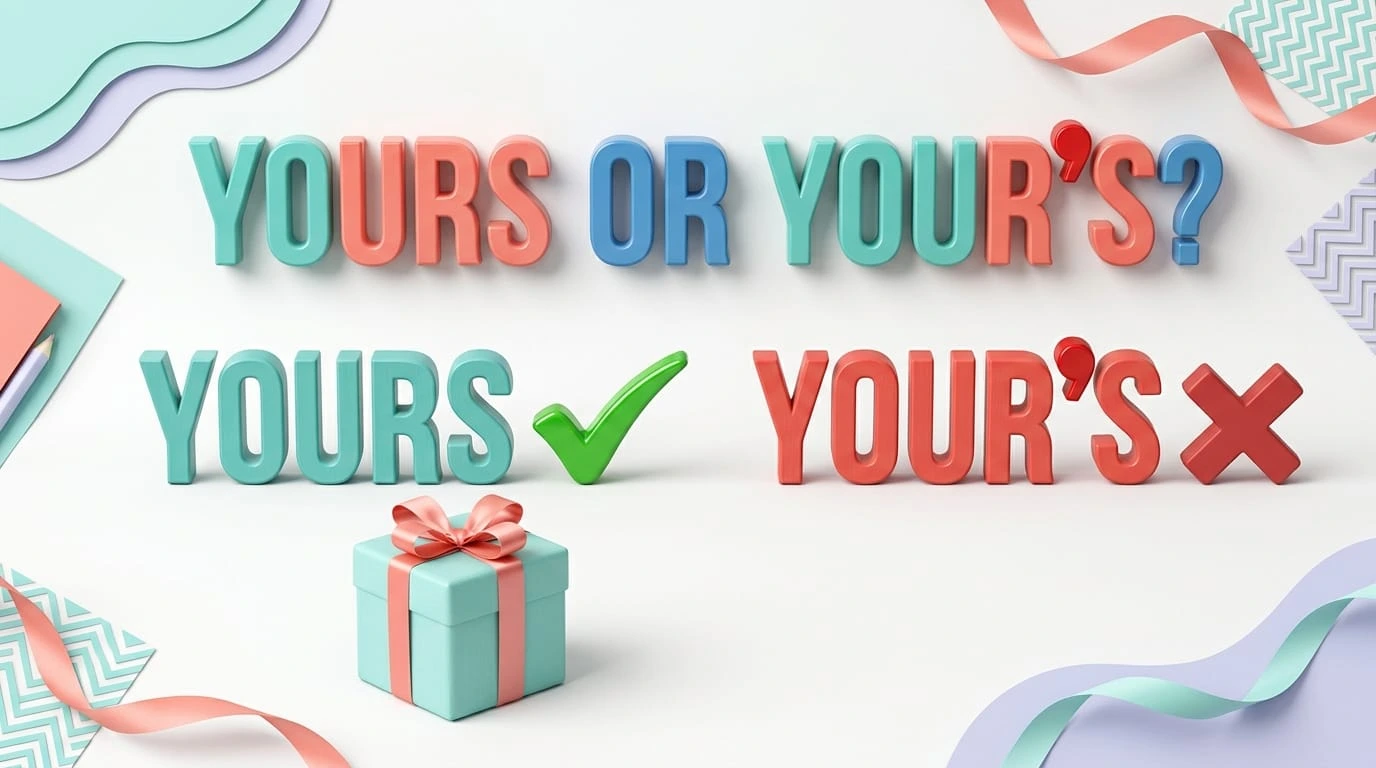
Yours is the correct spelling. It shows that something belongs to you. Your’s is incorrect because possessive pronouns do not need an apostrophe.
Have you ever stopped while writing a message and wondered whether to type yours or your’s? You are not alone. This small spelling mistake can happen to students, new writers, and even people who use English every day.
Imagine writing a letter to a friend. You finish with “Your’s sincerely” and send it without checking. The message is clear, but the spelling is wrong. One tiny apostrophe can make your writing look less polished.
As an English teacher and language writer, I often see learners mix up apostrophes in words that show ownership. They know that words like John’s and Sarah’s use apostrophes. So, they may think your’s should follow the same rule.
However, English has a simple rule that makes this easy to remember. Words such as yours, ours, theirs, hers, and its do not need an apostrophe to show ownership.
In this guide, you will learn the difference between yours and your’s, see clear examples, and discover how to avoid common mistakes. By the end, you will know which spelling to use in schoolwork, emails, letters, and everyday messages.
Yours or Your’s: Quick Answer
Yours is the correct spelling when you mean that something belongs to the person you are speaking to. Your’s is a spelling error in standard English.
Examples:
- Correct: This blue bag is yours.
- Incorrect: This blue bag is your’s.
- Correct: The final choice is yours.
- Incorrect: The final choice is your’s.
Remember this simple rule: Use “yours” without an apostrophe.
What does “yours” mean?
Yours is a possessive pronoun. It shows that something belongs to the person or people being addressed.
For example:
- This seat is yours.
- My phone is here, but yours is missing.
- The success is yours.
- Is this book yours?
In each sentence, yours replaces a noun phrase. It helps you avoid repeating the name of the thing that belongs to someone.
The Origin and Background of Yours
The word yours comes from the older English word your, which was used to show possession. Over time, English developed forms such as yours to make possessive expressions clearer.
The ending -s in yours is part of the word. It is not an apostrophe-based contraction or a sign that you should add another mark.
Why do people write your’s? The answer is simple. Many English nouns use ‘s to show ownership.
For example:
- Ali’s book
- Emma’s bag
- The teacher’s desk
These examples use apostrophes because they are possessive nouns. But yours is already a possessive pronoun. It follows a different rule.
Compare these sentences:
- This is Ali’s book.
- This book is yours.
The first sentence uses a noun with an apostrophe. The second uses a possessive pronoun without one.
That is why your’s is not the correct form.
Yours Explained: Key Differences and Variations
The main difference is spelling and grammar. Yours is correct, while your’s is incorrect in standard English.
It also helps to understand the difference between your and yours. These two words are both correct, but they work in different ways.
Your vs. Yours vs. Your’s
| Term | Meaning | When to Use | Region/Context |
| Your | Shows ownership before a noun | Your book is on the desk. | Standard English |
| Yours | Shows ownership without repeating the noun | This book is yours. | Standard English |
| Your’s | Incorrect spelling of the possessive pronoun | Do not use it in standard writing. | Nonstandard or mistaken usage |
When should you use “your”?
Use your before a noun. It tells the reader who owns something.
Examples:
- Your phone is ringing.
- I like your new shoes.
- Please bring your notebook.
- Your answer is correct.
Notice that a noun follows your in each example.
When should you use “yours”?
Use yours when the noun does not need to be repeated.
Examples:
- My room is small, but yours is large.
- This pen is yours.
- The decision is yours.
- Our house is near yours.
You do not need to write yours book or yours phone. Instead, write your book or your phone.
Why is “your’s” wrong?
The apostrophe is not needed because yours is already a possessive pronoun. Adding one does not make the word more possessive.
Incorrect: Is this your’s?
Correct: Is this yours?
The same rule applies to other possessive pronouns. Write hers, ours, theirs, and its without apostrophes when showing possession.
Which Version Should You Use?
The answer is simple: always use “yours” when you mean something belongs to someone. Do not use your’s in standard English.
Here is how the rule applies to different readers.
For students
Use yours in essays, exams, homework, and classroom exercises.
Example: “The red notebook is yours.”
Apostrophe errors can affect the accuracy of your writing. Learning this rule will help you avoid a common mistake.
For teachers and English learners
Teach your and yours as two separate forms.
- Your + noun: Your bag is new.
- Yours alone: The new bag is yours.
This simple pattern helps learners understand the difference without memorizing a long grammar rule.
For professional writers
Use yours in business emails, letters, reports, and formal documents.
For example: “The final decision is yours.”
In a formal letter, you may also write “Yours sincerely” or “Yours faithfully,” depending on the letter’s style and context.
For social media and casual messages
Use yours in texts, comments, captions, and online chats.
Example: “The last slice of pizza is yours!”
Casual writing may contain many spelling errors, but using the correct form makes your message clear and polished.
Common Mistakes with Yours or Your’s
Here are five common mistakes and how to fix them.
1. Adding an apostrophe to yours
Incorrect: This seat is your’s.
Correct: This seat is yours.
Why it happens: Writers may copy the possessive noun pattern, such as James’s car.
2. Using yours before a noun
Incorrect: Yours phone is on the table.
Correct: Your phone is on the table.
Why it happens: Learners may confuse a possessive adjective with a possessive pronoun.
3. Confusing your with you’re
Incorrect: Your going to enjoy the film.
Correct: You’re going to enjoy the film.
Why it happens: The words sound alike, but their meanings differ. Your shows ownership. You’re means you are.
4. Adding an apostrophe to other possessive pronouns
Incorrect: The choice is our’s.
Correct: The choice is ours.
Incorrect: That house is her’s.
Correct: That house is hers.
Why it happens: Writers may think all words showing ownership need an apostrophe. They do not.
5. Using the wrong closing in a letter
Incorrect: Your’s sincerely,
Correct: Yours sincerely,
Why it happens: The writer may assume that the closing needs an apostrophe because it refers to the reader.
The rule remains the same: write yours without an apostrophe.
Yours or Your’s in Real-World Examples
Seeing the word in real situations can make the rule easier to remember.
1. Professional email
Example:
Subject: Review of the Final Draft
Hello Alex,
I have attached the latest draft for your review. Please let me know if you would like any changes. The final decision is yours.
Kind regards,
Sam
Why it works: Yours shows that the final decision belongs to Alex.
2. News article
Example headline: “The Final Choice Is Yours: Residents Vote on New Park Plans”
Why it works: The headline tells readers that residents have the power to choose.
3. Social media post
Example:
“Your future is yours to shape. Keep learning, stay focused, and take one step at a time.”
Why it works: Yours refers to the future without repeating the noun phrase.
4. Formal letter
Example:
Dear Mr. Smith,
Thank you for taking the time to review my application. I look forward to hearing from you.
Yours sincerely,
Jordan Lee
Why it works: Yours sincerely is a standard closing in many forms of British English correspondence.
5. Everyday conversation
Example:
A: “Which cup is mine?”
B: “The white one is yours.”
Why it works: The word replaces “your cup,” so there is no need to repeat cup.
Yours or Your’s: Data, Trends, and Usage
The spelling difference between yours and your’s is mainly a grammar and spelling issue. People usually search for this topic because they want to know which form is correct and how to use it.
Search intent
The main search intent is informational. Readers want a quick answer, a simple grammar rule, and examples they can apply to their writing.
Common related searches include:
- Yours or your’s: which is correct?
- Is your’s a word?
- Your vs. yours
- How do you spell yours?
- Does yours need an apostrophe?
- Yours sincerely or your’s sincerely?
Where does the confusion happen?
This mistake can occur among English learners and native speakers alike. It is easy to understand why: many possessive nouns use apostrophes, but possessive pronouns follow a different pattern.
The rule applies across standard British, American, Canadian, and Australian English. There is no regional spelling difference between yours and your’s.
Why does this matter?
Correct spelling helps readers focus on your message instead of your mistakes. It also helps students write more accurately and gives professional emails and formal letters a polished look.
Practical tip: When you write yours, pause before adding an apostrophe. You do not need one.
Yours or Your’s: Standalone Comparison Table
| Term/Variant | Meaning | Region/Context | Best Used When |
| Yours | Something belongs to you | Standard English worldwide | Showing ownership without repeating a noun |
| Your | Shows ownership before a noun | Standard English worldwide | Writing phrases such as “your book” |
| Your’s | Incorrect form of yours | Nonstandard spelling | Avoid it in edited writing |
| You’re | Short form of “you are” | Standard English worldwide | Writing “you’re ready” or “you’re right” |
| Yours sincerely | A formal letter closing | Common in British-style correspondence | Ending a letter when the recipient is named |
Frequently Asked Questions About Yours or Your’s
1. Is it yours or your’s?
Yours is correct. It is a possessive pronoun that shows ownership. The spelling your’s is incorrect in standard English because the word does not need an apostrophe.
2. What does yours mean?
Yours means that something belongs to the person you are speaking to. For example, “This jacket is yours” means that the jacket belongs to you.
3. How do you use yours in a sentence?
Use yours when you do not need to repeat the noun. For example, “My answer is different from yours.” Here, yours means “your answer.”
4. Is yours acceptable in formal writing?
Yes. Yours is correct in formal and informal writing. You can use it in essays, emails, reports, letters, and professional documents.
5. Why doesn’t yours have an apostrophe?
Yours is a possessive pronoun. English possessive pronouns do not use apostrophes to show ownership. The same rule applies to hers, ours, theirs, and its.
6. What is the difference between your and yours?
Your comes before a noun, as in “your car.” Yours can stand alone, as in “The car is yours.” Both words show ownership, but they have different roles in a sentence.
7. Should I write “Yours sincerely” or “Your’s sincerely”?
Write “Yours sincerely.” It is a standard way to end a formal letter in British-style correspondence when you know the recipient’s name. Never add an apostrophe to yours.
8. Is your’s ever correct in English?
No. Your’s is not the accepted spelling of the possessive pronoun in standard English. Use yours instead, even in casual messages and social media posts.
Conclusion: Always Choose Yours
The difference between yours and your’s is easy to remember once you know the rule. Yours is correct, and your’s is incorrect in standard English. You do not need an apostrophe to show ownership with this possessive pronoun.
Keep these three points in mind:
- Use your before a noun, as in “your book.”
- Use yours when the noun does not need to be repeated, as in “The book is yours.”
- Avoid your’s in essays, emails, letters, and everyday messages.
Remember that possessive nouns and possessive pronouns follow different patterns. Words such as John’s and Sarah’s use apostrophes, while yours, hers, ours, and theirs do not.
Once you learn this small rule, you can avoid a common spelling mistake in almost any type of writing. You do not need to second-guess yourself or add an apostrophe just because a word shows ownership.
Tries or Trys: The Simple Rule That Ends the Confusion

I’m a language enthusiast and content writer. I’m specialized in English grammar, spelling differences, vocabulary explanations, and word comparisons. My goal is to help readers improve their writing skills through clear, accurate, and easy-to-understand language guides.