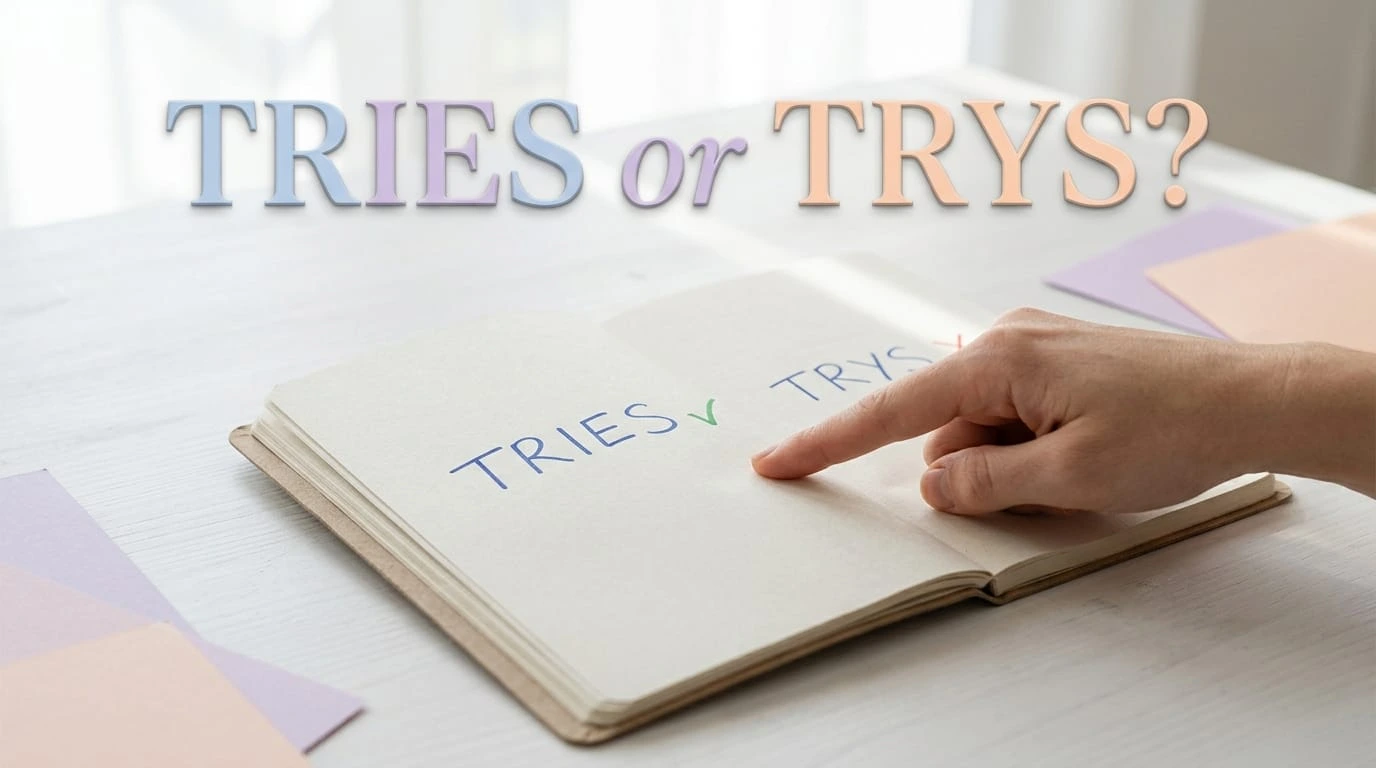
Tries is the correct spelling, while trys is incorrect in standard English. Use tries as the third-person singular form of try or as the plural of the noun try.
Have you ever typed “trys” and then wondered if it was actually correct? This small spelling question can cause a surprising amount of confusion.
Many English verbs simply take -s in the third person. For example, run becomes runs and help becomes helps. So it may seem natural to write trys.
But try follows a different spelling rule.
When a word ends in a consonant + y, the y changes to i before -es is added. That gives us tries, not trys.
This rule is useful far beyond one word. It also explains why we write cries, studies, carries, copies, and worries.
Whether you are a student checking homework, a writer editing an article, or simply trying to improve your English, knowing this rule can help you avoid a common spelling mistake.
By the end of this guide, you will know exactly when to use try, tries, tried, and trying.
Tries or Trys: Quick Answer
Tries is the correct spelling. Trys is not a standard English word.
Use tries in two main situations:
- As the third-person singular form of try.
- As the plural form of the noun try.
For example:
She tries to learn something new every day.
He made several tries before he succeeded.
So, if you are asking “Is it tries or trys?”, the answer is simple:
tries ✓
trys ✗
What Does “Try” Mean?
Before looking at tries, it helps to understand the meaning of try.
The verb try means to make an effort or attempt to do something.
For example:
I will try to finish the work today.
Here, try means make an effort.
The word can also be a noun.
Give it another try.
Here, try means attempt.
The word has several related forms:
- try — base form
- tries — third-person singular or plural noun
- tried — past tense
- trying — present participle
Understanding these forms makes try grammar much easier.
Why Is “Tries” Correct and “Trys” Wrong?
The main reason is an English spelling rule for words ending in y.
When a word ends in consonant + y, the y usually changes to i before an ending such as -es is added.
The pattern looks like this:
consonant + y → ies
That gives us:
- try → tries
- cry → cries
- fly → flies
- study → studies
- carry → carries
- copy → copies
- worry → worries
So when someone asks “Why is tries spelled with ies?”, this is the answer.
The r in try is a consonant. Therefore:
try + es = tries
Not:
try + s = trys
Try vs Tries: What Is the Difference?
The difference between try and tries depends on the subject and the grammar of the sentence.
Use “try” with I, you, we, and they
Examples:
- I try to stay calm.
- You try your best.
- We try new ideas.
- They try to solve the problem.
Use “tries” with he, she, and it
Examples:
- He tries to help.
- She tries to understand.
- It tries to connect to the network.
This is the basic third person of try.
| Subject | Correct Form | Example |
| I | try | I try to help. |
| You | try | You try your best. |
| We | try | We try again. |
| They | try | They try new ideas. |
| He | tries | He tries again. |
| She | tries | She tries to help. |
| It | tries | It tries to restart. |
The key rule is easy:
I/You/We/They → try
He/She/It → tries
Is “Tries” a Word?
Yes. Tries is a correct English word.
It can be a verb or a noun.
“Tries” as a verb
She tries to improve her writing.
Here, tries means makes an effort.
“Tries” as a noun
He made three tries before getting the answer right.
Here, tries means three attempts.
So if you search “is tries a word?”, the answer is definitely yes.
Is “Trys” a Word?
In standard English, trys is not the correct spelling of the word.
If you are writing an essay, email, report, article, assignment, or professional message, use tries.
For example:
❌ She trys to help.
✅ She tries to help.
The incorrect form often appears because writers apply the simple verb + s rule without remembering the special spelling pattern for consonant + y.
Try, Tries, Tried, or Trying?
These forms are related, but they do not work in the same way.
| Form | Grammar | Example |
| try | Base form | I try to help. |
| tries | Third-person singular | She tries to help. |
| tried | Past tense | She tried yesterday. |
| trying | -ing form | She is trying again. |
Try
They try to solve the problem.
Tries
He tries to solve the problem.
Tried
He tried to solve the problem yesterday.
Trying
He is trying to solve the problem now.
Knowing the difference between tried or tries is especially useful when writing about past and present actions.
When Should You Use “Tries”?
Use tries when:
1. The subject is he, she, or it
She tries to arrive early.
2. A singular noun is the subject
The student tries to answer the question.
The company tries to improve its service.
3. You mean more than one attempt
He made several tries.
Her first two tries were unsuccessful.
This makes when to use tries easy to remember.
When Should You Use “Try”?
Use try when it is the base form of the verb.
With I
I try to stay organized.
With you
You try to solve the puzzle.
With we
We try to help.
With they
They try new methods.
You also use try after modal verbs.
- can try
- should try
- might try
- could try
- will try
- must try
For example:
She can try again.
Not:
She can tries again.
Common Mistakes With “Tries”
Mistake 1: Writing “trys”
❌ He trys to help.
✅ He tries to help.
Reason: Change y to i and add -es.
Mistake 2: Using “try” with she
❌ She try to understand.
✅ She tries to understand.
Reason: She is third-person singular.
Mistake 3: Using “tries” after can
❌ He can tries again.
✅ He can try again.
Reason: A modal verb takes the base form.
Mistake 4: Using “tries” for a past action
❌ She tries yesterday.
✅ She tried yesterday.
Reason: The past form of try is tried.
Mistake 5: Confusing tries with trying
❌ He is tries to help.
✅ He is trying to help.
Reason: The present continuous uses the -ing form.
The “Y to IES” Spelling Rule
The easiest way to remember the correct spelling is to learn the y to ies rule.
When a word ends in:
consonant + y
change:
y → i
and add:
-es
Examples:
- try → tries
- cry → cries
- reply → replies
- study → studies
- carry → carries
- hurry → hurries
This rule can help you spell many words correctly, not just tries.
But What About Words Like “Plays”?
Here is where many learners get confused.
Not every word ending in y changes to ies.
If the letter before y is a vowel, the y stays.
Examples:
- play → plays
- stay → stays
- enjoy → enjoys
- obey → obeys
- annoy → annoys
Compare:
try → tries
because r is a consonant.
But:
play → plays
because a is a vowel.
This is one of the most useful ways to understand the consonant y spelling rule.
Tries in Real-World Examples
Professional Email
Our team tries to respond to every customer within one business day.
News Article
The new study tries to explain why people struggle to sleep.
Social Media Post
She tries something new every week.
Formal Report
The report tries to identify the main causes of the problem.
Everyday Conversation
My brother tries to cook dinner on weekends.
These examples show how natural tries sounds in real English.
British English and American English
Some words have different spellings in British and American English.
For example:
- British: favourite
- American: favorite
And:
- British: colour
- American: color
But tries is not one of these words.
Both British English and American English use:
try → tries
So there is no regional spelling choice here.
If you are writing for a global audience, tries is correct.
Tries vs Try: Quick Comparison
| Term/Variant | Meaning | Region/Context | Best Used When |
| try | Make an effort or attempt | Standard English | With I, you, we, they |
| tries | Makes an effort or attempts | Standard English | With he, she, it |
| tries | More than one attempt | Standard English | Plural noun |
| trys | Incorrect spelling | Nonstandard | Do not use |
Quick Rule
Try → tries
Not: try → trys
How to Remember the Correct Spelling
Use this simple question:
What letter comes before the Y?
In try, the letter before y is r.
R is a consonant.
Therefore:
try → tries
You can remember the pattern with four words:
Try, cry, study, carry
Their forms are:
tries, cries, studies, carries
Once you remember this group, the spelling becomes much easier.
Frequently Asked Questions
Q: Is it “tries” or “trys”?
Tries is correct. Trys is an incorrect spelling in standard English.
Q: Is “trys” a word?
No. Trys is not the standard spelling. Use tries instead.
Q: Is “tries” a word?
Yes. Tries is a standard English word. It can be the third-person form of try or the plural noun form.
Q: What is the plural of “try”?
The plural of try is tries.
Example:
He made several tries before succeeding.
Q: What is the third-person singular of “try”?
The third-person singular form is tries.
Example:
She tries to help.
Q: Does “try” become “tries”?
Yes. In the third-person singular simple present, try becomes tries.
The y changes to i, and -es is added.
Q: Why is “trys” wrong?
Because try ends in a consonant followed by y. The standard spelling rule changes the y to i and adds -es.
Q: What is the past tense of “try”?
The past tense is tried.
Example:
I tried to call her yesterday.
Q: Is “tries” used in formal writing?
Yes. Tries is correct in formal writing, academic writing, business communication, and everyday English.
Q: Is “tries” British or American English?
It is used in both British and American English. There is no spelling difference.
Conclusion
If you have been wondering “tries or trys?”, you now have a clear answer.
Tries is correct. Trys is incorrect.
Use try with I, you, we, and they. Use tries with he, she, and it in the simple present. You can also use tries as the plural noun for more than one attempt.
The key spelling rule is:
consonant + y → ies
That gives us:
try → tries
The same rule appears in cries, studies, carries, copies, and worries.
Also remember that tries is used in both British and American English. You do not need to worry about regional spelling here.
So the next time you see trys, stop and check the rule. Change the y to i, add -es, and you have the correct form:
TRIES ✓
Keep this simple rule in mind, and you will never need to second-guess this spelling again.
Michael or Micheal: Correct Spelling Comparison

I’m an English language researcher and content writer. I am specialized in spelling comparisons, commonly confused words, grammar usage, and vocabulary guides. Through detailed language articles,I am helping readers to understand the differences between similar words and improve their written communication skills.