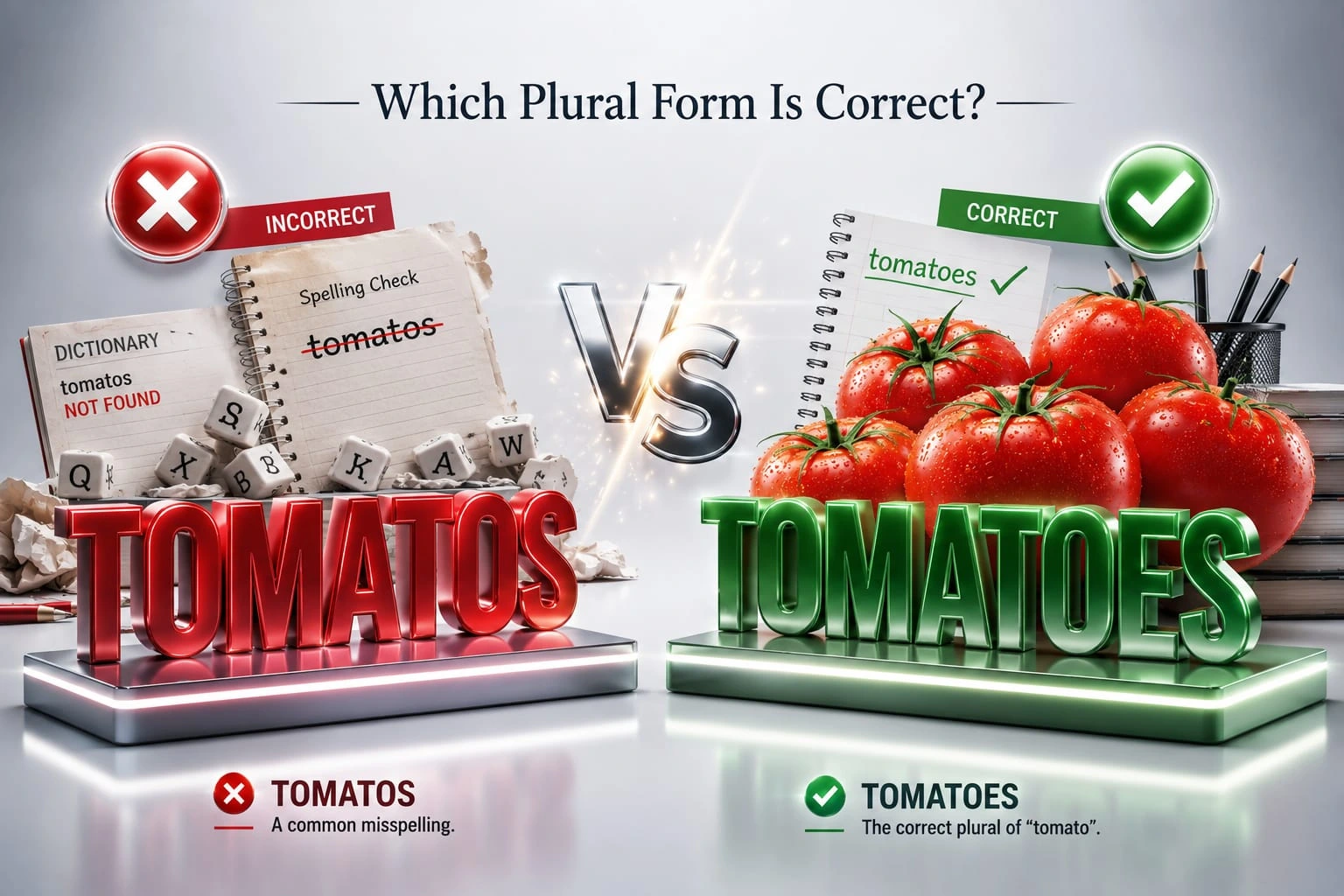
Tomatoes” is the correct spelling. “Tomatos” is a common misspelling; nouns ending in a consonant + o usually add -es in the plural, not just -s.
Last summer, I scribbled a shopping list in a hurry: “onions, tomatos, garlic.” My partner circled the word and said, “That’s not right.” I second-guessed myself for a solid minute was it tomatos, tomatoes, or something else entirely?
Turns out, this is one of the most Googled spelling mix-ups in English, right up there with “potatoes.” If you’ve ever paused mid-sentence wondering which one to use, you’re in good company.
Here’s the good news: the rule behind this one is easy to remember once you see it. This guide walks through exactly why “tomatoes” is correct, where the confusion started, and how to never doubt yourself again.
Tomatoes vs Tomatos: Quick Answer
“Tomatoes” is always correct. “Tomatos” is a spelling mistake, not an accepted variant.
- ✅ I bought fresh tomatoes at the market.
- ❌ I bought fresh tomatos at the market.
The confusion comes from how English handles plurals of nouns ending in o. Some just add -s (photo → photos), but others need -es (tomato → tomatoes). There’s no shortcut, you simply have to know which group each word falls into.
The Origin of the Confusion
The word “tomato” entered English in the early 1600s, borrowed from Spanish tomate, which came from the Nahuatl word tomatl. As the word settled into English, it followed a spelling pattern shared by several other consonant + o nouns: add -es to form the plural.
That’s why you get:
- potato → potatoes
- hero → heroes
- tomato → tomatoes
Meanwhile, words like “photo,” “piano,” and “logo”; often borrowed more recently or ending in a vowel before the o, just take a simple -s. English never fully standardized this rule, which is exactly why so many writers guess wrong.
Autocorrect tools have also historically been inconsistent here, letting “tomatos” slip through in casual typing.
Tomatoes Explained: Key Differences and Variations
| Word | Correct Plural | Pattern | Example |
|---|---|---|---|
| Tomato | Tomatoes | consonant + o → -es | She sliced the tomatoes for the salad. |
| Potato | Potatoes | consonant + o → -es | We planted potatoes in the garden. |
| Photo | Photos | vowel/loanword → -s | He printed the photos from the trip. |
| Piano | Pianos | vowel/loanword → -s | Three pianos sat in the concert hall. |
Notice the pattern: “tomato” and “potato” behave the same way, which is a helpful memory trick if you already know one of them.
Which Version Should You Use?
- For everyday writing → Always use tomatoes. There’s no acceptable context for “tomatos.”
- For students and ESL learners → Pair “tomato” with “potato” as a memory anchor; both add -es.
- For professional or formal documents → Don’t rely on autocorrect alone; some tools still miss this error.
- For global or neutral use → “Tomatoes” is standard across American, British, Australian, and all other English dialects.
Common Mistakes With Tomatoes
Mistake 1: Writing “tomatos” instead of “tomatoes”
✅ I grew tomatoes in my backyard this year.
❌ I grew tomatos in my backyard this year.
Why it happens: Writers default to the simple -s rule without remembering the -es exception for consonant + o nouns.
Mistake 2: Assuming all o-ending nouns follow the same rule
✅ Tomatoes and potatoes need -es; photos and pianos just need -s.
❌ Tomatos, like photos, only needs an -s.
Why it happens: English doesn’t apply one consistent rule to every o-ending noun, so people generalize incorrectly.
Mistake 3: Misspelling the singular form as “tomatoe”
✅ This tomato is ripe.
❌ This tomatoe is ripe.
Why it happens: People overcorrect, adding an extra e to the singular after learning the plural has one.
Mistake 4: Dropping the plural entirely in casual speech
✅ I need two tomatoes for this recipe.
❌ I need two tomato for this recipe.
Why it happens: Fast, casual typing sometimes skips the plural form altogether.
Mistake 5: Letting “tomatos” slip into recipes or menus
✅ Fresh tomatoes, basil, and mozzarella.
❌ Fresh tomatos, basil, and mozzarella.
Why it happens: Menus and handwritten signs are rarely proofread carefully, so the error spreads.
Carmel or Caramel: What Should You Use? (2026)
Tomatoes in Real-World Examples
Professional email:
“Please confirm the delivery includes 50 crates of tomatoes for Saturday’s market.”
News headline:
“Tomatoes Prices Surge After Unseasonal Rainfall Damages Crops”
Social media post:
“Nothing beats homegrown tomatoes straight off the vine. 🍅”
Formal document:
“The shipment manifest lists 200 kg of tomatoes among the perishable goods.”
In every case, tomatoes is the only correct spelling; regardless of tone or formality.
Tomatoes: Data, Trends & Usage
Spelling searches like “tomatoes or tomatos” spike heavily during gardening season and grocery shopping moments, especially among home cooks, students, and non-native English speakers. This falls into the informational search category, people want a quick, confident answer, not a grammar lecture.
Interest also rises around recipe blogs and food writing, where the word appears constantly. Despite being one of the most common nouns in everyday English, “tomatoes” remains one of the most frequently misspelled plurals, largely because the -es rule isn’t intuitive for many writers.
Tomatoes vs Tomatos: Comparison Table
| Term/Variant | Meaning | Region/Context | Best Used When |
|---|---|---|---|
| Tomatoes | Correct plural of “tomato” | Universal, all English dialects | Always in any writing context |
| Tomatos | Misspelling, not a real word | None; incorrect everywhere | Never avoid entirely |
| Tomatoe | Incorrect singular form | None; incorrect everywhere | Never the singular is “tomato” |
Frequently Asked Questions
Q: What does “tomatoes” mean?
A: “Tomatoes” is simply the plural form of “tomato,” referring to more than one of the fruit (commonly used as a vegetable in cooking).
Q: How do you use “tomatoes” correctly in a sentence?
A: Use “tomatoes” whenever you’re referring to more than one tomato, such as “She bought six tomatoes at the store.”
Q: Tomatoes vs tomatos: what’s the difference?
A: There’s no real difference in meaning, because “tomatos” isn’t a correct word. “Tomatoes” is the only accepted spelling.
Q: Is “tomatoes” acceptable in formal writing?
A: Yes, completely. “Tomatoes” is standard in recipes, agricultural reports, academic writing, and any professional context.
Q: Which version is correct: tomatoes or tomatos?
A: “Tomatoes” is correct. “Tomatos” is a spelling error that won’t appear in any dictionary.
Q: Where does the word “tomato” come from?
A: It comes from the Nahuatl word tomatl, passed into Spanish as tomate, and then adapted into English as “tomato” in the early 1600s.
Q: Can “tomatoes” be used in casual conversation and texting?
A: Yes. The spelling stays the same whether you’re texting a friend or writing a formal report.
Final Takeaway
Here’s the short version. “Tomatoes” is always correct. “Tomatos” is always wrong.
Key points to remember:
- The rule: Nouns ending in consonant + o often add -es in the plural (tomato → tomatoes, potato → potatoes)
- Memory trick: Pair “tomato” with “potato”; they follow the same pattern
- Watch the singular too: It’s “tomato,” never “tomatoe”
- No exceptions: “Tomatoes” is standard in every English dialect, formal or casual
Once you lock in the -es rule, you’ll never second-guess “tomatoes” again.
Tomatoes vs tomatos explained; correct spelling, meaning, usage, and examples. Learn the simple rule and avoid this common mistake.
Lying or Lieing: The Correct Spelling (2026)

I’m an English language researcher and content writer. I am specialized in spelling comparisons, commonly confused words, grammar usage, and vocabulary guides. Through detailed language articles,I am helping readers to understand the differences between similar words and improve their written communication skills.