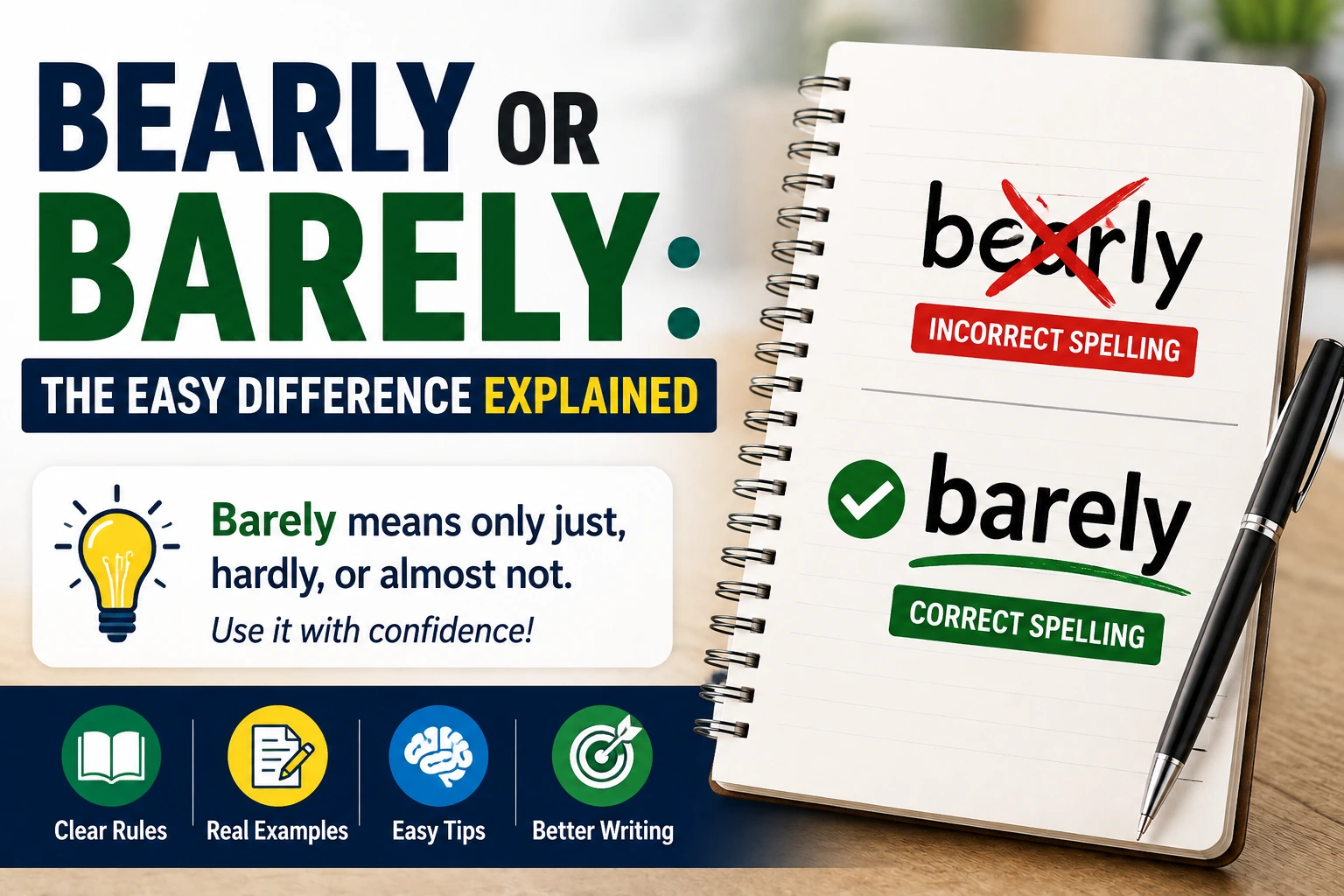
Barely is the correct standard English word. It means “only just,” “hardly,” or “almost not.” Bearly is a common spelling mistake and is not standard English.
Have you ever typed a word, looked at it twice, and suddenly wondered, “Wait, is that spelling right?” Bearly or barely is one of those small spelling questions that can stop you in the middle of a sentence.
I have seen this kind of mistake many times when helping English learners improve their writing. The problem is easy to understand. Bearly looks like it could be a real word because it begins with “bear.” English has many words that sound alike but have different spellings, so it is natural to hesitate.
But there is a simple answer.
Barely is the correct word when you mean “only just,” “hardly,” or “almost not.” For example, you can say, “I could barely hear you.” You should not write, “I could bearly hear you.”
The good news is that you do not need to memorize a complicated rule. Once you understand what barely means and where it comes from, the spelling becomes much easier to remember.
Let’s look at the difference, common mistakes, examples, and a few simple tricks that can help you choose the right word every time.
Bearly or Barely: Quick Answer
Barely is the correct spelling in standard English.
It is an adverb that means only just, hardly, or by a very small amount.
For example:
- I could barely see the road.
- She barely passed the exam.
- We had barely enough money for lunch.
- He was barely awake.
Bearly is not the standard spelling of this word. If you write “bearly” when you mean “hardly” or “only just,” you have made a spelling error.
A simple memory trick
Think of barely as something that is barely there.
If something exists in a very small amount, or something happens by only a small margin, use barely.
Barely = only just / almost not
The Origin and Background of Barely
The word barely comes from the adjective bare.
The basic idea behind bare is something that is uncovered, empty, or lacking much of something. Over time, barely developed the meaning of only just or to a very small degree.
The ending -ly is common in English adverbs.
For example:
- slow → slowly
- clear → clearly
- quiet → quietly
- bare → barely
So barely follows a familiar English pattern.
Why do people write “bearly”?
The spelling mistake usually happens because of sound and visual confusion.
The word bear is a very familiar English word. It refers to a large animal, such as a brown bear or polar bear. When people hear the beginning of barely, they may connect it with bear and write bearly.
There is also another reason.
The words bare and bear sound alike in many varieties of English. They are homophones. Their meanings and spellings, however, are different.
That is why barely can be easy to misspell.
Bearly vs Barely: Key Differences
The difference is simple:
| Term | Meaning | When to Use | Region/Context |
|---|---|---|---|
| Barely | Only just; hardly; almost not | Standard English | All major forms of English |
| Bearly | Not a standard word in this meaning | Avoid it | Usually a spelling mistake |
What does barely mean?
Barely tells us that something happened by a very small amount.
Consider this sentence:
I barely caught the bus.
This means I caught the bus, but only just. Perhaps the doors were about to close when I got on.
Now consider:
She barely passed the test.
She passed, but her score was only slightly above the passing mark.
The word often suggests that something came very close to not happening.
More examples
We barely had enough food.
This means there was only a small amount of food available.
He could barely walk after the long race.
He could walk, but doing so was difficult.
I barely remember his name.
I remember it only a little.
Which Version Should You Use?
If you are wondering whether to write bearly or barely, choose barely.
There is no standard-English situation where you should replace barely with bearly when you mean “hardly” or “only just.”
For students
Use barely in essays, assignments, exams, and schoolwork.
Example:
The student barely passed the final exam.
For professional writers
Use barely in emails, reports, articles, presentations, and business documents.
Example:
The company barely met its quarterly target.
For casual writing
Use barely in texts, comments, captions, and social media posts too.
Example:
I barely slept last night!
For global English
Barely is the safest choice. It is understood across British, American, Canadian, Australian, and other major forms of English.
Common Mistakes with Bearly or Barely
Here are some errors you may see.
1. Using “bearly” instead of “barely”
Incorrect:
I could bearly hear the speaker.
Correct:
I could barely hear the speaker.
Why?
The standard word is barely.
2. Confusing barely with “bare”
Incorrect:
I bare could see the screen.
Correct:
I could barely see the screen.
Why?
Bare is usually an adjective or verb. Barely is the adverb needed here.
3. Thinking barely means “completely not”
Example:
I could barely hear you.
This does not always mean that I could not hear you at all.
It usually means I could hear you, but only with difficulty.
4. Using barely when something did not happen
Incorrect idea:
I barely didn’t go.
This can sound confusing.
Instead, say:
I almost didn’t go.
The words barely and almost can overlap, but they do not always work in the same sentence.
5. Confusing barely with nearly
Barely often focuses on a small amount or a narrow margin.
She barely passed.
This means she passed by a small margin.
Nearly often means something almost happened but did not.
She nearly failed.
This means failure was close, but she did not fail.
The difference can be subtle, so context matters.
Barely in Real-World Examples
Knowing the definition is useful. Seeing the word in real situations is even better.
1. Professional Email
I barely had enough time to review the document before the meeting.
Here, barely means the writer had just enough time.
2. News Headline
Local Team Barely Wins Final Match
The headline means the team won by a very small margin.
3. Social Media Post
I barely made it to class on time today!
The person arrived just before class began.
4. Formal Report
The project barely met the required performance target.
This means the project reached the target, but only by a small amount.
5. Everyday Conversation
I can barely see anything in this room.
The speaker can see something, but visibility is very poor.
Barely: Data, Trends & Usage
The search intent behind “bearly or barely” is mainly informational. People usually search this phrase because they are unsure about the correct spelling.
The question is often simple:
“Which spelling should I use?”
This type of search is common among students, English learners, writers, and people checking a sentence before publishing it.
There is also a useful spelling lesson here. Many English mistakes happen because words sound similar. English has many homophones, such as:
- bare / bear
- there / their / they’re
- your / you’re
- hear / here
- to / too / two
Understanding the meaning of a word is often the best way to remember its spelling.
For barely, remember this:
bare + ly = barely
That simple pattern can help you avoid the incorrect spelling bearly.
Bearly or Barely: Standalone Comparison Table
| Term/Variant | Meaning | Region/Context | Best Used When |
|---|---|---|---|
| Barely | Only just; hardly; almost not | Standard English | When describing a very small amount or narrow margin |
| Bearly | Not standard English in this sense | Common spelling mistake | Do not use it for “hardly” or “only just” |
Barely vs Almost
These words can sometimes have similar meanings, but they are not always interchangeable.
I barely passed.
This focuses on the small margin by which I passed.
I almost failed.
This focuses on how close I came to failing.
Both sentences describe a similar situation, but the focus changes.
Barely vs Hardly
Barely and hardly are often close in meaning.
I could barely hear him.
I could hardly hear him.
Both suggest that hearing him was very difficult.
Still, barely often carries the idea of something happening by the smallest possible amount.
FAQs About Bearly or Barely
Q: Is “bearly” a correct English word?
A: Bearly is not the standard spelling when you mean “hardly” or “only just.” Use barely instead.
Q: What does barely mean?
A: Barely means “only just,” “hardly,” or “almost not.” It often describes something that happens by a very small amount.
Q: How do you use barely in a sentence?
A: Use barely before or near the word it modifies. For example: “I could barely hear her” or “He barely passed the test.”
Q: Is barely acceptable in formal writing?
A: Yes. Barely is a standard English word and is completely acceptable in formal writing, including essays, reports, emails, and academic work.
Q: Which is correct, bearly or barely?
A: Barely is correct. Bearly is a spelling error when you mean “only just” or “hardly.”
Q: Where does the word barely come from?
A: Barely comes from bare with the adverb ending -ly. Its meaning developed around the idea of something existing or happening only to a small degree.
Q: Can barely be used with verbs?
A: Yes. Barely commonly modifies verbs. For example, “She could barely walk,” “I barely remember,” and “They barely won.”
Q: Is barely the same as hardly?
A: They are often very close. Both can mean “almost not,” but barely often suggests that something happened by a very small amount.
Final Verdict: Bearly or Barely?
When choosing between bearly or barely, the answer is easy: barely is the correct standard English word.
Use barely when you mean:
- Only just
- Hardly
- Almost not
- By a very small amount
For example:
I could barely see the sign.
She barely passed the exam.
We barely caught the train.
The spelling bearly is a common mistake. It may look natural because bear is a familiar English word, but it does not replace barely.
One useful way to remember the difference is to connect barely with bare. The ending -ly turns it into an adverb.
So the next time you stop and wonder, “Is it bearly or barely?” you do not need to guess.
Choose barely.
Bookmark this guide so you never second-guess the spelling again, and share it with someone who needs a quick English refresher.
Bearly or barely explained with meaning, correct spelling, usage, examples, and simple tips to avoid this common English mistake today.
Miniscule or Minuscule: Which Spelling Is Correct? (2026)

I’m an English language researcher and content writer. I am specialized in spelling comparisons, commonly confused words, grammar usage, and vocabulary guides. Through detailed language articles,I am helping readers to understand the differences between similar words and improve their written communication skills.