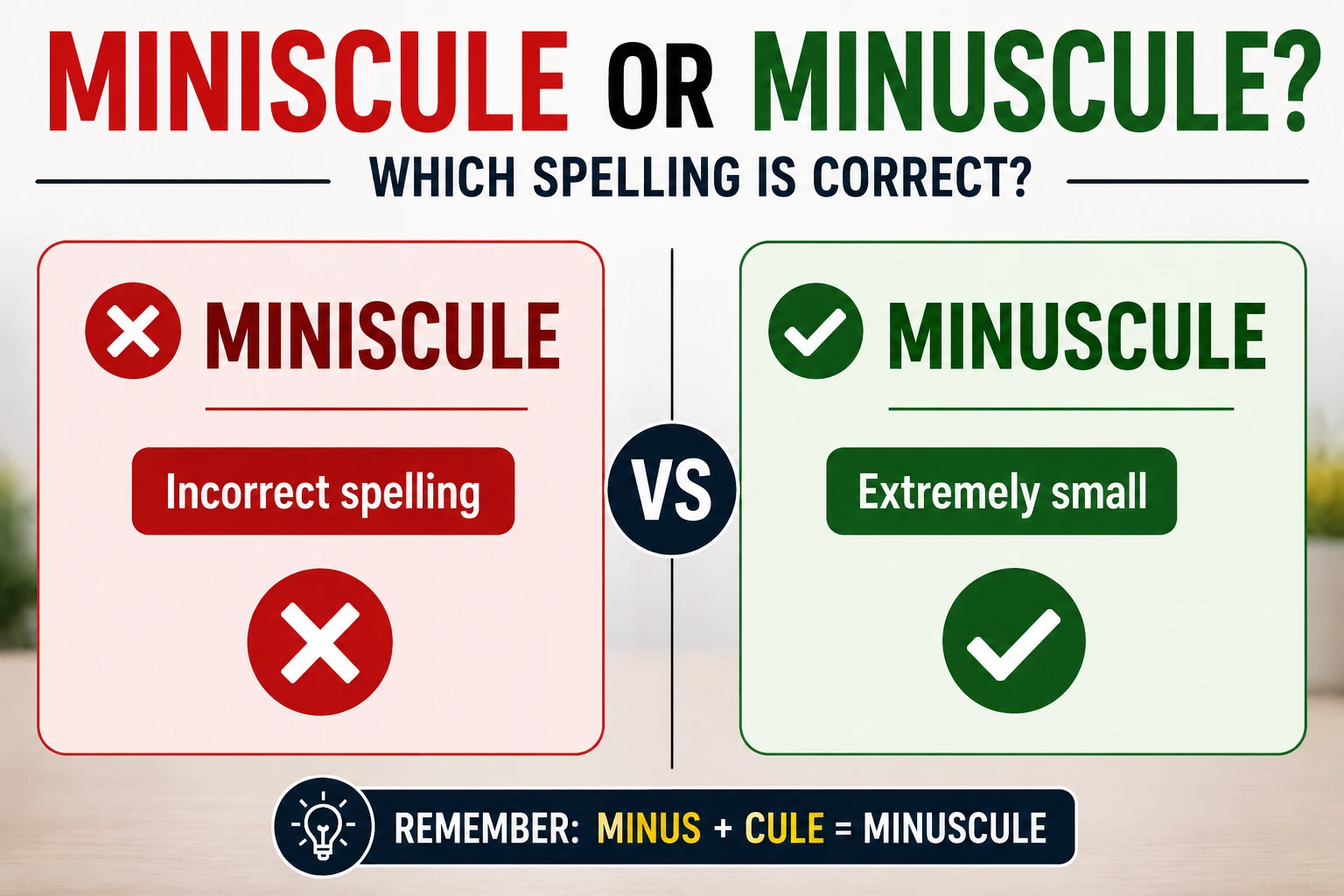
Minuscule is the correct spelling. Miniscule is a common misspelling, although it is often seen because it looks like the word “mini.”
Have you ever typed miniscule and then stopped to wonder if something looked wrong? I have seen this mistake many times while reviewing English writing. It is easy to make because miniscule looks logical. After all, “mini” means very small.
But English does not always follow the spelling pattern we expect.
The correct word is minuscule. It means extremely small or tiny. The spelling has a u after the first “n”: m-i-n-u-s-c-u-l-e.
This small spelling detail can cause trouble in school work, emails, reports, and online writing. A single missing letter may make a correct word look like a spelling error.
If you have searched for miniscule or minuscule, you are likely trying to answer one simple question: Which spelling should you use?
The answer is clear: use minuscule in standard English.
In this guide, you will learn what minuscule means, where the word comes from, why people spell it as miniscule, and how to use it correctly. You will also see simple examples that make the spelling easy to remember.
Miniscule or Minuscule: Quick Answer
Minuscule is the standard and correct spelling.
It is an adjective that means very small, tiny, or extremely little.
For example:
- The difference was minuscule.
- She noticed a minuscule crack in the glass.
- The chance of success was minuscule.
Miniscule is usually treated as a misspelling of minuscule. It is not the spelling you should choose in formal or careful writing.
The easy rule
Remember this:
MINUS + CULE = MINUSCULE
The word starts with minus, not minis.
That small memory trick can help you avoid the mistake.
Pronunciation
Minuscule is pronounced:
MIN-uh-skyool /ˈmɪn.ə.skjuːl/
👉 Minuscule = MIN-uh-skyool
Miniscule is usually pronounced the same way, but it is the incorrect spelling.
The Origin and Background of Minuscule
The spelling minuscule has an interesting history.
The word comes from the Latin minusculus, which means rather small or very small. It is related to the Latin word minor, meaning “smaller.”
The word later became connected with small letters and handwriting. In the history of writing, minuscule referred to a style of small letters. This is also why you may see the word used in discussions about manuscripts, handwriting, and typography.
Over time, its meaning expanded.
Today, minuscule is commonly used to describe anything extremely small.
For example:
- a minuscule amount
- a minuscule error
- a minuscule detail
- a minuscule chance
- minuscule writing
The spelling miniscule is easy to understand as a mistake. People often connect the word with mini, which means small.
That creates a natural spelling trap:
mini + scule → miniscule
But the standard spelling is:
minus + cule → minuscule
Knowing the history makes the spelling easier to remember.
Miniscule or Minuscule Explained: Key Difference
There is one main difference between the two forms: one is standard, and the other is generally considered a misspelling.
| Term | Meaning | When to Use | Region/Context |
|---|---|---|---|
| Minuscule | Extremely small | Standard English writing | British and American English |
| Miniscule | Intended to mean extremely small | Avoid in careful writing | Common spelling error |
Minuscule
Minuscule is the correct form.
It can describe something that is physically tiny.
The insect was minuscule.
It can also describe something that is small in amount, degree, or importance.
There was a minuscule difference between the two results.
Miniscule
Miniscule is commonly used by mistake.
People often spell the word this way because of mini, a familiar word that means small.
For example:
❌ The chance of rain is miniscule.
✅ The chance of rain is minuscule.
The meaning is usually clear when someone writes “miniscule,” but the spelling is not the standard choice.
Which Version Should You Use?
The best choice is simple:
Use “minuscule.”
You should use it in school, work, websites, reports, emails, and other forms of standard English writing.
For students
Use minuscule in essays, assignments, exams, and research papers.
Example:
The study found only a minuscule change in temperature.
For professionals
Use minuscule in business emails, reports, presentations, and official documents.
Example:
The new process resulted in a minuscule reduction in costs.
For bloggers and content writers
Use minuscule when you want to describe something very small.
Example:
Even a minuscule error can change the meaning of a sentence.
For global readers
Minuscule is the safest form because it is the standard spelling in both British and American English.
You do not need to switch between minuscule and another spelling based on region.
Common Mistakes with Minuscule
The word is easy to misspell. Here are some of the most common mistakes.
1. Writing miniscule
❌ The amount was miniscule.
✅ The amount was minuscule.
The missing u is the main spelling error.
2. Connecting it with “mini”
It is tempting to think:
mini + scule = miniscule
But that is not how the word is spelled.
Instead, remember:
minuscule
The u comes after min.
3. Using “minuscule” when you mean “small” in every sense
Although minuscule means very small, it usually suggests that something is extremely small.
For example:
I made a small mistake.
This does not always need minuscule.
But:
I made a minuscule mistake.
This suggests that the mistake was very tiny or insignificant.
4. Confusing minuscule with miniature
These words are related in meaning, but they are not always interchangeable.
Minuscule means extremely small.
Miniature usually means a small representation or model of something larger.
For example:
The writing was minuscule.
But:
He bought a miniature model of the house.
Minuscule in Real-World Examples
The word minuscule appears in many types of writing.
Professional Email
The difference in the two figures is minuscule, so it should not affect the final report.
Here, minuscule describes a very small difference.
News Article
The company reported a minuscule increase in sales during the quarter.
This gives readers the idea that the increase was very small.
Social Media Post
I made a minuscule change to my daily routine, but it made a big difference!
The word adds emphasis to how small the change was.
Formal Report
The experiment showed a minuscule variation between the two samples.
Here, the word fits well in formal and academic writing.
Everyday Conversation
There is only a minuscule amount of sugar left.
This means there is almost no sugar left.
Minuscule: Data, Trends & Usage
People who search for miniscule or minuscule are usually looking for a spelling answer. Their search intent is mainly informational.
The confusion is easy to understand. The incorrect form contains mini, a familiar word associated with small size. That makes miniscule look natural, even though minuscule is the standard spelling.
The word is used in both American English and British English. There is no major regional spelling difference here.
You may find minuscule in many contexts, including:
- Academic writing
- Business reports
- News articles
- Scientific writing
- Literature
- Everyday descriptions
- Typography and handwriting
One useful insight is that spelling mistakes often happen when a word looks like a familiar word. In this case, the presence of mini can make the incorrect spelling feel right.
That is why learning the word’s structure is more useful than simply memorizing the letters.
Miniscule vs Minuscule: Side-by-Side Comparison
| Term/Variant | Meaning | Region/Context | Best Used When |
|---|---|---|---|
| Minuscule | Extremely small | Standard English | Always use for the intended meaning |
| Miniscule | Intended as “extremely small” | Common misspelling | Avoid in formal and standard writing |
The safest rule is simple:
Minuscule = correct
Miniscule = incorrect spelling in standard English
Minuscule vs Miniature
These two words can sometimes look similar because both relate to small things.
However, they have different uses.
Minuscule describes something that is extremely small.
The text was minuscule.
Miniature often refers to something made as a small version of a larger object.
She collects miniature houses.
Compare these:
- A minuscule amount of water = an extremely small amount.
- A miniature bottle = a small version of a bottle.
Understanding this difference can improve both spelling and word choice.
How to Remember the Correct Spelling
If you often write miniscule, use a simple memory trick.
Think “minus”
Start with:
MINUS
Then add:
CULE
Together:
MINUS + CULE = MINUSCULE
You can also break the word into parts:
MI – NUS – CULE
The important letter is U.
Whenever you are unsure, ask yourself:
Does it start with “mini” or “minus”?
The answer is minus.
That quick check can save you from the common spelling mistake.
Frequently Asked Questions
Q: What does minuscule mean?
A: Minuscule means extremely small or tiny. It can describe physical size, amount, degree, or importance.
Q: Is miniscule or minuscule correct?
A: Minuscule is the correct standard spelling. Miniscule is a common misspelling and should be avoided in formal writing.
Q: How do you use minuscule in a sentence?
A: You can use minuscule to describe something extremely small. For example: “There was a minuscule amount of dust on the table.”
Q: Is minuscule acceptable in formal writing?
A: Yes. Minuscule is completely acceptable in formal writing. You can use it in academic papers, business reports, professional emails, and official documents.
Q: Why do people spell minuscule as miniscule?
A: The spelling error probably feels natural because people connect the word with mini, which means small. However, the correct spelling is minuscule, with a u after “min.”
Q: Is minuscule the same as miniature?
A: No. Minuscule means extremely small, while miniature often means a small representation or model of something larger. The two words can overlap in some contexts but are not identical.
Q: Is minuscule used in British and American English?
A: Yes. Minuscule is the standard spelling in both British and American English. You do not need a different spelling based on region.
Conclusion
When you see miniscule or minuscule, there is no need to guess. Minuscule is the correct spelling.
The word means extremely small. You can use it for size, amount, degree, or importance. For example, you might describe a minuscule amount, a minuscule error, or a minuscule chance.
The common mistake is miniscule. It is easy to write because it looks connected to mini, a word that means small. But the correct spelling comes from minuscule, not “mini.”
A simple memory trick can help:
MINUS + CULE = MINUSCULE
Use minuscule in your essays, emails, reports, articles, and everyday writing. Once you remember the u, this confusing spelling becomes much easier.
Openned or Opened: Which One Is Correct?

I specialize in spelling comparisons, confusing word pairs, grammar, and vocabulary development. My content helps readers improve their English, avoid common mistakes, and write with confidence. My goal is to provide accurate, reliable, and easy-to-understand language resources