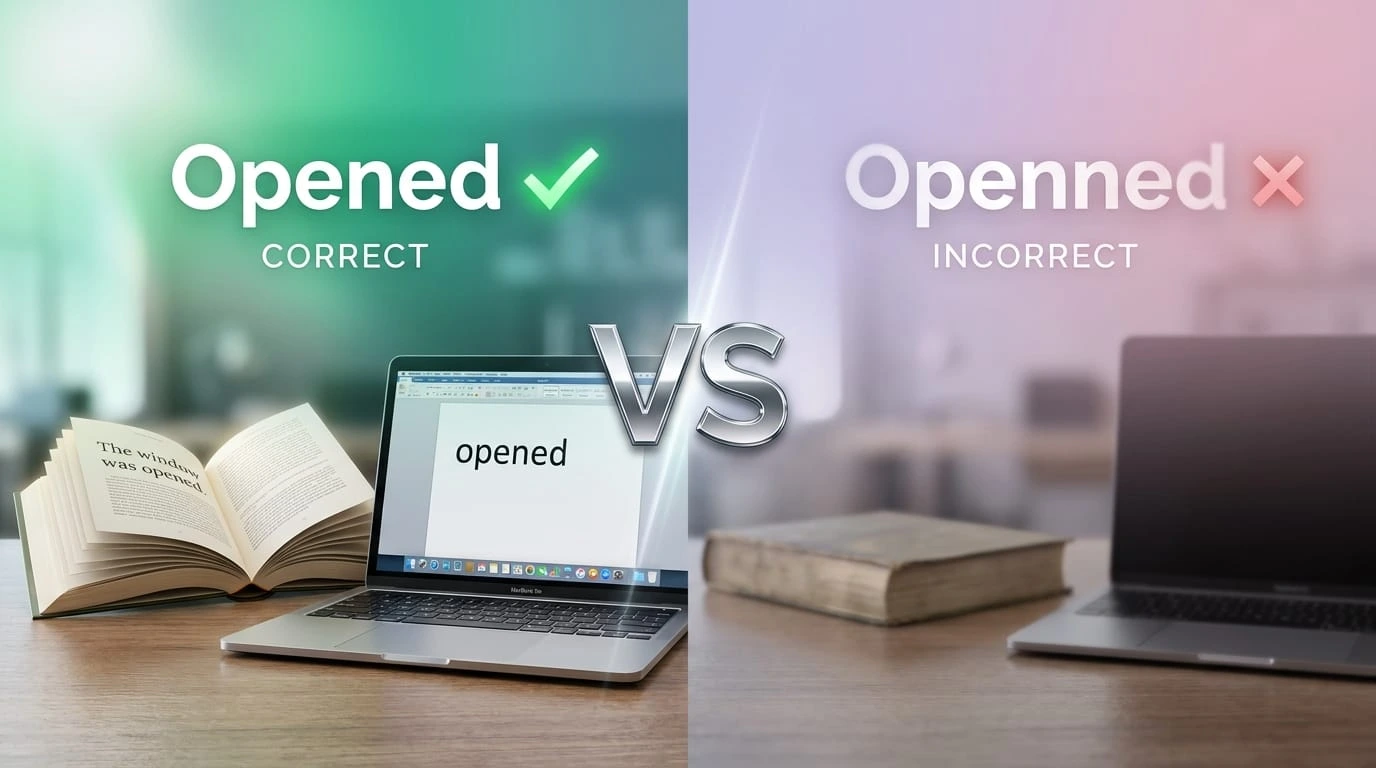
Opened is the correct spelling. Openned is incorrect because the verb open takes only one n before the -ed ending.
Have you ever written “openned” and then stopped to ask, “Does that look right?” This is an easy mistake to make. The word open ends with a consonant, so adding -ed can make it feel like the final letter should be doubled.
I have seen this mistake often while checking English writing. It usually happens because English has many verbs that double their final consonant before adding -ed. For example, stop becomes stopped, and plan becomes planned. So it seems logical that open might become openned.
But English has a simple rule here.
The correct spelling is opened, with only one n before -ed. Openned is not a standard English spelling.
This small difference matters in school assignments, emails, reports, articles, and everyday writing. One extra letter can make a sentence look incorrect.
In this guide, you will learn why opened is correct, how to pronounce it, why openned is wrong, and how to remember the spelling without second-guessing yourself.
Opened or Openned: Quick Answer
Opened is the correct spelling.
It is the past tense and past participle of open, meaning to move, remove, or change something so that it is no longer closed.
Openned is incorrect.
Examples
- She opened the door. ✅
- I opened the email this morning. ✅
- He opened the window. ✅
- She openned the door. ❌
The correct form is always opened in standard English.
Opened Pronunciation
Opened is usually pronounced in two syllables:
OH-pənd or OH-pənd.
opened (OH-pənd)
The -ed ending is pronounced with a /d/ sound, not as a separate “ed” syllable.
| Word | Pronunciation | Syllables |
| Open | OH-pən | 2 |
| Opened | OH-pənd | 2 |
| Openned | Incorrect spelling | — |
You can remember it this way:
Open → Opened
The word does not gain another n.
The Origin and Background of Opened
The word opened comes from the verb open.
Open has a long history in English. It is related to older Germanic words that carried the idea of making something accessible, uncovered, or no longer closed.
Over time, open became one of the most common verbs in English.
Today, it has many uses.
You can:
- open a door
- open a window
- open a book
- open an account
- open an email
- open a conversation
- open a meeting
- open a business
When you put the verb into the past tense, you simply add -ed:
open + ed = opened
There is no need to double the final n.
Why Is “Openned” Incorrect?
The confusion comes from a common English spelling rule.
Some short verbs double their final consonant before adding -ed.
For example:
- stop → stopped
- plan → planned
- drop → dropped
- rob → robbed
This happens because these words follow a particular consonant-doubling pattern.
But open does not follow that pattern.
The final n is not doubled.
So:
open + ed = opened
Not:
open + ned = openned
This is why opened is correct.
Opened Explained: The Main Spelling Rule
A useful way to understand this is to compare open with verbs that really do double their final consonant.
| Verb | Past Tense | Correct? |
| open | opened | ✅ |
| stop | stopped | ✅ |
| plan | planned | ✅ |
| drop | dropped | ✅ |
| admit | admitted | ✅ |
| prefer | preferred | ✅ |
The important point is that not every verb ending in a consonant doubles that consonant.
The spelling of opened follows the normal form for open.
When Should You Use “Opened”?
Use opened whenever you are talking about something that became open or something that someone made open in the past.
Examples include:
- She opened the door.
- He opened his gift.
- We opened the shop at nine.
- They opened the meeting with a short speech.
- I opened the message yesterday.
- The teacher opened the book to page ten.
You can also use opened as a past participle.
Examples:
- The door has opened.
- The store had opened before we arrived.
- The package was opened carefully.
In each case, the spelling stays the same.
Common Mistakes with Opened
The biggest mistake is adding an extra n.
| ❌ Incorrect | ✅ Correct |
| She openned the door. | She opened the door. |
| He openned the box. | He opened the box. |
| The store openned last week. | The store opened last week. |
| I openned the email. | I opened the email. |
| They openned a new office. | They opened a new office. |
Mistake 1: Writing “Openned”
❌ The teacher openned the book.
✅ The teacher opened the book.
The extra n does not belong in the past tense.
Think of the spelling as:
OPEN + ED = OPENED
Mistake 2: Applying the Doubling Rule Everywhere
Some learners learn that certain verbs double their final consonant before -ed.
That rule is useful, but it does not apply to every verb.
For example:
stop → stopped
But:
open → opened
Do not double the n simply because you see a consonant before -ed.
Mistake 3: Confusing Opened With Other Past-Tense Forms
The base form is:
open
The past tense is:
opened
The present participle is:
opening
Examples:
- I open the shop every morning.
- I opened the shop yesterday.
- I am opening the shop now.
Learning these three forms together makes the spelling easier to remember.
Mistake 4: Trusting Sound Instead of Spelling
When you say opened, the ending sounds quick. You may not hear every letter clearly.
That can lead some learners to spell it incorrectly.
The best approach is to remember the written form:
opened
Not:
openned
Opened in Real-World Examples
The word opened appears in almost every type of English writing.
Professional Email Example
I opened the document and reviewed the information you provided.
Here, opened means the writer accessed the document.
News Headline Example
New Community Center Opened in the City
The headline refers to a center that became available for public use.
Social Media Example
I finally opened the package I’ve been waiting for all week!
This is a natural everyday use of opened.
Formal Report Example
The company opened its new branch in Lahore last month.
The verb describes an event that happened in the past.
Academic Writing Example
The researcher opened the discussion by presenting the main findings.
Here, opened has a more abstract meaning. It means the researcher started the discussion.
Everyday Conversation Example
I opened the window because the room was too warm.
This is one of the most common uses of the word.
Opened vs Opening vs Open
These forms are related, but they have different grammatical jobs.
| Form | Function | Example |
| Open | Base verb / present | I open the door every morning. |
| Opened | Past tense / past participle | I opened the door yesterday. |
| Opening | Present participle / gerund | I am opening the door now. |
Knowing the word family can help you avoid spelling mistakes.
Which Version Should You Use?
The answer is clear for all standard English writing:
Use “opened.”
For Students
Use opened in essays, assignments, exams, and school projects.
Example:
The teacher opened the discussion with a question.
For Professionals
Use opened in emails, reports, presentations, and business documents.
Example:
The company opened its new office in June.
For Bloggers and Content Writers
Use opened in articles and online content.
It is the standard spelling and will look natural to readers.
For Formal Writing
Opened is completely acceptable in formal English.
There is no need to replace it with another word unless the context requires a different meaning.
For Global English
Use opened.
It is the standard spelling in both British and American English.
Opened or Openned: A Simple Memory Trick
Here is the easiest trick:
Open has one “n.” Opened also has one “n.”
Think:
OPEN → OPENED
Do not think:
OPEN → OPENNED
You can also use the sentence:
“Open the door, then opened the door.”
The base word keeps its spelling when -ed is added.
Another useful trick is to compare:
- open → opened
- clean → cleaned
- listen → listened
- answer → answered
These verbs do not double their final consonant before -ed.
Opene: Data, Trends & Usage
The search intent behind openned or opened is clearly informational. People searching this phrase usually want to confirm the correct spelling.
The topic is especially useful for:
- English learners
- Students
- Teachers
- Content writers
- Proofreaders
- Job seekers
- People improving their written English
Why Do People Search for “Openned”?
The most likely reason is the consonant-doubling rule.
English learners often know examples such as:
plan → planned
stop → stopped
shop → shopped
They may then assume:
open → openned
But that assumption is incorrect.
The correct form is opened.
Search Intent
| Search Factor | Details |
| Primary Intent | Informational |
| Main Question | Is it opened or openned? |
| Topic Type | Spelling comparison |
| Audience | Students and English learners |
| Correct Form | Opened |
Standalone Comparison Table
| Term/Variant | Meaning | Region/Context | Best Used When |
| Open | To make something accessible or not closed | Standard English | Present or base form |
| Opened | Past tense or past participle of open | Standard English worldwide | Talking about a past action or completed state |
| Opening | Present participle or gerund of open | Standard English worldwide | Talking about an action in progress |
| Openned | Incorrect spelling | Nonstandard | Do not use |
Frequently Asked Questions
Q: Is it opened or openned?
A: Opened is the correct spelling. Openned is incorrect because open does not double its final n before adding -ed.
Q: Why is opened spelled with one n?
A: The verb open keeps its normal spelling when -ed is added. Therefore, open + ed = opened, not openned.
Q: Is openned a real word?
A: Openned is not a standard English spelling. If you mean the past tense of open, always write opened.
Q: What is the past tense of open?
A: The past tense of open is opened. For example, “She opened the door.”
Q: Is opened correct in formal writing?
A: Yes. Opened is the standard form and is completely acceptable in academic, professional, and formal writing.
Q: Why do people spell opened as openned?
A: The mistake often comes from applying the consonant-doubling rule used with words such as stop → stopped. However, open does not follow that pattern.
Q: Is opened the same in British and American English?
A: Yes. Opened is the standard spelling in both British and American English.
Conclusion
The choice between openned and opened is simple once you know the spelling rule. Opened is the only standard spelling for the past tense and past participle of open.
Remember these key points:
- Opened is correct.
- Openned is incorrect.
- Open does not double its final n before -ed.
- The same spelling is used in British and American English.
- The easiest memory trick is open → opened.
Do not let the extra n trick you. English has many verbs that double their final consonant, but open is not one of them.
The next time you need the past tense of open, write opened with confidence.
Carrys or Carries: Which Spelling Is Correct? (2026)

I’m an English language researcher and content writer. I am specialized in spelling comparisons, commonly confused words, grammar usage, and vocabulary guides. Through detailed language articles,I am helping readers to understand the differences between similar words and improve their written communication skills.