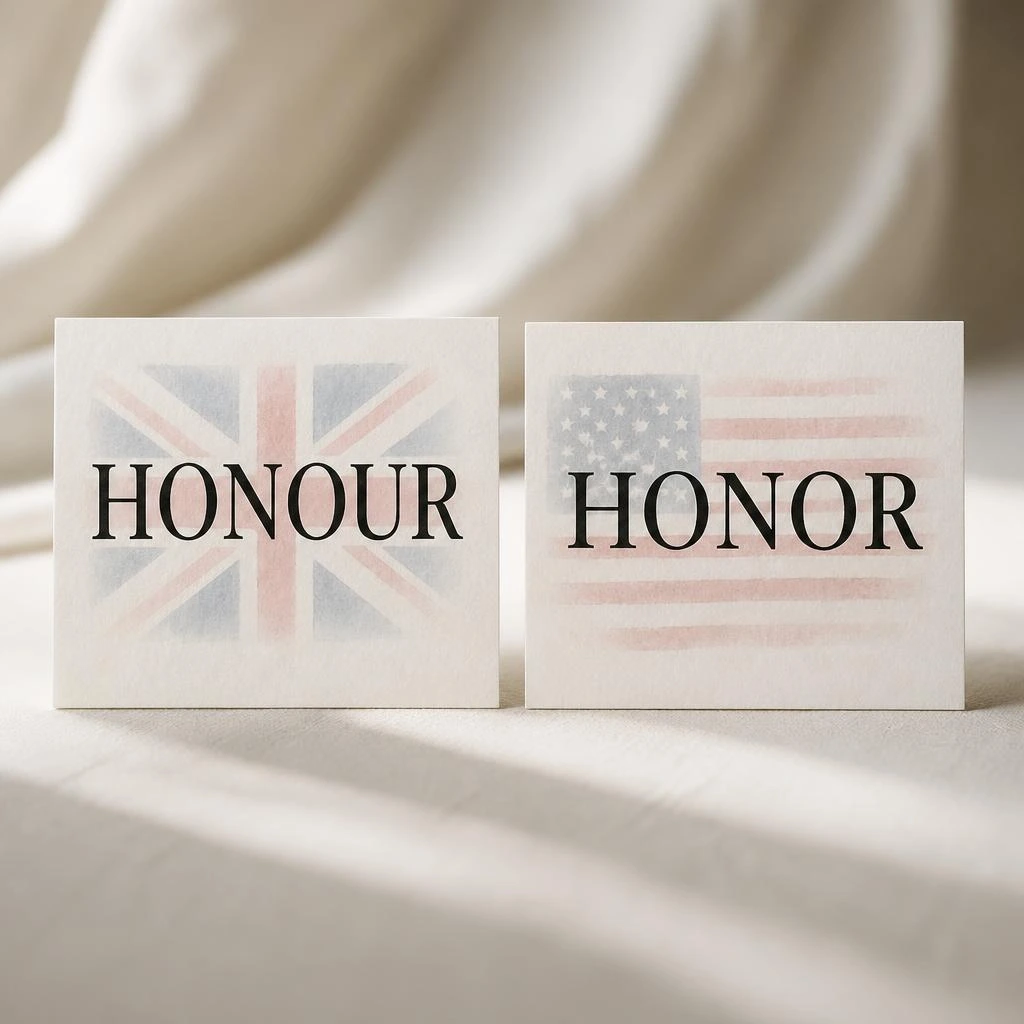
Honour and honor have the same meaning. Honour is the British spelling, while honor is the American spelling.
Have you ever typed honour and wondered if the extra “u” was a mistake? Or perhaps you wrote honor and your teacher changed it to honour?
I have seen this small spelling difference confuse many English learners. The funny part is that both spellings are correct. The choice depends mainly on the type of English you are using.
Both words describe respect, high regard, dignity, or a strong sense of doing what is right. They can also be used as verbs. For example, you can honor a person, or you can honour a promise.
The only major difference is the spelling. American English usually drops the u, while British English keeps it.
This guide makes the choice simple. You will learn where these spellings come from, when to use each one, common mistakes to avoid, and how they appear in real writing.
By the end, you will know exactly whether to write honour or honor.
Honour or Honor: Quick Answer
Honour and honor are two spellings of the same word.
- Honour = British English spelling
- Honor = American English spelling
Both mean respect, dignity, or high regard.
For example:
She received an award in honour of her work.
In American English, the same sentence would be:
She received an award in honor of her work.
The meaning does not change. Only the spelling changes.
The same rule applies when the word is used as a verb:
We honour our teachers.
We honor our teachers.
So, if you are writing for a British audience, choose honour. For an American audience, choose honor.
The Origin and Background of Honour and Honor
The difference between honour and honor comes from the history of English spelling.
The word traces back to Latin honor, meaning dignity, esteem, or reputation. It entered English through Old French, where spelling patterns influenced the form used in English.
For centuries, English spelling was not fully fixed. Different writers and regions used different forms.
British English eventually kept the u in words such as:
- honour
- colour
- favour
- labour
- neighbour
American English later moved toward shorter spellings in many of these words.
That is why American English uses:
- honor
- color
- favor
- labor
- neighbor
The change was strongly associated with American dictionary maker Noah Webster. He supported simpler and more distinct American spelling forms.
This does not mean one spelling is more correct than the other.
Think of it as a regional spelling choice.
If you write colour, you are following British spelling. If you write color, you are following American spelling. The same pattern applies to honour and honor.
Honour or Honor Explained: What Is the Difference?
The main difference is regional spelling, not meaning.
| Term | Meaning | When to Use | Region/Context |
|---|---|---|---|
| Honour | Respect, dignity, or high regard | British-style writing | UK, Australia, and other British-English contexts |
| Honor | Respect, dignity, or high regard | American-style writing | United States and American-English contexts |
1. Honour
Honour is the standard spelling in British English.
Examples:
- It was an honour to meet the professor.
- They acted with great honour.
- We should honour those who served their country.
- She was invited to honour the winner.
You may also see honour in formal British writing.
2. Honor
Honor is the standard American English spelling.
Examples:
- It was an honor to meet the professor.
- They acted with great honor.
- We should honor those who served their country.
- She was invited to honor the winner.
The meaning remains exactly the same.
Does the Pronunciation Change?
Usually, no.
Both honour and honor are pronounced in essentially the same way.
The difference is mainly visible when you write the word.
That makes this an English spelling variation, not a difference in pronunciation or meaning.
Which Version Should You Use?
The easiest rule is this:
Match your spelling to your audience.
If you write British English
Use honour.
This is a good choice for:
- British schools
- UK publications
- British government writing
- British English exams
- Audiences that expect British spelling
For example:
It was a great honour to receive the award.
If you write American English
Use honor.
This is suitable for:
- American schools
- US publications
- American businesses
- American websites
- US government-related writing
For example:
It was a great honor to receive the award.
What About International Writing?
If your readers come from many countries, consistency matters most.
Choose one spelling system and follow it throughout your document.
Do not write:
It was an honor to receive the award. We will honour your request.
That may look inconsistent unless there is a specific reason for using both forms.
A better approach is to choose either:
It was an honor to receive the award. We will honor your request.
Or:
It was an honour to receive the award. We will honour your request.
Consistency makes your writing look polished.
Common Mistakes With Honour and Honor
These words are easy to understand, but writers often make spelling or usage mistakes.
Mistake 1: Mixing British and American spelling
Incorrect style:
It was an honor to receive the award, and we will honour your work.
The sentence is not grammatically wrong, but the spelling is inconsistent if you are following one English variety.
Better:
It was an honour to receive the award, and we will honour your work.
Or:
It was an honor to receive the award, and we will honor your work.
Mistake 2: Thinking “honour” is always correct
Some learners believe the longer spelling is the original or more formal version.
That is not true.
Honor is completely correct in American English.
For example:
It is a great honor to be here.
This is perfectly acceptable American English.
Mistake 3: Thinking “honor” is a spelling error
The opposite mistake also happens.
A British English writer may see honor and assume it is wrong.
It is not wrong.
It is the normal American spelling.
The key is to identify the English variety being used.
Mistake 4: Confusing honour with “honest”
Although honour can relate to good character and moral behavior, it does not simply mean honest.
For example:
He is an honest man.
This means he tells the truth and does not cheat.
But:
He acted with honour.
This suggests dignity, integrity, and respect for moral principles.
The words are related in some contexts, but they are not interchangeable.
Mistake 5: Forgetting the noun and verb can be the same word
Honour/honor can work as both a noun and a verb.
As a noun:
It was an honour to meet her.
As a verb:
We honour her achievements.
The American forms are:
It was an honor to meet her.
We honor her achievements.
Honour or Honor in Real-World Examples
Seeing the words in context makes the difference much easier to remember.
1. Professional Email
British English:
It was an honour to work with your team. Thank you for giving me the opportunity.
American English:
It was an honor to work with your team. Thank you for giving me the opportunity.
Both are professional and correct.
2. News Headline
A British publication might write:
Local Hero Receives Award in Honour of Community Service
An American publication might write:
Local Hero Receives Award in Honor of Community Service
Again, the spelling changes, but the meaning does not.
3. Social Media Post
British style:
Feeling proud and grateful to receive this award. It is a great honour!
American style:
Feeling proud and grateful to receive this award. It is a great honor!
The choice depends on the audience.
4. Formal Document
British English:
The organization will honour its commitment to the community.
American English:
The organization will honor its commitment to the community.
Both versions are formal and natural.
Honour or Honor: Comparison Table
Here is the difference at a glance:
| Term/Variant | Meaning | Region/Context | Best Used When |
|---|---|---|---|
| Honour | Respect, dignity, or high regard | British English | Writing for UK and other British-English audiences |
| Honor | Respect, dignity, or high regard | American English | Writing for US audiences |
| Honour | To show respect or fulfill a promise | British English | British formal and everyday writing |
| Honor | To show respect or fulfill a promise | American English | American formal and everyday writing |
The most useful point is simple: neither spelling is wrong.
Your audience decides which form is better.
Honour or Honor: Data, Trends & Usage
Searches for honour or honor are usually informational. People often search the phrase because they have seen both spellings and want to know which one is correct.
This type of question is especially common among:
- English learners
- Students
- Writers
- Editors
- Teachers
- Bloggers
- People working with international audiences
The spelling difference also appears across related words.
For example:
| British English | American English |
|---|---|
| honour | honor |
| colour | color |
| favour | favor |
| labour | labor |
| neighbour | neighbor |
This pattern gives you a useful memory trick.
British English often keeps “-our.” American English often uses “-or.”
This matters today because online writing crosses borders. A website may have readers from the UK, US, Canada, Australia, Pakistan, India, and many other countries.
You do not need to worry when you see the other spelling. Just identify the English style you are using and stay consistent.
Frequently Asked Questions About Honour or Honor
Q: What does honour or honor mean?
A: It means respect, dignity, high regard, or good moral character. It can also mean showing respect to someone or fulfilling a promise.
Q: Is honour or honor correct?
A: Both are correct. Honour is the usual British English spelling, while honor is the standard American English spelling.
Q: Is honour British or American?
A: Honour is primarily the British spelling. It is also used in other varieties of English that follow British spelling conventions.
Q: Is honor American English?
A: Yes. Honor is the standard spelling in American English. It is used in both formal and informal American writing.
Q: What is the difference between honour and honor?
A: There is no difference in meaning or normal pronunciation. The difference is spelling: British English uses honour, while American English uses honor.
Q: Is honour acceptable in formal writing?
A: Yes. Honour is fully acceptable and often preferred in formal British English. The American equivalent is honor.
Q: Can I use honour and honor in the same document?
A: You can, but it is usually better to choose one spelling system and stay consistent. Mixing British and American spellings can make your writing look less polished.
Q: Where does the word honour come from?
A: The word comes from Latin honor and entered English through French. Over time, British and American English developed different spelling conventions.
Final Verdict: Honour or Honor?
So, which spelling should you choose?
The answer is easier than it first appears.
Honour is the standard British English spelling. Honor is the standard American English spelling. Both words have the same meaning, and neither is a spelling mistake.
If you are writing for a British audience, choose honour. If your readers are mainly American, choose honor.
The biggest rule to remember is consistency. Once you choose British or American English, follow that style across your entire article, email, report, or website.
You can also use the “-our” versus “-or” pattern to remember similar words such as colour/color, favour/favor, and labour/labor.
English has many regional differences. Knowing them makes your writing more confident and precise.
Now you know exactly when to use honour or honor. Bookmark this guide so you never have to second-guess this spelling again.
Oriented or Orientated: Which One Is Correct?

I’m a language enthusiast and content writer. I’m specialized in English grammar, spelling differences, vocabulary explanations, and word comparisons. My goal is to help readers improve their writing skills through clear, accurate, and easy-to-understand language guides.