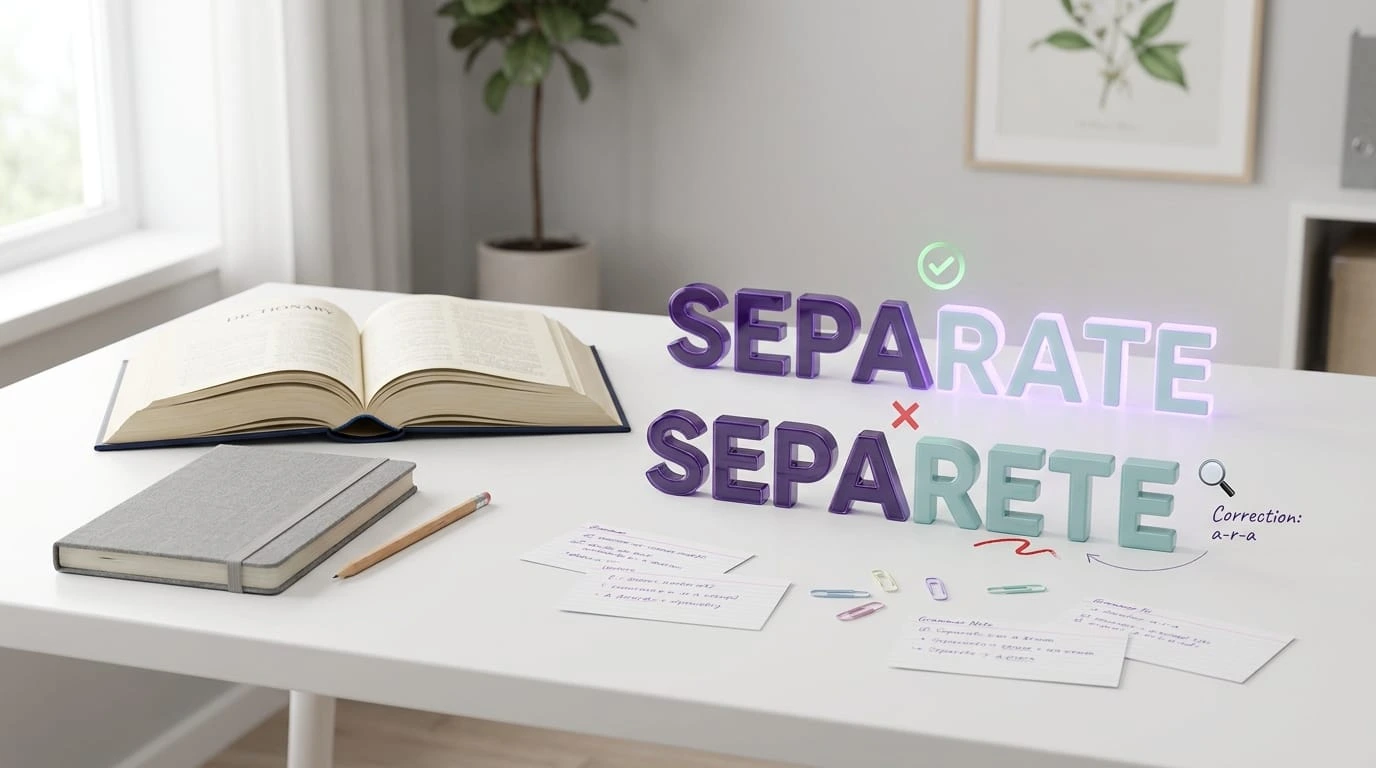
“Separate” is the correct spelling. “Seperate” is a common spelling mistake and should not be used in standard English.
Have you ever typed “seperate” and then stopped to wonder if it looked right? You are not alone. This is one of those English spelling mistakes that can fool even confident writers.
I have seen learners make this mistake because separate does not sound exactly the way it looks. When we say the word, the middle vowel can be easy to miss. Your brain may naturally turn it into “seperate.”
The good news is that there is a simple way to remember the correct spelling.
The correct word is separate.
It has “par” in the middle:
sep-a-r-a-te → separate
The incorrect spelling is:
sep-e-r-a-te → seperate ❌
In this guide, you will learn the difference between seperate or separate, where the word comes from, how to use it, common mistakes, and easy examples. By the end, you should be able to spell separate with confidence.
Seperate or Separate: Quick Answer
The correct spelling is separate.
Seperate is incorrect in standard English.
| Spelling | Correct? | Example |
| Separate | ✅ Yes | Please separate the two files. |
| Seperate | ❌ No | Please seperate the two files. |
Separate can be used as an adjective, verb, or noun.
As an adjective
It means different or apart.
We have separate rooms.
As a verb
It means to move apart or divide something.
Please separate the white clothes from the dark clothes.
As a noun
It can refer to an item of clothing worn with other items.
The store sells fashionable separates.
The Origin and Background of Separate
The word separate comes from Latin separare, meaning to divide or set apart.
It entered English through French and developed into the spelling we use today.
The word has a clear idea behind it: things that are apart from each other.
That meaning connects well with the spelling. Think of two things being placed apart.
The spelling mistake “seperate” happens mainly because of pronunciation.
When people say separate, the middle vowel can sound weak. This makes it easy to write seperate instead.
That is why this error is common among students, writers, and English learners.
Separate Explained: Key Differences and Uses
Separate has several common uses.
1. Separate as an adjective
As an adjective, separate means not joined or not together.
Examples:
- The children have separate bedrooms.
- We need separate tickets.
- They work in separate offices.
- Keep the two documents in separate folders.
2. Separate as a verb
As a verb, separate means to divide or move things apart.
Examples:
- Separate the eggs carefully.
- The teacher asked the students to separate into groups.
- Please separate the recyclable items.
- The wall separates the two rooms.
3. Separate as a noun
The noun form is less common.
In fashion, separates are individual clothing pieces that can be combined with other pieces.
Example:
She bought several separates for her new wardrobe.
“Separate vs Apart”
This is a very useful semantic comparison because readers may wonder whether they can use apart instead.
Example:
- The two houses are separate.
- The two houses are far apart.
Explain that they are related but not always interchangeable
Which Version Should You Use?
There is no regional spelling choice here.
Unlike words such as color/colour or center/centre, separate is not a British-versus-American spelling issue.
For students
Use separate in essays, assignments, exams, and classwork.
For professional writing
Use separate in emails, reports, documents, and business communication.
For social media
You should still use separate if you want your writing to look correct and polished.
For global English
Choose separate.
It is the standard spelling in both British English and American English.
Simple rule:
Separate = correct
Seperate = incorrect
Common Mistakes with Separate
Mistake 1: Writing “seperate”
❌ Please seperate the documents.
✅ Please separate the documents.
The incorrect form uses e where a should appear.
Mistake 2: Forgetting the “par”
A useful memory trick is to look at the middle:
sep + ar + ate
The word contains “par.”
Think:
There is a “par” in separate.
This small trick can help you remember the spelling.
Mistake 3: Confusing separate with separation
These words are related, but their forms are different.
- Separate = divide or keep apart
- Separated = already divided or apart
- Separation = the act or state of being apart
- Separately = in a separate way
Example:
The files were separated before the final separation of the records.
Mistake 4: Using “seperate” in formal writing
Because seperate looks close to the correct word, writers sometimes miss the error during proofreading.
Always check the middle of the word.
sep-a-rate ✅
Mistake 5: Thinking pronunciation controls spelling
English spelling does not always match pronunciation perfectly.
Even when the middle sound is unclear, the spelling remains:
separate
not
seperate.
Separate in Real-World Examples
Knowing the spelling is useful, but seeing the word in real situations makes it easier to remember.
Professional Email
Please send the two invoices as separate attachments.
Here, separate means that the invoices should not be combined.
News Headline
Government Announces Separate Plans for Education and Health
Here, separate means the plans are different from each other.
Social Media Post
Keep your work and personal accounts separate for better organization.
The word describes two things that are kept apart.
Formal Report
The research team analyzed the two groups as separate categories.
Here, separate means the categories were treated independently.
Everyday Conversation
Can you put these clothes in a separate bag?
The clothes should be placed apart from the other items.
Seperate or Separate: Data, Trends & Usage
The search intent behind “seperate or separate” is mainly informational.
People usually search this phrase when they are unsure about the spelling and want a quick answer.
The confusion is especially common among:
- Students
- English learners
- Bloggers
- Job seekers
- Professional writers
- People proofreading emails and documents
The important point is that this is a spelling-check query, not a regional spelling question.
Searchers are usually asking:
“Which spelling is correct?”
The answer is simple: separate.
This matters because spelling errors can affect how your writing looks. In schoolwork, professional emails, websites, and formal documents, using the correct spelling helps your writing appear clear and polished.
Standalone Comparison: Seperate vs Separate
| Term/Variant | Meaning | Region/Context | Best Used When |
| Separate | Apart, divided, or distinct | Standard English | Always |
| Seperate | Incorrect spelling | Common spelling mistake | Never |
| Separated | Made or kept apart | Standard English | Describing a past action or state |
| Separately | In an individual or distinct way | Standard English | Describing how something happens |
| Separation | The act or state of being apart | Standard English | Discussing the process or condition |
Easy Ways to Remember the Correct Spelling
If you often write seperate, try one of these memory tricks.
Remember “PAR”
The easiest trick is:
sep-a-r-a-te
It contains PAR.
Think:
There is a PAR in separate.
Break the Word Into Parts
Say it slowly in your mind:
sep + ar + ate
This makes the a easier to remember.
Connect It With “Apart”
Separate means apart.
When two things are separate, they are apart.
So remember:
Separate things stay apart.
Write It Three Times
Try writing:
separate — separate — separate
Seeing the correct form several times helps build visual memory.
Frequently Asked Questions
What is the correct spelling: seperate or separate?
Separate is the correct spelling. Seperate is a common spelling mistake and should be avoided in standard English.
What does separate mean?
Separate means apart, different, or not joined together. As a verb, it can also mean to divide or move things apart.
How do you spell separate correctly?
The correct spelling is S-E-P-A-R-A-T-E. A useful trick is to remember that “par” appears in the middle of the word.
Is “seperate” an acceptable spelling?
No. Seperate is not the standard spelling of the word. Use separate in academic, professional, formal, and everyday writing.
Is separate British or American spelling?
Separate is used in both British English and American English. There is no British-versus-American spelling difference for this word.
What is the difference between separate and separated?
Separate describes something that is apart or describes the action of dividing. Separated usually describes something that has already been divided or moved apart.
Is “seperate” a typo?
Yes. In standard English, seperate is considered a misspelling of separate.
Can separate be used as a verb?
Yes. Separate can be a verb meaning to divide or move things apart.
For example:
Please separate the blue papers from the white papers.
Conclusion
The seperate or separate question has a simple answer: separate is correct.
The spelling seperate is a common mistake. It often happens because the middle sound in separate can be hard to hear.
Remember the most useful trick:
Separate contains “par.”
You can also connect the word with its meaning. When things are separate, they are apart or not joined.
The word works as an adjective and verb, and it can also appear in related forms such as separated, separately, and separation.
Most importantly, do not treat seperate as an alternative spelling. It is simply an error.
Ninth or Nineth: Which Spelling Is Correct?

I am a professional content writer with a strong interest in English spelling and vocabulary. I am interested in creating informative guides on commonly confused words, spelling differences, and language usage to help readers write more accurately and effectively.