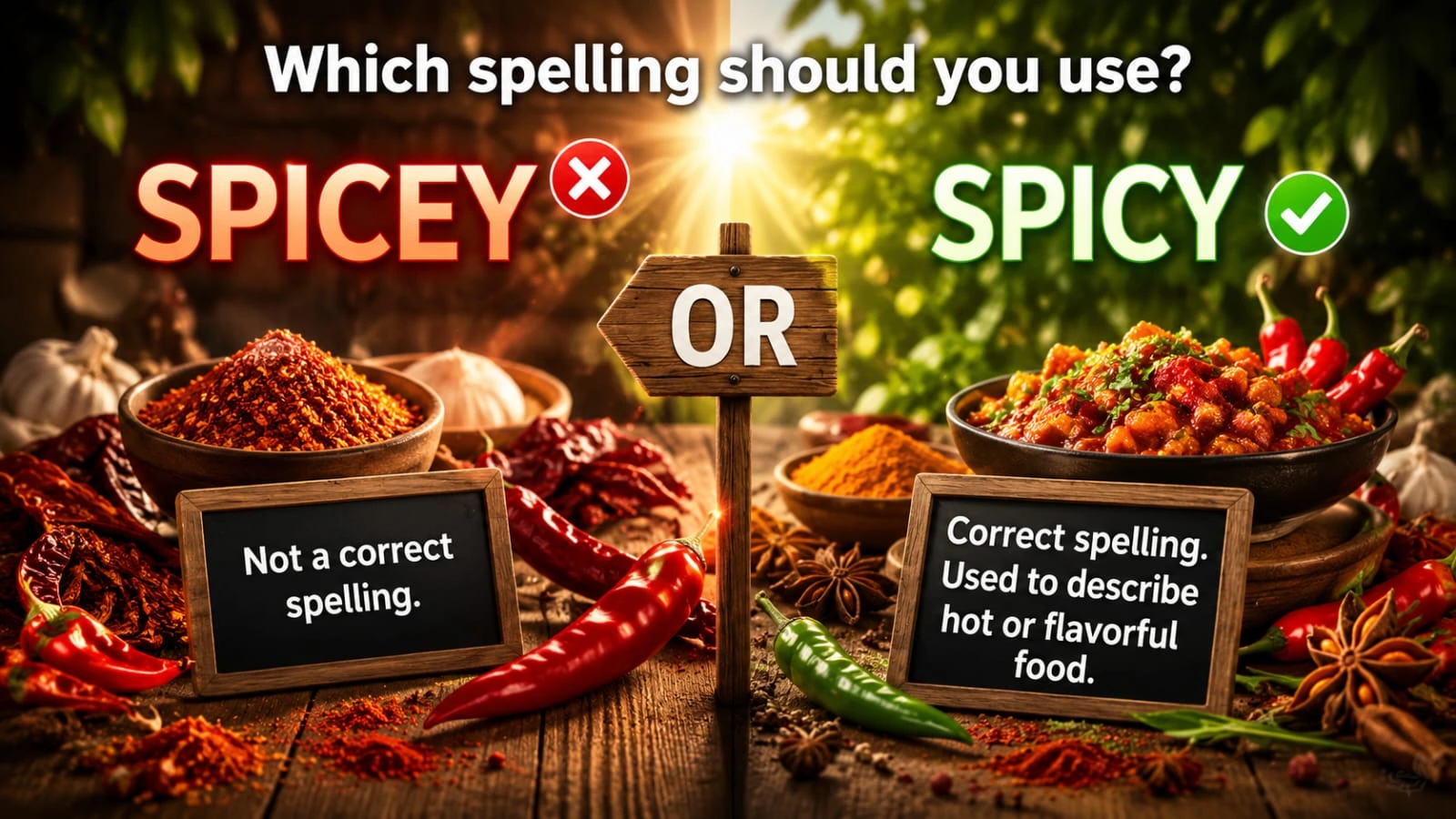
"Spicy" is the correct spelling. "Spicey" is a common misspelling, based on a pattern that doesn't actually apply to this word.
Years ago, I helped a friend design a menu for her food truck, and I typed “Spicey Chicken Tacos” across the top in bold letters. A customer pointed at it and asked, “Is that spelled right?” I had no idea, and honestly, I’d seen it written both ways plenty of times before.
If you’ve ever paused before typing this word, you’re in very good company. This is one of the most commonly misspelled food-related words in English, and the confusion comes from a totally understandable place.
This guide breaks down exactly why “spicy” drops the e, where the confusion comes from, and how to spell it correctly every time, whether you’re writing a menu, a recipe, or a quick text to a friend.
Spicey or Spicy: Quick Answer
“Spicy” is always correct. “Spicey” is a spelling error, not an accepted variant.
- ✅ This curry is incredibly spicy.
- ❌ This curry is incredibly spicey.
The confusion happens because some English words that end in a vowel plus a consonant add an e before certain suffixes, like “grace” becoming “gracey.” But “spicy” doesn’t follow that pattern, it comes from “spice” plus the suffix “-y,” and that combination drops the silent e.
The Origin of Spicy
“Spice” comes from Old French espice, rooted in Latin species, originally meaning a specific kind or sort, later narrowing to mean aromatic substances used in cooking. When English adds the adjective-forming suffix “-y” to a word ending in a silent e, the standard rule is to drop that final e before adding the suffix.
This same pattern shows up across dozens of common words:
- spice → spicy
- ice → icy
- noise → noisy
- grace → graceful (exception, since this uses a different suffix)
Because English has so many competing spelling rules, writers sometimes default to keeping the e, assuming it looks more “complete.” That instinct is exactly what leads to the mistaken spelling “spicey.”
Spicy Explained: Key Differences and Variations
| Word | Correct Spelling | Rule Applied | Example |
| Spice | Spice | Base noun, keeps the e | Add a pinch of spice to the sauce. |
| Spicy | Spicy | Drops the e before -y | This salsa is very spicy. |
| Spiciness | Spiciness | Keeps the y, adds -ness | The spiciness caught me off guard. |
| Spicier | Spicier | Changes y to i before -er | This version is spicier than the last. |
Notice that once “spicy” exists, further suffixes like “-ness” or “-er” follow their own separate rules, none of which bring back the original e.
Which Spelling Should You Use?
For everyday writing
Always use spicy. There’s no context where “spicey” is correct.
For students and ESL learners
Remember the rule: words ending in a silent e usually drop it before adding “-y” (spice → spicy, ice → icy, noise → noisy).
For menus, recipes, and food blogs
Double-check before printing or publishing, since “spicey” is one of the most common typos in food writing.
For global or neutral use
Spicy is standard across American, British, Australian, and all other English dialects. There’s no regional variation here.
Common Mistakes with Spicy
Mistake 1: Writing “spicey” instead of “spicy”
✅ I love spicy food, especially Thai curries.
❌ I love spicey food, especially Thai curries.
Why it happens: Writers assume the e from “spice” should carry over into the adjective form.
Mistake 2: Applying the same mistake to comparative and superlative forms
✅ spicier, spiciest
❌ spicyer, spicyest
Why it happens: Writers correctly drop the e but then forget the y-to-i shift required before adding “-er” or “-est.”
Mistake 3: Confusing “spicy” with unrelated -ey words
✅ spicy, icy, noisy
❌ spicey, icey, noisey (assuming all these words keep an e)
Why it happens: A handful of unrelated words, like “money” or “honey,” do end in “-ey,” which creates false confidence that “spicey” follows the same pattern.
Mistake 4: Misspelling in recipe titles and food blogs
✅ Spicy Garlic Noodles
❌ Spicey Garlic Noodles
Why it happens: Recipe titles are often typed quickly, without careful proofreading before publishing.
Mistake 5: Relying on autocorrect to catch it every time
✅ Proofread manually, since some autocorrect tools miss this error.
❌ Assuming spellcheck will always flag “spicey” as wrong.
Why it happens: Certain keyboard autocorrect settings and casual writing apps don’t consistently catch this specific mistake.
Spicy in Real-World Examples
Professional email:
“The catering menu includes both mild and spicy options for the event on Friday.”
News headline:
“Local Restaurant Wins Award for Spicy Signature Dish”
Social media post:
“This is way too spicy for me, but I can’t stop eating it. 🌶️”
Formal document:
“The product label must clearly indicate whether the sauce is mild, medium, or spicy.”
In every case, spicy is the only correct spelling, regardless of tone or formality.
Spicy: Data, Trends & Usage
Search interest in “spicey vs spicy” is consistently high, driven largely by food bloggers, restaurant owners, and home cooks double-checking spelling before publishing recipes or designing menus. This falls into the informational search category, with people wanting a fast, reliable answer before hitting publish or print.
Interest spikes around recipe seasons, particularly during spicy food trends, cooking competitions, and viral food challenges on social media. Despite being such a common word, “spicy” remains one of the more frequently misspelled adjectives in casual and commercial food writing.
Lying or Lieing: The Correct Spelling (2026)
Spicey vs Spicy: Comparison Table
| Term/Variant | Meaning | Region/Context | Best Used When |
| Spicy | Correct adjective describing heat or strong flavor | Universal, all English dialects | Always, in any writing context |
| Spicey | Misspelling, not a real word | None, incorrect everywhere | Never, avoid entirely |
| Spice | Base noun form | Universal | Referring to the seasoning itself |
Frequently Asked Questions
Q: What does “spicy” mean?
A: “Spicy” describes food or flavors with a strong, hot, or pungent quality, usually from ingredients like chili peppers, pepper, or certain spices.
Q: How do you use “spicy” correctly in a sentence?
A: Use “spicy” as an adjective describing food or flavor intensity, such as “This soup is too spicy for my taste” or “She prefers spicy over mild dishes.”
Q: Spicy vs spicey, what’s the difference?
A: There’s no real difference in meaning, since “spicey” isn’t a correct word at all. “Spicy” is the only accepted spelling.
Q: Is “spicy” acceptable in formal writing?
A: Yes, completely. “Spicy” is standard in professional food writing, product labeling, restaurant menus, and academic or journalistic contexts.
Q: Which version is correct, spicy or spicey?
A: “Spicy” is correct. “Spicey” is a spelling error that doesn’t appear in any English dictionary.
Q: Where does the word “spicy” come from?
A: It comes from “spice,” rooted in Old French espice and Latin species. The adjective form drops the silent e before adding the “-y” suffix.
Q: Can “spicy” be used in casual conversation and texting?
A: Yes. The spelling never changes based on tone, it’s “spicy” whether you’re texting a friend or writing a restaurant review.
Final Takeaway
Here’s the short version. “Spicy” is always correct. “Spicey” is always wrong.
Key points to remember:
- The rule: Words ending in a silent e usually drop it before adding “-y” (spice → spicy, ice → icy, noise → noisy)
- Watch comparative forms too: It’s “spicier” and “spiciest,” never “spicyer” or “spicyest”
- Don’t confuse it with unrelated -ey words: “Money” and “honey” follow a different pattern entirely
- No exceptions: “Spicy” is standard in every English dialect, formal or casual
Once you lock in the silent-e rule, you’ll never write “spicey” again.
Tomatoes or Tomatos: The Correct Spelling (2026)

I am a professional content writer with a strong interest in English spelling and vocabulary. I am interested in creating informative guides on commonly confused words, spelling differences, and language usage to help readers write more accurately and effectively.