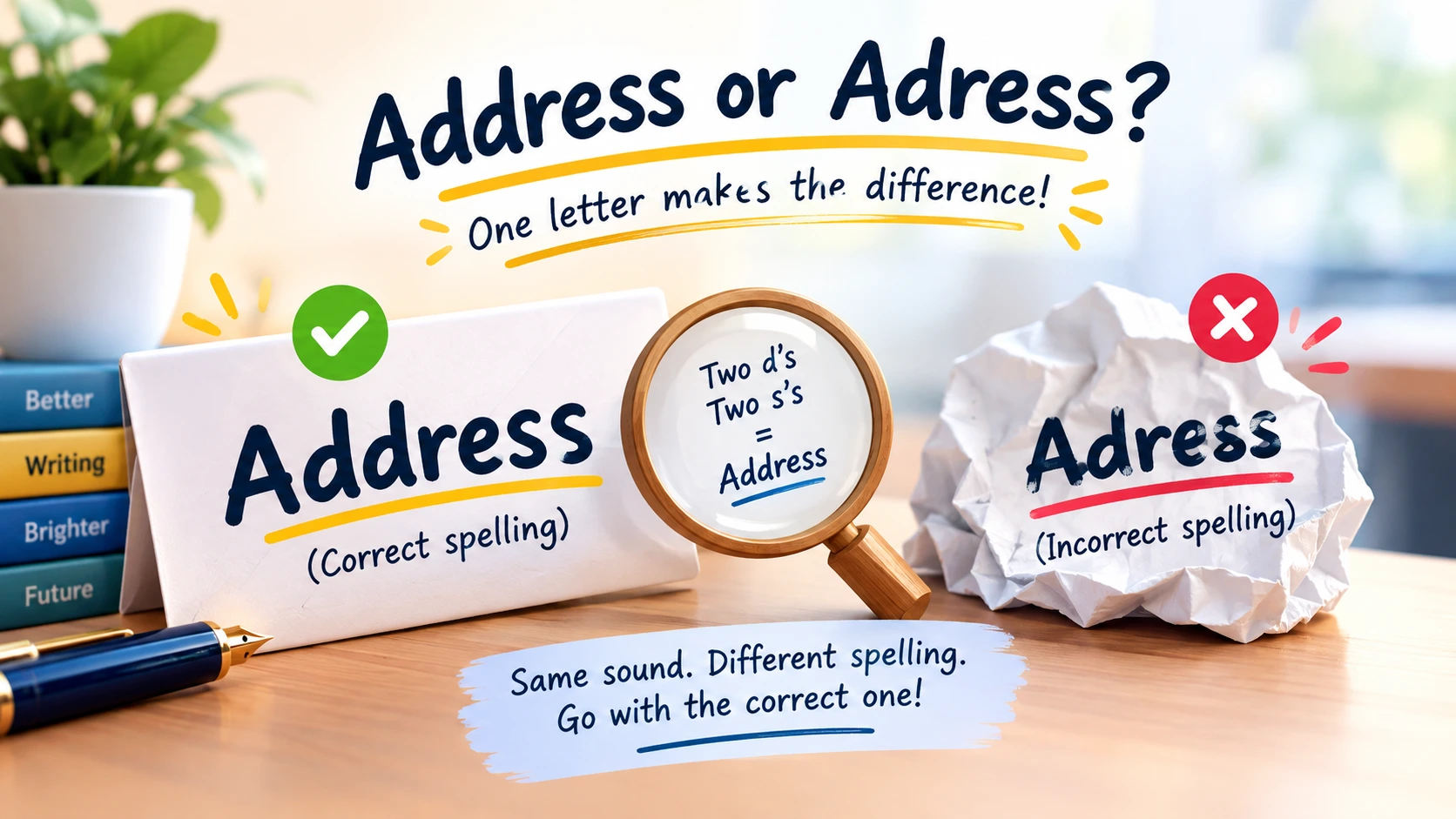
Address is the correct spelling. Adress is a common misspelling and should not be used in standard English.
Have you ever typed an email, filled out an online form, or written a letter and suddenly stopped at one simple word: address? I have seen this mistake many times in everyday writing, especially when learners are writing quickly. The problem is easy to understand because address has a double d and a double s, which can make its spelling feel harder than it really is.
The confusion becomes even stronger when you hear the word spoken. The pronunciation does not clearly remind you that there are two d’s and two s’s. As a result, some writers type adress without noticing the missing letter.
The good news is simple. You only need to remember one standard spelling: address.
In this guide, we will look at address or adress, explain why the mistake happens, show how to use the correct spelling, and give you simple examples for emails, forms, documents, and everyday writing.
Address or Adress: Quick Answer
The correct spelling is address.
Adress is a spelling mistake. It is not the standard spelling of the word in English.
The word address can refer to several things depending on the sentence.
For example:
- Please write your address on the form.
- What is your email address?
- The company changed its office address.
- The speaker addressed the audience.
Notice the spelling:
A-D-D-R-E-S-S
A useful way to remember it is:
address = add + ress
The word has two d’s and two s’s.
The Origin and Background of Address
The word address has a long history. It entered English through French and can be traced further back to Latin roots connected with ideas such as directing or making something straight.
Over time, English speakers used address in several related ways. It could mean directing words toward someone, dealing with an issue, or referring to a location.
That is why the modern word has more than one common use.
Today, you may use address when talking about:
- A home or business location
- An email location
- A person or group being spoken to
- A problem or issue that needs attention
- A formal speech
The spelling remained address, with two d’s and two s’s.
The form adress can appear when someone writes the word from memory or types it quickly. It may also happen because the second d is easy to overlook.
Address or Adress Explained
The difference between the two forms is very simple.
| Term | Meaning | When to Use | Region/Context |
|---|---|---|---|
| address | The correct English spelling | Standard writing | All major forms of English |
| adress | Misspelling of address | Avoid it | Nonstandard spelling |
Address
Address is the correct form.
Examples:
- Please send the package to my home address.
- I need your email address.
- The office has a new address.
- She gave a short address to the students.
Adress
Adress is incorrect in standard English.
For example:
❌ Please enter your adress.
Correct:
✅ Please enter your address.
The missing d is the main spelling problem.
Why Do People Spell Address as Adress?
The mistake usually happens because address does not sound exactly the way it looks.
When you say the word, you may not notice every letter. Your brain often remembers the sound rather than the complete spelling.
There is another reason, too. Many English words do not use double consonants in the same way. When you write quickly, it is easy to remove one of the letters.
Common mistakes include:
- adress instead of address
- addres instead of address
- adresss with an extra s
- adresses instead of addresses
The safest approach is to remember the basic form:
address
Then build other forms from it:
- address
- addresses
- addressed
- addressing
Which Version Should You Use?
If you are choosing between address and adress, use address.
This applies whether you are writing for school, work, business, social media, or everyday communication.
For students
Use address in assignments, applications, essays, and school forms.
My home address is written at the top of the application.
For professionals
Use address in emails, reports, letters, invoices, and business documents.
Please confirm the delivery address before shipping the order.
For online forms
Use address when entering your home, billing, shipping, or email information.
Enter your complete address below.
For formal writing
Address is the standard spelling and is suitable for formal documents.
There is no reason to replace it with adress.
Common Mistakes with Address
1. Writing “adress”
❌ What is your home adress?
✅ What is your home address?
The correct word has two d’s.
2. Forgetting the second “s”
❌ Please send it to this addres.
✅ Please send it to this address.
Remember that the word ends in ss.
3. Adding an unnecessary letter
❌ What is your addresss?
✅ What is your address?
Only two s’s are needed at the end.
4. Misspelling the plural
❌ We have the customer’s different adresss.
✅ We have the customers’ different addresses.
The plural form is addresses.
5. Confusing address with related forms
The word can change when it is used as a verb.
For example:
- The letter was addressed to Mr. Khan.
- The manager is addressing the problem.
- The company has two office addresses.
The base spelling still begins with address.
Address in Real-World Examples
Seeing the word in normal situations can make the spelling easier to remember.
Professional Email
Please confirm your address before we arrange delivery.
Here, address refers to a location where something will be delivered.
News Article
The mayor gave a public address after the announcement.
Here, address means a formal speech.
Social Media Post
Please send your shipping address by direct message.
Here, address means the location where an item should be sent.
Formal Document
The applicant must provide a current residential address.
Here, the word refers to a person’s place of residence.
Please send the report to my email address.
Here, address refers to an electronic contact location.
Different Meanings of Address
One reason this word appears so often is that address has several common uses.
1. Physical Address
A physical address identifies a place.
The company moved to a new address.
2. Email Address
An email address identifies an email account.
Please send the details to my email address.
3. Speech or Formal Address
An address can also be a formal speech.
The president delivered an address to the nation.
4. Addressing a Problem
As a verb, address can mean dealing with something.
We need to address this problem quickly.
These meanings are different, but the spelling remains the same.
Address or Adress: Comparison Table
| Term/Variant | Meaning | Region/Context | Best Used When |
|---|---|---|---|
| address | Correct spelling | American English | All standard writing |
| address | Correct spelling | British English | All standard writing |
| adress | Misspelling | Nonstandard | Should be avoided |
Unlike some English words that have different American and British spellings, address does not change spelling between American and British English.
So whether you write for readers in the United States, the United Kingdom, Canada, Australia, or another English-speaking region, the standard spelling is address.
Address: Data, Trends & Usage
Address is a very common English word because it belongs to several everyday areas.
People encounter it when they:
- Complete online forms
- Send letters or packages
- Create email accounts
- Write business documents
- Read news reports
- Talk about homes and offices
- Discuss problems that need attention
The spelling question “address or adress” is mainly informational. Someone searching this phrase usually wants to know which spelling is correct before using the word.
This matters because spelling errors can create problems in practical writing. A misspelled word may look unprofessional in an email, application, website form, or business document.
A simple spelling check can prevent that mistake.
A Simple Trick to Remember Address
Try breaking the word into two parts:
AD + DRESS
Then remember:
address = two D’s + two S’s
You can also repeat the spelling:
A-D-D-R-E-S-S
This is especially useful if you often type the word quickly.
Another helpful trick is to connect it with the word dress:
address → ad + dress
The word is not actually formed as a modern spelling rule from “ad” plus “dress,” but this memory trick can help you remember the letters.
Address vs. Addressee
Another word that can cause confusion is addressee.
These words are related, but they do not mean the same thing.
Address can mean a location, a speech, or the act of dealing with something.
Addressee means the person who receives a letter, message, or communication.
For example:
Please write the recipient’s address on the envelope.
The addressee is the person receiving the letter.
So:
- Address = location or other meanings
- Addressee = person receiving a message
Address vs. Location
The words address and location can sometimes be used in similar situations, but they are not always interchangeable.
A location is a place or position.
An address usually gives specific information used to identify that place.
For example:
The restaurant’s location is easy to find.
The restaurant’s address is 25 Main Street.
The first sentence focuses on the place. The second gives its specific address.
Frequently Asked Questions
Q: Is address or adress correct?
A: Address is correct. Adress is a misspelling and should be avoided in standard English.
Q: How do you spell address correctly?
A: The correct spelling is A-D-D-R-E-S-S: address. Remember that it contains two d’s and two s’s.
Q: Is adress a word?
A: Adress is not the standard English spelling of the word. If you mean a home location, email location, formal speech, or the verb meaning “deal with,” use address.
Q: Is address spelled differently in American and British English?
A: No. Both American and British English use address. There is no standard American-versus-British spelling difference here.
Q: Can address be used as a verb?
A: Yes. As a verb, address can mean to speak to someone, deal with an issue, or direct something toward a person or group.
For example:
We need to address the problem.
Q: What is the plural of address?
A: The plural is addresses.
For example:
The company has offices at several addresses.
Q: What is the difference between address and addressee?
A: An address can refer to a location or other meanings, while an addressee is the person who receives a letter or message.
Q: Why is address often misspelled as adress?
A: The word is easy to misspell because the pronunciation does not make the double letters obvious. Writers may remember the sound and accidentally leave out one of the d’s.
Final Takeaway: Address or Adress?
When you are choosing between address or adress, the answer is straightforward: address is the correct spelling.
Remember these three points:
- Address is the standard spelling.
- Adress is a misspelling.
- Address is used in both American and British English.
The word is useful in many settings. You may use it for a home location, email account, business location, formal speech, or an issue that needs attention.
If you are unsure, look at the middle and end of the word:
A-D-D-R-E-S-S
Two d’s. Two s’s.
That small memory trick can save you from a common spelling mistake.
Now that you know the difference, you can use address with confidence in your next email, form, assignment, or professional document. Bookmark this guide so you never have to second-guess the spelling again.
Tweek or Tweak: Which Spelling Is Correct?

I’m a language enthusiast and content writer. I’m specialized in English grammar, spelling differences, vocabulary explanations, and word comparisons. My goal is to help readers improve their writing skills through clear, accurate, and easy-to-understand language guides.