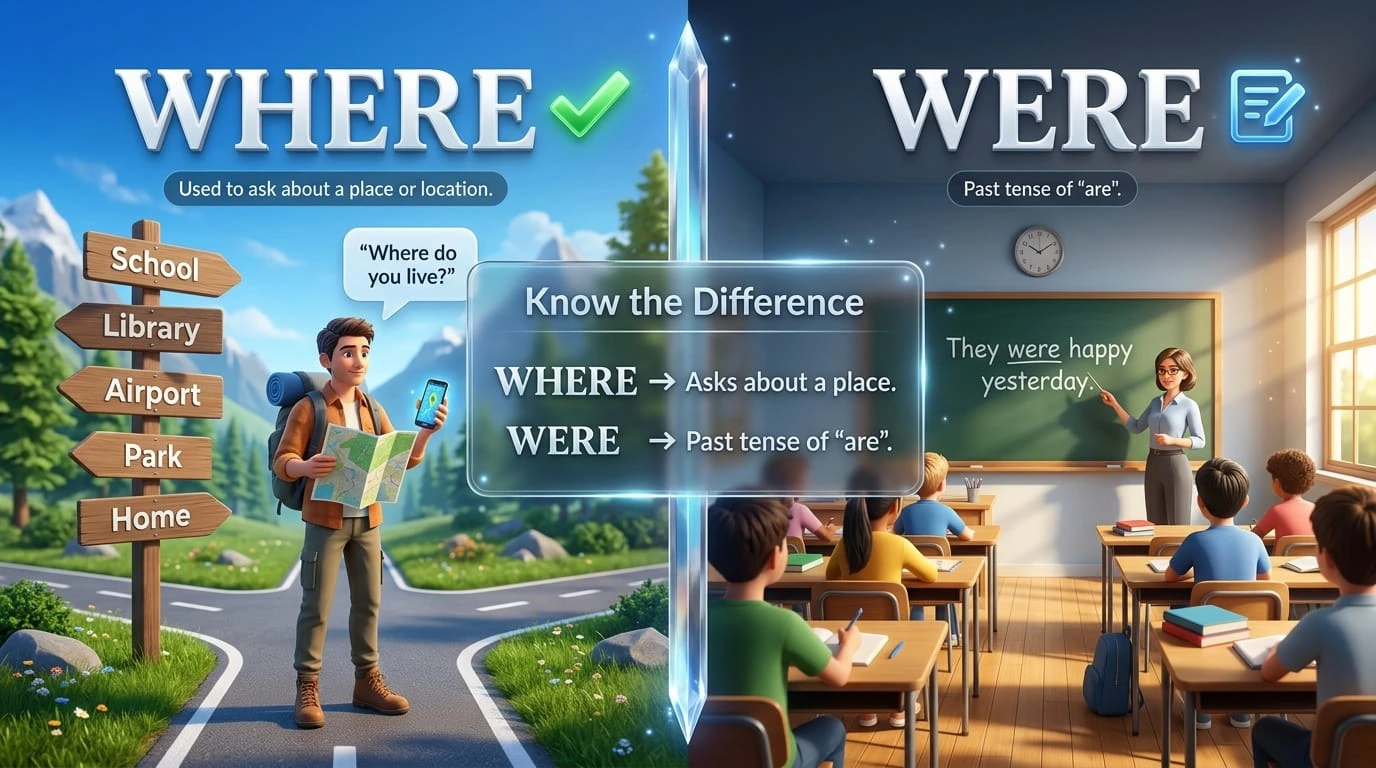
“Where” refers to a location or place. “Were” is the past tense of “to be,” used with plural subjects or “you.” They aren’t different spellings of the same word, they’re two completely different words that just look alike.
I once texted a friend, “were are you? we’re running late.” I hit send without a second thought, then noticed my own mistake seconds later. I’d swapped “where” for “were” without even realizing it.
If you’ve ever done the same thing, you’re in extremely good company. This is one of the most common word mix-ups in casual writing, texting, and even professional emails, because “where” and “were” look so similar and share several of the same letters.
This guide clears up exactly what each word means, how to tell them apart instantly, and how to avoid this mix-up for good, whether you’re texting a friend or writing a formal report.
Where or Were: Quick Answer
“Where” asks about or describes a location.
- ✅ Where did you put my keys?
“Were” is the past tense of “to be,” used with plural subjects, “you,” or hypothetical situations.
- ✅ They were at the party last night.
- ❌ Were did you put my keys?
A simple trick: if you can replace the word with “was” or “are,” you need “were.” If you’re asking about a place, you need “where.”
The Origin of Where/Were
“Where” comes from Old English hwær, related to a family of question words like “when,” “why,” and “what,” all rooted in an ancient interrogative form. It has always referred to location or place, and that meaning hasn’t shifted much over the centuries.
“Were” comes from a completely different root, Old English wǣron, the plural past tense of the verb “to be.” It belongs to the same verb family as “was,” “is,” “am,” and “are,” a group of irregular forms English speakers call the verb “to be.”
These two words developed along entirely separate paths in Old English. Their modern similarity in spelling is mostly coincidental, they simply ended up sharing several letters after centuries of language change, which is exactly why they’re so easy to confuse today.
Where vs Were Explained: Key Differences and Variations
| Term | Part of Speech | Meaning | Example |
| Where | Adverb/Conjunction | Refers to a location or place | Where is the nearest exit? |
| Were | Verb | Past tense of “to be” (plural or “you”) | We were late for the meeting. |
| We’re | Contraction | Short for “we are” | We’re leaving in five minutes. |
Notice that “were” is often confused with a third word too, “we’re.” All three sound completely different when spoken clearly, but they’re easy to mix up while typing quickly.
Which Word Should You Use?
When asking about or describing a location
Use where. This applies to questions and statements about place, direction, or position.
When describing a past state involving plural subjects or “you”
Use were. This fits naturally into sentences describing something that already happened.
When shortening “we are”
Use we’re, with the apostrophe. Don’t confuse this contraction with either “where” or “were.”
For quick self-checks while writing
Ask yourself: does the sentence need a location, a past-tense verb, or a contraction of “we are”? That question alone solves almost every mix-up.
Common Mistakes with Where/Were
Mistake 1: Using “were” instead of “where”
✅ Where did you leave the umbrella?
❌ Were did you leave the umbrella?
Why it happens: The words share several letters, and fast typing often swaps them without the writer noticing.
Mistake 2: Using “where” instead of “were”
✅ They were excited about the announcement.
❌ They where excited about the announcement.
Why it happens: Writers sometimes default to the more visually familiar word without checking which meaning the sentence actually needs.
Mistake 3: Confusing “were” with “we’re”
✅ We’re heading to the store now.
❌ Were heading to the store now.
Why it happens: Dropping the apostrophe turns a contraction into a completely different word with a different meaning.
Mistake 4: Mixing all three words in one sentence
✅ Where were you when we’re supposed to meet?
❌ Were were you when where supposed to meet?
Why it happens: When all three words appear close together, it becomes easy to lose track of which one belongs where.
Mistake 5: Relying on autocorrect to catch the error
✅ Proofread carefully, since “where” and “were” are both real words and won’t get flagged.
❌ Assuming spellcheck will catch every instance of the wrong word choice.
Why it happens: Because both words are spelled correctly on their own, spellcheck tools don’t flag the swap.
its or it’s: Complete Easy Grammar Guide
Where/Were in Real-World Examples
Professional email:
“Please confirm where the meeting will take place, since the invite didn’t include a location.”
News headline:
“Officials Were Unaware of the Safety Violations Until This Week”
Social media post:
“Does anyone know where this photo was taken? It’s stunning. 📸”
Formal document:
“The applicants were notified of the decision by mail on the stated date.”
Notice how “where” always points to a place, while “were” always describes something in the past.
Where/Were: Data, Trends & Usage
Search interest in “where vs were” stays consistently high, driven largely by students, ESL learners, and writers double-checking grammar before submitting assignments or professional writing. This falls into the informational search category, with people wanting a quick, clear answer rather than a long grammar lesson.
This confusion appears frequently in casual texting and social media, where fast typing leads to more errors slipping through unnoticed. Because both words are common and grammatically valid on their own, this mix-up remains one of the most persistent word-choice errors in everyday English writing.
Where vs Were: Comparison Table
| Term/Variant | Meaning | Region/Context | Best Used When |
| Where | Refers to a location or place | Universal, all English dialects | Asking or describing location |
| Were | Past tense of “to be” | Universal, all English dialects | Describing a past state, plural subjects or “you” |
| We’re | Contraction of “we are” | Universal, all English dialects | Shortening “we are” in casual or formal writing |
Frequently Asked Questions
Q: What does “where” mean?
A: “Where” refers to a location, place, or position, and is used in both questions and statements, such as “Where do you live?” or “I know where the store is.”
Q: How do you use “were” correctly in a sentence?
A: Use “were” as the past tense of “to be” with plural subjects or “you,” such as “You were right” or “The kids were playing outside.”
Q: Where vs were, what’s the difference?
A: “Where” refers to location, while “were” is a past-tense verb. They aren’t related in meaning, they simply look similar in spelling.
Q: Is “were” acceptable in formal writing?
A: Yes, completely. “Were” is standard in formal, academic, and professional writing whenever describing a past state for plural subjects or “you.”
Q: Which version is correct, where or were?
A: Both are correct, but they mean different things. Choose “where” for location and “were” for past tense, based on what your sentence actually needs.
Q: Where does the word “were” come from?
A: It comes from Old English wǣron, the plural past tense of the verb “to be,” part of the same irregular verb family as “was,” “is,” and “am.”
Q: Can “where” and “were” ever be used interchangeably?
A: No. They serve completely different grammatical roles, and swapping one for the other always changes or breaks the meaning of the sentence.
Final Takeaway
Here’s the short version. “Where” is about location. “Were” is about the past tense of “to be.” They aren’t variant spellings, they’re entirely different words.
Key points to remember:
- The test: If you can replace it with “was” or “are,” use “were.” If you’re asking about a place, use “where”
- Watch for a third word too: Don’t confuse “were” with the contraction “we’re”
- Fast typing causes most errors: Slow down and proofread when these words appear close together
- No shortcuts: Spellcheck won’t catch this mix-up, since both words are spelled correctly
Once you lock in the location-versus-past-tense distinction, you’ll never confuse “where” and “were” again.
Where vs were explained, correct meaning, usage, and examples. Learn the simple trick to never mix them up again.
Who’s or Whose: The Complete Guide to Using Them Correctly (2026)

I am a professional content writer with a strong interest in English spelling and vocabulary. I am interested in creating informative guides on commonly confused words, spelling differences, and language usage to help readers write more accurately and effectively.