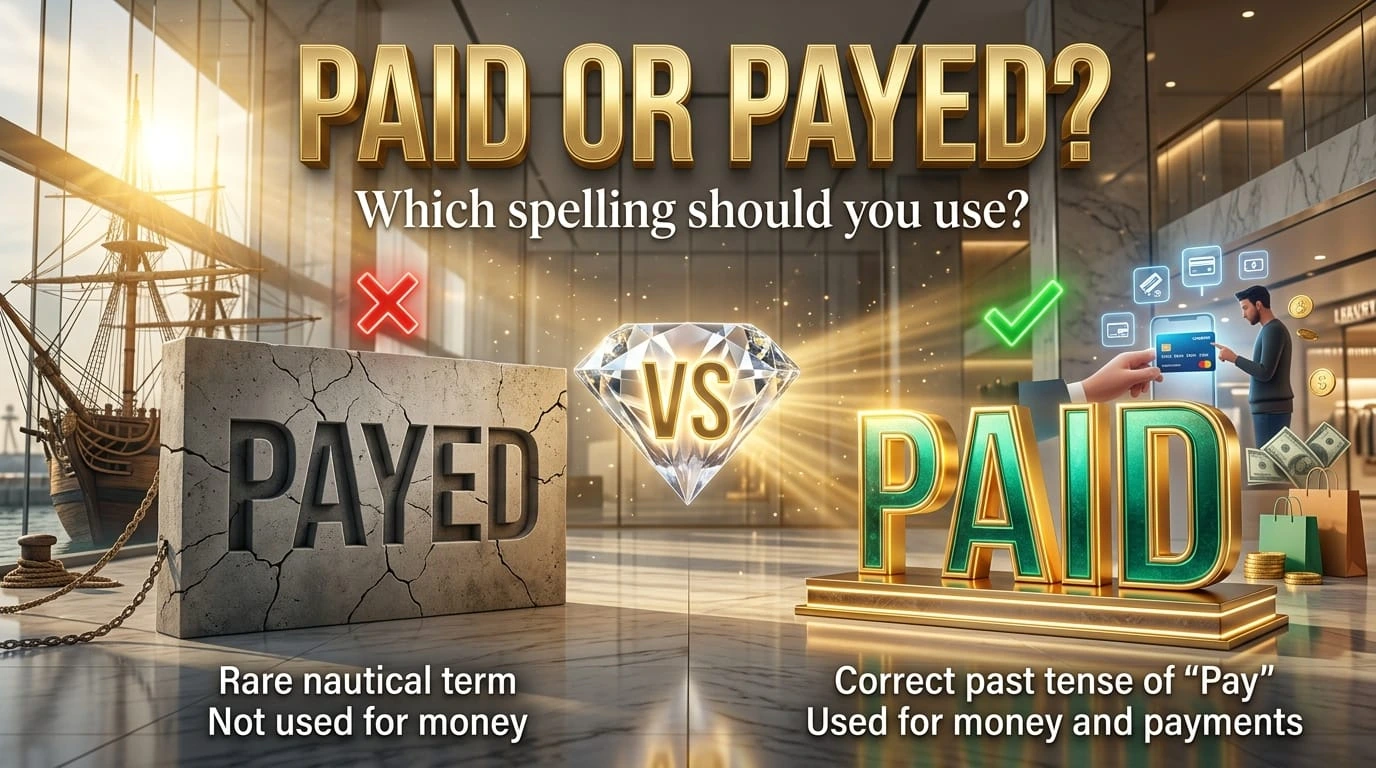
“Paid” is the correct past tense of “pay” in almost every situation. “Payed” is a rare nautical term, used only when describing a rope or cable being let out. _____________________________________________________________________________________________________
I once sent a client an invoice note that read, “This amount has already been payed.” Within minutes, I got a reply gently correcting me. I was embarrassed, since “pay” seemed like such a simple word to get wrong.
Here’s what I didn’t know at the time: “payed” isn’t just a typo, it’s a real word, but only in one very specific context. Outside of sailing and rope work, it’s always incorrect.
If you’ve ever typed “payed” and wondered whether it was right, this guide clears up exactly when “paid” applies, the one narrow exception where “payed” is correct, and how to avoid this mistake in emails, invoices, and everyday writing.
Paid or Payed: Quick Answer
“Paid” is the correct past tense of “pay” in nearly every context. Use it for money, bills, favors, and figurative expressions.
- ✅ She paid the bill before the due date.
- ✅ He paid attention during the meeting.
“Payed” only applies to nautical usage, describing a rope or cable being slowly let out.
- ✅ The crew payed out the anchor chain.
- ❌ She payed the bill before the due date.
The Origin of Paid/Payed
“Pay” comes from Old French paier, rooted in Latin pacare, meaning to appease or satisfy, related to the idea of settling a debt. As English verbs formed their past tense, most regular verbs ending in -y simply changed the y to i and added -d, giving English the standard form “paid.”
This same pattern shows up in other common verbs:
- lay → laid
- say → said
- pay → paid
The nautical exception, “payed,” survives from an older, now mostly obsolete spelling convention. Sailing terminology often preserves archaic spellings long after they disappear from everyday language, and “payed out” is one of those maritime holdouts, referring specifically to slackening or releasing a rope, chain, or cable.
Paid vs Payed Explained: Key Differences and Variations
| Term | Meaning | When to Use | Region/Context |
| Paid | Past tense of “pay,” meaning gave money or settled a debt | Everyday writing, finance, general usage | Universal, all English dialects |
| Payed | Past tense used only for letting out rope or cable | Nautical and sailing contexts | Rare, specialized maritime usage |
| Pay | Base verb form | Present tense or infinitive | Universal |
A simple test: if the sentence involves money, effort, or attention, use “paid.” If it involves letting out a rope on a ship, use “payed.”
Which Spelling Should You Use?
For everyday writing, finance, and business
Use paid. This covers bills, salaries, debts, compliments, and nearly every figurative use of “pay.”
For nautical or sailing writing
Use payed, but only specifically when describing rope or cable being released, as in “payed out the line.”
For students and ESL learners
Default to paid in almost every case. The nautical exception is rare enough that most writers will never need it.
For global or neutral use
Paid is the universal, safe choice across every English dialect and context outside of specialized sailing terminology.
Common Mistakes with Paid/Payed
Mistake 1: Writing “payed” instead of “paid” for money or bills
✅ He paid his rent on the first of the month.
❌ He payed his rent on the first of the month.
Why it happens: Writers assume “pay” follows the regular -ed rule, without realizing the standard past tense actually changes the spelling.
Mistake 2: Using “payed” for figurative expressions
✅ She paid attention to every detail in the report.
❌ She payed attention to every detail in the report.
Why it happens: The nautical exception gets misapplied to common idioms that have nothing to do with sailing.
Mistake 3: Assuming “payed” is simply an alternate spelling
✅ “Paid” is standard everywhere except nautical rope terminology.
❌ Treating “payed” as an acceptable substitute for “paid” in general writing.
Why it happens: Some writers mistake the rare exception for a valid stylistic choice.
Mistake 4: Misusing “payed” in professional documents
✅ Invoice paid in full as of March 1st.
❌ Invoice payed in full as of March 1st.
Why it happens: Financial and legal documents rarely get proofread as closely as they should, letting the error slip through.
Mistake 5: Relying on spellcheck to catch it
✅ Proofread carefully, since “payed” is a real word and won’t always get flagged.
❌ Assuming autocorrect will catch every instance of “payed” used incorrectly.
Why it happens: Because “payed” exists in the dictionary for nautical use, spellcheck tools often don’t flag it as an error.
Leaves or Leafs: The Correct Spelling (2026)
Paid/Payed in Real-World Examples
Professional email:
“Please confirm the outstanding balance has been paid before we proceed with the next shipment.”
News headline:
“City Council Approves Funds After Contractors Went Unpaid for Months”
Social media post:
“Finally paid off my student loans today. 🎉”
Formal document (nautical context):
“The crew payed out additional line as the vessel drifted from the dock.”
Notice how “paid” dominates nearly every context, while “payed” appears only in that final, highly specific maritime example.
Paid/Payed: Data, Trends & Usage
Search interest in “paid vs payed” is steady and mostly informational, driven by writers, students, and professionals confirming spelling before sending invoices, emails, or reports. The vast majority of searches have nothing to do with sailing, most people are simply unsure whether “payed” is ever correct.
Search volume for the nautical meaning of “payed” is extremely low, appearing mainly in sailing manuals, maritime history writing, and boating forums. For nearly everyone else, “paid” is the only spelling they’ll ever need.
Paid vs Payed: Comparison Table
| Term/Variant | Meaning | Region/Context | Best Used When |
| Paid | Settled a debt, gave money, or gave attention | Universal, all English dialects | Everyday writing, finance, general usage |
| Payed | Let out a rope or cable | Nautical and sailing contexts only | Rare, specialized maritime writing |
| Pay | Base verb form | Universal | Present tense or infinitive use |
Frequently Asked Questions
Q: What does “paid” mean?
A: “Paid” is the past tense of “pay,” meaning money was given, a debt was settled, or attention or respect was given, as in “paid attention” or “paid respects.”
Q: How do you use “paid” correctly in a sentence?
A: Use “paid” any time you’re describing a completed payment or a figurative use of “pay,” such as “They paid the deposit” or “He paid tribute to his mentor.”
Q: Paid vs payed, what’s the difference?
A: “Paid” is the standard past tense used almost everywhere. “Payed” is a rare nautical term used only for letting out a rope or cable.
Q: Is “payed” ever acceptable in formal writing?
A: Only in nautical or maritime contexts describing rope or cable being released. In every other type of formal writing, “paid” is correct.
Q: Which version is correct, paid or payed?
A: “Paid” is correct for virtually all everyday, financial, and figurative uses. “Payed” is correct only in the narrow nautical sense.
Q: Where does the word “paid” come from?
A: It comes from Old French paier, rooted in Latin pacare, meaning to appease or settle. The spelling shifted from y to i following a common pattern in English past-tense verbs.
Q: Can “payed” be used in casual conversation?
A: No, not for everyday meanings like money or attention. Casual conversation should always use “paid,” reserving “payed” strictly for sailing terminology.
Final Takeaway
Here’s the short version. “Paid” is correct almost everywhere. “Payed” is correct only when describing a rope or cable being let out on a ship.
Key points to remember:
- The rule: “Pay” follows the same y-to-i pattern as “say” and “lay,” becoming “paid”
- The one exception: “Payed” applies only to nautical rope and cable usage
- Watch financial writing closely: Invoices, bills, and receipts always use “paid”
- When in doubt: Default to “paid,” since it covers nearly every situation you’ll encounter
Once you know the nautical exception exists, you’ll never second-guess “paid” in everyday writing again.
Tomatoes or Tomatos: The Correct Spelling (2026)

I am a language content specialist specializing in spelling comparisons, vocabulary usage, and commonly confused English words. I write detailed, informative articles that help readers improve their language skills. I am passionate about helping students, writers, and professionals develop a stronger understanding of the English language.