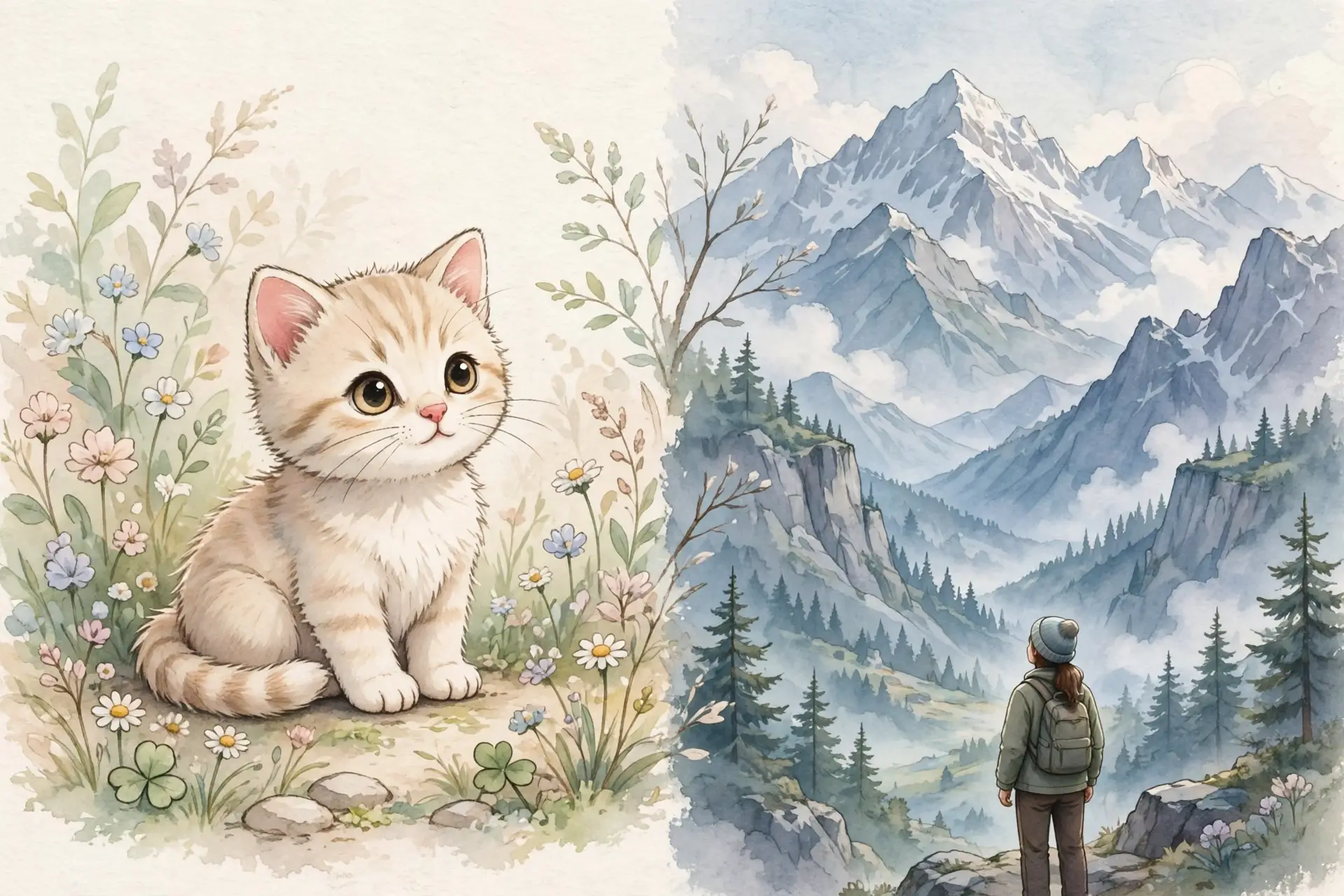
Aww is an interjection you say when something is cute, sweet, or sad, and awe is a noun for a deep feeling of wonder, respect, and amazement they sound alike but mean very different things.
I still remember the day my little niece showed me a video of a kitten trying to climb into a shoe. She looked up at me, smiled, and said “Aww!” before I even had time to react. Her whole face lit up, and I knew exactly what she meant. Nobody taught her that word. She had just heard it a hundred times and knew it fit the moment. That is how most of us learn “aww.” It is the sound we make when our hearts melt a little. But then, in the same week, I read a travel article that said, “The view filled us with awe.” It was the same sound, spelled differently, and it meant something much bigger. A kitten in a shoe is cute. A mountain at sunrise is awe. I have seen friends, students, and even native speakers mix these two up in writing, especially in chats and posts. The words sound almost the same, and that is exactly why they are so easy to confuse. In this guide, you will learn the difference between aww and awe, when each word is correct, and how to never mix them up again. By the end, you will hear the difference as clearly as you feel it.
Aww or Awe: Quick Answer
Aww is an interjection. Say it when something is cute, sweet, or sad — a baby, a puppy, or a kind gesture. For example: “Aww, look at that puppy!” Awe is a noun. It means a deep feeling of wonder, respect, and amazement — the feeling you get in front of a huge mountain or a great work of art. For example: “The cathedral filled us with awe.” The simplest rule is this: if you are reacting to something cute, write aww. If you are describing a powerful feeling of wonder, write awe.
The Origin and Background of Aww or Awe
Awe is the older word. It entered English around the year 1200, borrowed from Old Norse agi, which meant fear or terror. It came from the Germanic word agaz, which had the same meaning. Long ago, awe meant fear mixed with respect. Over time, its meaning softened. It came to mean a feeling of great wonder and respect, and even fear filled with wonder. That is the awe we still use today. Two modern words came from it: awesome, which once meant “full of fear,” but now often means “another thing — wonderful,” and awful, which once meant “full of awe,” but today often means “very bad.”
Aww is much younger and much simpler. It comes from the natural sigh people make — “aw” — stretched out into “aww.” It is the sound of the heart melting, or of a small disappointment. Some dictionaries trace it to the early 1900s, when the word “aw” began to be written with two w’s. It became common in casual writing, comics, and then in chats and social media. That is why it feels so natural to type: it is a sound we write, not a word we learned from a book.
Aww or Awe Explained: Key Differences
The difference is all about feeling. Aww is a reaction. It is short, sweet, and spoken in the moment. Awe is a state of mind. It is deep, powerful, and often lasts longer than a second. Aww is something you say. Awe is something you feel.
| Term | Meaning | When to Use | Region/Context |
|---|---|---|---|
| Aww | Interjection for cute, sweet, or sad things | Reacting to babies, pets, kind gestures | Informal, chats, social media |
| Awe | Feeling of wonder, respect, amazement | Facing mountains, art, great people | All English, formal and informal |
| Aw | Shorter interjection, also for disappointment | “Aw, I missed the bus” | Informal English |
| Awed | Past tense of awe, filled with awe | “We were awed by the view” | All English |
Look at the contrast. “Aww, how cute!” is a quick reaction in the moment. “We stood there in awe” describes a deep feeling that stays with you. One is a sound. The other is an emotion.
See the full definition of awe here: awe definition.
Which Version Should You Use?
The right version depends on the feeling you mean. Use this simple guide:
- For something cute, sweet, or touching → use aww. “Aww, look at the baby!” “Aww, thank you so much!” It is a reaction, not a description.
- For a deep feeling of wonder → use awe. “The view left us in awe.” “I felt awe at the size of the mountain.” The feeling is bigger and deeper.
- For a moment of sadness or sympathy → use aww. “Aww, I’m so sorry.” “Aww, that poor cat.” The tone is gentle and kind.
- For respect and amazement at something great → use awe. “She spoke of him with awe.” “The audience watched in awe.” The feeling is serious and deep.
- For global or neutral use → use awe when you mean the emotion. It is the safest choice. In most serious writing, the word you need is awe, not the casual interjection.
A quick test helps. If you can replace the word with “how cute” or “that’s sweet” and the sentence still works, you need aww. If you can replace it with “wonder” or “amazement” and it still works, you need awe. “Aww, the kitten” means “how cute, the kitten.” “The view left us in wonder” means “in awe.” The meaning tells you the spelling.
Common Mistakes with Aww or Awe
Mistake 1: Using awe when you mean the cute reaction.
❌ “Awe, look at the puppy!”
✅ “Aww, look at the puppy!”
Why: Awe is a noun for a deep feeling. It is not the sound you make when something is cute.
Mistake 2: Using aww when you mean the deep feeling.
❌ “We stood there in aww.”
✅ “We stood there in awe.”
Why: In awe is a fixed phrase. It means filled with wonder. Aww does not fit that phrase.
Mistake 3: Spelling aww with one w.
❌ “Aw, how cute!” (when you mean a warm reaction)
✅ “Aww, how cute!”
Why: Aw is the shorter form, and it can also show disappointment. Aww is the warm, cute reaction. The two w’s make the feeling clear.
Mistake 4: Using aww in formal writing.
❌ “The speech left the crowd in aww.” (formal report)
✅ “The speech left the crowd in awe.”
Why: Aww is casual and belongs in chats and social media. In formal writing, the feeling is awe.
Mistake 5: Mixing up awe and awful.
❌ “The view was awful.” (when you mean wonderful)
✅ “The view was awesome.” (or “The view filled me with awe.”)
Why: Awful means very bad today. If you mean wonderful, use awesome — or describe the feeling of awe.
Aww or Awe in Real-World Examples
In a friendly message:
“Aww, your baby is so cute!” (interjection — a cute reaction)
“Aww, thank you for the gift!” (interjection — a warm reaction)
In a news report:
“The crowd watched in awe as the rocket lifted off.” (noun — wonder and respect)
“The singer’s voice held the audience in awe.” (noun — deep admiration)
In a social media post:
“Aww, this kitten is the cutest thing ever!” (interjection — cute)
“Standing under the mountain, I felt pure awe.” (noun — deep wonder)
In a formal document or report:
“The committee expressed awe at the scale of the project.” (noun — formal)
“The students gazed in awe at the ancient ruins.” (noun — formal wonder)
Aww or Awe: Data, Trends & Usage
This topic is searched most by students, teachers, and social media users. People search it when they reply to cute posts, write captions, or try to describe a strong feeling. The search intent is informational: readers want a quick, clear rule they can trust. Aww and awe are searched most in English-speaking countries, especially the United States, the United Kingdom, Canada, and Australia. The confusion is biggest on social media, where aww appears every day in comments and captions.
One insight matters now. Autocorrect rarely fixes this pair, because both words are spelled correctly. Your phone cannot tell if you meant a cute reaction or a deep feeling. That is why this mistake is so common, and why a quick check matters so much. Read your sentence again before you send it. Ask yourself: am I reacting to something cute, or describing wonder? The answer gives you the spelling.
Aww vs Awe at a Glance
| Term/Variant | Meaning | Region/Context | Best Used When |
|---|---|---|---|
| Aww | Interjection for cute, sweet, touching things | Informal, chats, social media | Reacting to babies, pets, kind acts |
| Awe | Feeling of wonder, respect, amazement | All English | Facing grand or powerful things |
| Aw | Shorter interjection, also for disappointment | Informal English | “Aw, I missed the bus” |
| Awed | Filled with awe (past tense of awe) | All English | “We were awed by the view” |
Frequently Asked Questions
Q: What does aww mean?
A: Aww is an interjection you say when something is cute, sweet, or sad. It is a quick reaction, like “Aww, look at that puppy!” It is casual and common in chats and social media.
Q: How do you use awe correctly?
A: Use awe as a noun for a deep feeling of wonder, respect, and amazement. For example: “We stood there in awe.” It works in formal and informal writing.
Q: Aww vs awe what’s the difference?
A: Aww is an interjection, a sound you make when something is cute. Awe is a noun, a deep feeling of wonder. One is a reaction. The other is an emotion.
Q: Is aww acceptable in formal writing?
A: No, aww is best kept for chats, social media, and casual messages. In formal writing, use awe for the feeling of wonder, or describe the reaction in another way.
Q: Which word is correct — aww or awe?
A: Both are correct, but for different meanings. Use aww for cute, sweet, or sad reactions, and awe for a deep feeling of wonder. The wrong one is only wrong when the meaning does not match.
Q: Where does awe come from?
A: Awe comes from Old Norse agi, meaning fear or terror. It entered English around the year 1200, from the Germanic word agaz. Its meaning softened over time into wonder and respect.
Q: Can awe be used in a caption or social media post?
A: Yes, awe is perfect for captions about big moments. “Standing under the mountain, I felt pure awe” describes a deep feeling, while “Aww, this kitten!” is the right choice for something cute.
Conclusion
The rule is short, and it is worth remembering. Aww is an interjection: the sound you make when something is cute, sweet, or sad. Awe is a noun: a deep feeling of wonder, respect, and amazement. Aww is a reaction. Awe is an emotion. When you write your next message, caption, or story, pause for one second and ask: am I reacting to something cute, or describing a feeling of wonder? That one question will keep your spelling clean.
Your readers will notice the difference, even if they never say so. Now you know exactly how to use each word. Go try it in your next message or post, and bookmark this guide so you never second-guess aww or awe again.
Mondays or Monday’s: The Correct Spelling Explained

I am a language content specialist specializing in spelling comparisons, vocabulary usage, and commonly confused English words. I write detailed, informative articles that help readers improve their language skills. I am passionate about helping students, writers, and professionals develop a stronger understanding of the English language.