Scarred means marked by scars. Scared means afraid. Both are correct words they just mean different things. Use scarred for a mark left by an injury, and scared for fear.
I still remember the red circle on my school essay. I had written, “I was scarred of the dark,” and my teacher drew a firm circle around scarred and wrote scared in the margin and i had mixed the two words up, and I was not the only one. The words look almost the same, sound almost the same, and both end in -ed. But they come from different roots and mean very different things. One talks about a mark on the skin or the heart. The other talks about fear. After that day, I started noticing the same mistake everywhere: in comments online, in messages from friends, even in office emails. People wrote “scarred” when they meant afraid, and “scared” when they meant marked. In this guide, I will show you the difference in plain words, with examples you can use today, so you never mix them up again in your own writing.
Quick Answer
Scarred is the past tense and past participle of scar. It means marked by a scar, the mark left on skin after an injury heals. It can also mean hurt inside, as in emotionally scarred.
Scared is the past tense and past participle of scare. It means frightened, thrown into a state of fear.
The quick test is simple. If you can replace the word with afraid, use scared. If you can replace it with marked, use scarred. “I was scared of the dark” means I was afraid of the dark. “His arm was scarred” means his arm carried a mark from an old injury.
Origin and Background
The two words come from different families, and their histories explain why they look alike.
Scar arrived in English in the 14th century. It came from Middle English escare or scar, borrowed from Middle French escare, meaning a scab. That French word came from Late Latin eschara, which came from Greek, where it meant a hearth or a scab. A scar was first a mark left on the body, and later it grew a second meaning: a lasting mark on the mind, an emotional injury that stays after the pain passes.
Scare is older. The verb appeared in the 12th century, from Middle English skerren, which came from Old Norse skirra, from skjarr, meaning shy or timid. To scare someone was to make them shy away in fright. The adjective scared, meaning thrown into fear, was first used in 1579.
So the shared letters are a coincidence. Scar grew from a word for a scab. Scare grew from a word for shyness. They met in modern English by accident, and the mix-up began.
Scarred vs Scared Explained: Key Differences
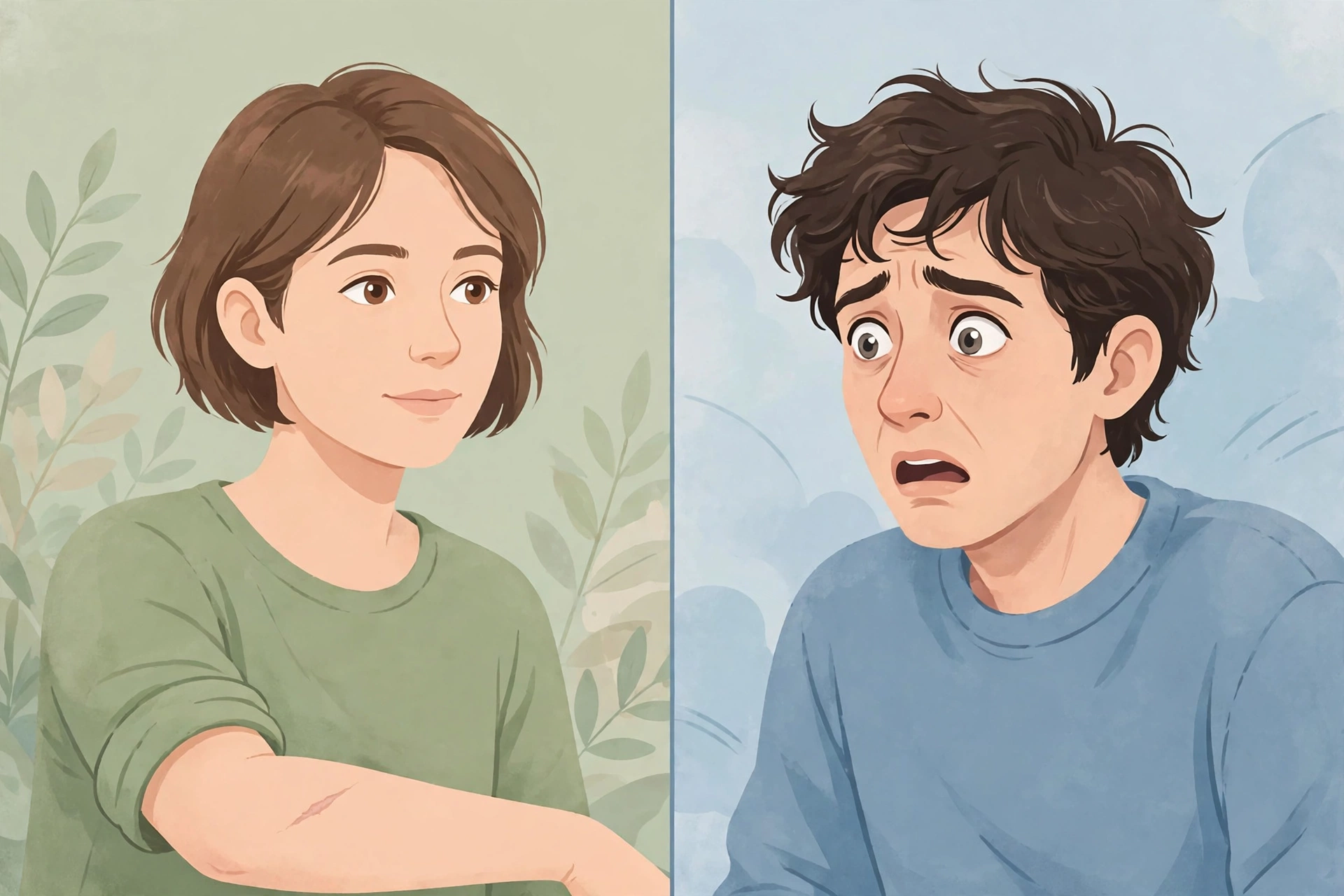
The core difference is meaning. Scarred is about a mark. Scared is about a feeling.
Scarred describes something that carries a scar. A scarred arm has a visible mark. A scarred childhood means a childhood that left lasting hurt. The word points backward, to an injury that already happened and left its mark.
Scared describes a feeling in the moment. A scared child is afraid right now. A scared crowd is running from danger. The word points to fear, whether the danger is real or imagined.
The sounds differ too, though only slightly. Scarred is pronounced with the “ar” sound, like car. Scared is pronounced with the “air” sound, like care. In fast speech the difference is small, which is why the mix-up is so common in writing.
| Feature | Scarred | Scared |
|---|---|---|
| Base word | Scar | Scare |
| Meaning | Marked by a scar | Frightened, afraid |
| Part of speech | Adjective / past participle | Adjective / past participle |
| Pronunciation | /skɑːrd/ — sounds like “car” | /skeərd/ — sounds like “care” |
| About | A mark left by injury | A feeling of fear |
| Example | His arm was badly scarred. | She was scared of the dark. |
See the full scared definition to check how the word is used in the dictionary.
Which Version to Use
Use scarred when you talk about a mark, a wound that healed, or a lasting hurt.
- “The old sailor had a scarred face.” The face carries marks from old injuries.
- “The war left her emotionally scarred.” The hurt stayed long after the events.
- “The wooden floor was scarred by years of use.” The floor shows dents and scratches.
Use scared when you talk about fear, fright, or nervousness.
- “I am scared of spiders.” Fear is the point.
- “The loud noise scared the baby.” The baby was frightened.
- “He was too scared to speak.” Fear stopped him from talking.
A handy rule: if the sentence is about being afraid, the word is scared. If it is about a mark, the word is scarred. “I was scared of the operation” means fear before surgery. “I was scarred by the operation” means the surgery left a mark. Both sentences are correct, and they say very different things.
Common Mistakes
Mistake 1: ❌ “I was scarred of the dark.” ✅ “I was scared of the dark.” Fear takes scared, not scarred.
Mistake 2: ❌ “His face was scared after the accident.” ✅ “His face was scarred after the accident.” A mark from an accident takes scarred.
Mistake 3: ❌ “The movie scarred me so much I could not sleep.” ✅ “The movie scared me so much I could not sleep.” The movie frightened you, so use scared. Use scarred only if the movie left a lasting emotional mark: “The film left me emotionally scarred.”
Mistake 4: ❌ “She was scarred to walk alone at night.” ✅ “She was scared to walk alone at night.” Being afraid to do something takes scared.
Mistake 5: ❌ “The tragedy left the town scared for years.” ✅ “The tragedy left the town scarred for years.” A lasting mark on a place or a people takes scarred.
Real-World Examples
- In daily life: “My little brother is scared of thunderstorms and hides under the bed.”
- In the news: “Residents were scared after the earthquake shook the city at night.”
- In a hospital: “The surgeon’s hands were steady, but the patient’s knee was badly scarred.”
- In a novel: “She was scared to open the letter, yet she tore it open anyway.”
- At work: “The new manager was scared of making a mistake in her first week.”
- In history: “The city was scarred by years of war, and the old buildings still show it.”
- In sport: “The goalkeeper was scared of the penalty, but he saved it.”
- In everyday talk: “I am scared of heights, so I never stand near the edge.”
Data, Trends & Usage
Scared is the word you will meet far more often in everyday English. People talk about fear every day: scared of exams, scared of flying, scared of the dark. It is one of the most common words for fear, used in speech, films, news, and novels alike.
Scarred is less common, and it appears in narrower places. It shows up in medical writing, in stories about accidents and war, and in writing about emotional pain. When writers want to say that something left a lasting mark, they reach for scarred.
The mix-up itself is common in learner writing and in fast typing, because the two words differ by a single letter in the middle: scarred has an extra r, scared has an e. Spellcheckers often miss the error, because both words are real words. Only the meaning gives the mistake away. That is why the quick test matters: afraid means scared, marked means scarred.
Scarred vs Scared at a Glance
| Scarred | Scared | |
|---|---|---|
| Correct? | Yes, a real word | Yes, a real word |
| From | Scar (a mark) | Scare (to frighten) |
| Means | Marked by a scar | Afraid, frightened |
| Used for | Injuries, lasting hurt | Fear, fright, nerves |
| Opposite | Unmarked, smooth, healed | Brave, calm, fearless |
| Example | A scarred arm | A scared child |
Frequently Asked Questions
Is scarred a real word?
Yes. Scarred is the past tense and past participle of scar. It means marked by a scar, as in a scarred arm, or hurt inside, as in emotionally scarred.
Is scared a real word?
Yes. Scared is the past tense and past participle of scare. It means frightened or afraid, as in scared of the dark.
What is the difference between scarred and scared?
Scarred means carrying a mark from an injury, on the skin or in the mind. Scared means feeling fear. One is about a mark, the other is about a feeling.
Can I say “I am scarred of spiders”?
No. If you mean you are afraid of spiders, say “I am scared of spiders.” Scarred of spiders would mean spiders left marks on you.
Can scarred mean emotionally hurt?
Yes. “Emotionally scarred” is a common phrase. It means a painful experience left a lasting mark on a person’s feelings, even after the event ended.
How do I remember which one to use?
Think of the letter r in scarred as the mark itself. Scarred has two r’s, like a rough mark. Scared has an e, like the word fear has an e. Or use the quick test: afraid means scared, marked means scarred.
Is “scarred for life” correct?
Yes. “Scarred for life” is a common phrase. It means an injury or a painful experience left a mark that never fully goes away, on the body or in the mind.
Conclusion
Scarred and scared look like twins, but they are not the same word. Scarred means marked by a scar, on the skin or in the heart. Scared means afraid, in the moment, of something real or imagined. The trick is the quick test: afraid means scared, marked means scarred. Keep that test in your pocket, and the mix-up will stop. It takes only a second to check, and that second saves you from a mistake that readers always notice, even when spellcheck does not. That one second of checking is the whole secret, and it works every single time.
Now it is your turn. Write three sentences of your own, one with scarred and two with scared, and read them back. If each word fits its meaning, you have mastered the pair. And if you want to keep your spelling sharp, read the next guide in this series and keep practising a little every day.
Instal or Install: The Correct Spelling Explained

I am a language content specialist specializing in spelling comparisons, vocabulary usage, and commonly confused English words. I write detailed, informative articles that help readers improve their language skills. I am passionate about helping students, writers, and professionals develop a stronger understanding of the English language.