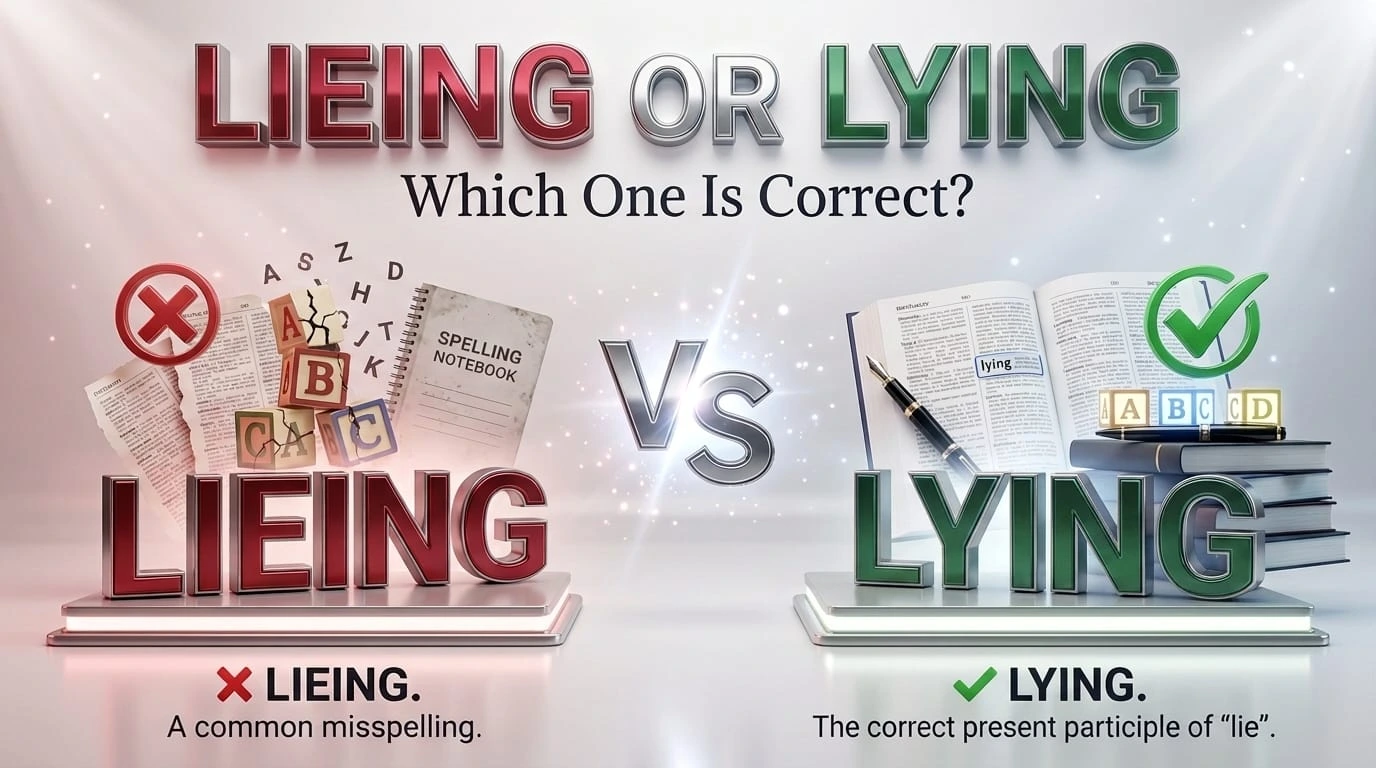
“Lying” is the correct spelling. “Lieing” is a common misspelling that doesn’t follow English spelling rules, the correct present participle of “lie” drops the e and adds -ying.
Last year, I drafted a message to a client and typed “I wasn’t lieing about the deadline.” Spellcheck lit up red before I hit send. I stared at it for a second, genuinely unsure which version was right.
If that’s happened to you too, you’re not alone. This mix-up trips up native speakers all the time. English spelling rules feel random, and “lie” breaks the pattern you’d expect.
Here’s the good news: once you see the rule, you’ll never second-guess it again. This guide breaks down exactly why “lying” is correct, where the confusion comes from, and how to avoid the mistake for good.
Lying vs Lieing: Quick Answer
“Lying” is always correct. “Lieing” is not a real word in standard English.
- ✅ She is lying about her age.
- ❌ She is lieing about her age.
The confusion happens because most verbs just add -ing to the base form (walk → walking, jump → jumping). But “lie” doesn’t play by that rule.
The Origin of the Confusion
The verb “lie” comes from Old English leogan, meaning to deceive with false statements. Over centuries, English spelling settled into a pattern: verbs ending in -ie swap the -ie for -y before adding -ing.
That’s why you get:
- die → dying
- tie → tying
- lie → lying
This rule exists because English avoids clusters like “ieing,” which look and sound clunky. Writers who haven’t memorized this exception default to the “just add -ing” habit, and end up with “lieing” by mistake.
There’s also a second “lie,” meaning to recline (as in “lie down”). It follows the exact same spelling rule, which adds another layer of mix-ups.
Lying Explained: Key Differences and Variations
English actually has two separate verbs spelled “lie,” and both turn into “lying”:
| Verb | Meaning | Example | Present Participle |
|---|---|---|---|
| Lie (deceive) | To say something untrue | He is lying to protect her. | lying |
| Lie (recline) | To rest in a flat position | The dog is lying on the couch. | lying |
| Lay (place) | To put something down | She is laying the book on the table. | laying |
Notice “lay” is a different verb entirely, and it does not share the same spelling shift. That’s a separate, and equally common, grammar trap.
Which Version Should You Use?
- For everyday writing → Always use lying. There’s no context where “lieing” is acceptable.
- For students and ESL learners → Memorize the -ie to -y swap as a fixed exception, not a guess.
- For professional or formal documents → Double-check with spellcheck, since “lieing” often slips through in fast typing.
- For global or neutral use → “Lying” is standard across American, British, Australian, and all other English dialects. No regional variation exists here.
Common Mistakes With Lying
Mistake 1: Writing “lieing” instead of “lying”
✅ He kept lying about where he was.
❌ He kept lieing about where he was.
Why it happens: Writers apply the standard -ing rule without remembering the -ie exception.
Mistake 2: Assuming “deceiving” and “reclining” are spelled differently
✅ The dog is lying on the couch. She is lying about her age.
❌ The dog is lieing on the couch. She is lieing about her age.
Why it happens: People assume different meanings need different spellings.
Mistake 3: Mixing up “lying” with “laying”
✅ The cat is lying in the sun.
❌ The cat is laying in the sun.
Why it happens: “Lay” and “lie” are close in sound and meaning, but “lay” needs an object.
Mistake 4: Adding extra letters, like “lyeing”
✅ lying: five letters: l-y-i-n-g
❌ lyeing / lieing
Why it happens: Autocorrect and rushed typing introduce extra characters.
Mistake 5: Letting “lieing” slip into professional writing
✅ I wasn’t lying about the deadline.
❌ I wasn’t lieing about the deadline.
Why it happens: Spellcheck sometimes flags it, but not always, depending on the tool.
Carmel or Caramel: What Should You Use? (2026)
Lying in Real-World Examples
Professional email:
“I want to clarify that I wasn’t lying about the project timeline, the delay came from a vendor issue.”
News headline:
“Witness Accused of Lying Under Oath During Testimony”
Social media post:
“Stop lying to yourself about what you actually want in 2026.”
Formal document:
“The applicant was found to be lying on the disclosure form, resulting in disqualification.”
In every case, lying is the only correct spelling, regardless of tone or formality.
Lying: Data, Trends & Usage
Spelling questions like this one are searched constantly, especially by students, ESL learners, and professionals proofreading work emails. It falls into the informational search category, people want a fast, clear answer, not a long grammar lecture.
Search interest tends to spike around back-to-school periods and during major news cycles involving public testimony or scandals, when words like “lying” appear in headlines often. Writing tools and browser spellcheckers have reduced this error over time, but it still shows up frequently in handwritten notes, texts, and fast typing where autocorrect isn’t active.
Lying vs Lieing: Comparison Table
| Term/Variant | Meaning | Region/Context | Best Used When |
|---|---|---|---|
| Lying | Correct spelling (deceiving or reclining) | Universal, all English dialects | Always, in any writing context |
| Lieing | Misspelling, not a real word | None: incorrect everywhere | Never avoid entirely |
| Laying | Present participle of “lay” (to place) | Universal | When something places an object down |
Frequently Asked Questions
Q: What does “lying” mean?
A: “Lying” has two meanings; telling an untruth, or being in a reclining position. Context makes clear which one is meant.
Q: How do you use “lying” correctly in a sentence?
A: Use it as the -ing form of “lie” in any tense that needs a continuous action, like “She is lying” or “He was lying.” It never has an extra e.
Q: Lying vs lieing: what’s the difference?
A: There is no real difference in meaning because “lieing” isn’t a correct word at all. “Lying” is the only accepted spelling in standard English.
Q: Is “lying” acceptable in formal writing?
A: Yes, completely. “Lying” is standard in academic, legal, journalistic, and professional writing with no restrictions.
Q: Which version is correct: lying or lieing?
A: “Lying” is correct. “Lieing” is a spelling error that doesn’t appear in any dictionary.
Q: Where does “lying” come from?
A: It comes from Old English leogan, evolving through Middle English into the modern verb “lie,” which follows the -ie to -y spelling shift before -ing.
Q: Can “lying” be used in casual conversation and texting?
A: Yes. It works the same way in casual and formal contexts, the spelling never changes based on tone.
Conclusion
Lying” is always the correct spelling: “lieing” never is. The rule is simple: verbs ending in -ie drop the e and add -y before -ing (lie → lying, die → dying, tie → tying).
Remember: “lying” has two meanings: telling a lie, or resting/reclining. Context makes it clear which one is meant.
One more thing to watch: “laying” is a different verb that needs an object, don’t confuse it with “lying.”
Whether you’re writing formally or casually, “lying” is the standard spelling everywhere, in every English dialect.
Lying vs lieing explained; correct spelling, meaning, usage, and examples. Learn the simple rule and avoid this common mistake.
Cancelation or Cancellation: The Correct Spelling Explained

I am a professional content writer with a strong interest in English spelling and vocabulary. I am interested in creating informative guides on commonly confused words, spelling differences, and language usage to help readers write more accurately and effectively.