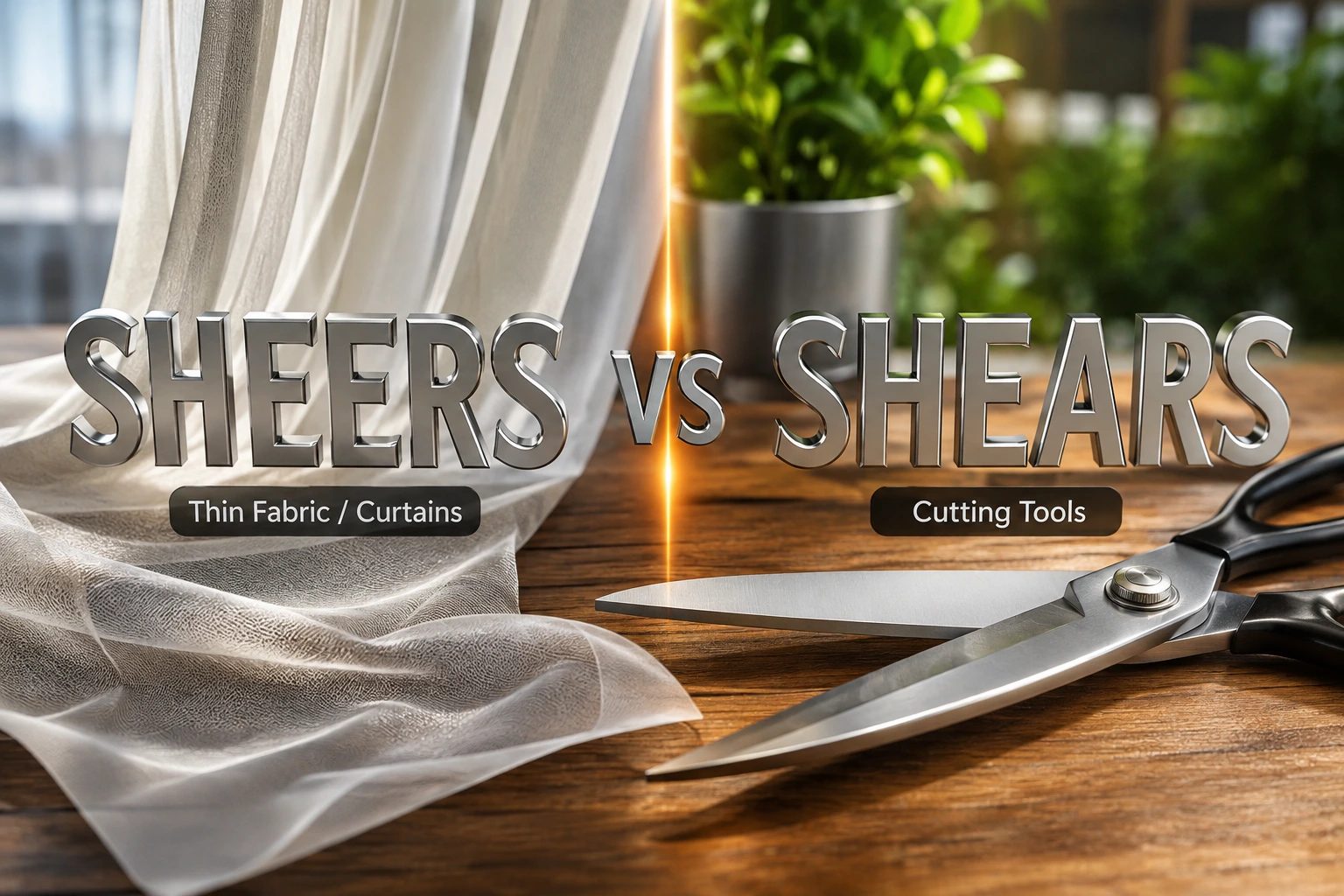
Sheers usually refers to things made of sheer, thin fabric or is a form of the verb sheer. Shears are cutting tools, like large scissors, used for gardening, sewing, hair, or other tasks.
Have you ever typed sheers when you meant a pair of cutting tools? You are not alone. These two words sound very similar, and that small spelling difference can change the meaning completely.
As an English language writer, I often see confusing word pairs like this cause trouble in everyday writing. The problem is easy to understand. Sheers and shears are pronounced in similar ways, but they do not usually refer to the same thing.
Imagine writing, “Please bring the garden sheers.” A reader may understand what you mean, but garden shears is the standard term for the cutting tool.
Now consider this sentence: “The room has white sheers on the windows.” Here, sheers can refer to thin, light curtains or fabric.
So, which word should you use? The answer depends on what you are talking about.
This guide explains sheers or shears, their meanings, origins, correct uses, common mistakes, and real-world examples. By the end, you will know exactly which word fits your sentence.
Sheers or Shears: Quick Answer
The easiest way to remember the difference is this:
- Shears = cutting tools.
- Sheers = things related to sheer, such as thin curtains or fabric, or a form of the verb sheer.
For example:
- “I bought new garden shears.”
- “The tailor used sharp shears.”
- “The windows were covered with white sheers.”
The word shears is normally used for a cutting tool that works like a large pair of scissors. Dictionaries describe shears as a cutting implement that is often larger than ordinary scissors.
Sheers, on the other hand, is not the standard spelling for that tool.
A quick memory trick
Think:
Shears → shear → cut.
If something cuts, you probably need shears.
The Origin and Background of Sheers and Shears
The story becomes easier when you look at where the words come from.
Shears is connected to the old verb shear, meaning to cut. The word shear goes back to Old English scieran and has related forms in other Germanic languages. Merriam-Webster records its first known use before the 12th century.
Over time, shears became a common name for cutting tools with two opposing blades.
You can find shears in many settings:
- Gardens
- Hair salons
- Sewing rooms
- Farms
- Workshops
- Kitchens
- Industrial settings
The word sheers has a different connection. It comes from sheer.
Sheer can mean very thin or transparent, especially when talking about fabric. It can also mean something completely different, such as “utter” or “very steep.” Merriam-Webster lists several meanings of sheer, including thin or transparent fabric.
Oxford also lists shears as a plural noun for a large cutting tool and traces it to Old English scēara, meaning a cutting instrument.
That history explains why the two spellings are easy to mix up. They look and sound close, but they developed from different words.
Sheers or Shears Explained: Key Differences
Here is the main difference at a glance:
| Term | Meaning | When to Use | Region/Context |
|---|---|---|---|
| Shears | A cutting tool like large scissors | Cutting hair, plants, fabric, wool, or other materials | General English |
| Sheers | Plural of sheer in some noun uses; also a verb form of sheer | Thin curtains/fabric or when sheer is used as a verb | General English, depending on context |
| Sheer | Thin, transparent, steep, or complete, depending on context | Describing fabric, cliffs, force, amount, etc. | General English |
| Shear | To cut or remove something by cutting | Hair, wool, plants, or materials | General English |
What are shears?
Shears are cutting tools.
They are similar to scissors but are often larger or designed for a specific job.
Examples include:
- Garden shears
- Pruning shears
- Hedge shears
- Pinking shears
- Hair shears
- Kitchen shears
For example:
“The gardener used shears to trim the hedge.”
The spelling is shears, not sheers.
What are sheers?
Sheers can be the plural form of the noun sheer when it refers to a thin or transparent fabric or an item made from that fabric.
For example:
“She bought white sheers for the living room windows.”
In this sentence, sheers refers to thin window coverings.
The word can also appear as the third-person singular form of the verb sheer:
“The boat sheers away from the rocks.”
Here, sheers means turns or moves suddenly away from a course. Merriam-Webster lists sheers as the present-tense third-person singular form of sheer.
So sheers is a real word. It is simply not the usual word for cutting tools.
Which Version Should You Use?
The right choice depends on your meaning.
For cutting tools → use shears
If you mean a tool used for cutting, choose shears.
- garden shears
- hair shears
- pruning shears
- sewing shears
- hedge shears
Example:
“These shears are sharp enough to cut thick branches.”
For thin curtains or fabric → use sheers
If you are talking about thin, light, or transparent curtains, sheers may be correct.
Example:
“The sunlight came through the white sheers.”
The meaning comes from sheer, which can describe a thin or transparent fabric.
For formal or general writing
Use the word that matches the meaning.
Do not choose sheers simply because it sounds like the plural of shear. If you mean the cutting tool, shears is the safe and standard choice.
Common Mistakes With Sheers or Shears
These words create several common spelling mistakes.
1. Writing “garden sheers”
Wrong:
I need garden sheers.
Correct:
I need garden shears.
Why? Because you are talking about a cutting tool.
2. Writing “hair sheers”
Wrong:
The stylist bought new hair sheers.
Correct:
The stylist bought new hair shears.
Hair shears are cutting tools. The spelling therefore uses -ars.
3. Assuming “sheers” is always wrong
This is also a mistake.
Sheers is a valid word in some contexts.
For example:
“The bedroom windows have white sheers.”
Here, the word refers to thin curtains or fabric.
So the question is not simply, “Is sheers correct?”
The better question is:
What do you mean?
4. Confusing “shear” with “sheer”
These words have different meanings.
- Shear = to cut.
- Sheer = very thin, very steep, complete, or utter, depending on context.
Examples:
“Farmers shear sheep.”
“She wore a sheer dress.”
“The mountain has a sheer cliff.”
5. Using “sheers” for every type of scissors
Shears and scissors are related, but they are not always interchangeable.
For larger or specialized cutting tools, shears is common.
For example:
“Pass me the scissors.”
But:
“The gardener sharpened the hedge shears.”
Sheers or Shears in Real-World Examples
Seeing the words in context makes the difference much easier to remember.
Professional Email
Could you please bring the shears to the workshop before the afternoon session?
Here, shears means cutting tools.
News Headline
New Garden Shears Help Homeowners Trim Hedges Faster
Again, shears refers to cutting tools.
Social Media Post
My new garden shears made trimming the backyard so much easier!
The word is shears because the item is a gardening tool.
Formal Document
Employees must inspect all cutting shears before beginning maintenance work.
This is also shears because the document refers to cutting equipment.
Home Decor Example
The designer replaced the heavy curtains with soft white sheers.
Here, sheers refers to thin curtains or fabric.
Verb Example
The small boat sheers away from the dock.
Here, sheers is a verb. It comes from sheer, meaning to turn or move away from a course.
Sheers or Shears: Data, Trends & Usage
Searches for sheers or shears are mainly informational. People usually want to know which spelling is correct, what each word means, or why the two forms are different.
The confusion makes sense because the words are close in sound and spelling.
The strongest everyday use is shears when people are discussing cutting tools. Dictionaries consistently define shears as a cutting implement, often similar to or larger than scissors.
Sheers appears in more specific contexts. One is thin curtains or fabric. Another is the verb form seen in sentences such as “the boat sheers away.”
Exact search volume can change over time and varies by keyword tool. Still, the search intent is clear: readers are usually trying to solve a spelling and word-meaning problem.
That makes this distinction useful for students, writers, editors, gardeners, tailors, and anyone who wants to avoid an embarrassing spelling mistake.
Sheers vs Shears: Standalone Comparison Table
| Term/Variant | Meaning | Region/Context | Best Used When |
|---|---|---|---|
| Shears | Cutting tools | General English | Talking about gardening, hair, fabric, wool, or other cutting tools |
| Sheers | Thin curtains or fabric in some uses | Home decor and textile contexts | Referring to sheer curtains or similar items |
| Sheers | Third-person singular of sheer | General English | Saying that something turns or moves away |
| Shear | To cut or remove by cutting | General English | Describing the action of cutting hair, wool, or similar material |
| Sheer | Thin, transparent, steep, complete, or utter | General English | Describing fabric, cliffs, force, amount, or degree |
FAQs
Q: What does shears mean?
A: Shears are cutting tools. They are often larger or more specialized than ordinary scissors and are used for tasks such as gardening, hair cutting, sewing, and farming.
Q: What does sheers mean?
A: Sheers can refer to thin curtains or fabric related to the word sheer. It can also be the third-person singular form of the verb sheer, as in “the boat sheers away.”
Q: Which is correct, sheers or shears?
A: Both are correct words, but they have different meanings. Use shears for cutting tools and sheers when the context calls for the plural of sheer or the verb form of sheer.
Q: Is “garden sheers” correct?
A: No, garden shears is the standard spelling for the cutting tool. Remember the simple link: shear → shears → cutting.
Q: Are shears the same as scissors?
A: They are similar cutting tools, but the words are not always interchangeable. Shears often refers to larger or specialized cutting tools, while scissors is the common word for everyday cutting tools.
Q: Where does the word shears come from?
A: Shears is linked to the verb shear, meaning to cut. Oxford traces the noun to Old English scēara, meaning a scissors-like cutting instrument.
Q: Can sheers be used in formal writing?
A: Yes, when the meaning is correct. For example, sheers can be used when discussing thin curtains or fabric. However, do not use sheers when you mean cutting tools.
Q: What is the difference between shear and sheer?
A: Shear means to cut or remove something by cutting. Sheer has several meanings, including very thin, very steep, complete, or utter.
Conclusion: Sheers or Shears?
The difference between sheers and shears is small in spelling but big in meaning.
Use shears when you mean a cutting tool. Garden shears, pruning shears, hair shears, and sewing shears all use -ars.
Use sheers in contexts connected to sheer, such as thin curtains or fabric. It can also appear as a verb form of sheer, as in “the ship sheers away.”
The easiest memory trick is simple:
Shears cut. Sheers come from sheer.
If you are writing about gardening, hair, sewing, or another cutting task, shears is almost certainly the word you need.
Next time you see these two spellings, stop and ask yourself what the word means in your sentence. That one-second check can prevent a common mistake.
Wack or Whack: The Easy Difference Explained

I am a professional content writer with a strong interest in English spelling and vocabulary. I am interested in creating informative guides on commonly confused words, spelling differences, and language usage to help readers write more accurately and effectively.