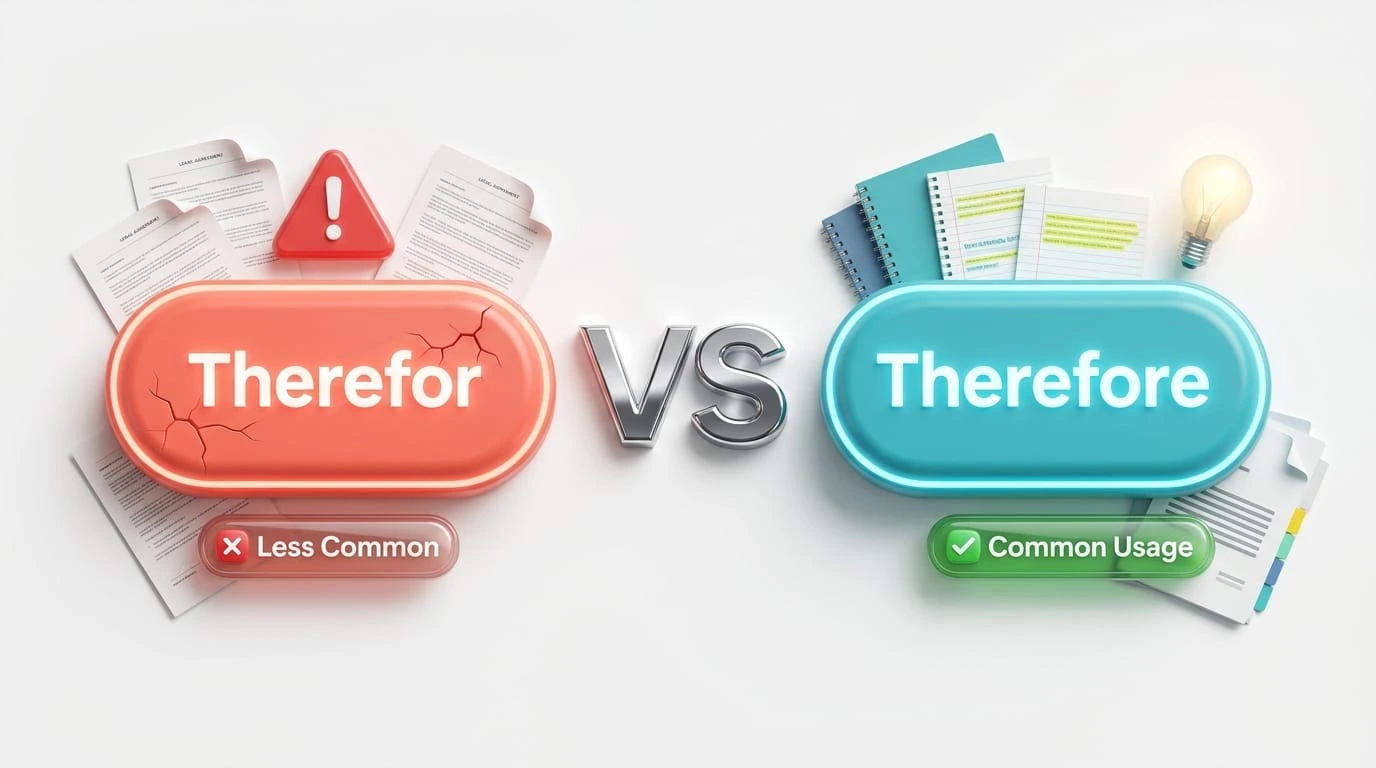
Therefore and therefor are both correct English words, but they have different meanings. Therefore means “for that reason” and is very common, while therefor means “for that” and is a rare, formal word mostly used in legal writing.
The first time I saw the word therefor in a legal document, I assumed it was a typo for therefore. They look almost identical, and when you read quickly, it’s easy to miss the missing “e.” After checking a dictionary, I discovered they are actually two different words with completely different meanings.
If you’ve searched for “therefore or therefor,” you’re probably wondering whether one spelling is incorrect or if both are acceptable. This confusion is common because therefore is one of the most frequently used transition words in English, while therefor appears so rarely that many native speakers have never encountered it.
The good news is that the difference is easy to understand. Once you know what each word means and where it’s used, you’ll never mix them up again. In this guide, you’ll learn the meanings, pronunciation, origins, key differences, common mistakes, and real-world examples of therefore and therefor, so you can use the correct word with confidence.
Therefore or Therefor: Quick Answer
Both therefore and therefor are correct, but they are not interchangeable.
- Therefore means “for that reason” or “as a result.”
- Therefor means “for that” or “for it” and is mostly found in legal or formal documents.
Examples
✅ She studied hard; therefore, she passed the exam.
✅ The company accepted the proposal and paid therefor as agreed in the contract.
❌ She studied hard; therefor, she passed the exam.
Quick Comparison
| Word | Meaning | Common? | Best Use |
| Therefore | For that reason; as a result | ✅ Very Common | Everyday and formal writing |
| Therefor | For that; for it | ❌ Rare | Legal and formal documents |
Pronunciation of Therefore or Therefor
- Therefore — /ˈðer.fɔːr/ (THAIR-for)
- Therefor — /ˌðerˈfɔːr/ (thair-FOR)
Although the spellings are almost identical, the stress is slightly different. Therefore places more emphasis on the first syllable, while therefor places the emphasis on the last syllable. In everyday conversation, however, many speakers pronounce them very similarly.
The Origin of Therefore or Therefor
Both words have existed in English for centuries and share the same root: there, meaning “that place” or “that thing.”
The word therefore developed as a conjunction and adverb meaning “for that reason.” Over time, it became one of the most common transition words in English. Writers use it to show that one statement logically follows another.
The word therefor, however, followed a different path. It means “for that” or “in exchange for that.” Because modern English now prefers phrases like for it, for that, or in return, therefor gradually became uncommon. Today, it is mostly seen in legal contracts, formal agreements, and older texts.
Therefore or Therefor Explained: Key Differences
Although these words differ by only one letter, their meanings are completely different.
| Term | Meaning | When to Use | Context |
| Therefore | For that reason; as a result | Showing cause and effect | Everyday and formal English |
| Therefor | For that; in exchange for it | Referring to payment or exchange | Legal and formal writing |
Examples
Therefore
It started raining; therefore, the match was postponed.
She forgot her passport. Therefore, she couldn’t board the flight.
Therefor
The buyer paid therefor according to the agreement.
Compensation therefor shall be provided under the contract.
How to Use Therefore with Punctuation
When therefore joins two independent clauses, use a semicolon before it and a comma after it.
Example:
Correct:
The weather was bad; therefore, the event was canceled.
Incorrect:
The weather was bad therefore the event was canceled.
Which Version Should You Use?
The correct choice depends on what you want to say.
For Students
Use therefore in essays, assignments, presentations, and exams whenever you mean “for that reason.”
For Business Professionals
In reports, emails, and presentations, therefore is almost always the correct choice.
For Legal Professionals
Use therefor only when writing legal documents or quoting contracts where the word is appropriate.
For Everyday Writing
Most people will only ever need therefore. The word therefor is so uncommon that many readers may mistake it for a typo.
Professional Recommendation
| Audience | Recommended Word |
| Students | Therefore |
| Business Professionals | Therefore |
| Academic Writers | Therefore |
| Legal Professionals | Therefor (when required) |
| General Readers | Therefore |
Quick Tip: If you can replace the word with “as a result,” choose therefore. If you mean “for that” in a legal sense, therefor may be correct.
Common Mistakes with Therefore or Therefor
Because the spellings are nearly identical, many writers confuse these two words.
| Mistake | Correct Version | Why? |
| He was late; therefor, he missed the train. | He was late; therefore, he missed the train. | Therefore shows a result. |
| Payment was made therefore. | Payment was made therefor. | Therefor means “for that.” |
| Assuming both words mean the same thing | They have different meanings | Context determines the correct word. |
| Using therefor in everyday writing | Use therefore instead | Therefor is rarely used outside legal writing. |
Quick Tip
Remember this simple rule:
- Therefore = for that reason
- Therefor = for that
Common Phrases with Therefore and Therefor
These are the most common phrases where each word is naturally used in English.
| Phrase | Preferred Word |
| Therefore, I agree | ✅ Therefore |
| Therefore, the results improved | ✅ Therefore |
| Therefore, we decided to leave | ✅ Therefore |
| Payment therefor | ✅ Therefor |
| Compensation therefor | ✅ Therefor |
| Liability therefor | ✅ Therefor |
Therefore or Therefor in Real-World Examples
Seeing these words in real situations makes the difference much easier to understand.
Doughnut or Donut: The Surprising Reason Both Are Correct
In a Professional Email
The project was completed ahead of schedule; therefore, we can begin the next phase immediately.
In a News Headline
Heavy rainfall continued overnight; therefore, several schools remained closed today.
On Social Media
I finished all my work early; therefore, it’s time to relax!
In a Legal Document
The purchaser shall pay therefor within thirty days of receiving the goods.
Therefore or Therefor: Data, Trends & Usage
Although the two words look almost identical, they are used very differently in modern English.
Usage Insights
- Therefore is one of the most common transition words in English writing.
- Therefor is now considered rare and mainly appears in legal contracts, government documents, and older texts.
- Most searches for “therefore or therefor” come from students, writers, and English learners trying to understand the spelling difference.
- Search intent is informational, as users want to know which word is correct in different contexts.
Popular Usage by Region
| Region | Commonly Used Word |
| United States | Therefore |
| United Kingdom | Therefore |
| Canada | Therefore |
| Australia | Therefore |
| New Zealand | Therefore |
Therefor is recognized in all English-speaking countries but is rarely used outside legal and formal writing.
Why It Matters
Using therefore when expressing cause and effect makes your writing clear and natural. Knowing the rare meaning of therefor also helps you understand legal documents without confusion.
Therefore vs Therefor Comparison Table
| Term | Meaning | Region/Context | Best Used When |
| Therefore | For that reason; as a result | Worldwide | Essays, emails, reports, conversations |
| Therefor | For that; for it | Legal and formal English | Contracts, legal notices, formal agreements |
Frequently Asked Questions
Q: What is the difference between therefore and therefor?
A: Therefore means “for that reason” and shows a result. Therefor means “for that” and is mainly used in legal or formal writing.
Q: Is therefor a real word?
A: Yes. Therefor is a correct English word, but it is rare and usually appears in legal documents rather than everyday writing.
Q: Which word should I use in everyday writing?
A: Use therefore. It is the standard choice for essays, emails, reports, and conversations.
Q: Can I use therefor instead of therefore?
A: No. The two words have different meanings and cannot be used interchangeably.
Q: Why is therefor rarely used?
A: Modern English usually replaces therefor with phrases like for it, for that, or in return, making the older word less common.
Q: Is therefore used in both British and American English?
A: Yes. Therefore is widely used in both British and American English with the same meaning.
Q: How can I remember the difference between therefore and therefor?
A: Think of therefore as meaning “for that reason.” If you mean “for that” in a legal sense, use therefor.
Conclusion
Although therefore and therefor differ by just one letter, they have very different meanings. Therefore is the word you’ll use most often to show a result or conclusion. It’s common in essays, emails, reports, and everyday conversations. Therefor, on the other hand, means “for that” and is mainly found in legal or highly formal writing.
A simple way to remember the difference is this: if you can replace the word with “as a result,” choose therefore. If you’re reading or writing a legal document and the meaning is “for that” or “in exchange for that,” therefor may be the correct choice.
Now you know exactly when to use therefore and therefor. Bookmark this guide for quick reference, and share it with anyone who has ever wondered which spelling is correct.
Girly or Girlie: Which Spelling Is Correct?

I am a language content specialist specializing in spelling comparisons, vocabulary usage, and commonly confused English words. I write detailed, informative articles that help readers improve their language skills. I am passionate about helping students, writers, and professionals develop a stronger understanding of the English language.