Cum is a real English word with several meanings, while come is the standard word for moving toward a place or person. In everyday writing, come is usually the word you need.
Have you ever typed cum when you meant come and then wondered if you made a spelling mistake? You are not alone.These two words look almost the same. Yet they can have very different meanings. That small difference matters because cum can appear in several contexts, including older or formal English, while it is also widely used as informal slang.
As an English writer, I often see learners pause over short words like these. They may know what they want to say but still feel unsure about the spelling. The problem gets bigger when a dictionary lists a word as correct but does not explain when you should actually use it.
That is why context is the key here.
If you want to say that someone moves toward you, come is the correct choice. If you see cum in a formal phrase such as writer-cum-editor, it has a different meaning. It can also have a slang meaning that is not suitable for formal writing.
Let us make the difference simple.
Cum or Come: Quick Answer
Come is the common English word used for movement toward a person, place, or point.
For example:
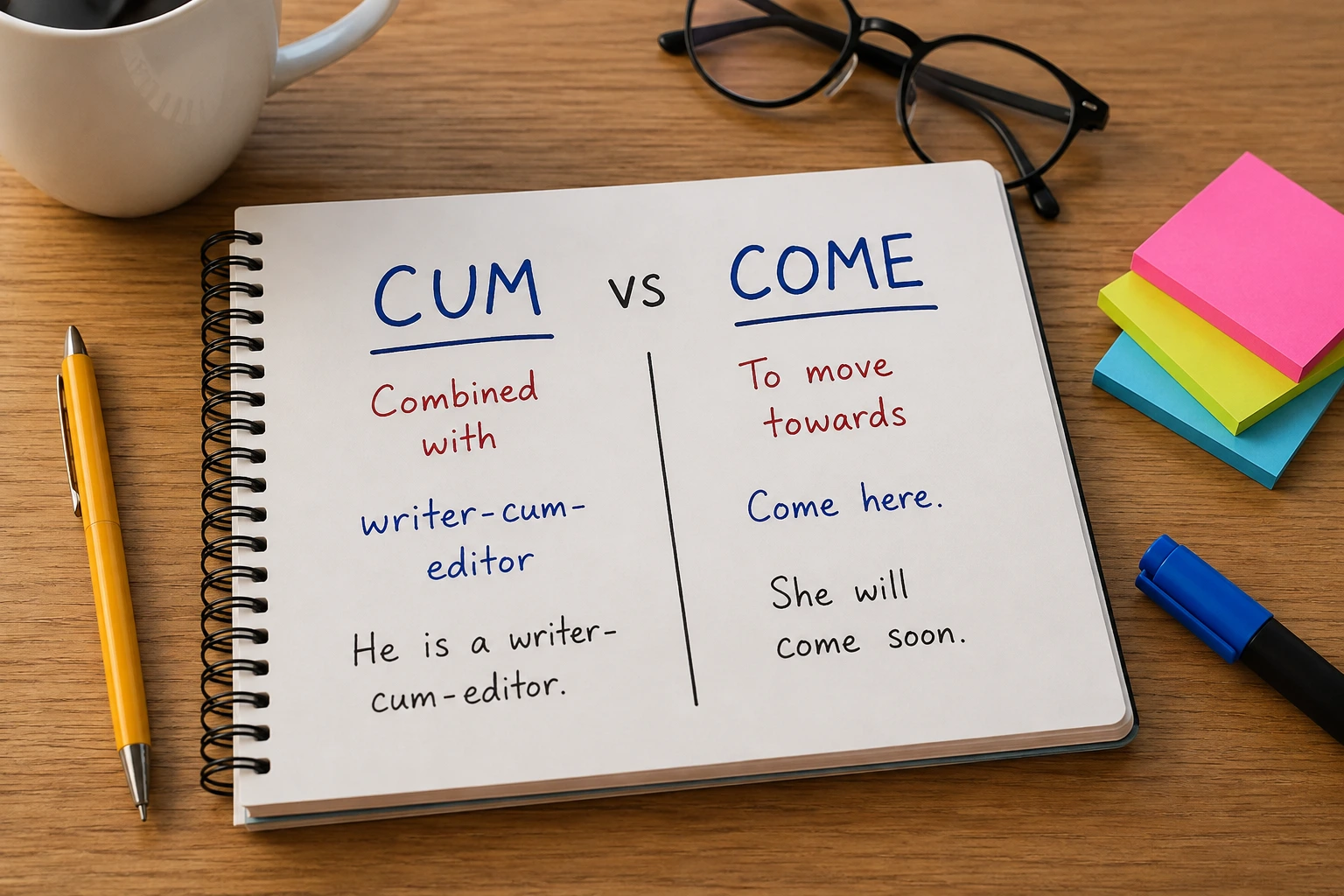
- Please come here.
- She will come to the party tonight.
- Can you come with me?
Cum is also a real word, but it has different uses. In formal or dictionary English, it can mean “combined with” or “also serving as.”
For example:
He is a writer-cum-editor.
This means he is both a writer and an editor.
The word cum is also used as informal sexual slang. Because of that meaning, you should be careful when using it in general communication.
The simple rule
If you mean move toward someone or something, use come.
If you see cum in a phrase such as kitchen-cum-dining room, it means combined with.
The Origin and Background of Cum and Come
The two words have different histories, even though they look and sound similar.
Where does “come” come from?
Come is a very old English word. It has been used for centuries to describe movement toward a person, place, or point.
It developed from older forms of English and related Germanic words. Its basic idea has stayed remarkably stable.
Today, come can describe physical movement:
Come into the room.
It can also describe movement toward a time, event, or situation:
Summer will come soon.
The word has also developed many common expressions, such as:
- come back
- come home
- come in
- come out
- come over
- come along
- come from
Because come is such a common verb, you will see it in almost every type of English.
Where does “cum” come from?
The formal use of cum has a different origin. It comes from Latin, where cum means “with.”
English later adopted it in combinations where one thing serves two roles.
For example:
A bedroom-cum-study
This means a room that functions as both a bedroom and a study.
You may also see:
A school-cum-library
This describes a place that serves as both a school and a library.
The slang use of cum developed separately. That is why context is so important when you encounter the word.
Cum Explained: Key Differences and Uses
Here is the easiest way to understand the two words.
| Term | Meaning | When to Use | Region/Context |
|---|---|---|---|
| come | Move toward a person or place | Everyday movement and many expressions | Standard English |
| cum | Combined with; also serving as | Formal compounds such as writer-cum-editor | Mainly formal or literary usage |
| cum | Informal sexual slang | Casual or adult contexts | Informal English |
The most important point is that cum and come are not interchangeable.
1. Come as a verb
Use come when someone or something moves toward a person, place, or point.
Examples:
- Come here for a moment.
- Will you come to my house?
- They came early.
- She is coming tomorrow.
Here, come is the correct word.
2. Cum as “combined with”
In some formal compounds, cum means that something has two functions.
Examples include:
- writer-cum-editor
- teacher-cum-researcher
Consider this sentence:
She works as a teacher-cum-writer.
This means she works as both a teacher and a writer.
3. Cum as slang
Cum is also used as informal sexual slang. This use is common in casual online language and some adult contexts.
It is not appropriate for most professional, academic, or formal writing.
This is one reason learners should not treat cum as a simple alternative spelling of come.
Which Word Should You Use?
For most English learners, the answer is easy:
For everyday English → use come
Use come when talking about movement.
Please come inside.
Are you coming with us?
I will come tomorrow.
For formal compounds → cum may be correct
Use cum when a person, place, or thing has two combined roles.
He is a journalist-cum-author.
This use is more common in some varieties of British and South Asian English than in everyday American English.
For professional writing → choose clarity
If your readers may not know the formal use of cum, you can often rewrite the sentence.
Instead of:
She is a teacher-cum-researcher.
You could write:
She is both a teacher and a researcher.
The second version is often clearer for an international audience.
For global English → prefer simple wording
When writing for readers from different countries, come is easy to understand.
For the formal compound use of cum, consider using and, both, or also if the meaning stays clear.
Common Mistakes With Cum and Come
These words cause several common errors.
Mistake 1: Using “cum” instead of “come”
❌ Please cum here.
✅ Please come here.
Why? The sentence describes movement toward a person. Therefore, come is required.
Mistake 2: Treating “cum” as a spelling variant
❌ Cum is another spelling of come.
✅ Cum and come have different meanings and uses.
Why? Although the words look similar, they are not interchangeable.
Mistake 3: Using “cum” in formal writing without checking context
❌ He used a casual slang meaning of cum in a business report.
✅ He is a writer-cum-editor.
Why? The formal compound use can be acceptable, but the slang meaning can create an awkward or inappropriate reading.
Mistake 4: Assuming every “cum” is sexual
❌ Every use of cum has a sexual meaning.
✅ Cum can also mean “combined with” in formal compounds.
Why? Context determines the meaning.
For example, writer-cum-editor has nothing to do with the slang meaning.
Mistake 5: Choosing the less familiar form
If your sentence simply means “move here,” do not use cum because it looks shorter or sounds similar.
Use the ordinary word:
Come with me.
That is clear, natural, and correct.
Cum or Come in Real-World Examples
Seeing the words in context makes the difference much easier to remember.
Professional email
Please come to my office at 10 a.m. so we can discuss the project.
Here, come describes movement toward the speaker.
News article
The former teacher-cum-writer spoke about her new book.
Here, cum means the person has two roles: teacher and writer.
Social media post
Come join us for the event this Saturday!
Here, come is the natural choice because the post invites people to attend.
Formal document
The building will contain a classroom-cum-meeting space.
Here, cum means the space has two functions.
A clearer alternative could be:
The building will contain a space used as both a classroom and a meeting room.
Cum vs Come: A Simple Comparison
| Term/Variant | Meaning | Region/Context | Best Used When |
|---|---|---|---|
| Come | Move toward someone or somewhere | All major forms of English | Everyday speech and writing |
| Cum | Combined with or also serving as | Formal compounds | Describing two roles or functions |
| Cum | Informal sexual slang | Casual/adult contexts | Only when that specific meaning is intended |
Remember this shortcut
Come = movement
Cum = combined role/function
Cum = also used as slang
If you remember those three points, most cases become easy.
Cum or Come: Data, Trends & Usage
Searches for “cum or come” often come from people who are unsure whether the two words are spelling variants. In reality, the question is mainly about meaning and context.
The confusion is easy to understand. The words are only one letter apart, and come is pronounced differently from what many learners might expect from its spelling.
There is another reason for the confusion: cum appears in more than one type of English.
In formal compounds, it can mean “combined with.” This use appears in phrases such as writer-cum-editor and bedroom-cum-study.
Online, however, cum is also widely recognized as sexual slang. That meaning can be much more familiar to some readers than the older formal use.
This creates a useful writing lesson:
A word can be grammatically correct but still be a poor choice for your audience.
If you are writing for students, customers, employers, or an international audience, clarity should come first.
When you mean movement, choose come. When you mean “combined with,” cum may be correct, but rewriting the phrase with and or both can make your meaning clearer.
Why Do People Confuse Cum and Come?
There are several reasons.
They look similar
The only difference is the final vowel:
- cum
- come
That makes them easy to mix up when typing quickly.
“Come” has an unusual spelling
Many learners expect the spelling of come to match its pronunciation more closely.
The silent e can make the word harder to spell than it seems.
“Cum” has multiple meanings
A dictionary may list several meanings for cum. This can make learners wonder whether it is simply another form of come.
It is not.
Online language adds confusion
Because cum has a common slang meaning online, readers may notice it outside formal compounds and assume that it is always slang.
That is also incorrect.
Context decides the meaning.
How to Remember Cum vs Come
Try this simple memory trick:
COME = MOVE
If someone is moving toward you, they come.
Come here.
CUM = COMBINE
If two roles or functions are combined, cum may be used.
Writer-cum-editor.
Think:
Come = movement.
Cum = combination.
That simple pair can help you remember the difference.
Frequently Asked Questions
Q: What does “cum” mean?
Cum can mean “combined with” or “also serving as” in formal compounds. It is also used as informal sexual slang, so its meaning depends strongly on context.
Q: How do you use “come” correctly?
Use come when someone moves toward a person, place, or point. For example: “Please come here” and “She will come tomorrow.”
Q: What is the difference between cum and come?
Come is normally a verb describing movement. Cum has a formal meaning related to combined roles or functions and also has an informal slang meaning.
Q: Is “cum” acceptable in formal writing?
It can be acceptable in formal compounds such as writer-cum-editor. However, the term can be misunderstood because of its slang meaning, so clearer wording may be better for many audiences.
Q: Is “cum” another spelling of “come”?
No. Cum is not an alternative spelling of come. The two words have different meanings and should not be used interchangeably.
Q: Where does “cum” come from?
The formal compound use comes from Latin cum, meaning “with.” English uses it in combinations to show that something has two roles or functions.
Q: Can I use “cum” in everyday conversation?
You may encounter it in everyday language, but the meaning can be unclear or inappropriate depending on the context. For ordinary movement, always use come.
Final Verdict:
The difference between cum and come is much easier once you focus on meaning rather than spelling.
Come is the standard word for movement. You use it when someone moves toward you, a place, an event, or a point.
Cum has a formal use meaning “combined with” or “also serving as.” You may see it in phrases such as writer-cum-editor or kitchen-cum-dining room. It also has an informal slang meaning, so you should consider your audience before using it.
For most everyday writing, there is no need to overthink it:
If you mean movement, use “come.”
If you mean two combined roles or functions, cum may be correct. For maximum clarity, though, phrases such as “both a writer and an editor” are often better for a broad audience.
Yacht or Nyacht: The Correct Spelling Made Easy

I’m an English language researcher and content writer. I am specialized in spelling comparisons, commonly confused words, grammar usage, and vocabulary guides. Through detailed language articles,I am helping readers to understand the differences between similar words and improve their written communication skills.