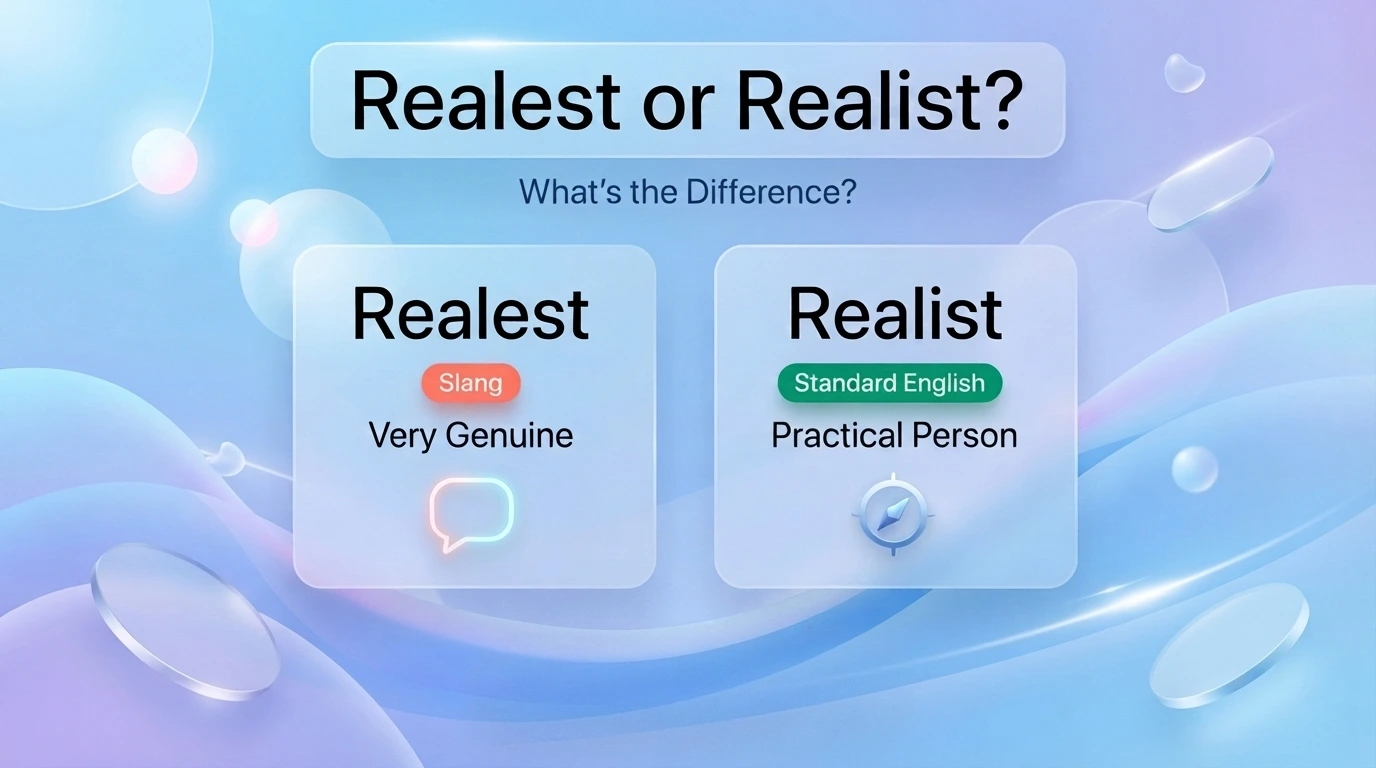
"Realest" is an informal slang superlative meaning "most real" or "most authentic." "Realist" is a standard English word referring to someone who sees things practically, or an artist working in the realism style.
I once scrolled past a social media caption calling someone “the realest person I know” and assumed the poster meant “realist.” I nearly commented to point out the “mistake” before realizing “realest” was actually intentional slang, not an error at all.
If you’ve run into this same confusion, you’re not alone. These two words look almost identical, yet they come from completely different corners of English, one is informal slang built from everyday speech, and the other is a standard dictionary word with a specific, established meaning.
This guide breaks down exactly what each word means, where “realest” comes from despite not following standard grammar rules, and how to use both correctly depending on your context.
Realest or Realist: Quick Answer
“Realest” is informal slang, meaning “most real,” “most authentic,” or “most genuine.”
- ✅ She’s the realest friend I’ve ever had.
“Realist” is a standard English word, referring to a person who accepts situations practically, or an artist associated with the realism movement.
- ✅ He’s a realist who always plans for worst-case scenarios.
- ❌ He’s a realest who always plans for worst-case scenarios. (grammatically incorrect usage)
The Origin of Realest or Realist
“Realist” comes from “real,” combined with the standard noun-forming suffix “-ist,” used throughout English to describe a person associated with a particular belief, practice, or field, similar to “artist,” “scientist,” or “specialist.” This word has existed in English since at least the 1600s, initially tied to philosophy and later expanded to describe practical-minded people and the 19th-century realism art movement.
“Realest” works completely differently. Standard English grammar doesn’t normally add “-est” to “real” at all, the correct superlative would technically be “most real.” However, “realest” emerged organically through informal speech and hip-hop and street culture, particularly gaining popularity from the 1990s onward as a way to emphasize authenticity or genuineness in an intensified, emotionally charged way that “most real” simply doesn’t capture in casual conversation.
Despite breaking traditional grammar rules, “realest” has become widely recognized and accepted in casual, spoken, and social media English, even though it remains absent from standard grammar guides.
Realest vs Realist Explained: Key Differences and Variations
| Term | Meaning | When to Use | Context |
|---|---|---|---|
| Realest | Most real, authentic, or genuine (informal) | Casual speech, social media, music, slang | Informal, conversational, or cultural contexts |
| Realist | A practical-minded person, or realism artist | Formal and everyday standard writing | Philosophy, personal description, art history |
| Real | The base adjective | Describing something genuine or true | Universal, standard usage |
| Really | Adverb form of “real” | Modifying verbs or adjectives | Universal, standard usage |
Notice that “realest” functions purely as an informal superlative of “real,” while “realist” is a completely separate noun with its own distinct grammatical role and dictionary definition.
Which Word Should You Use?
For casual, conversational, or social media writing
Use realest if you’re intentionally aiming for an informal, emphatic tone, and your audience will recognize the slang usage.
For formal or standard writing
Use “most real” instead of “realest,” since “realest” isn’t recognized as grammatically standard outside of casual contexts.
When describing a practical-minded person
Use realist. This applies to personality descriptions, philosophical discussions, or general character traits.
When discussing art or the realism movement
Use realist as well, referring to artists or works associated with realistic, true-to-life representation.
Cheque or Check: What's the Difference? (2026)
Common Mistakes with Realest or Realist
Mistake 1: Using “realest” in formal writing
✅ She is, without question, the most real person I’ve ever met. (formal)
❌ She is, without question, the realest person I’ve ever met. (informal, inappropriate for formal contexts)
Why it happens: Writers unfamiliar with the word’s slang origin sometimes use it without considering the formality of their audience or platform.
Mistake 2: Confusing “realist” with “realest” in casual conversation
✅ He’s definitely the realest guy in the group. (intentional slang)
❌ He’s definitely the realist guy in the group. (incorrect, since “realist” doesn’t function as a superlative)
Why it happens: The words look nearly identical, and casual typing increases the chance of an accidental swap.
Mistake 3: Assuming “realest” is simply a typo
✅ Recognize “realest” as intentional informal slang, not an error.
❌ Automatically “correcting” every instance of “realest” to “realist.”
Why it happens: Readers unfamiliar with the slang usage assume any nonstandard grammar must be a mistake.
Mistake 4: Using “realist” when describing authenticity or genuineness
✅ That was the realest moment of the entire show. (informal, meaning most genuine)
❌ That was the realist moment of the entire show. (incorrect, since “realist” doesn’t mean “most genuine”)
Why it happens: Writers sometimes default to the more familiar dictionary word without realizing it doesn’t carry the intended meaning.
Realest or Realist in Real-World Examples
Social media post:
“Shoutout to the realest people in my life who show up no matter what. 🙏”
Professional or formal description:
“As a realist, she approaches every project with practical, achievable goals.”
Music or entertainment writing:
“The rapper’s lyrics are praised for staying true to his realest experiences growing up.”
Art history or academic writing:
“The realist painters of the 19th century focused on depicting everyday life with striking accuracy.”
Notice how “realest” appears almost exclusively in casual, cultural, or emotionally expressive contexts, while “realist” fits naturally into formal, descriptive, or academic writing.
Realest or Realist: Data, Trends & Usage
Search interest in “realest vs realist” is driven largely by younger audiences, social media users, and music fans trying to confirm correct spelling and usage in casual writing. This falls into the informational search category, with people wanting quick clarity on an informal term that isn’t covered in traditional grammar resources.
“Realist” maintains steady search interest tied to philosophy, personality descriptions, and art history content. “Realest” sees concentrated interest tied closely to music culture, social media captions, and casual conversation, reflecting its strong roots in informal and cultural language rather than academic or formal writing.
Realest vs Realist: Comparison Table
| Term/Variant | Meaning | Context | Best Used When |
|---|---|---|---|
| Realest | Most real, authentic, or genuine | Informal, slang, cultural | Casual conversation, social media, music |
| Realist | A practical-minded person, or realism artist | Formal, standard English | Philosophy, character description, art history |
| Real | Genuine or true (base adjective) | Universal | Standard everyday usage |
Frequently Asked Questions
Q: What does “realest” mean?
A: “Realest” is informal slang meaning “most real,” “most authentic,” or “most genuine,” commonly used in casual speech, music, and social media.
Q: How do you use “realist” correctly in a sentence?
A: Use “realist” to describe a practical, pragmatic person, or an artist associated with realism, such as “He’s a realist who focuses on facts over feelings.”
Q: Realest vs realist, what’s the difference?
A: “Realest” is informal slang meaning “most real,” while “realist” is a standard word describing a practical-minded person or realism artist. They aren’t related in meaning.
Q: Is “realest” acceptable in formal writing?
A: No. “Realest” is considered informal slang and isn’t recognized in standard grammar guides, so it’s best avoided in formal or professional writing.
Q: Which version is correct, realest or realist?
A: Both are valid words, but they mean entirely different things. Choose “realest” for informal emphasis on authenticity, and “realist” for describing a practical person or art style.
Q: Where does the word “realest” come from?
A: It developed informally through casual speech and hip-hop and street culture, particularly gaining popularity from the 1990s onward as an emphatic way to describe authenticity.
Q: Can “realest” ever be used in professional writing?
A: Generally, no. Since it’s grammatically nonstandard, “most real” or “most genuine” would be the more appropriate choice for professional or formal contexts.
Final Takeaway
Here’s the short version. “Realest” is informal slang meaning “most real” or “most authentic.” “Realist” is a standard word describing a practical person or realism artist.
Key points to remember:
- The context test: Casual, emotional emphasis calls for “realest”; formal description calls for “realist”
- Grammar note: “Realest” isn’t standard grammar, but it’s widely recognized in informal and cultural contexts
- Different meanings entirely: These words aren’t related despite looking similar
- When in doubt: Use “most real” in formal writing instead of “realest”
Once you separate the slang usage from the standard dictionary word, you’ll never confuse “realest” and “realist” again.
Bookmark this guide so you never second-guess “realest” vs “realist” again, and share it with anyone curious about this common social media word choice.
Realest vs Realist explained with simple examples. Discover the surprising difference and learn which word is correct before you use it.
Phased or Fazed: The Correct Word Explained (2026)

I’m a language enthusiast and content writer. I’m specialized in English grammar, spelling differences, vocabulary explanations, and word comparisons. My goal is to help readers improve their writing skills through clear, accurate, and easy-to-understand language guides.