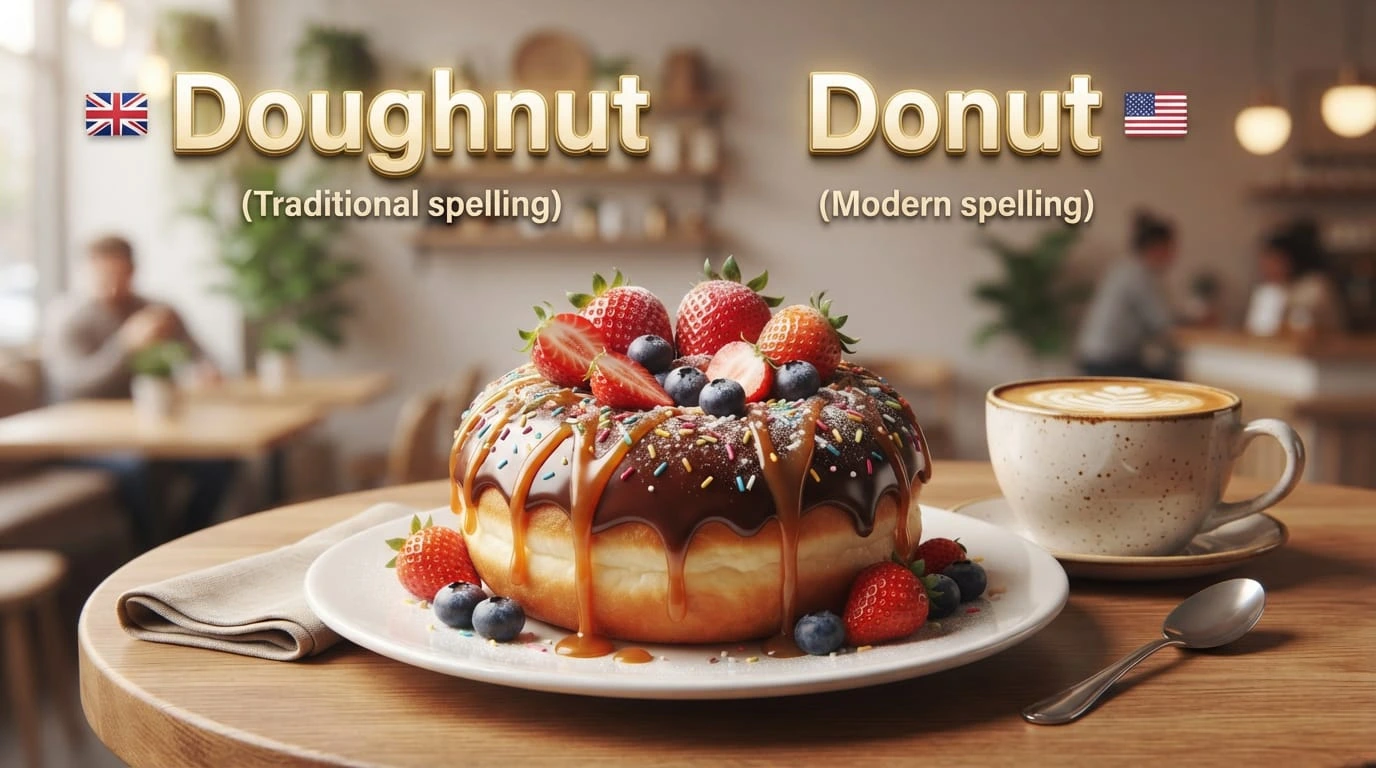
“Doughnut” and “donut” both refer to the same fried, ring-shaped pastry. “Doughnut” is the traditional spelling, while “donut” is a simplified American variant that’s become widely accepted, especially in branding and casual writing.
I once walked into a small bakery and asked for a “doughnut,” fully spelling it out in my head as I spoke. The cashier laughed and said, “You mean a donut, right?” I genuinely wasn’t sure if I’d said something wrong.
Here’s the twist: both spellings are completely correct. Unlike many English spelling debates, this one doesn’t have a clean winner. Both “doughnut” and “donut” appear in dictionaries, and both show up constantly on menus, packaging, and everyday conversation.
This guide breaks down exactly where each spelling comes from, why “donut” became so popular despite being the newer form, and how to choose confidently between the two in your own writing.
Doughnut or Donut: Quick Answer
Both “doughnut” and “donut” are correct spellings of the same sweet, fried pastry, typically ring-shaped, though sometimes filled.
- ✅ She grabbed a chocolate doughnut on her way to work.
- ✅ She grabbed a chocolate donut on her way to work.
In modern usage, “donut” has become extremely common, especially in American branding and casual writing. “Doughnut” remains the more traditional, dictionary-first spelling.
The Origin of Doughnut/Donut
“Doughnut” combines “dough” and “nut,” a reference to the small, nut-sized pieces of fried dough that were common before the modern ring shape became standard. The word dates back to at least the early 1800s in American English, appearing in Washington Irving’s writings among other early sources.
“Donut” emerged much later as a simplified spelling, gaining real traction in the 20th century. The shortened form got a massive boost in popularity thanks to Dunkin’ Donuts, founded in 1950, whose branding helped cement “donut” as a familiar, everyday spelling across the United States.
Simplified spellings like “donut,” “lite,” and “thru” reflect a broader pattern in American English, informal, phonetic spellings that emerged largely through advertising and branding rather than traditional dictionary evolution. Despite starting as a casual variant, “donut” has become so widespread that most major dictionaries now list it as an accepted alternative spelling.
Doughnut vs Donut Explained: Key Differences and Variations
| Term | Meaning | When to Use | Region/Context |
|---|---|---|---|
| Doughnut | Fried, ring-shaped pastry | Formal writing, traditional recipes, British English | Preferred in the UK and in more formal American writing |
| Donut | Fried, ring-shaped pastry | Casual writing, branding, everyday American English | Extremely common in the US, especially in marketing |
| Doughnut hole | The small piece of dough removed from the center | Universal | Refers specifically to the small round pastry pieces |
Unlike stricter spelling pairs, “doughnut” and “donut” refer to the exact same food, the difference lies entirely in formality and regional habit, not meaning.
Which Spelling Should You Use?
For formal or traditional writing
Use doughnut. This remains the more widely recognized spelling in dictionaries and formal publications.
For casual, branding, or marketing content
Donut works well and feels modern, especially for American audiences familiar with major donut chains and casual food culture.
For British or international audiences
Doughnut is generally preferred, since “donut” is viewed as a distinctly American simplification.
For global or neutral use
Doughnut is the safer, more universally recognized choice if you’re writing for an international audience unfamiliar with American branding conventions.
Tear or Tare: The Correct Word (2026)
Common Mistakes with Doughnut/Donut
Mistake 1: Assuming one spelling is simply wrong
✅ Both “doughnut” and “donut” are accepted spellings.
❌ “Donut” is a typo for “doughnut.”
Why it happens: People assume every spelling variation must have one strictly correct answer, when this one allows both.
Mistake 2: Mixing spellings within the same document
✅ The bakery sells doughnuts daily, and each doughnut is made fresh.
❌ The bakery sells doughnuts daily, and each donut is made fresh.
Why it happens: Writers switch unconsciously between the two accepted forms.
Mistake 3: Assuming “donut” is incorrect in formal writing
✅ Recognize that “donut” appears in most major dictionaries as an accepted variant.
❌ Insisting “donut” is always wrong in professional writing.
Why it happens: Some writers assume simplified, brand-driven spellings never become “official,” even after widespread dictionary acceptance.
Mistake 4: Overthinking casual, everyday writing
✅ Pick either spelling for casual writing, and stay consistent.
❌ Agonizing over “doughnut” versus “donut” in a quick social media caption.
Why it happens: Writers assume this distinction carries more formal weight than it actually does in casual contexts.
Mistake 5: Ignoring brand or publication style guides
✅ Check whether your organization has a preferred spelling before publishing.
❌ Assuming every food blog or publication treats “doughnut” and “donut” identically.
Why it happens: Style guides vary, and not every writer checks before submitting content.
Doughnut/Donut in Real-World Examples
Professional email:
“We’ve finalized the doughnut selection for Friday’s office celebration, let me know if anyone has dietary restrictions.”
News headline:
“Local Bakery Wins Award for Best Donut in the State”
Social media post:
“Sunday mornings mean coffee and a donut, no exceptions. ☕”
Formal document (UK-based):
“The catering menu includes a selection of doughnuts, pastries, and fresh fruit.”
Notice how “donut” dominates casual American content, while “doughnut” appears more often in formal writing or British-based publications.
Doughnut/Donut: Data, Trends & Usage
Search interest in “doughnut vs donut” is steady, driven largely by content writers, bakery owners, and marketers confirming spelling before publishing menus, packaging, or promotional content. This falls into the informational search category, with people wanting a fast, reliable answer before finalizing copy.
“Donut” dominates search volume in the United States, closely tied to major brand recognition and casual food culture. “Doughnut” maintains stronger search interest in the UK, Australia, and other English-speaking regions less influenced by American fast-food branding.
Doughnut vs Donut: Comparison Table
| Term/Variant | Meaning | Region/Context | Best Used When |
|---|---|---|---|
| Doughnut | Fried, ring-shaped pastry | Traditional, UK, formal writing | Formal content, British audiences, traditional recipes |
| Donut | Fried, ring-shaped pastry | Casual, US-dominant | Marketing, branding, everyday American writing |
| Doughnut hole | Small round pastry piece from the center | Universal | Referring specifically to the small filler pastry pieces |
Frequently Asked Questions
Q: What does “doughnut” or “donut” mean?
A: Both words refer to the same sweet, fried pastry, typically ring-shaped, sometimes filled with cream, jelly, or other fillings.
Q: How do you use “donut” correctly in a sentence?
A: Use “donut” the same way you’d use “doughnut,” for example, “I grabbed a donut on my way out” works exactly like “I grabbed a doughnut on my way out.”
Q: Doughnut vs donut, what’s the difference?
A: There’s no difference in meaning. “Doughnut” is the traditional spelling, while “donut” is a simplified, popular American variant.
Q: Is “donut” acceptable in formal writing?
A: It’s increasingly accepted, especially in American contexts, though “doughnut” remains the more traditional choice for formal or international writing.
Q: Which version is correct, doughnut or donut?
A: Both are correct. Choose “doughnut” for traditional or formal writing, or “donut” for casual, modern American content.
Q: Where does the word “doughnut” come from?
A: It combines “dough” and “nut,” referencing the small, nut-sized fried dough pieces that predated the now-familiar ring shape.
Q: Why did “donut” become so popular?
A: Major American brands, particularly Dunkin’ Donuts, helped popularize the simplified spelling throughout the 20th century, making it widely familiar in everyday American English.
Final Takeaway
Here’s the short version. Both “doughnut” and “donut” are correct, this isn’t a right-versus-wrong spelling situation.
Key points to remember:
- The rule: No strict rule exists; both spellings are dictionary-accepted
- Traditional pick: “Doughnut” leads in formal writing and international contexts
- Modern trend: “Donut” dominates American branding and casual use
- Consistency matters: Pick one spelling per document and stick with it
Once you know both are valid, choosing between “doughnut” and “donut” comes down to tone and audience, not correctness.
Girly or Girlie: Which Spelling Is Correct?

I specialize in spelling comparisons, confusing word pairs, grammar, and vocabulary development. My content helps readers improve their English, avoid common mistakes, and write with confidence. My goal is to provide accurate, reliable, and easy-to-understand language resources