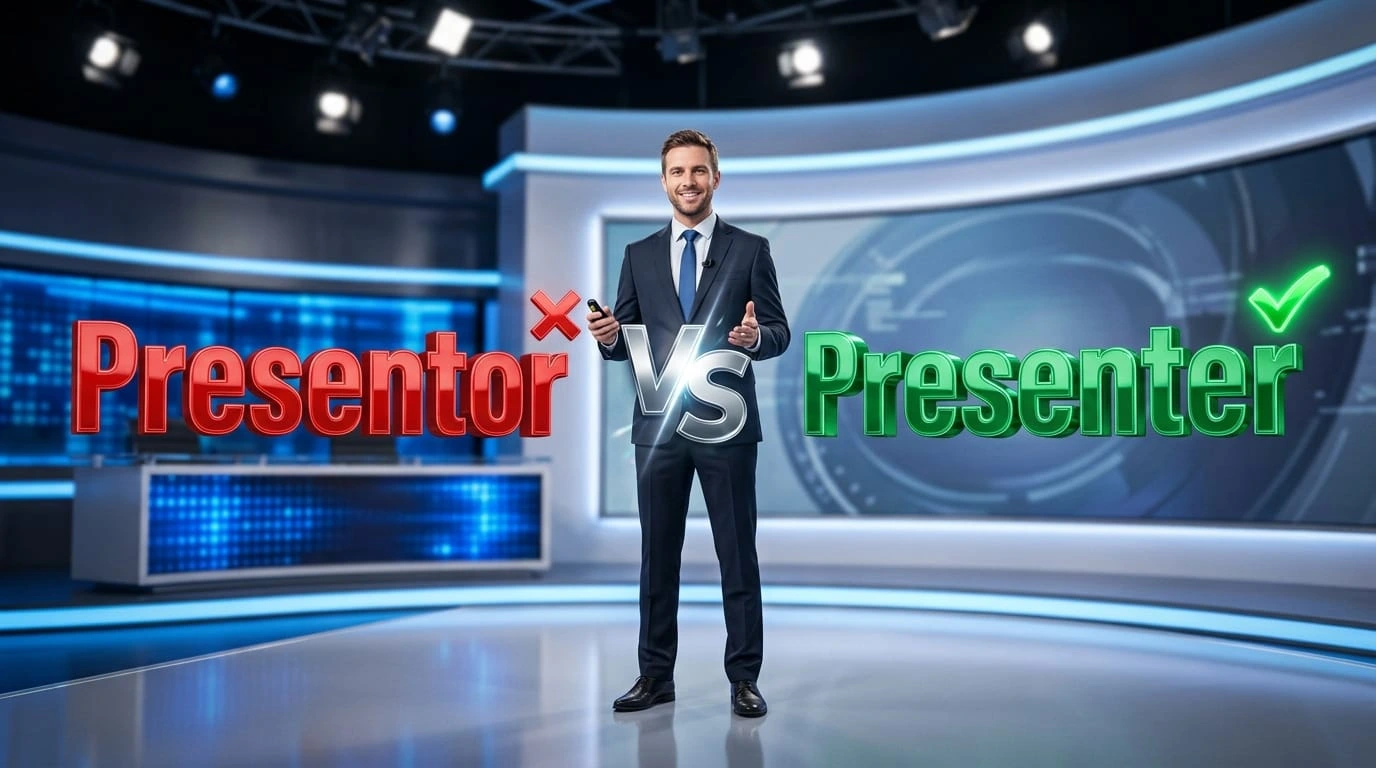
Presenter is the correct spelling in modern English. Presentor is a rare variant that appears mainly in legal or technical contexts but is considered incorrect for referring to someone who presents a TV show, speech, or presentation.
Have you ever typed presentor in an email only to see your spell checker underline it in red? I certainly have. While editing a training guide for a client, I noticed I had written presentor several times without thinking. It looked logical because many English words end in -or, but every trusted dictionary and style guide pointed me back to presenter.
This mix-up is more common than you might think. The words sound almost identical, making it easy to assume both spellings are interchangeable. Add in the fact that presentor does exist in a few specialised legal contexts, and the confusion becomes even greater.
If you’ve ever wondered which spelling belongs in your presentation slides, résumé, business email, or classroom assignment, you’re in the right place. This guide explains the difference in plain English. You’ll learn where each word came from, when to use presenter, why presentor sometimes appears, and how to avoid this common writing mistake.
Presentor or Presenter: Quick Answer
For almost every situation, presenter is the correct word.
Use presenter when talking about someone who:
- Gives a presentation
- Hosts a TV or radio programme
- Introduces speakers
- Delivers a speech
- Leads a meeting or workshop
The spelling presentor is uncommon. In general English, it should be avoided unless you’re referring to a specialised legal or financial meaning.
Examples
- ✅ Sarah is the presenter of the morning news.
- ✅ Our presenter explained the new software clearly.
- ❌ Sarah is the presentor of the morning news.
The Origin and Background of Presentor or Presenter
Both words come from the Latin verb praesentare, meaning to place before or to show.
The English verb present eventually developed into the noun presenter, meaning someone who presents something to others.
So why does presentor exist?
English has many nouns ending in -or, such as:
- actor
- creator
- inventor
- editor
Because of this pattern, many people naturally assume presentor should also be correct.
However, English followed a different path for this word. Over time, presenter became the accepted standard in everyday language, education, journalism, broadcasting, and business.
The word presentor survived only in a few specialised fields, especially certain legal and banking documents, where it can refer to the person who presents a cheque, bill, or legal document for payment or acceptance.
That specialised meaning is why some dictionaries still include the word, even though most English speakers never use it.
Presentor or Presenter Explained
Although the spellings differ by only one letter, they are not equally common.
| Term | Meaning | When to Use | Region/Context |
| Presenter | A person who presents, hosts, or speaks | Everyday English | Worldwide |
| Presentor | A person presenting a legal or financial document | Rare legal or banking use | Specialised contexts |
Presenter
This is the spelling you’ll see in:
- TV programmes
- Conferences
- Schools
- Universities
- Business meetings
- Online courses
- Public speaking
Examples
- Emma is the presenter of the science programme.
- The presenter answered questions from the audience.
- Every presenter received a certificate.
Presentor
This spelling appears mainly in legal documents involving negotiable instruments such as cheques or bills.
Examples include:
- the presentor of a cheque
- the presentor of a bill of exchange
Outside these specialised meanings, most editors recommend avoiding presentor.
Quick Comparison
| Feature | Presenter | Presentor |
| Standard English | ✅ Yes | ❌ No |
| TV host | ✅ Yes | ❌ No |
| Conference speaker | ✅ Yes | ❌ No |
| School presentation | ✅ Yes | ❌ No |
| Business presentation | ✅ Yes | ❌ No |
| Legal or banking documents | Rarely | ✅ Sometimes |
Which Version Should You Use?
For nearly every writing situation, the answer is simple: use presenter.
It is the spelling accepted by major dictionaries, style guides, schools, universities, and publishers. Most readers also expect to see presenter, so using it makes your writing look more polished and professional.
For students
Use presenter in:
- Essays
- Assignments
- Classroom presentations
- Exam answers
Example:
The presenter explained the project clearly.
For professionals
Choose presenter in:
- Business emails
- Company reports
- Meeting agendas
- Training materials
- Conference programmes
Example:
The keynote presenter will begin at 10:00 a.m.
For TV, radio, and podcast creators
Always write presenter.
It is the standard term for someone who hosts or introduces a programme.
Examples:
- TV presenter
- Radio presenter
- News presenter
- Podcast presenter
For legal or banking professionals
You may occasionally see presentor in legal documents involving:
- Cheques
- Bills of exchange
- Negotiable instruments
Outside these specialised meanings, presenter remains the better choice.
Final recommendation
✔ Presenter → Everyday English
✔ Presentor → Rare legal or financial usage only
If you’re unsure, choose presenter every time.
Common Mistakes with Presentor or Presenter
Many writers make the same errors because both words sound alike.
Here are the most common ones.
| Mistake | Correct Form | Why It Happens |
| Presentor of the TV show | Presenter of the TV show | Everyday English uses presenter |
| Conference presentor | Conference presenter | Incorrect spelling for general use |
| Radio presentor | Radio presenter | Common spelling mistake |
| Best presentor award | Best presenter award | Confusing -er and -or endings |
| Presentation presentor | Presentation presenter | Following the wrong word pattern |
Why do people write “presentor”?
Several English words end in -or, including:
- actor
- creator
- inventor
- director
Because of these patterns, many people naturally assume presentor should also be correct.
In modern English, however, presenter is the accepted spelling.
Easy Memory Trick
Think of the verb.
Present → Presenter
Both words end with -er.
This makes the spelling easy to remember.
Another helpful example:
- Teach → Teacher
- Write → Writer
- Present → Presenter
Following this pattern will help you avoid the mistake.
Curtsy or Curtsey? Most People Get This Wrong
Presenter in Real-World Examples
Here are examples from everyday writing.
Professional email
Our presenter will begin the training session at 2:00 p.m.
News headline
Presenter Wins National Broadcasting Award
Social media post
Excited to be today’s presenter at the marketing conference!
Formal report
The presenter answered every question before the meeting ended.
Job advertisement
We are looking for an experienced TV presenter to join our team.
School announcement
Each presenter will have five minutes to explain their project.
Notice that every natural example uses presenter.
Presenter: Data, Trends & Usage
People search presentor or presenter because they want to know which spelling is correct before writing.
Search intent
Informational
Most users simply want a quick grammar answer.
Who searches this topic?
Common audiences include:
- Students
- English learners
- Teachers
- Public speakers
- Content writers
- Journalists
- Business professionals
- Job seekers
Regions where it’s commonly searched
Interest comes from many English-speaking countries, including:
- United Kingdom
- United States
- Canada
- Australia
- New Zealand
- India
- Pakistan
Why this confusion continues
The confusion exists because English contains many nouns ending in -or, while presenter ends in -er.
People often spell words the way they sound rather than how dictionaries recommend.
Spell-check tools also catch presentor in most everyday documents, reminding writers that presenter is the preferred standard.
Presenter vs Presentor Comparison Table
| Term/Variant | Meaning | Region/Context | Best Used When |
| Presenter | A person who presents, hosts, or speaks | Standard English worldwide | TV, radio, meetings, speeches, education, business |
| Presentor | Person presenting a legal or financial document | Rare legal and banking contexts | Only when referring to specialised legal usage |
Similar Word Pairs That Cause Confusion
If you were unsure about presentor or presenter, you may also wonder about these commonly confused words:
- Advisor or Adviser
- Counsellor or Counselor
- Instructor or Teacher
- Narrator or Commentator
- Organizer or Organiser
- Creator or Creator (correct spelling remains the same)
- Employer or Employee
Many of these pairs differ because of regional spelling or historical usage. Presenter, however, is the standard choice in general English.
Frequently Asked Questions
Q: Is presenter or presentor correct?
A: Presenter is the correct spelling in everyday English. Use it for someone who gives a presentation, hosts a TV show, or leads a meeting. Presentor is a rare term used mainly in legal or banking contexts.
Q: What does presenter mean?
A: A presenter is a person who presents information to an audience. This can include a TV host, news anchor, teacher, public speaker, or conference speaker.
Q: Why do some people write presentor?
A: Many people assume presentor is correct because words like actor, creator, and director end in -or. However, standard English uses presenter for almost all situations.
Q: Is presentor accepted in formal writing?
A: Not in general writing. Essays, business documents, articles, and emails should all use presenter. Presentor only appears in specialised legal or financial documents.
Q: Is presenter used in British and American English?
A: Yes. Both British and American English use presenter as the standard spelling for someone who presents or hosts a programme.
Q: Can I call a TV host a presentor?
A: No. The correct term is presenter. TV presenters, radio presenters, and conference presenters all use the -er spelling.
Q: How can I remember the correct spelling?
A: Think of the verb present. Simply add -er to make presenter. Remember: Present → Presenter.
Conclusion
If you’ve been wondering whether to write presentor or presenter, the answer is straightforward. Presenter is the standard spelling in modern English and is the one you’ll see in schools, workplaces, television, journalism, and everyday writing. It refers to someone who presents information, hosts a programme, or delivers a speech.
Although presentor exists, its use is limited to a few specialised legal and banking contexts. For almost everyone, it’s a spelling you’ll never need in daily communication.
When in doubt, remember the simple pattern: Present → Presenter. This easy rule will help you avoid a common mistake and make your writing look more accurate and professional.
Else’s vs Elses: The Apostrophe Rule Explained

I am a language content specialist specializing in spelling comparisons, vocabulary usage, and commonly confused English words. I write detailed, informative articles that help readers improve their language skills. I am passionate about helping students, writers, and professionals develop a stronger understanding of the English language.