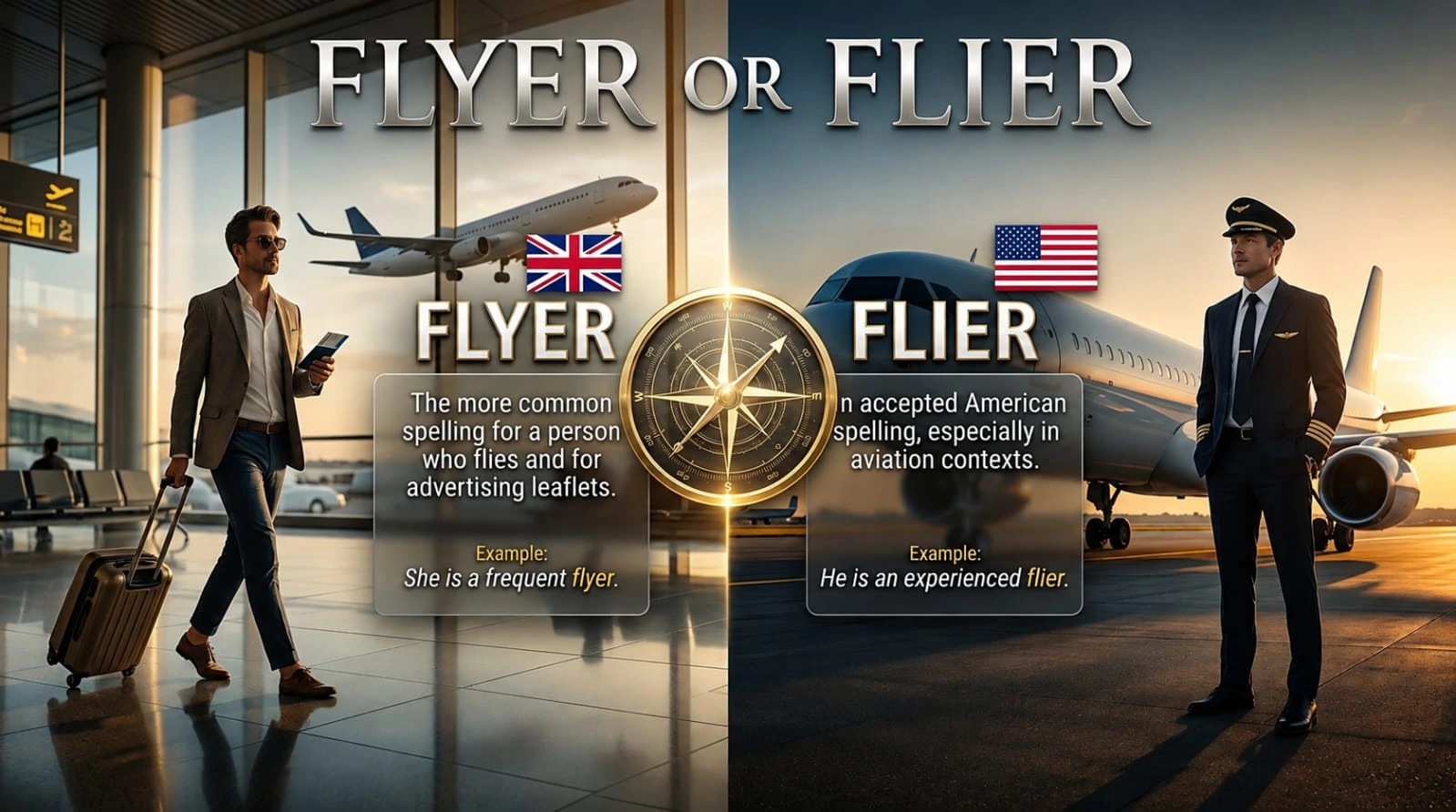
Both “flyer” and “flier” are correct spellings. “Flyer” is the more common choice today, especially for printed handbills, while “flier” is the older, more traditional form still used in certain fixed phrases.
A few years back, I ordered a print run of promotional handouts for a local event. I typed “fliers” into the design template without a second thought. A friend glanced at it and said, “Don’t you mean flyers?” I froze, I genuinely didn’t know which one was right.
Here’s the twist: we were both right. Unlike most spelling mix-ups, this one isn’t about correct versus incorrect. Both spellings exist in modern dictionaries, and both show up in professional writing every day.
That’s exactly why this word confuses so many people, there’s no clean rule to memorize, just a pattern of usage that shifts depending on context and region.
This guide breaks down when to use “flyer,” when “flier” makes more sense, and why airlines, marketers, and editors don’t always agree.
Flyer or Flier: Quick Answer
Both “flyer” and “flier” are correct spellings of the same word. The difference is mostly about convention, not grammar rules.
- ✅ She handed out flyers for the bake sale.
- ✅ She handed out fliers for the bake sale.
In modern usage, “flyer” has become the more common spelling overall, especially for printed advertisements. “Flier” survives mainly in a handful of set phrases and in some style guides that still prefer it.
The Origin of Flyer/Flier
The word traces back to the verb “fly,” combined with the agent suffix “-er,” meaning “one who flies” or “something that flies.” Early English spelling wasn’t standardized, so both “-yer” and “-ier” endings coexisted for centuries.
Historically, “flier” was the older, more established spelling, used for pilots, birds, and fast-moving objects. “Flyer” gained popularity later, particularly in the 20th century, as it became the go-to term for printed promotional sheets, the kind you’d find stuck under a car wiper or handed out on a street corner.
Airlines complicated things further. Programs originally used “frequent flier miles,” but many companies have since shifted their branding to “frequent flyer.” That single industry shift nudged public habit strongly toward “flyer” as the default spelling.
Flyer/Flier Explained: Key Differences and Variations
| Term | Meaning | When to Use | Region/Context |
|---|---|---|---|
| Flyer | Printed handbill; person or thing that flies | Advertisements, general modern usage | Preferred in most American English today |
| Flier | Person or thing that flies; used in fixed idioms | “Frequent flier,” “take a flier,” aviation contexts | More traditional, still common in the US and UK |
| Flyers | Plural of flyer | Multiple handbills, general use | Same context as “flyer” |
Both spellings appear across American, British, Australian, and Canadian English, this isn’t a strict regional split like “color” versus “colour.”
Which Spelling Should You Use?
For marketing and printed advertisements
Use flyer. It’s the more widely recognized spelling for handbills today.
For airline loyalty programs or idiomatic phrases
Either works, but check the specific brand’s official spelling (many still use “frequent flier,” others “frequent flyer”).
For aviation or someone who pilots aircraft
Flier is the more traditional choice, though “flyer” is increasingly accepted.
For global or neutral use
Flyer is the safer default, since it dominates search volume and everyday usage.
Common Mistakes with Flyer/Flier
Mistake 1: Assuming one spelling is simply wrong
✅ Both “flyer” and “flier” are correct spellings.
❌ “Flier” is a typo for “flyer.”
Why it happens: People assume every spelling variation must have one “correct” answer, when this one genuinely doesn’t.
Mistake 2: Mixing spellings within the same document
✅ We printed 200 flyers, and each flyer listed the event details.
❌ We printed 200 flyers, and each flier listed the event details.
Why it happens: Writers switch spellings unconsciously, especially when copy-pasting from different sources.
Mistake 3: Misspelling the plural form
✅ flyers, fliers
❌ flyres, flieres
Why it happens: Rushed typing or unfamiliarity with the correct plural pattern.
Mistake 4: Ignoring brand-specific spelling in loyalty programs
✅ Check the airline’s official term before writing “frequent flyer” or “frequent flier.”
❌ Assuming every airline uses the same spelling.
Why it happens: Writers don’t realize spelling varies by company branding, not just by dialect.
Mistake 5: Overthinking which one is “more correct”
✅ Pick one spelling and stay consistent throughout your writing.
❌ Constantly switching spellings mid-project out of uncertainty.
Why it happens: Because both are valid, writers sometimes second-guess themselves unnecessarily.
Who’s or Whose: The Complete Guide to Using Them Correctly (2026)
Flyer/Flier in Real-World Examples
Professional email:
“Attached is the final flyer for next week’s product launch, please review before we send it to print.”
News headline:
“Local Business Owners Distribute Flyers Ahead of Weekend Festival”
Social media post:
“Swipe to see our new event flyer, tag a friend who needs to come! 🎉”
Formal document:
“Members enrolled in the frequent flier program will receive priority boarding.”
Notice how both spellings can appear naturally, depending on the specific context and industry convention.
Flyer/Flier: Data, Trends & Usage
Search data consistently shows “flyer” outpacing “flier” in everyday queries, particularly for marketing, events, and printed advertisements. This falls into the informational search category, with people typically trying to confirm which spelling to use before printing or publishing something.
“Flier” still holds steady search volume tied to travel and aviation, largely due to legacy loyalty program names. Marketing teams, small business owners, and event organizers are the biggest group searching this term, usually right before finalizing promotional materials.
Flyer vs Flier: Comparison Table
| Term/Variant | Meaning | Region/Context | Best Used When |
|---|---|---|---|
| Flyer | Printed handbill; one who flies | Dominant in modern American English | Marketing, ads, general everyday use |
| Flier | One who flies; fixed idiomatic phrases | Traditional, still used in aviation and idioms | “Frequent flier,” “take a flier,” formal aviation writing |
| Fliers/Flyers | Plural forms | Same as singular counterparts | Match whichever singular form you’re already using |
Frequently Asked Questions
Q: What does “flyer” or “flier” mean?
A: Both words refer to a printed advertisement or handbill, or to a person or object that flies. The meaning is identical, only the spelling differs.
Q: How do you use “flyer” correctly in a sentence?
A: Use “flyer” the same way you’d use “flier”.For example, “We designed a flyer for the concert” works exactly like “We designed a flier for the concert.”
Q: Flyer vs flier; what’s the difference?
A: There’s no grammatical difference. “Flyer” is more common today, especially for advertisements, while “flier” survives mainly in older or idiomatic usage.
Q: Is “flier” acceptable in formal writing?
A: Yes. Many style guides, including some traditional ones, still list “flier” as an acceptable or even preferred spelling.
Q: Which version is correct: flyer or flier?
A: Both are correct. Choose “flyer” for general modern use, or “flier” if you’re matching a specific brand, idiom, or older style guide.
Q: Where does the word “flyer” come from?
A: It comes from the verb “fly” plus the suffix “-er.” Both “-yer” and “-ier” spellings developed over time, with “flyer” becoming more dominant in the 20th century.
Q: Can “flier” be used in casual conversation and texting?
A: Yes. Both spellings work in casual contexts; pick whichever feels natural, and stay consistent within the same conversation or document.
Final Takeaway
Here’s the short version. Both “flyer” and “flier” are correct; this isn’t a right-versus-wrong situation like many spelling debates.
Key points to remember:
- The rule: No strict rule exists; both spellings are dictionary-approved
- Modern trend: “Flyer” leads in everyday and marketing use
- Watch for idioms: Phrases like “frequent flier” and “take a flier” often keep the older spelling
- Consistency matters: Pick one spelling per document and stick with it
Once you know both are valid, choosing between “flyer” and “flier” becomes a matter of style, not correctness.
Flyer vs flier explained; both spellings are correct. Learn the difference, common usage, and which one fits your writing.
There or Their: The Complete Guide to Using the Right Word

I am a language content specialist specializing in spelling comparisons, vocabulary usage, and commonly confused English words. I write detailed, informative articles that help readers improve their language skills. I am passionate about helping students, writers, and professionals develop a stronger understanding of the English language.