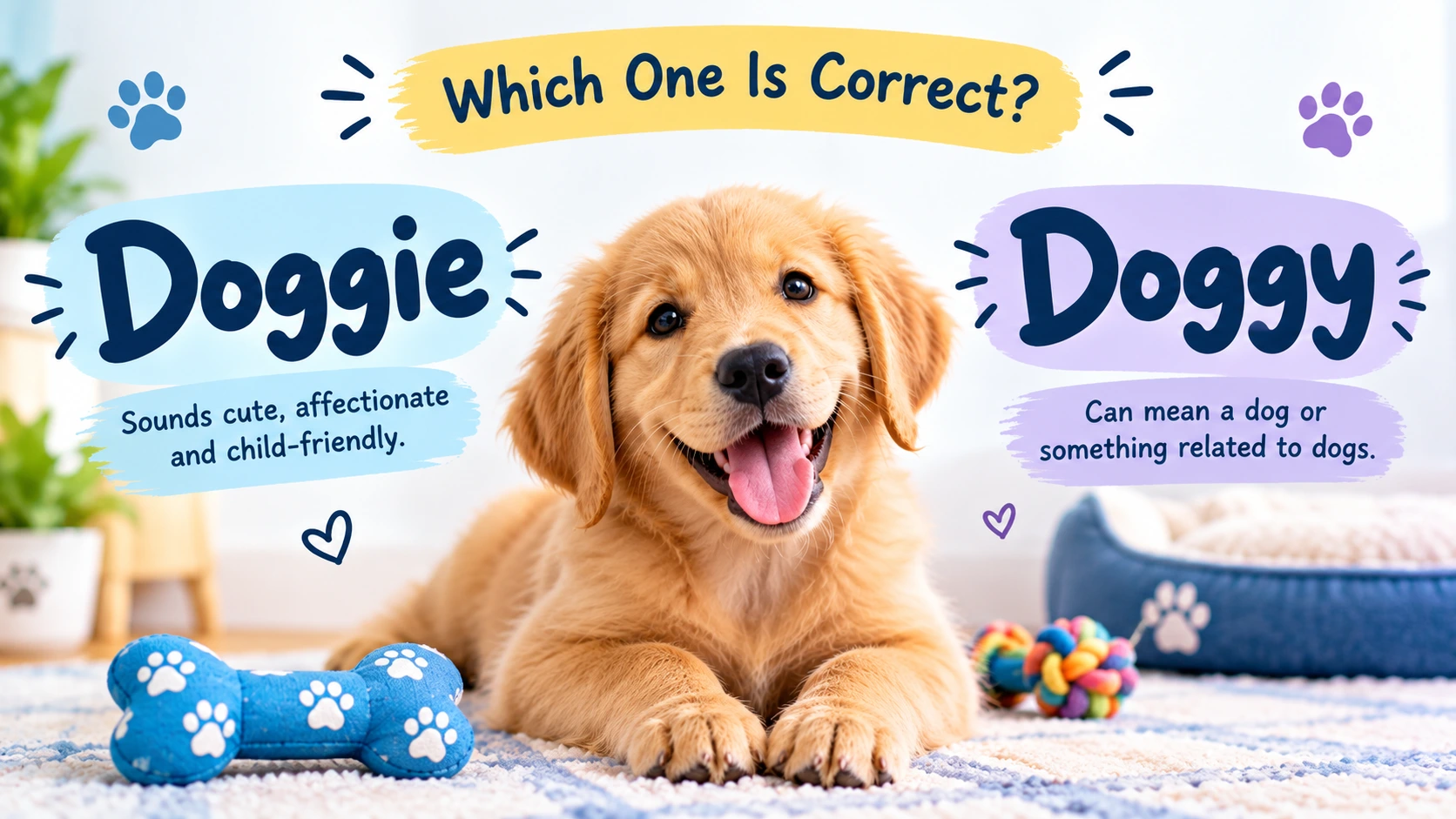
Doggie and doggy are both correct informal words for a dog. Doggie sounds more affectionate, while doggy can also mean dog-like or related to dogs.
Have you ever typed a cute message about a dog and then stopped to wonder, “Is it doggie or doggy?” I have seen this small spelling question many times when helping English learners with everyday words.
Both forms look almost the same. They also have similar meanings. That makes the choice seem harder than it really is.
The good news is that both doggie and doggy are accepted English words. The main difference is not about one being right and the other being wrong. It is about tone, meaning, and context.
For example, a child might say, “Look at that cute doggie!” Here, doggie sounds warm and playful. You might also hear someone say, “We bought a doggy bed.” In this phrase, doggy is used as a casual word connected with dogs.
In this guide, you will learn how these two spellings differ, where they came from, when to use each one, and which form works best in different situations.
Doggie or Doggy: Quick Answer
Doggie and doggy are both correct spellings.
They are informal words related to dogs, but their common uses can differ.
- Doggie usually sounds cute, affectionate, or child-friendly.
- Doggy can mean a dog or something related to dogs.
- Doggy can also mean dog-like.
- Neither word is usually suitable for highly formal writing.
Simple examples
- “The little girl hugged her doggie.”
- “We bought a new doggy bed.”
- “What a cute doggie!”
- “The puppy has a very doggy smell.”
The best choice depends on what you want the word to express.
The Origin and Background of Doggie and Doggy
Both doggie and doggy developed from the basic word dog.
English often creates affectionate or informal forms by adding endings to familiar words. The endings -ie and -y can make a word sound smaller, softer, or more familiar.
This pattern appears in many everyday English words.
For example:
- dog → doggie
- dog → doggy
- bird → birdie
- duck → ducky
The spelling with -ie often gives a stronger sense of affection or childish speech. That is why doggie is common when people talk to young children or speak warmly about pets.
The form doggy has a wider range of uses. It can refer to a dog, but it can also describe something associated with dogs.
For example:
“The children love the doggy show.”
Here, doggy describes something related to dogs.
The two forms therefore overlap, but they are not always interchangeable.
Doggie vs Doggy: Key Differences
The easiest way to understand the difference is to look at tone and function.
| Term | Meaning | When to Use | Region/Context |
|---|---|---|---|
| Doggie | An affectionate or informal word for a dog | Cute, warm, or child-friendly contexts | Common in casual English |
| Doggy | A dog or something related to dogs | Casual speech and descriptive phrases | Common in informal English |
| Doggy | Dog-like in appearance, behavior, or smell | When describing something connected with dogs | Informal English |
When to use doggie
Use doggie when you want your language to sound sweet or affectionate.
For example:
- “Come here, little doggie!”
- “My daughter loves that doggie.”
- “The doggie is sleeping.”
- “She bought a toy for her doggie.”
The word often has a warm, playful feeling.
When to use doggy
Use doggy when you are speaking casually about a dog or describing something associated with dogs.
For example:
- “The child wants a doggy.”
- “This is a cute doggy.”
- “We need a new doggy bed.”
- “The puppy has a doggy face.”
In some contexts, doggy means dog-like rather than simply “dog.”
For example:
“That puppy has a very doggy personality.”
Here, doggy describes a quality or behavior associated with dogs.
Which Version Should You Use?
Your choice depends on the situation and the feeling you want to create.
For children
Doggie is often a natural choice.
It sounds gentle and playful.
“Look at the doggie!”
For casual conversation
Doggy and doggie can both work.
Your choice may depend on your personal style.
“We saw a cute doggy at the park.”
“We saw a cute doggie at the park.”
Both sentences are understandable.
For affectionate pet talk
Doggie can sound especially warm.
“My doggie is waiting by the door.”
For descriptions
Doggy can be more useful when the word means dog-like or related to dogs.
“The toy has a funny doggy shape.”
For formal writing
Avoid both words when a more neutral term is better.
Instead, use:
- dog
- canine
- pet
- puppy, when appropriate
For example:
Informal: “The doggie was taken to the vet.”
Neutral: “The dog was taken to the vet.”
The second sentence is more suitable for formal reports or professional writing.
Common Mistakes with Doggie and Doggy
These words are easy to confuse because their meanings overlap.
1. Thinking one spelling is wrong
Mistake: “Doggie is wrong. Only doggy is correct.”
Correction: Both doggie and doggy are correct informal forms.
The difference is mainly in usage and tone.
2. Using doggie in formal writing
Mistake: “The doggie was examined by the veterinarian.”
Better: “The dog was examined by the veterinarian.”
Doggie sounds informal and affectionate. A formal report normally uses dog.
3. Using doggy when you mean a cute pet name
Mistake: “Come here, my doggie!”
There is nothing grammatically wrong with this sentence. However, if you want a playful and affectionate tone, doggie may fit better.
4. Assuming doggy always means “dog”
Mistake: Treating every use of doggy as a simple synonym for dog.
Correction: Doggy can also mean dog-like or related to dogs.
For example:
“The room has a strong doggy smell.”
Here, doggy describes the smell. It does not mean “a dog.”
5. Using either word in technical writing
Mistake: “The doggy showed signs of infection.”
Better: “The dog showed signs of infection.”
Technical and professional writing usually favors precise, neutral vocabulary.
Doggie or Doggy in Real-World Examples
Seeing these words in different situations makes the difference easier to remember.
Professional email
A professional email would usually use dog rather than either informal form.
“The dog was brought to the clinic for a routine examination.”
This sounds neutral and professional.
News article
A news article may also prefer dog.
“The rescue team found a lost dog near the park.”
However, a quoted statement from a child or pet owner could naturally contain doggie or doggy.
Social media post
Social media is much more relaxed.
“Look at this adorable doggie! 🐶”
Or:
“Our little doggy loves playing outside!”
Both can work well in casual posts.
Formal document
Use a neutral term:
“The dog must remain on a leash in public areas.”
Using doggie here would make the sentence sound too informal.
Doggie vs Doggy: Standalone Comparison
| Term/Variant | Meaning | Region/Context | Best Used When |
|---|---|---|---|
| Doggie | Affectionate or playful word for a dog | Informal English | Talking warmly about a pet |
| Doggy | Informal word for a dog | Casual English | Casual speech or writing |
| Doggy | Dog-like or related to dogs | Informal descriptive English | Describing appearance, behavior, smell, or objects |
| Dog | Standard word for the animal | All major varieties of English | General, neutral, and formal writing |
| Canine | Formal term related to dogs | Scientific or professional contexts | Technical and formal writing |
Doggie or Doggy: Data, Trends and Usage
The search for doggie or doggy is mainly informational. People usually want to know whether the two spellings are correct and how their meanings differ.
The question also appears often among:
- English learners
- Parents teaching children vocabulary
- Pet owners
- Writers and bloggers
- Social media users
- People checking casual English spelling
One reason this question continues to appear is that English allows several affectionate forms of common words. The difference is often about tone rather than strict correctness.
Another useful point is that informal language changes with context. A word that sounds natural in a text message may feel out of place in a report.
That is why learning when to use a word, rather than simply memorizing its spelling, gives you better control of English.
FAQ: Doggie or Doggy
Q: What does doggie mean?
A: Doggie is an informal and affectionate word for a dog. It often sounds cute, playful, or child-friendly.
Q: What does doggy mean?
A: Doggy is an informal word that can mean a dog. It can also describe something that is dog-like or related to dogs.
Q: Is doggie or doggy correct?
A: Both are correct. They are informal forms connected with the word dog. Your choice depends on context and tone.
Q: Is doggie more affectionate than doggy?
A: Often, yes. Doggie can sound especially cute or affectionate. However, both words can be used casually and warmly.
Q: Is doggie acceptable in formal writing?
A: Usually, no. In formal writing, dog is the safer and more neutral choice. Doggie has a casual and affectionate tone.
Q: Is doggy a synonym for dog?
A: In informal contexts, doggy can mean a dog. However, doggy can also mean dog-like, so the exact meaning depends on the sentence.
Q: Can I use doggie for a puppy?
A: Yes. Doggie can be used affectionately for a puppy or an adult dog. It does not specifically mean a young dog.
Q: Which spelling should children use?
A: Children can learn either doggie or doggy as informal forms. For standard vocabulary, however, dog is the basic word.
Conclusion
So, doggie or doggy? The answer is simple: both spellings are correct, but they can create slightly different feelings and meanings.
Doggie often sounds cute, loving, and playful. It is common when people talk about pets or speak with children.
Doggy is also informal. It can refer to a dog, but it can also describe something dog-like or related to dogs.
For everyday casual conversation, either form may work. For formal writing, reports, academic work, and professional communication, dog is usually the better choice.
The key is to think about your audience and the tone of your sentence. If you want warmth, doggie can fit nicely. If you are describing something dog-related, doggy may be more natural.
Now that you know the difference, you can choose the form that matches your meaning and tone. Bookmark this guide so you never second-guess doggie or doggy again.
Devine or Divine: The Correct Spelling Explained

I am a language content specialist specializing in spelling comparisons, vocabulary usage, and commonly confused English words. I write detailed, informative articles that help readers improve their language skills. I am passionate about helping students, writers, and professionals develop a stronger understanding of the English language.