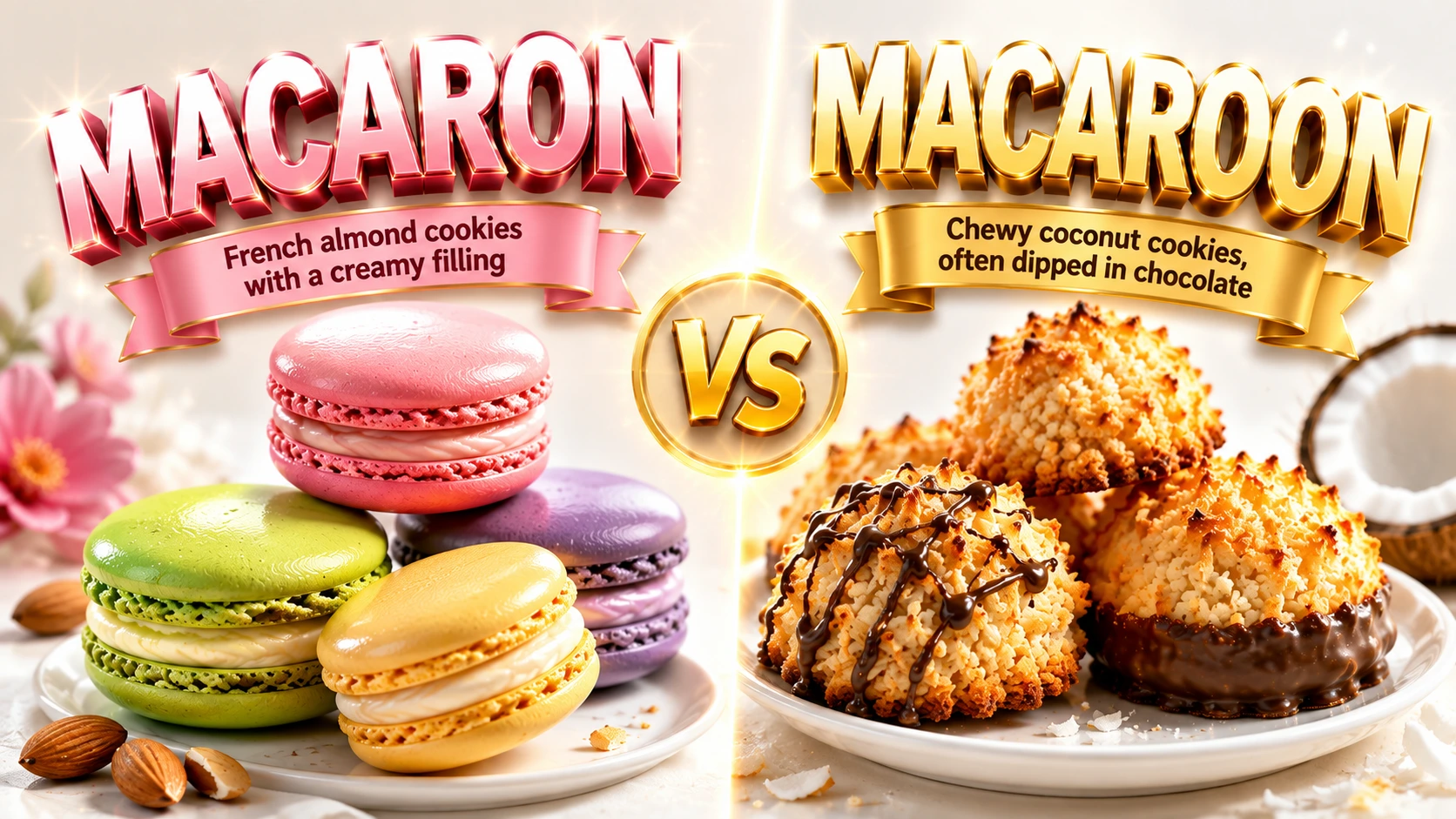
Macaron is a small French cookie made with almond flour and a soft filling, while macaroon is usually a chewy coconut cookie. They are different desserts, even though their names sound almost the same.
Have you ever looked at a colorful French cookie and wondered, Is this a macaron or a macaroon? You are not alone. These two words look almost identical, but they name two different treats.
The confusion is easy to understand. Both words describe small cookies that can be sweet and chewy. Both are popular at bakeries and cafés. Yet one is known for its smooth shells and creamy filling, while the other is famous for its coconut flavor.
When I explain this difference to English learners, I use one simple clue: a macaron looks like a tiny sandwich, while a macaroon often tastes like coconut. That small trick makes the spelling much easier to remember.
The difference also matters when you are writing a menu, ordering dessert, reading a recipe, or talking about French food. A single extra o can change what dessert you mean.
So, which spelling should you use? Let’s make the answer simple.
Macaron or Macaroon: Quick Answer
Macaron and macaroon are both correct words, but they refer to different cookies.
- Macaron: A French-style cookie made from almond flour, sugar, and egg whites. It usually has two smooth shells with a filling between them.
- Macaroon: A small cookie that often contains shredded coconut, egg whites, and sugar.
Simple examples
I bought a box of colorful macarons from the French bakery.
My grandmother makes chewy macaroons with coconut.
The easiest memory trick is:
Macaron = almond-based French sandwich cookie.
Macaroon = usually coconut-based cookie.
The Origin and Background of Macaron and Macaroon
The two words have a shared history, which helps explain why they are so easy to mix up.
Macaron comes from French macaron. The French word is linked to an older Italian word, maccarone, which referred to a type of food made from a paste.
The modern French macaron developed into the delicate cookie many people know today. It has two light shells made mainly from almond flour, egg whites, and sugar. A filling such as buttercream, ganache, or jam sits between the shells.
The history of the macaroon is also connected to the same family of words. Over time, English usage developed in a different direction. The word became strongly associated with a small cookie, especially one made with coconut.
That is why the two names look related but now describe different foods.
Interestingly, not every macaroon is made with coconut. Some traditional versions use almonds or other nuts. Still, coconut macaroon is the meaning most English speakers expect when they hear macaroon today.
Macaron vs. Macaroon: Key Differences
The clearest way to understand these words is to compare the cookies themselves.
| Term | Meaning | When to Use | Region/Context |
|---|---|---|---|
| Macaron | A French-style almond cookie with a filling | When talking about colorful sandwich-style cookies | French cuisine, bakeries, cafés |
| Macaroon | A chewy cookie, often made with coconut | When talking about coconut-based cookies | English-speaking countries |
| Coconut macaroon | A specific type of macaroon made with coconut | When you want to be very clear | Common in American and other English recipes |
What does a macaron look like?
A macaron usually has:
- Two round, smooth shells
- A crisp or slightly firm outer layer
- A soft center
- A filling between the shells
- Bright or pastel colors
Popular flavors include chocolate, vanilla, pistachio, raspberry, lemon, and salted caramel.
What does a macaroon look like?
A macaroon is usually more rustic.
It may look like a small mound or rough ball. The texture is often chewy and moist. Coconut is one of its most common ingredients.
For example:
The bakery sells chocolate-dipped coconut macaroons.
That sentence clearly refers to the coconut cookie, not the French sandwich cookie.
Macaron vs. Macaroon: A Simple Memory Trick
Still mixing them up?
Try this:
Macaron = French + fancy
Think of a colorful French pastry shop. You see neat rows of tiny, round cookies in pink, green, yellow, and purple.
Those are macarons.
Macaroon = coconut + chewy
Think of shredded coconut baked into a sweet, chewy mound.
That is a macaroon.
You can also remember the extra o in macaroon as a reminder of its round, coconut-heavy cookie form.
The spelling is not a perfect rule, but it is a useful memory aid.
Which Version Should You Use?
Your choice depends on the dessert you mean.
For French sandwich cookies
Use macaron.
I ordered a pistachio macaron.
These chocolate macarons are delicious.
For coconut cookies
Use macaroon.
She baked a batch of coconut macaroons.
The chocolate-covered macaroons were soft and chewy.
For global or neutral writing
Be specific if your readers might be confused.
Instead of simply writing macaroon, you can write:
coconut macaroon
Instead of simply writing macaron, you can write:
French macaron
This is especially helpful on menus, recipes, food blogs, and product descriptions.
Common Mistakes With Macaron and Macaroon
These words are often confused in writing. Here are some common mistakes.
| Mistake | Correction | Why? |
|---|---|---|
| I bought a coconut macaron. | I bought a coconut macaroon. | Coconut usually points to the chewy cookie. |
| She made French macaroons. | She made French macarons. | The French sandwich cookie is a macaron. |
| I love almond macaroons with filling. | I love almond macarons with filling. | Filled almond-flour shells are macarons. |
| The bakery sells colorful macaroons. | The bakery sells colorful macarons. | Colorful filled French cookies are usually macarons. |
Mistake 1: Adding an extra “o”
You may write macaroon when you mean the French cookie.
Remember:
Macaron → French sandwich cookie
Mistake 2: Assuming both words mean the same thing
They do not.
Although the words are related, modern English uses them for different types of cookies.
Mistake 3: Thinking all macarons contain coconut
They usually do not.
Traditional macarons are made with almond flour, not shredded coconut.
Mistake 4: Using “macaroon” for every colorful French cookie
This is one of the most common spelling and vocabulary errors.
If the cookie has two smooth shells and a creamy filling, macaron is the word you want.
Macaron and Macaroon in Real-World Examples
Knowing the definition is useful. Knowing how to use the word naturally is even better.
1. Professional email
Thank you for arranging the event. The macarons were a lovely addition to the dessert table.
Here, macarons refers to the elegant French-style cookies.
2. News headline
Local Bakery Launches New Pistachio Macaron Collection
The singular macaron is correct because the headline refers to one type or flavor.
3. Social media post
Just baked a fresh batch of coconut macaroons! 🥥
Here, macaroons refers to chewy coconut cookies.
4. Formal document or report
The dessert menu includes French macarons, chocolate truffles, and fruit tarts.
The spelling macarons is correct for the French cookie.
5. Everyday conversation
Do you want a chocolate macaron or a coconut macaroon?
This sentence shows the difference clearly. Both words can appear in the same sentence because they refer to different desserts.
Macaron or Macaroon: Data, Trends & Usage
The search for “macaron or macaroon” is mainly informational. People usually want to know whether the words mean the same thing and which spelling matches the dessert they have in mind.
The confusion is especially common because the words differ by only one letter.
People may search for related phrases such as:
- macaron vs macaroon
- macaroon vs macaron
- what is a macaron?
- what is a macaroon?
- macaron spelling
- coconut macaroon
- French macaron
- are macarons and macaroons the same?
Food culture also adds to the confusion. Macarons have become popular in bakeries, cafés, gift boxes, weddings, and social media. At the same time, coconut macaroons remain a familiar homemade cookie.
This makes the distinction useful beyond spelling. If you run a bakery, write recipes, create menus, or publish food content, using the right word helps readers know exactly what you mean.
Macaron vs. Macaroon: Side-by-Side Comparison
| Term/Variant | Meaning | Region/Context | Best Used When |
|---|---|---|---|
| Macaron | French almond-based sandwich cookie | French cuisine and modern bakeries | Talking about filled, colorful French cookies |
| Macarons | Plural of macaron | General English usage | Talking about two or more French cookies |
| Macaroon | Small cookie, often made with coconut | English-speaking food culture | Talking about chewy coconut cookies |
| Macaroons | Plural of macaroon | General English usage | Talking about two or more coconut cookies |
| Coconut macaroon | Coconut-based macaroon | Recipes and bakeries | When you want maximum clarity |
Frequently Asked Questions About Macaron and Macaroon
Q: What does macaron mean?
A: A macaron is a French-style cookie made with almond flour, egg whites, and sugar. It usually has two smooth shells with a filling between them.
Q: What does macaroon mean?
A: A macaroon is a small cookie that is often made with shredded coconut, egg whites, and sugar. It is usually chewy and has a rougher shape than a macaron.
Q: Are macarons and macaroons the same thing?
A: No. They are related words, but they usually describe different cookies. A macaron is typically a smooth, filled French cookie, while a macaroon is often a chewy coconut cookie.
Q: Which is correct: macaron or macaroon?
A: Both are correct. Use macaron for the French almond-based sandwich cookie and macaroon for the cookie that is often made with coconut.
Q: Is macaron acceptable in formal writing?
A: Yes. Macaron is the standard English spelling for the French-style cookie. It is appropriate in menus, recipes, reports, articles, and other formal writing.
Q: Where does the word macaron come from?
A: Macaron comes from French and is related to an older Italian food word, maccarone. The two modern English terms developed different meanings over time.
Q: Can a macaroon contain almonds instead of coconut?
A: Yes. Some traditional macaroon recipes use almonds or other nuts. However, coconut macaroon is a very common meaning in modern English.
Q: How do I remember macaron vs. macaroon?
A: Think macaron = French sandwich cookie and macaroon = coconut cookie. The extra “o” in macaroon can be your quick memory clue.
Final Takeaway: Macaron or Macaroon?
Macaron and macaroon are both correct spellings, but they are not interchangeable.
A macaron is the smooth, colorful French cookie made with almond flour. It usually has two shells and a filling in the middle.
A macaroon is usually a chewy cookie made with coconut. It often has a rough, mound-like shape.
The simplest rule is:
Macaron = French sandwich cookie.
Macaroon = usually coconut cookie.
Once you connect each word with its dessert, the spelling becomes much easier. You will know which word to use on a menu, in a recipe, in an email, or in everyday conversation.
So the next time you see a box of colorful French cookies, call them macarons. When you reach for a chewy coconut cookie, choose macaroon.
Shrank or Shrunk: The Easy Difference Explained

I’m an English language researcher and content writer. I am specialized in spelling comparisons, commonly confused words, grammar usage, and vocabulary guides. Through detailed language articles,I am helping readers to understand the differences between similar words and improve their written communication skills.