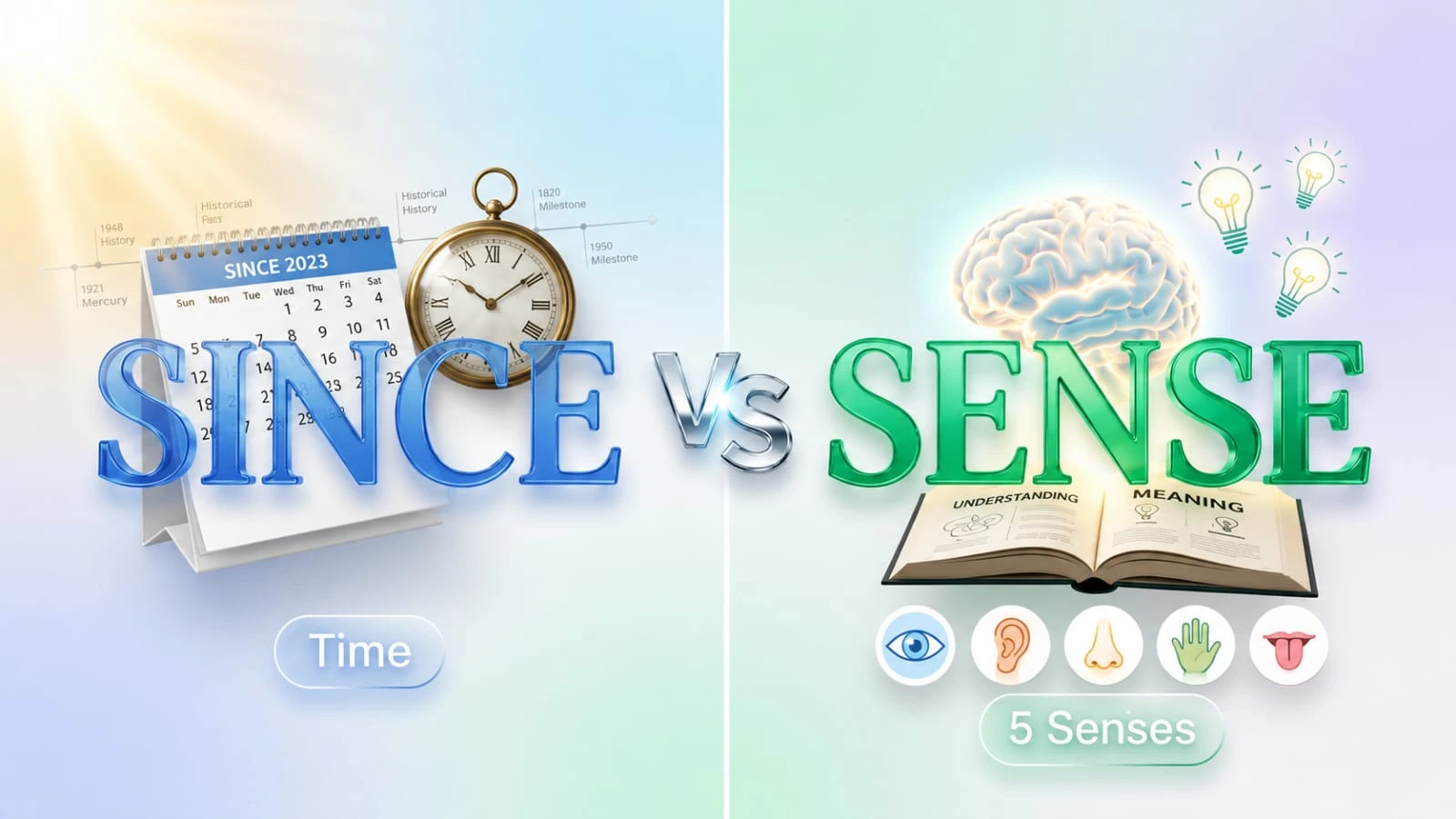
Since refers to time or a reason, while sense refers to meaning, understanding, or one of your five senses. They sound similar but have completely different meanings and uses.
A few years ago, I was proofreading a student’s essay when I came across this sentence:
“I haven’t seen her sense Monday.”
I smiled because I instantly understood what the student wanted to say. They meant since Monday, but using sense completely changed the sentence. It’s a small mistake that many English learners make because the two words sound almost identical when spoken aloud.
This confusion is more common than you might think. Both words are real English words, so spellcheck often won’t flag the error. That means you need to understand their meanings rather than rely on software to catch the mistake.
If you’ve ever paused while writing and wondered whether to choose since or sense, you’re not alone. By the end of this guide, you’ll know exactly what each word means, where it came from, how to use it correctly, the mistakes to avoid, and an easy memory trick that will help you remember the difference every time.
Since or Sense: Quick Answer
Although since and sense sound very similar, they have different meanings.
- Since is used when talking about time or a reason.
- Sense is used when talking about understanding, meaning, judgment, or perception.
Examples
✅ I have lived here since 2020.
❌ I have lived here sense 2020.
✅ I have lived here since 2020.
The Origin of Since or Sense
Even though these words are often mixed up, they come from completely different language families.
Since
The word since comes from the Old English word siththan, meaning after that time or from a particular point in time. As English developed, it also gained the meaning because, allowing it to introduce a reason as well as a time reference.
Sense
This word comes from the Latin sensus, meaning feeling, perception, or understanding. It entered English through Old French and has always been connected with awareness, meaning, judgment, and the five human senses.
Why People Confuse Them
People commonly mix these words because:
- They sound almost identical.
- Both are everyday English words.
- Spellcheck usually accepts both spellings.
- The correct choice depends on the sentence’s meaning, not its pronunciation.
Since or Sense Explained: Key Differences
Although these words share a similar pronunciation, they play very different roles in English.
| Term | Meaning | Part of Speech | When to Use |
|---|---|---|---|
| Since | From a point in time or because | Preposition, conjunction, adverb | Talking about time or giving a reason |
| Sense | Meaning, understanding, judgment, or one of the five senses | Noun (occasionally a verb) | Talking about logic, awareness, or perception |
Since
Use since when referring to time or a reason.
Examples
- I have worked here since January.
- Since it was raining, we stayed indoors.
- She has been happier since moving to London.
Sense
Use sense when referring to understanding, meaning, or perception.
Example
- Your explanation makes sense.
Quick Memory Trick
A simple memory trick can help you remember the difference instantly.
- Think of the “i” in since as standing for “in time.”
- Think of the “e” in sense as reminding you of eyes, ears, and experience.
Remember
- Time or because → Since
- Meaning or understanding → Sense
This quick trick works well in exams, emails, and everyday writing.
Which Version Should You Use?
The correct choice depends on what you want to say. The words are not interchangeable because they have different meanings.
For Students
- Use since when talking about time or giving a reason.
- Use sense when talking about understanding, meaning, or perception.
For Professional Writing
Choose since when referring to dates, periods of time, or explaining why something happened.
Example:
The policy has been effective since last year.
Choose sense when discussing logic, awareness, or good judgment.
Example:
Your proposal makes perfect sense.
For Everyday Conversations
Both words are common, but they are used in different situations.
Examples
- I haven’t seen him since Monday.
- That doesn’t make sense.
For a Global Audience
There is no British vs American English difference.
Both British and American English use since and sense with the same spellings and meanings.
Pronunciation
| Word | IPA | Simple Pronunciation |
|---|---|---|
| Since | /sɪns/ | SINS |
| Sense | /sens/ | SENS |
Note: These words are near-homophones. They sound very similar, so always choose the correct word based on the meaning of your sentence rather than the pronunciation.
Common Collocations
Learning common word combinations makes it easier to remember how each word is used naturally.
Common Collocations with Since
- since yesterday
- since childhood
- since then
- ever since
- since morning
- since last year
Examples
- I’ve known her since childhood.
- Ever since we met, we’ve been close friends.
- She has worked here since 2021.
Common Collocations with Sense
- make sense
- common sense
- sense of humor
- sense of direction
- sense of responsibility
- sense of smell.
Example
- She has an excellent sense of humor.
Common Mistakes with Since or Sense
Because these words sound almost identical, many writers accidentally use one in place of the other.
| ❌ Mistake | ✅ Correct |
|---|---|
| I have lived here sense 2022. | I have lived here since 2022. |
| That doesn’t make since. | That doesn’t make sense. |
| Sense it was raining, we stayed home. | Since it was raining, we stayed home. |
| I’ve known her sense childhood. | I’ve known her since childhood. |
| His idea makes no since. | His idea makes no sense. |
Therefore or Therefor: What’s the Difference?
Why These Mistakes Happen
People often confuse these words because:
- They sound almost the same.
- Both are real English words.
- Spellcheck may not detect the mistake.
- One refers to time or reason, while the other refers to meaning or understanding.
Since or Sense in Real-World Examples
Professional Email
We have worked together since 2021, and your suggestion makes perfect sense.
News Headline
Scientists Say New Research Makes Sense of Climate Changes.
Social Media Post
I’ve loved this band since high school! 🎵
Formal Report
Employee satisfaction has improved since the new policy was introduced.
Everyday Conversation
Emma: “Should we leave now?”
Ryan: “Yes, that makes sense since traffic will get worse later.”
Since or Sense: Data, Trends & Usage
Search Intent
Primary Search Intent: Informational
Most people search for this topic because they want clear answers to questions like:
- Is it since or sense?
- What is the difference between these words?
- Which one is correct in my sentence?
- How do I remember when to use each word?
- Why do they sound so similar?
Where It’s Most Searched
This topic is frequently searched in countries where English is widely spoken or learned, including:
- United States
- United Kingdom
- Canada
- Australia
- India
Who Searches for It?
People searching for this topic often include:
- English learners
- Students
- Teachers
- ESL learners
- Bloggers
- Professional writers
- Content creators
Standalone Comparison Table
| Term | Meaning | Region/Context | Best Used When |
|---|---|---|---|
| Since | From a point in time or because | Worldwide English | Talking about time or giving a reason |
| Sense | Meaning, understanding, judgment, or perception | Worldwide English | Talking about logic, awareness, or the five senses |
Frequently Asked Questions
Q: What is the difference between since and sense?
A: Since refers to time or a reason, while sense refers to understanding, meaning, judgment, or perception. Although they sound alike, they are used in completely different situations.
Q: Can since mean because?
A: Yes. Since can introduce a reason as well as a point in time.
Example: Since it was late, we decided to leave.
Q: Is sense a verb or a noun?
A: Sense is most commonly used as a noun, but it can also be a verb meaning to detect or be aware of.
Example: She sensed that something was wrong.
Q: Are since and sense pronounced the same?
A: They are pronounced very similarly, which is why many learners confuse them. The meaning of the sentence tells you which word is correct.
Q: Is there a British and American English difference?
A: No. Both British and American English use since and sense with the same spellings and meanings.
Q: How can I remember the difference between since and sense?
A: Remember this simple trick: since relates to time or because, while sense relates to meaning, understanding, or the five senses.
Conclusion
The difference between since and sense is easy to remember once you focus on what each word means. Use since when you’re talking about time or giving a reason. Use sense when referring to meaning, understanding, good judgment, or one of the five senses.
Although they sound almost identical, they have completely different functions in English. Before you finish writing an email, essay, report, or social media post, take a moment to check which idea you want to express. A quick review can help you avoid a common mistake and make your writing clearer and more professional.
Doughnut or Donut: The Surprising Reason Both Are Correct

I’m an English language researcher and content writer. I am specialized in spelling comparisons, commonly confused words, grammar usage, and vocabulary guides. Through detailed language articles,I am helping readers to understand the differences between similar words and improve their written communication skills.