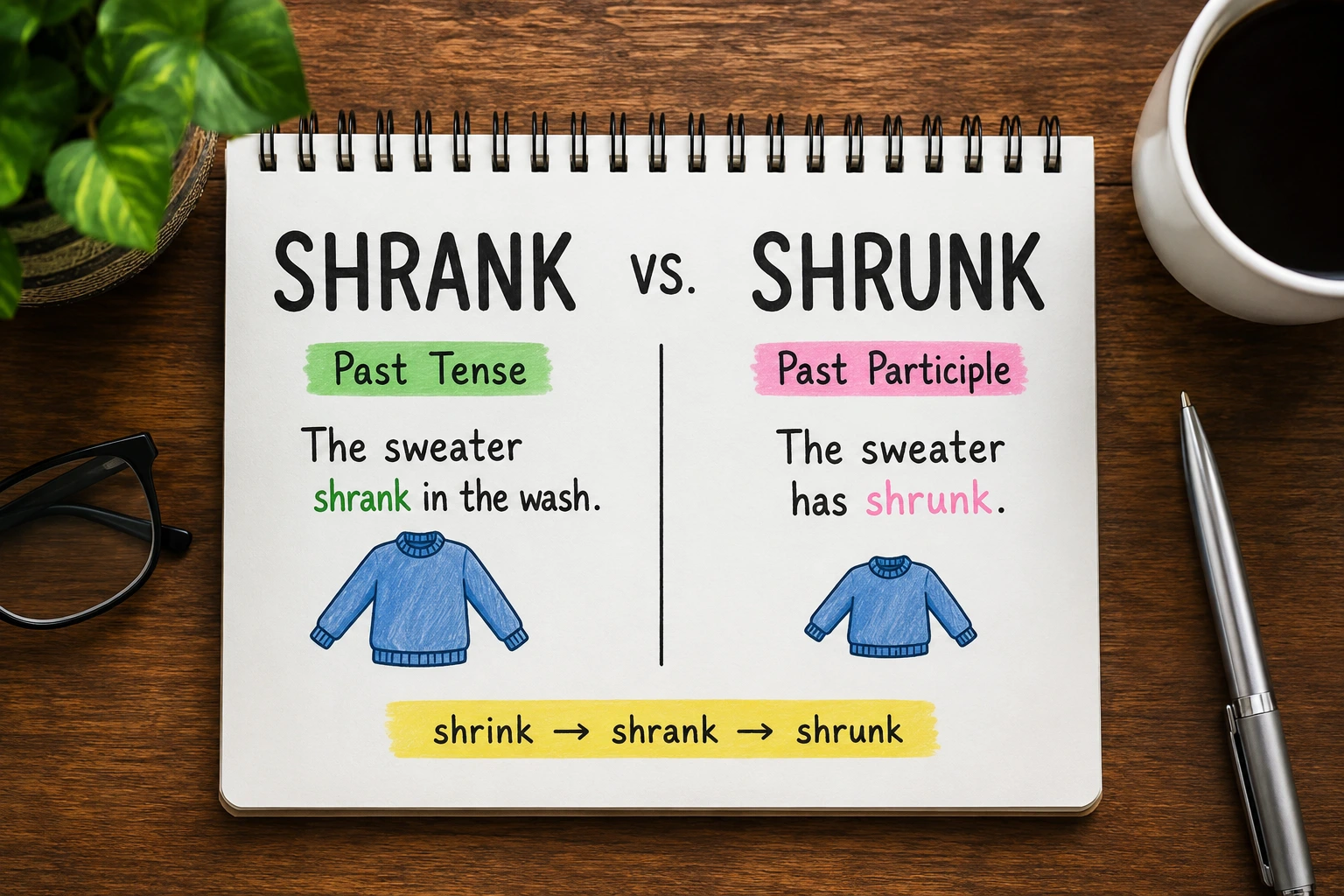
Shrank is the usual simple past form of shrink, while shrunk is the usual past participle. Say “My shirt shrank” but “My shirt has shrunk.”
Have you ever looked at a sentence and stopped at one tiny word: shrank or shrunk?
I have seen this confusion many times in everyday English. It often appears when someone talks about clothes that became smaller, a business that lost money, or a problem that became less serious. The meaning seems clear, but the verb form can feel tricky.
The reason is simple. Shrink is an irregular verb. It does not follow the normal pattern of adding -ed. Instead, its forms change: shrink → shrank → shrunk.
That small change matters.
If you write, “My sweater shrunk yesterday,” many readers will understand you. But in standard English, “My sweater shrank yesterday” is the safer choice for the simple past.
So, when should you use shrank? When does shrunk fit better? And what about shrunken?
Let’s make the difference easy.
Shrank or Shrunk: Quick Answer
Shrank is the simple past tense of shrink.
- The shirt shrank in the wash.
- The company shrank after several difficult years.
Shrunk is normally the past participle.
It usually appears with has, have, or had:
- The shirt has shrunk.
- The company had shrunk by 20 percent.
A useful pattern is:
shrink → shrank → shrunk
Think of it like this:
| Verb formExample | |
|---|---|
| Present | The shirt shrinks in hot water. |
| Simple past | The shirt shrank in hot water. |
| Past participle | The shirt has shrunk in hot water. |
The standard forms are shrank for the past tense and shrunk for the past participle.
The Origin and Background of Shrank and Shrunk
Shrink is a very old English verb.
The word shrink is very old, tracing back through Middle English to Old English scrincan. It has been used in English since before the 12th century.
Its early meanings were linked to contracting, curling up, becoming smaller, or drawing back. Over time, the verb developed several related meanings.
Today, shrink can mean:
- To become smaller.
- To make something smaller.
- To become less in amount or importance.
- To move back because of fear or discomfort.
- To avoid something difficult, as in shrink from responsibility.
The older forms of the verb also help explain why its modern forms look unusual. English once had forms such as scranc and scruncen. The modern shrank and shrunk developed from this older pattern.
So, no, shrank and shrunk are not random spellings.
They are part of a very old irregular verb pattern.
Shrank or Shrunk Explained: Key Differences
The main difference is grammar, not meaning.
Both forms come from shrink and describe something becoming smaller or causing something to become smaller. The key question is: What verb tense or structure are you using?
| Term | Meaning | When to Use | Region/Context |
| shrink | Become or make smaller | Present tense | Standard English |
| shrank | Became smaller | Simple past | Standard English |
| shrunk | Has/had become smaller | Past participle | Standard English |
| shrunken | Having become smaller | Often adjective; also participle | Formal/literary contexts |
1. Use shrank for the simple past
Use shrank when the action happened in the past.
Examples:
- My sweater shrank in the dryer.
- The lake shrank during the dry season.
- The company’s profits shrank last year.
- Her confidence shrank after the criticism.
Notice that there is no has, have, or had before shrank.
2. Use shrunk with helping verbs
Use shrunk when it works as a past participle.
Examples:
- My sweater has shrunk.
- The market has shrunk considerably.
- Their budget had shrunk by half.
- The population has shrunk over the past decade.
Here, has, have, or had helps form the perfect tense.
3. What about shrunken?
You may also see shrunken.
It can work as an adjective:
- a shrunken shirt
- a shrunken budget
- a shrunken population
Shrunk and shrunken can both be used as forms related to the past participle, but shrunken is especially common as an adjective.
For everyday writing, however, shrunk is often the easiest choice after has, have, or had.
Which Version Should You Use?
If you are writing standard English, follow this simple rule:
For students
Use shrank for the simple past.
The sweater shrank after washing.
Use shrunk after has, have, or had.
The sweater has shrunk.
This rule is easy to learn and works in most situations.
For professional writers
Use shrank when describing a completed past event.
Revenue shrank by 10% last year.
Use shrunk when connecting a past change to the present or another point in time.
Revenue has shrunk by 10% since 2025.
For formal or global English
The safest pattern is:
shrink → shrank → shrunk
It is clear, standard, and widely understood.
You do not need to choose a different form for British or American English. Shrank and shrunk are standard forms in both varieties.
Common Mistakes with Shrank or Shrunk
These two forms are easy to mix up. Here are the most common mistakes.
Mistake 1: Using “shrunk” as the simple past
❌ My shirt shrunk yesterday.
✅ My shirt shrank yesterday.
In careful standard English, shrank is the simple past form.
Mistake 2: Using “shrank” after “has”
❌ My shirt has shrank.
✅ My shirt has shrunk.
After has, use the past participle shrunk.
Mistake 3: Adding “-ed”
❌ The clothes shrinked in the wash.
✅ The clothes shrank in the wash.
Shrink is irregular. Shrinked is not the standard form for ordinary modern English, although it has appeared in historical writing. For modern writing, shrank is the standard simple past choice.
Mistake 4: Confusing “shrunken” with “shrunk”
❌ The sweater has shrunken.
✅ The sweater has shrunk.
Shrunken can occur as a participle, but it is especially common as an adjective:
a shrunken sweater
For the normal perfect tense, has shrunk is the simple choice.
Mistake 5: Using the wrong tense
❌ The company shrank over the past five years.
(Possible, but it may not express the intended connection to now.)
✅ The company has shrunk over the past five years.
When a change began in the past and continues to matter now, the present perfect can be more natural.
Shrank or Shrunk in Real-World Examples
Knowing the rule is useful. Seeing it in context is even better.
1. Professional email
“Our team has shrunk since the department restructuring, so we may need more time to complete the project.”
Here, has shrunk connects the past change with the current situation.
2. News headline or article
Local Population Shrank Last Year
The event happened in the past, so shrank works as the simple past.
Another example:
The Local Population Has Shrunk by 15% Since 2020
Here, has shrunk connects the past with the present.
3. Social media post
“My favorite sweater shrank in the wash. I guess I should have read the care label!”
The action happened in the past, so shrank is correct.
4. Formal report
“The company’s operating costs have shrunk since the new process was introduced.”
The report discusses a change from the past to the present, so have shrunk works well.
Shrank or Shrunk: A Simple Memory Trick
Here is an easy way to remember the difference:
No helping verb → shrank
The shirt shrank.
Has, have, or had → shrunk
The shirt has shrunk.
You can remember it as:
Yesterday: shrank.
Has happened: shrunk.
This is not a rule for every possible sentence, but it is a very useful shortcut for everyday writing.
Shrank vs. Shrunk vs. Shrunken
The third form, shrunken, sometimes creates another problem.
Compare these sentences:
- The shirt shrank yesterday.
- The shirt has shrunk.
- The shrunken shirt no longer fits.
The first sentence uses the simple past.
The second uses the past participle with has.
The third uses shrunken as an adjective describing the shirt.
That distinction becomes much easier once you stop thinking of these words as different words. They are different forms of the same verb.
Shrank or Shrunk: Standalone Comparison Table
| Term | Variant Meaning | Region | Context Best Use |
| shrink | Become or make smaller | All standard English | Present or base form |
| shrank | Became smaller | Standard English | Simple past |
| shrunk | Has/had become smaller | Standard English | Past participle |
| shrunken | Having become smaller | Often descriptive/formal | Adjective or certain participle uses |
| shrinked | Historical/nonstandard today | Rare or historical | Avoid in normal modern writing |
The important point is that shrank and shrunk are both correct. They simply do different grammatical jobs.
Shrank or Shrunk; Data, Trends & Usage
The search “shrank or shrunk” has clear informational intent. People who type it usually want to know which form is grammatically correct.
The confusion is easy to understand. English has many irregular verbs with changing forms, such as:
- sing → sang → sung
- drink → drank → drunk
- ring → rang → rung
- shrink → shrank → shrunk
This makes shrink part of a familiar but tricky group.
There is also a useful historical reason for the confusion. Shrunk was commonly used as a simple past form for hundreds of years, even though shrank is the usual standard simple past form today.
That history explains why you may sometimes encounter shrunk in older writing or informal usage where you expected shrank.
For modern formal writing, though, the safest choice is simple:
Use “shrank” for simple past and “shrunk” as the past participle.
This applies across common English contexts rather than being a major British-versus-American spelling difference. Shrank and shrunk are standard forms in both varieties.
Frequently Asked Questions
Q: What does “shrank” mean?
A: Shrank is the simple past form of shrink. It means that something became smaller in the past. For example, “The sweater shrank in the wash.”
Q: What does “shrunk” mean?
A: Shrunk is normally the past participle of shrink. It is commonly used with has, have, or had, as in “The sweater has shrunk.”
Q: Is “shrank” or “shrunk” correct?
A: Both are correct, but they are used differently. Use shrank for the simple past and shrunk for the past participle.
Q: Is “The shirt shrunk” correct?
A: In standard formal English, “The shirt shrank” is the safer choice for the simple past. However, shrunk has a long history of use as a past-tense form, especially in less formal or historical contexts.
Q: Is “shrinked” a word?
A: Shrinked has appeared in historical English, but it is not the normal modern form. In standard modern writing, use shrank for the simple past and shrunk for the past participle.
Q: Should I say “has shrank” or “has shrunk”?
A: Say “has shrunk.” The word after has should normally be the past participle. Therefore, “The market has shrunk” is correct.
Q: Where does the word “shrink” come from?
A: Shrink comes from Middle English shrinken and Old English scrincan. It has been used in English since before the 12th century.
Conclusion: Shrank or Shrunk?
The difference between shrank and shrunk becomes easy once you focus on the verb form.
Shrank is the standard simple past:
The sweater shrank in the wash.
Shrunk is normally the past participle:
The sweater has shrunk.
And shrunken often works as an adjective:
The shrunken sweater no longer fits.
The key pattern to remember is shrink → shrank → shrunk. Do not use shrinked in normal modern writing.
If you are unsure, check the sentence for a helping verb. No helping verb? “Shrank” is usually the answer. Has, have, or had? “Shrunk” is usually the answer.
Cum or Come: Which One Is Correct? (2026)

I specialize in spelling comparisons, confusing word pairs, grammar, and vocabulary development. My content helps readers improve their English, avoid common mistakes, and write with confidence. My goal is to provide accurate, reliable, and easy-to-understand language resources