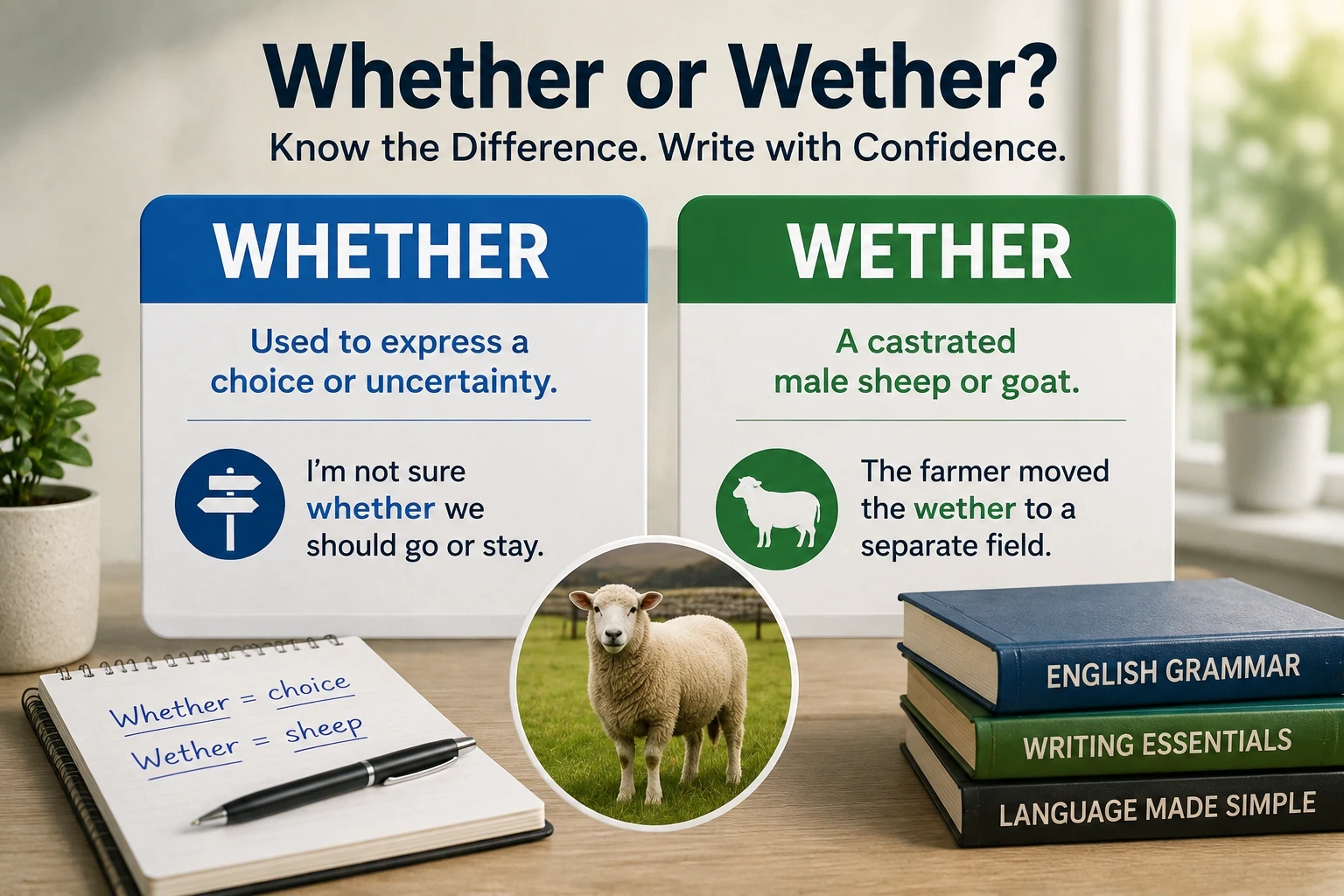
Whether is the correct spelling when you mean “if” or “which of two possibilities.” Wether is a different word used for a castrated male sheep or goat and is rarely needed in everyday English.
Have you ever typed a sentence and stopped at whether or wether? I have seen this mistake many times while helping English learners improve their writing. The two words look almost identical, but they have very different meanings.
The confusion is easy to understand. Whether and wether sound very similar, especially in fast speech. Yet only one is normally used in sentences such as, “I don’t know whether she will come.”
This small spelling mistake can change the meaning of your sentence. It can also make formal writing look careless.
The good news is that the difference is simple once you know what each word means. In this guide, you will learn whether vs. wether, their origins, correct usage, common mistakes, real-world examples, and a few easy memory tricks. By the end, you should never need to guess between these two spellings again.
Whether or Wether: Quick Answer
Whether is the word you need in almost all everyday sentences.
Use whether when you are talking about a choice, doubt, or two possible situations.
- I don’t know whether he will come.
- She asked whether we were ready.
- We must decide whether to stay or leave.
Wether is a rare noun. It refers to a castrated male sheep, especially one raised for wool or meat.
- The farmer bought a young wether.
- The flock included several wethers.
Easy Rule
If you mean “if,” “which of two,” or “regardless of which,” use whether.
If you are talking about a male sheep, use wether.
The Origin and Background of Whether and Wether
The words whether and wether look similar because they developed from old English forms. Their meanings, however, come from different language histories.
Where Does Whether Come From?
Whether comes from Old English hwæther, which meant “which of two” or “which one of two.” Over time, its spelling and use changed as English developed.
It became the modern word whether, which is now commonly used to introduce alternatives or express uncertainty.
For example:
I don’t know whether he is at home.
Here, the speaker is unsure about one of two possibilities: he is at home, or he is not.
Where Does Wether Come From?
Wether comes from Old English weðer, referring to a male sheep that had been castrated.
The word has remained in English with a very specific meaning. It is now mainly found in farming, agriculture, livestock, and historical writing.
That is why most English learners will rarely need wether.
Why Are They Confused?
The main reason is pronunciation.
In many varieties of English, whether and wether sound the same or almost the same. This makes the mistake more common in writing than in speech.
When you hear someone say the word, you must use the context to know which spelling is intended.
Whether vs. Wether: Key Differences
| Term | Meaning | When to Use | Region/Context |
| Whether | Expresses a choice, doubt, or alternative | Everyday speech and writing | All major varieties of English |
| Wether | A castrated male sheep | Farming or livestock contexts | Mainly specialized English |
Whether
Whether is a conjunction or an interrogative word. It is used when discussing alternatives or uncertainty.
Examples:
- I can’t decide whether to go.
- Tell me whether you agree.
- She wondered whether he knew the truth.
Wether
Wether is a noun related to sheep.
Examples:
- The farmer separated the wether from the ewes.
- The young wether was moved to another pen.
For normal conversations, emails, essays, and social media posts, whether is almost always the spelling you need.
Whether in Common Phrases
- whether or not
- whether or not to
- whether…or…
- regardless of whether
- it depends on whether
How to Use Whether Correctly
There are several common patterns with whether.
1. Whether + Clause
Use whether before a clause when you are talking about uncertainty.
- I don’t know whether she is coming.
- We need to find out whether the store is open.
- He asked whether I needed help.
2. Whether + To-Infinitive
You can use whether + to + verb when someone must choose between possible actions.
- I don’t know whether to stay.
- She couldn’t decide whether to accept the offer.
- They discussed whether to continue.
3. Whether … or …
Use whether … or … to show two alternatives.
- I don’t know whether to call or wait.
- Tell me whether you want tea or coffee.
- We must decide whether to stay or leave.
4. Whether or Not
Whether or not means that the result does not depend on the choice or condition.
- I will go whether or not you come.
- She will finish the job whether or not she gets help.
You can also use whether without or not when the meaning is already clear.
📌Whether, Wether, or Weather?
| Word | Meaning | Example |
| Whether | Expresses a choice or possibility | I don’t know whether she will come. |
| Wether | A castrated male sheep | The farmer raised a wether. |
| Weather | Conditions outside | The weather is sunny today. |
Which Version Should You Use?
For most readers, the answer is very simple: use whether.
For Students
Use whether when writing essays, assignments, answers, and academic work.
The study examined whether exercise improved concentration.
For Professional Writing
Use whether in emails, reports, applications, and business documents.
Please confirm whether you will attend the meeting.
For Everyday English
Use whether when talking about choices or uncertainty.
I’m not sure whether I should go.
For Farming or Livestock Writing
Use wether only when you are specifically discussing a castrated male sheep.
The farmer inspected each wether before moving the flock.
For Global or Neutral English
Whether is the safe choice when discussing alternatives or uncertainty. It is standard in American and British English.
Common Mistakes with Whether and Wether
Mistake 1: Writing “wether” for “if”
❌ I don’t know wether she will come.
✅ I don’t know whether she will come.
Why? The sentence expresses uncertainty, so whether is correct.
Mistake 2: Using “wether” in a choice
❌ I can’t decide wether to stay or leave.
✅ I can’t decide whether to stay or leave.
Why? The sentence presents two possible actions.
Mistake 3: Assuming They Have the Same Meaning
❌ Wether means “if.”
✅ Whether can mean “if” in many contexts.
Why? Although the words sound similar, their meanings are unrelated.
Mistake 4: Using “weather” Instead
❌ I don’t know weather he will come.
✅ I don’t know whether he will come.
Why? Weather means the condition of the atmosphere, such as rain, wind, or sunshine.
A Simple Memory Trick
Think:
Whether = choice
The word whether often appears when you are choosing between possibilities.
Whether to stay or go.
Wether = sheep
Think of wether as a livestock word.
Weather = sky
Think about rain, sunshine, wind, and storms.
This simple three-word distinction can prevent many spelling mistakes.
Whether or Wether in Real-World Examples
Professional Email
Please let me know whether you can attend the meeting on Friday.
Here, whether introduces uncertainty about attendance.
News Article
Officials are still investigating whether the new policy will affect local businesses.
Again, whether introduces an uncertain possibility.
Social Media Post
I can’t decide whether to watch a movie or read a book tonight!
The writer is choosing between two options.
Formal Report
The research examined whether the new method could reduce production costs.
This is a formal use of whether.
Farming Context
The farmer moved the young wether into a separate enclosure.
Here, wether is correct because the sentence refers to a type of male sheep.
Whether or Wether: Data, Trends & Usage
The spelling whether is far more common in general English because it appears in everyday questions, choices, formal writing, academic work, and professional communication.
Wether has a much narrower use. It mainly appears in agricultural and livestock contexts.
This difference matters for learners because wether may look like a common spelling variation of whether, but it is not. It is a separate word with a specialized meaning.
The search intent behind “whether or wether” is mainly informational. People usually search the pair because they have seen or written one spelling and want to know which one is correct.
Understanding the context is the fastest way to choose the right spelling.
Standalone Comparison: Whether vs. Wether
| Term/Variant | Meaning | Region/Context | Best Used When |
| Whether | Expresses uncertainty or alternatives | General English | Talking about choices or possibilities |
| Wether | Castrated male sheep | Agriculture/livestock | Talking about sheep |
| Weather | Atmospheric conditions | General English | Talking about rain, wind, heat, or storms |
Whether vs. If: Are They the Same?
Whether and if can sometimes have similar meanings, especially when introducing uncertainty.
- I don’t know whether she will come.
- I don’t know if she will come.
Both sentences are natural.
However, whether is often preferred when there are clear alternatives.
- I don’t know whether to stay or leave.
You should not replace whether with wether. The latter has a completely different meaning.
Frequently Asked Questions
Q: What does whether mean?
Whether is used to express uncertainty or a choice between alternatives. It often means something similar to “if” or introduces two possible options.
Q: What does wether mean?
Wether is a noun for a castrated male sheep. It is a specialized word used mainly in farming and livestock contexts.
Q: Is whether or wether correct?
Both are correct words, but they have different meanings. Whether is correct for choices and uncertainty, while wether refers to a type of male sheep.
Q: Is whether acceptable in formal writing?
Yes. Whether is completely standard in formal writing. It is common in academic papers, business writing, reports, and professional emails.
Q: Is wether used in everyday English?
Not usually. Wether is a specialized livestock term, so most people rarely use it outside farming or agricultural contexts.
Q: Is whether the same as if?
Sometimes. Both can introduce uncertainty, as in “I don’t know whether he is coming” and “I don’t know if he is coming.” However, whether is especially useful when presenting alternatives.
Q: What is the difference between whether and weather?
Whether expresses choice or uncertainty. Weather refers to atmospheric conditions such as rain, snow, wind, or sunshine.
Conclusion
The difference between whether or wether is easier than it first appears. Whether is the word you need when you are talking about uncertainty, choices, or alternatives. It is common in everyday English, professional writing, academic work, and formal documents.
Wether is a completely different word. It refers to a castrated male sheep and is mainly used in farming and livestock contexts.
There is also a third word worth remembering: weather. It refers to conditions such as rain, wind, heat, and sunshine.
If you are unsure which spelling to use, ask yourself what you mean. Are you talking about a choice or possibility? Use whether. Are you talking about a male sheep? Use wether. Are you talking about rain or sunshine? Use weather.
Bookmark this guide so you never second-guess these three confusing words again.
Macaron or Macaroon: What’s The Difference?

I am a language content specialist specializing in spelling comparisons, vocabulary usage, and commonly confused English words. I write detailed, informative articles that help readers improve their language skills. I am passionate about helping students, writers, and professionals develop a stronger understanding of the English language.