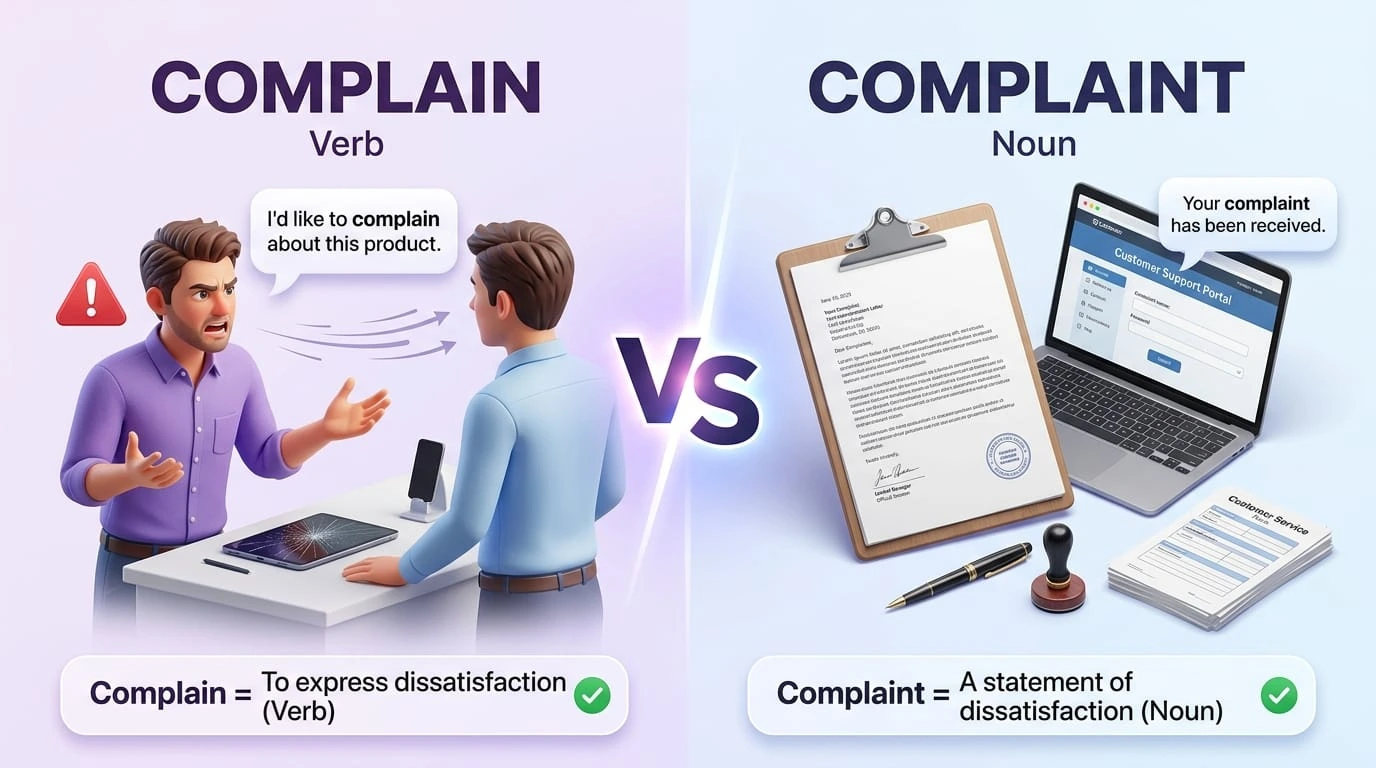
Complain is a verb that means to express dissatisfaction. Complaint is a noun that refers to the statement, problem, or act of complaining.
Have you ever stopped while writing an email and wondered whether to use complain or complaint? I certainly have. Early in my writing career, I once typed, “I would like to complaint about my order.” It looked right at first, but it was wrong. The correct sentence was, “I would like to complain about my order.” That small mistake taught me an important lesson about English word forms.
Many learners confuse these words because they come from the same root and have similar spellings. However, they do different jobs in a sentence. One is an action, while the other is a thing.
If you know the difference, your emails, essays, and everyday conversations become much clearer. In this guide, you’ll learn the meanings, pronunciation, origins, examples, memory tricks, and common mistakes so you can confidently choose the correct word every time.
Pronunciation
complain or complaint (kuhm-PLAYN or kuhm-PLAYNT)
| Word | Pronunciation | Word Type |
| Complain | kuhm-PLAYN | Verb |
| Complaint | kuhm-PLAYNT | Noun |
Pronunciation Tip
Both words begin the same way. The only difference is the ending.
- Complain ends with the “playn” sound.
- Complaint ends with the “playnt” sound.
The extra “t” sound reminds you that complaint is the thing or statement, not the action.
Complain or Complaint: Quick Answer
The easiest way to remember the difference is this:
- Complain = the action of expressing dissatisfaction.
- Complaint = the statement, issue, or report of dissatisfaction.
Simple Examples
- I want to complain about the poor service. ✅
- The manager handled my complaint quickly. ✅
- Customers often complain about long waiting times. ✅
- Your complaint has been received. ✅
A simple memory trick:
- Complain = Action (Verb)
- Complaint = Thing (Noun)
If someone is doing something, use complain.
If you’re talking about the problem itself, use complaint.
The Origin of Complain and Complaint
Learning where these words came from makes their meanings easier to understand.
Origin of Complain
The word complain comes from the Old French word complaindre, meaning “to express grief, sorrow, or dissatisfaction.” It later entered Middle English and gradually took on the meaning we use today.
Today, complain means to express that something is wrong or unsatisfactory.
Examples:
- Customers complain when deliveries are late.
- She decided to complain to the hotel manager.
- Don’t complain before trying to solve the problem.
The word always describes an action.
Origin of Complaint
The noun complaint developed from the same French root. Over time, English speakers used it to describe the expression of dissatisfaction itself rather than the act.
Today, complaint refers to a formal or informal statement about a problem.
Examples:
- The company received several complaints.
- Your complaint will be investigated.
- The customer filed a written complaint.
Although both words share the same history, English gives each one a different grammatical role.
Complain vs Complaint Explained
These words are closely related, but they are not interchangeable.
The easiest way to tell them apart is to ask one simple question.
Am I talking about an action or a thing?
- Action → Complain
- Thing or statement → Complaint
Here is a quick comparison.
| Term | Meaning | When to Use | Context |
| Complain | To express dissatisfaction | When someone is taking action | Conversation, emails, customer service |
| Complaint | A statement or report of dissatisfaction | When referring to the issue itself | Business, legal, customer support, everyday English |
When to Use Complain
Use complain when someone is expressing that they are unhappy about something.
Examples:
- I need to complain about the damaged package.
- Employees sometimes complain about heavy workloads.
- She refused to complain, even when things became difficult.
- They complained about the noisy neighbors.
Think of complain as something people do.
When to Use Complaint
Use complaint when referring to the problem, report, or statement.
Examples:
- The hotel received a complaint from a guest.
- Please submit your complaint in writing.
- His complaint was resolved within two days.
- Customer complaints have decreased this year.
Here, the word names the issue rather than the action.
The Easy Memory Trick
Many learners remember the difference with this simple rule:
- Complain = Verb = Action
- Complaint = Noun = Problem or Report
Another easy clue:
If you can place “to” before the word, you probably need complain.
✅ I want to complain.
If you can place “a” or “the” before the word, you probably need complaint.
✅ I filed a complaint.
This simple test works in most everyday situations.
Which Should You Use?
The correct choice depends on whether you’re talking about an action or a thing.
Use “Complain” When Talking About an Action
Choose complain when someone is expressing dissatisfaction or reporting a problem.
This word is used in:
- Everyday conversations
- Customer service calls
- Emails
- Workplace discussions
- School and college writing
Examples:
- I want to complain about my internet service.
- Customers often complain when orders arrive late.
- She decided to complain to the store manager.
- They complained about the noisy construction.
Remember, complain is something you do.
Use “Complaint” When Talking About the Problem or Report
Choose complaint when referring to the issue, report, or written statement.
This word is common in:
- Customer support
- Business communication
- Legal documents
- Government forms
- Official reports
Examples:
- I submitted a complaint yesterday.
- The company responded to every complaint.
- Your complaint has been received.
- The manager investigated the customer’s complaint.
Remember, complaint is the thing, not the action.
Recommendations for Different Audiences
| Audience | Best Choice | Why |
| Students | Learn both forms | Exams often test verb and noun differences. |
| English Learners | Focus on sentence structure | It helps you choose the correct grammar. |
| Professionals | Use the correct form in emails | It makes your writing sound polished. |
| Customer Service Staff | Know both words | They appear in daily communication. |
| Global Readers | Learn both | They are standard English worldwide. |
A Simple Rule to Remember
Ask yourself one question:
Am I describing an action or naming a problem?
- Action? → Complain
- Problem or report? → Complaint
This simple question helps you choose the correct word almost every time.
Common Mistakes with Complain and Complaint
These words are related, so people often use one when they actually need the other.
Here are the most common mistakes.
| ❌ Mistake | ✅ Correct |
| I want to complaint about my order. | I want to complain about my order. |
| She made a complain yesterday. | She made a complaint yesterday. |
| Please submit your complain in writing. | Please submit your complaint in writing. |
| Customers complaint every day. | Customers complain every day. |
| He filed a complain against the company. | He filed a complaint against the company. |
Mistake 1: Using “Complaint” After “To”
❌ I want to complaint about the service.
✅ I want to complain about the service.
Why?
After to, you need a verb, and complain is the verb.
Mistake 2: Using “Complain” as a Noun
❌ She filed a complain.
✅ She filed a complaint.
Why?
After a, you usually need a noun. Complaint is the noun.
Mistake 3: Forgetting the Different Word Forms
Both words change depending on the sentence.
Examples:
Complain
- complain
- complains
- complained
- complaining
Complaint
- complaint
- complaints
Knowing the forms helps you build correct sentences.
Mistake 4: Confusing Formal and Informal Usage
People often think complaint is always formal.
It isn’t.
Examples:
- I have a complaint about the food.
- My little brother has one complaint—the pizza was too spicy.
The word works in both formal and everyday English.
Mistake 5: Translating Directly from Another Language
Many English learners translate word for word from their native language.
Instead, think about the sentence.
Ask yourself:
- Is someone doing something? → Complain
- Am I naming the issue? → Complaint
That simple habit prevents most mistakes.
Complain or Complaint in Real-World Examples
Let’s see how both words appear in everyday situations.
Professional Email
I would like to complain about the delayed delivery of my order. I hope this issue can be resolved soon.
Here, the writer is taking action.
Customer Service Reply
Thank you for your complaint. We are investigating the matter and will contact you shortly.
The company is referring to the report itself.
News Headline
Airline Receives Hundreds of Customer Complaints After Flight Delays
The headline discusses the reports submitted by passengers.
Business Report
Employees rarely complain about workplace safety because regular inspections are carried out.
The employees are performing the action.
Social Media Post
I won’t complain about free coffee on a Monday morning! ☕
The speaker is expressing an action.
Government Website
To submit a complaint, complete the online form and attach any supporting documents.
The website refers to the official report.
Office Conversation
Employee:
I’d like to complain about the air conditioning in the office.
Manager:
Thank you for bringing this issue to my attention. I’ll record your complaint today.
Both words appear naturally in the same conversation with different meanings.
Hotel Reception
Guest:
I’d like to complain about the noise from the next room.
Receptionist:
I’m sorry to hear that. I’ll register your complaint immediately.
This is one of the easiest ways to remember the difference:
- Complain = what the guest does
- Complaint = what the receptionist records
Complain or Complaint: Data, Trends & Usage
People search for complain or complaint because these words are closely related but belong to different parts of speech. Many writers know the meaning but struggle to choose the correct form when writing emails, essays, or customer service messages.
Who Searches for This Topic Most?
This topic is especially popular among:
- Students learning English grammar
- English language learners (ESL/EFL)
- Customer service professionals
- Business writers
- Job seekers writing formal emails
- Teachers and editors
Search Intent
| Factor | Details |
| Primary Search Intent | Informational |
| Secondary Intent | Improve grammar and writing accuracy |
| Common Questions | Is it complain or complaint? Which one is a verb? How do I use each correctly? |
| Difficulty Level | Beginner to Intermediate |
Why It Matters Today
Clear communication matters more than ever. Whether you’re writing a complaint email, filling out an online form, or speaking with customer support, using the correct word makes your message sound professional and easy to understand.
Standalone Comparison Table
| Term/Variant | Meaning | Region/Context | Best Used When |
| Complain | To express dissatisfaction | Standard English worldwide | Talking about the action of reporting a problem |
| Complained | Past tense of complain | Spoken and written English | Referring to an action in the past |
| Complaining | Present participle of complain | Everyday English | Describing an ongoing action |
| Complaint | A statement or report of dissatisfaction | Formal and informal English | Referring to the problem or report itself |
| Complaints | Plural form of complaint | Business, legal, customer service | Talking about multiple reports or issues |
Frequently Asked Questions
Q1. What is the difference between complain and complaint?
Complain is a verb that means to express dissatisfaction. Complaint is a noun that refers to the statement, report, or issue being raised.
Q2. Is it “make a complain” or “make a complaint”?
The correct phrase is make a complaint.
Examples:
- ✅ She made a complaint about the service.
- ❌ She made a complain about the service.
Q3. Can complain be used as a noun?
No.
Complain is only a verb.
If you need a noun, use complaint.
Q4. Which word should I use in a formal email?
Use complain when describing your action.
Example:
I would like to complain about my recent order.
Use complaint when referring to the report.
Example:
Please accept this complaint regarding your service.
Q5. Why do people confuse complain and complaint?
They share the same root word and have similar spellings. The only real difference is their grammatical role.
- Complain = verb
- Complaint = noun
Q6. Is “complaint” always formal?
No.
You can use complaint in both formal and everyday conversations.
Examples:
- I have one complaint about this phone.
- The company received several customer complaints.
Q7. How can I remember the difference quickly?
Use this simple rule:
- Complain = Action
- Complaint = Thing
If someone is doing something, use complain.
If you’re naming the issue, use complaint.
Conclusion
Understanding the difference between complain and complaint is easier than many learners think. Although these words come from the same root, they serve different purposes in a sentence.
Remember these key points:
- Complain is a verb that means to express dissatisfaction.
- Complaint is a noun that refers to the issue or report.
- Use complain after to because it describes an action.
- Use complaint after a, an, or the because it names the problem.
Once you focus on whether you’re describing an action or a thing, choosing the correct word becomes simple. With a little practice, you’ll avoid one of the most common grammar mistakes in English.
Shakey or Shaky? Only One Is Correct (Most People Get It Wrong)

I’m a language enthusiast and content writer. I’m specialized in English grammar, spelling differences, vocabulary explanations, and word comparisons. My goal is to help readers improve their writing skills through clear, accurate, and easy-to-understand language guides.