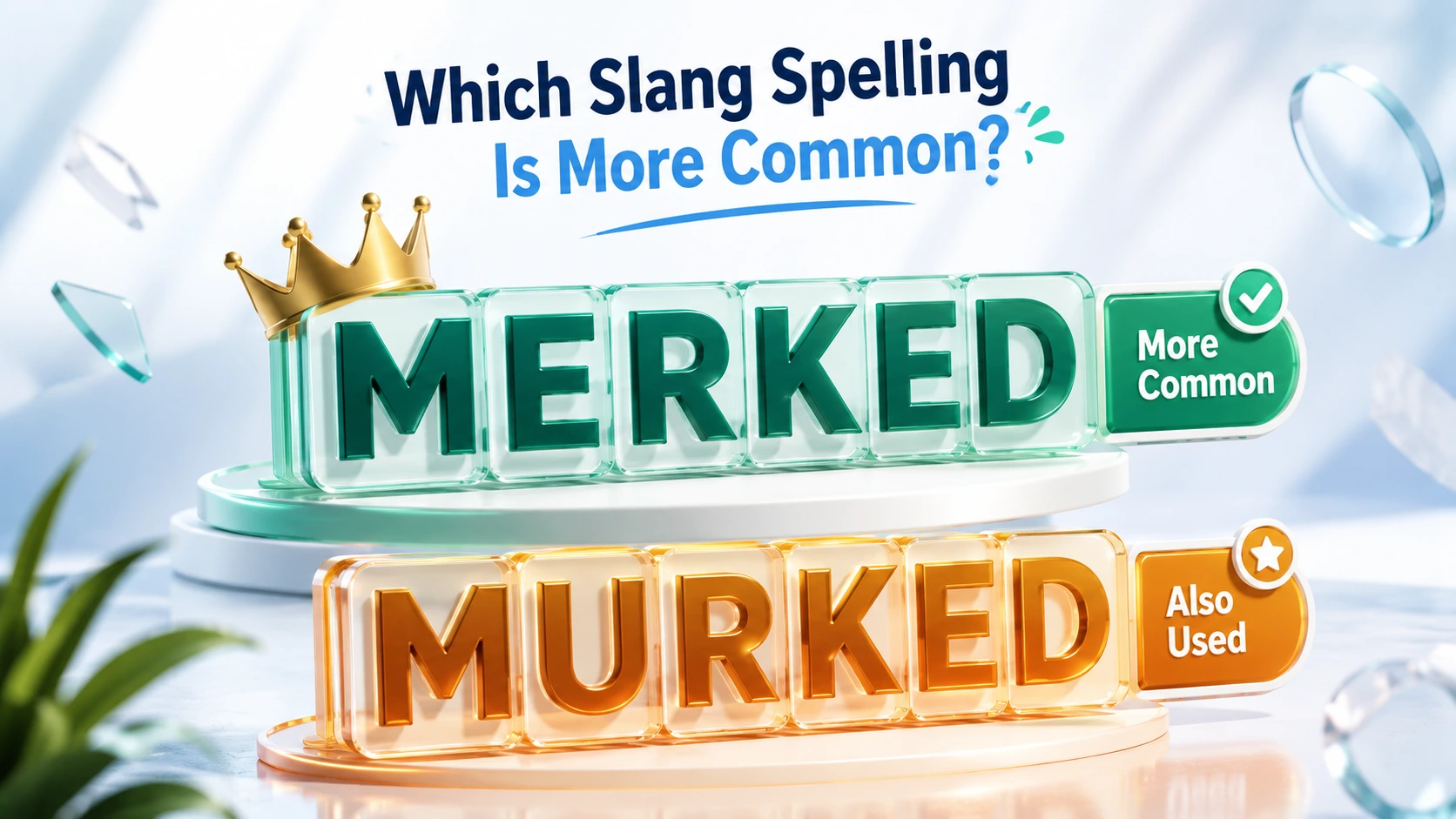
"Merked" and "murked" are both slang spellings meaning to defeat, dominate, or seriously harm someone, often used in gaming, hip-hop, or casual trash-talk. Both spellings circulate widely, though "merked" has become the more common form online.
I once played an online match and saw a teammate type “just merked that whole team.” I had no context, so I asked what it meant. As it turns out, it meant they’d completely dominated the other players. Still, I wasn’t sure if I should spell it “merked” or “murked” if I ever used it myself.
Here’s the twist: people genuinely use both spellings interchangeably. Unlike most English spelling questions, this one lives almost entirely in slang, so dictionaries and style guides don’t offer much guidance either way.
This guide breaks down exactly what this slang term means, where it likely came from, and which spelling shows up more often today, so you can use it confidently in chat, comments, or casual conversation.
Merked or Murked: Quick Answer
“Merked” and “murked” both mean to defeat, dominate, or seriously harm someone, often used in gaming, music, sports trash-talk, or casual online conversation.
- ✅ He merked the entire lobby in that last match.
- ✅ He murked the entire lobby in that last match.
In modern online usage, “merked” has become the more common spelling, especially in gaming and social media contexts. However, “murked” still appears frequently, particularly in music and hip-hop culture.
How to Pronounce Merked and Murked
“Merked” rhymes with “worked” or “jerked,” and you say it as “murkt.” The “er” sound stays soft and quick, similar to how “her” or “fern” sound.
“Murked” sounds exactly the same way, “murkt.” Despite the different spelling, both versions sound completely identical out loud, and that’s a big reason the two spellings coexist so easily online. Since slang spreads mostly through speech, video, and voice chat rather than written text, nobody hears a difference, they only notice one once they see it typed out.
The Origin of Merked/Murked
Nobody has pinned down this slang term’s exact origin, but most language trackers point to two possible roots. First, some trace it to “murder,” shortened and slangified into “murk” or “merk” as an intense way to say someone got thoroughly defeated or “destroyed,” similar to how people casually say “killed it” without any literal violence.
Alternatively, others connect it to the older English word “murk,” meaning darkness or obscurity, which speakers eventually extended metaphorically to mean “taking someone out” or making them disappear from competition entirely.
The term truly gained traction through hip-hop culture starting in the 1990s and 2000s, when artists used “murk” or “murked” to describe dominating a rap battle, a diss track, or a rival. Later, as gaming culture grew alongside internet slang, the term spread into online multiplayer communities, and “merked” became a popular way to describe a dominant, one-sided win.
Because slang spreads primarily through speech, video, and casual typing rather than formal writing, no single spelling ever became “official.” As a result, both “merked” and “murked” continue to coexist today.
Merked vs Murked Explained: Key Differences and Variations
| Term | Meaning | When to Use | Context |
|---|---|---|---|
| Merked | To defeat, dominate, or destroy | Gaming, social media, casual slang | Increasingly common in online and gaming spaces |
| Murked | To defeat, dominate, or destroy | Music, hip-hop culture, casual slang | Common in music lyrics and hip-hop culture references |
| Merking/Murking | Present participle form | Describing an ongoing action | Matches whichever base spelling you’re already using |
Unlike formal spelling pairs, “merked” and “murked” carry identical slang meaning. Instead, the difference comes down to which online community or cultural context you’re writing for.
Which Spelling Should You Use?
For gaming chats, streams, or online communities
Choose merked. It’s the more commonly recognized spelling in gaming culture and general internet slang today.
For music, hip-hop culture, or lyric-related content
Murked fits naturally here, since it carries stronger historical ties to hip-hop and rap battle culture specifically.
For casual conversation or social media
Either spelling works well, since people widely understand both, though merked tends to read as slightly more current.
For formal or professional writing
Avoid both spellings entirely. Neither “merked” nor “murked” counts as standard English, so this term simply doesn’t belong in formal contexts.
Cheque or Check: What's the Difference? (2026)
Common Mistakes with Merked/Murked
Mistake 1: Assuming one spelling is simply wrong
✅ Both “merked” and “murked” are widely used slang spellings.
❌ “Murked” is a typo for “merked.”
Why it happens: People assume slang terms need one standardized spelling, just like formal vocabulary does.
Mistake 2: Using either spelling in formal writing
✅ He completely dominated the competition.
❌ He completely merked the competition. (in a professional report or formal document)
Why it happens: Writers sometimes forget slang terms don’t translate well into professional or academic contexts.
Mistake 3: Overexplaining the term in casual contexts
✅ Let the context carry the meaning in casual chat or comments.
❌ Awkwardly defining “merked” mid-conversation when the audience already understands slang.
Why it happens: Once writers unfamiliar with the term learn its meaning, they sometimes overcompensate by over-explaining it.
Mistake 4: Assuming the term is universally understood
✅ Check your audience before using slang terms like “merked” or “murked.”
❌ Using either spelling with an audience unfamiliar with gaming or hip-hop culture, without any context.
Why it happens: Slang terms feel obvious to people already familiar with them, but they can easily confuse readers outside that specific cultural space.
Merked/Murked in Real-World Examples
Social media post:
“That comeback was wild, they got murked in the first round and still won. 🔥”
Music or hip-hop culture reference:
“The track’s chorus references getting murked in a battle, classic 2000s slang.”
Casual conversation:
“We got completely merked in that match, need a rematch.”
Notice how both spellings show up naturally across gaming, music, and casual online conversation, and the surrounding context makes the meaning immediately clear.
Merked/Murked: Data, Trends & Usage
Gamers, streamers, and younger social media users drive most of the search interest in “merked vs murked,” typically trying to confirm spelling before typing in chat or captions. This falls into the informational search category, since people simply want quick clarity on a term that traditional dictionaries don’t cover.
“Merked” pulls stronger, more consistent search volume tied to gaming platforms and streaming culture. Meanwhile, “murked” maintains steady interest connected to music culture and older internet slang references, which reflects its earlier roots in hip-hop.
Merked vs Murked: Comparison Table
| Term/Variant | Meaning | Context | Best Used When |
|---|---|---|---|
| Merked | To defeat, dominate, or destroy | Gaming, social media, modern slang | Online gaming, streaming, casual internet use |
| Murked | To defeat, dominate, or destroy | Hip-hop, music culture | Music references, older internet slang contexts |
| Destroyed/Dominated | Standard English equivalent | Formal or general writing | Professional or formal contexts where slang doesn’t fit |
Frequently Asked Questions
Q: What does “merked” or “murked” mean?
A: Both words are slang meaning to defeat, dominate, or thoroughly beat someone. People commonly use them in gaming, music, and casual online conversation.
Q: How do you use “merked” correctly in a sentence?
A: You can use “merked” the same way you’d use “murked.” For example, “They got merked in the final round” works exactly like “They got murked in the final round.”
Q: Merked vs murked, what’s the difference?
A: There’s no strict difference in meaning. “Merked” leans more common in gaming and modern slang, while “murked” carries stronger ties to hip-hop and music culture.
Q: Is “murked” acceptable in formal writing?
A: No. Since neither “murked” nor “merked” counts as standard English, you should avoid both in professional or academic writing.
Q: Which version is correct, merked or murked?
A: Both count as correct slang. Choose based on context, “merked” for gaming and general online use, “murked” for music or hip-hop references.
Q: Where does the term “merked” or “murked” come from?
A: It likely traces back to “murder,” shortened into slang, or possibly to the older word “murk,” meaning darkness. Either way, speakers extended the meaning metaphorically to describe thoroughly defeating someone.
Q: Can “merked” or “murked” be used outside of gaming and music?
A: Yes, casually. Both terms have expanded into general internet slang, though they remain informal, so save them for casual conversation.
Final Takeaway
Here’s the short version. Both “merked” and “murked” count as correct slang spellings. This isn’t a right-versus-wrong situation, it’s simply a matter of context and community.
Key points to remember:
- The rule: No strict rule exists; both spellings count as widely recognized slang
- Gaming trend: “Merked” leads in gaming and modern internet culture
- Music roots: “Murked” carries stronger ties to hip-hop and rap battle culture
- Keep it casual: Neither spelling belongs in formal or professional writing
Once you know both are valid, choosing between “merked” and “murked” simply comes down to your audience and context, not correctness.
Bookmark this guide so you never second-guess “merked” vs “murked” again, and share it with anyone confused after seeing it in a gaming chat or song lyric.
Merked or Murked explained. Learn the meaning, origin, key differences, and when each slang spelling is the better choice.
Shakey or Shaky? Only One Is Correct (Most People Get It Wrong)

I am a language content specialist specializing in spelling comparisons, vocabulary usage, and commonly confused English words. I write detailed, informative articles that help readers improve their language skills. I am passionate about helping students, writers, and professionals develop a stronger understanding of the English language.