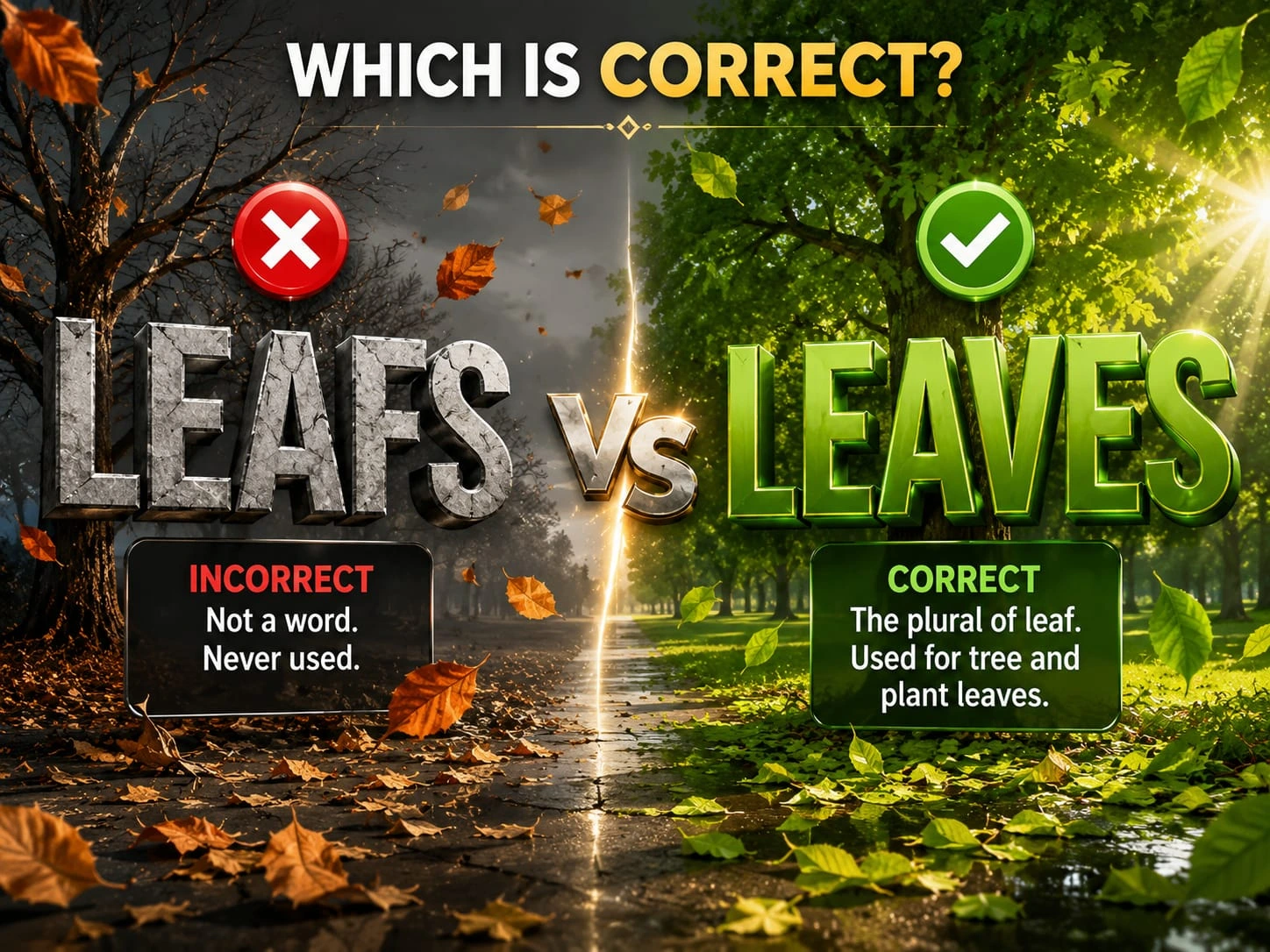
“Leaves” is the correct plural of the noun “leaf.” “Leafs” is used only as a verb (to leaf through something) or as a proper noun, like the Toronto Maple Leafs hockey team.
A coworker wore a Toronto Maple Leafs jersey to the office, and I joked, “Shouldn’t that say Leaves?” She laughed and told me the team name is intentionally spelled “Leafs.” I didn’t believe her until I looked it up myself.
That moment taught me something most grammar guides skip entirely. “Leaves” and “leafs” aren’t simply two spellings of the same word. One is a standard noun plural, one is a verb form, and one is a famous exception baked into a sports team’s name.
If you’ve ever paused over which spelling to use in a sentence, this guide clears up every version, so you never second-guess yourself in an essay, an email, or a casual conversation about hockey.
Leaves or Leafs: Quick Answer
“Leaves” is the standard plural noun. Use it whenever you’re talking about more than one leaf from a tree or plant.
- ✅ The leaves turned orange in October.
“Leafs” is a verb. Use it when someone flips through pages.
- ✅ She leafs through the magazine while waiting.
Mixing these up is one of the most common noun-versus-verb errors in everyday writing, especially since both words sound almost identical when spoken quickly.
The Origin of Leaves/Leafs
“Leaf” comes from Old English leaf, related to plant foliage. English nouns ending in f often follow an irregular pluralization pattern, changing the f to v before adding -es. This same shift shows up in several common words:
- leaf → leaves
- knife → knives
- wife → wives
- half → halves
This f-to-v pattern is one of the oldest surviving irregularities in English grammar, dating back to Old English pronunciation habits. Because it isn’t intuitive, many writers assume “leaf” simply adds an s, the same way “roof” became “roofs” in modern usage.
The verb form works differently. “To leaf” means to turn pages, and it follows the standard regular verb rule, simply adding -s for the third-person singular present tense: “leafs.” No irregular spelling shift applies to verbs the way it does to this particular noun.
Leaves vs Leafs Explained: Key Differences and Variations
| Term | Part of Speech | Meaning | When to Use |
|---|---|---|---|
| Leaves | Noun (plural) | More than one leaf from a plant or tree | Nature, gardening, seasonal writing |
| Leafs | Verb (present tense) | Turns pages, or flips through something | Describing an action, like browsing a book |
| Leafs | Proper noun (exception) | Refers to the Toronto Maple Leafs hockey team | Sports writing, team names only |
A simple test: if you’re talking about tree foliage, it’s “leaves.” If you’re describing someone flipping pages, it’s “leafs.” If you’re naming the hockey team, it’s also “Leafs,” by design.
Which Spelling Should You Use?
For nature, gardening, or seasonal writing
Use leaves. This is the correct plural noun for describing foliage on trees and plants.
For describing an action, like browsing pages
Use leafs. This is the correct verb form, as in “he leafs through the report before the meeting.”
For sports writing about the Toronto Maple Leafs
Use Leafs, capitalized. The team name intentionally breaks the standard pluralization rule as a stylistic choice.
For everyday or general writing
Default to leaves unless you’re specifically describing an action or referencing the hockey team by name.
Common Mistakes with Leaves/Leafs
Mistake 1: Using “leafs” instead of “leaves” for the noun plural
✅ The trees dropped their leaves early this year.
❌ The trees dropped their leafs early this year.
Why it happens: Writers assume “leaf” follows the simple rule of just adding an s, without accounting for the irregular f-to-v shift.
Mistake 2: Using “leaves” as a verb
✅ He leafs through the newspaper every morning.
❌ He leaves through the newspaper every morning.
Why it happens: Writers default to the more familiar noun spelling without checking whether the sentence needs a verb.
Mistake 3: Misspelling the Toronto Maple Leafs
✅ The Toronto Maple Leafs won last night’s game.
❌ The Toronto Maple Leaves won last night’s game.
Why it happens: Writers apply standard grammar rules to a proper noun that intentionally ignores them.
Mistake 4: Assuming every -f noun follows the same pattern
✅ Leaves and knives follow the f-to-v rule, but roofs and chiefs do not.
❌ Assuming “roof” becomes “rooves” just because “leaf” becomes “leaves.”
Why it happens: English doesn’t apply the f-to-v rule consistently across every word ending in f.
Mistake 5: Inconsistent use across a single document
✅ The leaves fell as she leafs through old photographs.
❌ The leafs fell as she leaves through old photographs.
Why it happens: Writers don’t realize the two spellings serve completely different grammatical roles within the same piece.
Flyer or Flier: Which Spelling Is Correct? (2026)
Leaves/Leafs in Real-World Examples
Professional email:
“Please rake the fallen leaves before the property inspection on Friday.”
News headline:
“Toronto Maple Leafs Clinch Playoff Spot With Overtime Win”
Social media post:
“Nothing beats the smell of autumn leaves on a crisp morning. 🍂”
Formal document:
“The gardener leafs through the maintenance log before starting each shift.”
Notice how the noun form dominates most everyday writing, while the verb form and the hockey team name only appear in specific contexts.
Leaves/Leafs: Data, Trends & Usage
Search interest in “leaves vs leafs” spikes during autumn months, when gardening blogs, landscaping companies, and seasonal content creators write about falling foliage. This falls into the informational search category, with writers and students confirming the correct plural before publishing seasonal content.
A separate wave of search traffic comes from hockey fans confirming the spelling of the Toronto Maple Leafs, especially during playoff season. This proper-noun exception drives consistent year-round interest, independent of the seasonal foliage searches.
Leaves vs Leafs: Comparison Table
| Term/Variant | Meaning | Region/Context | Best Used When |
|---|---|---|---|
| Leaves | Plural noun for tree or plant foliage | Universal, all English dialects | Nature, gardening, seasonal writing |
| Leafs | Verb form (to leaf through something) | Universal, all English dialects | Describing the action of turning pages |
| Leafs | Proper noun exception | Sports writing, specifically hockey | Referring to the Toronto Maple Leafs |
Frequently Asked Questions
Q: What does “leaves” mean?
A: “Leaves” is the plural noun form of “leaf,” referring to more than one leaf from a tree, plant, or book of paper-thin material like gold leaf.
Q: How do you use “leafs” correctly in a sentence?
A: Use “leafs” as a verb, describing the action of turning pages, for example, “She leafs through the catalog before making a decision.”
Q: Leaves vs leafs, what’s the difference?
A: “Leaves” is a noun (plural of leaf), while “leafs” is a verb (third-person singular of “to leaf”). They serve completely different grammatical roles, except when “Leafs” refers to the hockey team.
Q: Is “leaves” acceptable in formal writing?
A: Yes. “Leaves” is the standard, expected spelling in academic, environmental, and everyday writing whenever referring to multiple leaves.
Q: Which version is correct, leaves or leafs?
A: Both are correct, but they mean different things. “Leaves” is correct for the noun plural, “leafs” is correct for the verb form or the hockey team name.
Q: Where does the word “leaf” come from?
A: It comes from Old English leaf, related to plant foliage. The irregular plural “leaves” follows an old English pattern of changing f to v before adding -es.
Q: Why is the hockey team called the “Maple Leafs” instead of “Maple Leaves”?
A: The Toronto Maple Leafs intentionally use the nonstandard plural as part of their official team name and branding, a stylistic choice that has stuck since the franchise’s founding.
Final Takeaway
Here’s the short version. “Leaves” is the noun you use for more than one leaf. “Leafs” is the verb you use when describing the action of turning pages, or the proper noun for a famous hockey team.
Key points to remember:
- The rule: Nouns take “leaves”; verbs take “leafs”
- Quick test: If it’s tree foliage, it’s “leaves”; if it’s an action, it’s “leafs”
- The exception: The Toronto Maple Leafs intentionally break the standard rule
- Watch nature writing closely: “Autumn leaves,” not “autumn leafs”
Once you separate the noun from the verb, and remember the hockey exception, you’ll never mix up “leaves” and “leafs” again.
Leaves vs leafs explained, learn the difference between the noun and verb forms, plus the famous hockey team exception.
its or it’s: Complete Easy Grammar Guide

I specialize in spelling comparisons, confusing word pairs, grammar, and vocabulary development. My content helps readers improve their English, avoid common mistakes, and write with confidence. My goal is to provide accurate, reliable, and easy-to-understand language resources